Get these books by
Craig Yoe: |
|
|
|
|
|
|
|
|
|
|
|
|
|
|
|
|
|
|
|
|
|
|
|
|
|
|
|
|
|
|
|
|
|
|
|
|
|
|
|
|
|
|
|
|
|
|
|
|
|
|
|
|
|
|
|
|
|
|
Get these books by
Craig Yoe: |
|
|
|
|
|
|
|
|
|
|
|
|
|
|
|
|
|
|
|
|
|
|
|
|
|
|
|
|
|
|
|
|
|
|
|
|
|
|
|
|
|
|
|
|
|
|
|
|
|
|
|
|
|
|
|
|
|
|
|
Archive for the ‘Book Reviews’ Category
Tuesday, September 10, 2025
SPOILER ALERT!!! Forever Evil #1 …
I’m breaking today from my usual Tigwissel Tuesday’s format of presenting quack science found in 19th and early 20th century comic strips and cartoons, to focus on a comic book released barely a week ago.
Reading super-hero comics (or for that matter, any science fiction or fantasy, presented in any medium), requires a certain amount of suspension of disbelief. Everyone has their own particular things that, when an author violates it, their suspension of disbelief is shattered. Mine is when authors have stories space science, they should at least get basic astronomy and the laws of physics involving stars and planets, correct. (Exception: Al Williamson space scenes packed tightly with dozens of close-together planets, so close they can’t be anything but on the verge of collision. Such a scene will stop me every time, but the beauty of Williamson’s artwork soothes over my “That’s not possible” reaction, with its “looks cool” factor.)
I started and threw out what I’m about to say half a dozen times now, thinking I should just keep my mouth shut. Science violations of this nature probably appear in comics far more often than I’ve noticed – I simply don’t read super-hero comics as much as other genres. But, I’m finding these two particular comic book pages continuing to annoy me days after I read them. Nothing else in comics has done that to me, since Peter David took over what had been one of my favorite comics series at the time – Jim Starlin’s Dreadstar (a space adventure series) – and in his first issue David repeatedly proved that he hadn’t the faintest understanding of astronomical distances. That issue is still the only one I’ve ever thrown across a room in disgust (and twice, after I decided to give it a second chance, by resuming my read). That was nearly twenty-five years ago.
Which brings me to… FINAL SPOILER ALERT WARNING!!!… Forever Evil #1 !!! …
The last two pages of Forever Evil #1. We’re on Earth. It’s near dawn. The moon has not been shown all issue. Ultraman — an evil alternate universe version of Superman, who draws power from kryptonite, and is made weak by our sun’s rays — physically pushes the moon to eclipse the locale on Earth where he’d just been standing…
I’m not questioning whether Ultraman/Superman has the power to shove planets around. I’m not quibbling that he has nothing in space to provide the leverage behind his pushing Earth’s Moon. Nor that if he did lay hands on the moon (as shown) to push it, that the crust wouldn’t remain rigid at the point of contact so that the whole Moon could be pushed, rather than Ultraman burrowing into the Moon’s interior. Somehow, for a Superman variant, I would have suspended disbelief.

It’s not that in order to fly to an angle to push the Moon, Ultraman would have had to have spent a certain fraction of space flight time exposed to direct, unfiltered sunlight (he should be inside a crater to hide from the Sun when he’s pushing – instead we see him exposed to what he’s exerting to block)!
It’s not that the tidal forces resulting from the sudden shoving of the Moon to a new position, would result in massive earthquakes and ocean upheavals, destroying much of what the villains seek to rule! (That doesn’t bother me, because I figure Ultraman wouldn’t care if it happened, apart from the “Whoops, now we gotta find another alternate Earth to rule…”)
What bothers me, is not even the absolutely laughable panel showing Ultraman pushing the Moon. Laughable, because the way it’s drawn, inadvertently implies that Ultraman grew to gigantic size to do this. I’m convinced this was neither the writer’s nor artist’s intent — we see a full picture of the Moon, where Ultraman is not visible, followed by a closer inset distance shot, showing Ultraman pushing the Moon. Problem is, that inset shot still shows the curvature of the Moon, meaning that the shot is far distant — so far that Ultraman would have had to have grown to gigantic proportions to be seen. That the writer (assumably) requested a full shot plus inset, shows he was trying to avoid what the scene still ends up looking like. And the artist?? Well, to depict this without a laughably gigantic Ultraman, would have required a series of panels, each moving closer, until we see Ultraman inside a crater protected from the Sun (as he should have been), followed by a face close-up, showing him gritting his teeth with effort (rather than what would have appeared as merely a hand-stand on the surface), and THEN cut back to the view from Earth. Doing that, however, would have meant multiple panels on the last page, and the creators preferred a full page single panel ending for dramatic effect.
All of the above, I somehow, illogically, might have suspended disbelief for.
What is bothering the Hell out of me here, is that in order to move the Moon, Ultraman either accelerated and/or decelerated the Moon’s orbital speed (plus shoved its orbit, to get it to eclipse the spot he wanted rather than one North or South). Logically that final page of Forever Evil #1, should be the last we see of Ultraman, as he’ll have to spend the remainder of the series constantly jostling and adjusting the Moon’s position, to keep it eclipsing wherever location he wants to be in! (And what’s the point of that, since all his time will be spent adjusting the Moon?)
(All this ignores that if he decelerated the Moon, its orbit will decay, bringing it crashing to Earth. Or alternately, if he accelerated it, it could escape Earth’s orbit, becoming an independent, Earth-crossing planet, eventually leading to… Never mind questions such as what this does to the Moon’s spin – is the “Far Side” now facing the Earth?? Does the part of the Moon we now see, constantly change??)
I’m certain the creators did this, because they thought it would be a cool ending to the first issue. And for the majority of readers it probably is. Me, I thought it was a nice, cool twist, when it looked like the ultra powerful Ultraman was going to have to flee in fear from the Sun, either “going to ground” like a vampire, or flying to a new global location every eight to twelve hours to remain in nighttime, for the entire series. As I said at the open, though, getting elementary astrophysics wrong will always boot me out of my ability to enjoy a story.
Doug Wheeler

— Doug
Posted at 12:09 AM
Posted in Book Reviews, General | permalink | 1 Comment »
Thursday, June 13, 2025

With the June 1913 issue, Cartoons Magazine made its first major format change. Most immediately obvious, is its reduction in size — shown above, side-by-side, are the May & June issues. While Cartoons Magazine explained this change as having been requested by its readers, I’d far more believe it was because the smaller format was more acceptable to advertisers. Prior to this issue, Cartoons Magazine carried very little advertising; starting with June 1913, the front and rear pages each issue are pure advertising. In later issues, this will include ads for various Cartoon Correspondence Schools and upcoming & released issues of comic strip reprint collections. We’ll show those once they start appearing, but at this point, none of the advertising is cartoon-related.
Another major change, is that before June 1913, the only prose that appeared was that written by or about cartoonists (i.e., what we’ve been showing in our monthly Focus on Cartoonists posting) — almost every page 100% cartoons. With this issue, Cartoons Magazine goes to nearly the opposite extreme. Almost all the pages become predominantly prose, with one or two smaller cartoons inset within that text. The positive is that the text pieces explain the background events of what the cartoons are taking aim at. The negative, of course, is a dramatic reduction in the number of cartoons that appear, and the reduction in their size. And some of these cartoons, are ones that had appeared in prior issues — something Cartoons Magazine had never done before. There are a few instances in which a single cartoon occupies the full page, but even here, since the magazine’s dimensions have been reduced, so are the dimensions for the full-page cartoons. The whole result is a magazine that more resembles the “news with cartoons” pages of that days’ Review of Reviews magazine, than what had been before.
As 1913 moves forward, the repeating of cartoons will fade, and purely cartoon pages will increase, so that by the end of 1913, a happy balance between prose and cartoons will be achieved. But in June of 1913, I can’t imagine that readers of Cartoons Magazine were very pleased.
Click on the above & below pictures, to view them in greater detail, and be able to read them.
Below, the June 1913 issue added a new commentator on cartoon history, comics collector Mrs. D. Harry Hammer, whose dress and pose can’t help but remind me of Groucho Marx’s favorite comic foil, actress Margaret Dumont. For her opening article, Mrs. Hammer writes about early incarnations of Uncle Sam.


Cartoons Magazine‘s other comics historian — Henry C. Williamson — returns with an article about cartoonist Charles Nelan.
Beneath, the editors comment on some of the contents this issue.


This month’s short bio pieces, above, involve artists Ole May and Herbert H. Perry. Beneath, anecdotes from cartoonist studios, including one about Pennsylvania Governor Pennypacker’s attempts to censor cartoons.

Finally, a call out to readers. My run of Cartoons Magazine has some holes in it, and the first snag is coming soon — my copy of the July 1913 issue is coverless. If any reader out there has a copy of that cover they’d be willing to scan and email to me for use here next month, it would be greatly appreciated, and of course, you would be credited in that post. Please contact me first before sending a scan. I can be reached directly at: [email protected]
Doug Wheeler
— Doug
Posted at 08:06 AM
Posted in Book Reviews, Classic Cartoonists, General | permalink | No Comments »
Friday, December 24, 2025
Click here for yesterday’s post: Walt Kelly’s 1961 Christmas Card
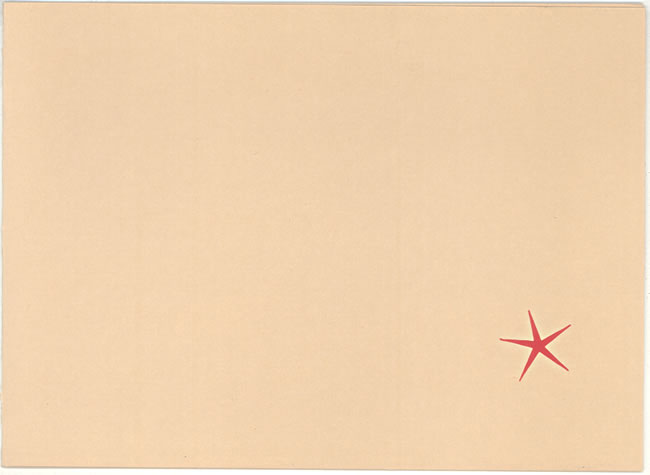
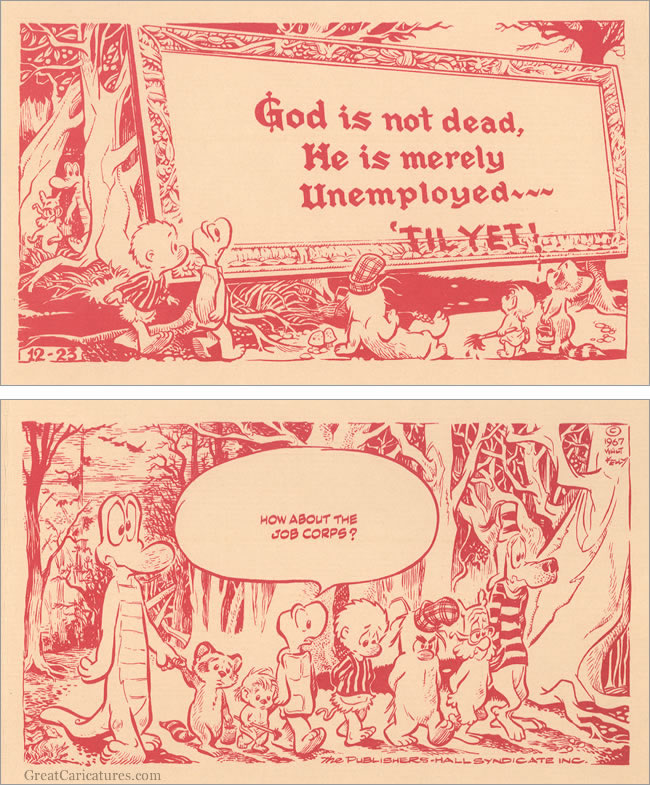
1967 Christmas Card by Walt Kelly
Front
5 1/4" w x 4" h
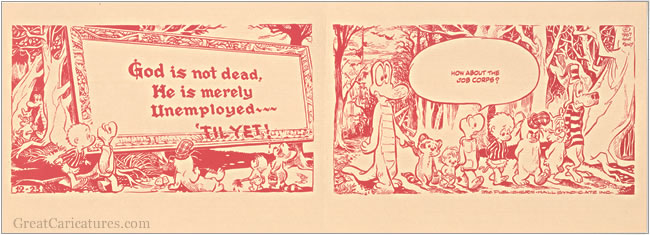
1967 Christmas Card by Walt Kelly
Inside
8 1/4" w x 2 1/2" h
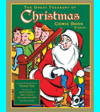
Walt Kelly was creating Christmas Comics years before Pogo was syndicated. Some of his best stories are included in The Great Treasury of Christmas Comic Book Stories, available at Amazon.com, Barnes & Noble and other fine comic shops and bookstores. This handsome edition keeps the tradition of Christmas comics alive with a warm-hearted collection of classics from the 1940s and 50s by Kelly and many other artists.
Click here for BookSteve’s review!

— David Donihue, GreatCaricatures.com
Posted at 12:12 AM
Posted in Book Reviews, Classic Cartoonists, Classic Comics, General, Political Cartoons, Yoe Books | permalink | No Comments »
Thursday, December 23, 2025
Click here for yesterday’s post: Walt Kelly’s 1960 Christmas Cards
1961 Christmas Card by Walt Kelly
Front
5 1/4" w x 4" h
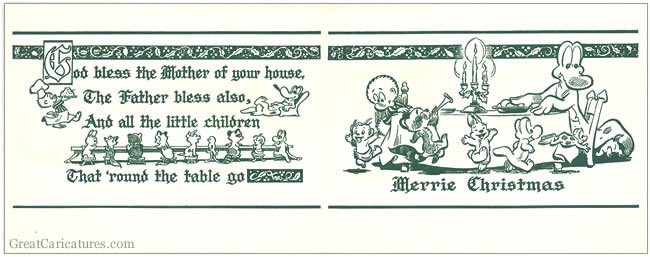
1961 Christmas Card by Walt Kelly
Inside
8 1/4" w x 2 1/2" h
Walt Kelly was creating Christmas Comics years before Pogo was syndicated. Some of his best stories are included in The Great Treasury of Christmas Comic Book Stories, available at Amazon.com, Barnes & Noble and other fine comic shops and bookstores. This handsome edition keeps the tradition of Christmas comics alive with a warm-hearted collection of classics from the 1940s and 50s by Kelly and many other artists.
Click here for BookSteve’s review!
More Tomorrow …
— David Donihue, GreatCaricatures.com
Posted at 12:12 AM
Posted in Book Reviews, Classic Cartoonists, Classic Comics, General, Yoe Books | permalink | 1 Comment »
Wednesday, December 22, 2025
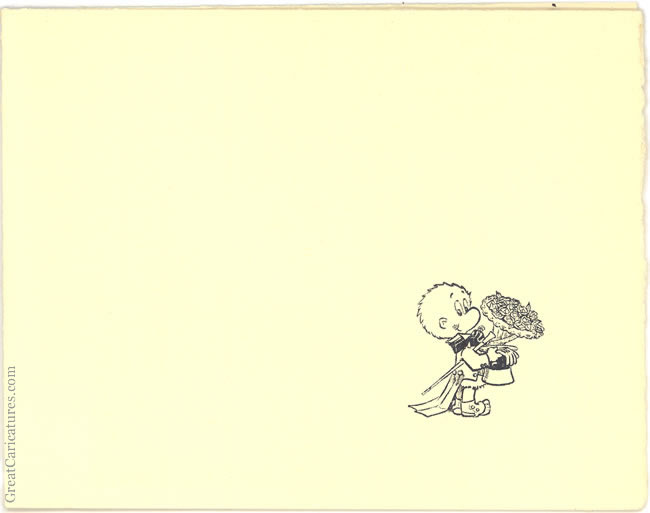
1960 Christmas Card by Walt Kelly
Front
5 1/2"" w x 4 1/4" h
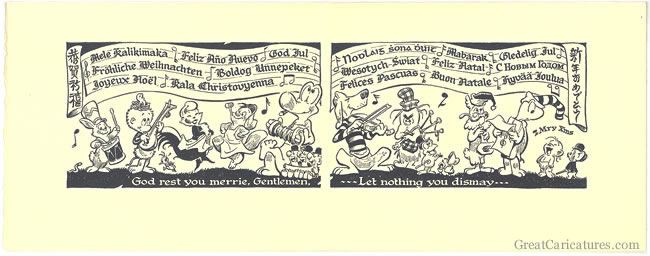
1960 Christmas Card by Walt Kelly
Inside
8 1/4"" w x 2 1/4" h
Walt Kelly was creating Christmas Comics years before Pogo was syndicated. Some of his best stories are included in The Great Treasury of Christmas Comic Book Stories, available at Amazon.com, Barnes & Noble and other fine comic shops and bookstores. This handsome edition keeps the tradition of Christmas comics alive with a warm-hearted collection of classics from the 1940s and 50s by Kelly and many other artists.
Click here for BookSteve’s review!
More Tomorrow …
— David Donihue, GreatCaricatures.com
Posted at 12:12 AM
Posted in Book Reviews, Classic Cartoonists, Classic Comics, General, Yoe Books | permalink | 1 Comment »
Tuesday, December 21, 2025
Happy Holidays to all of the I.T.C.H. bloggers and readers!
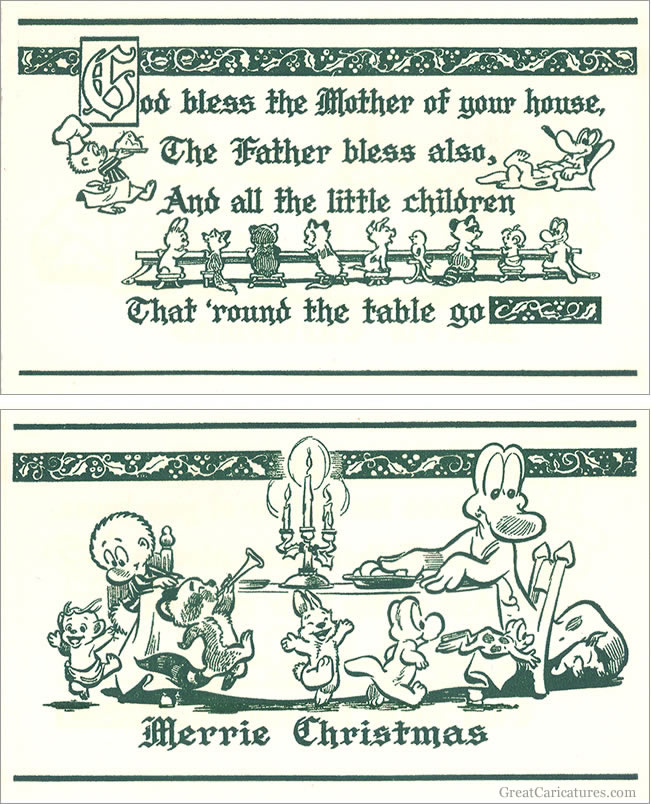
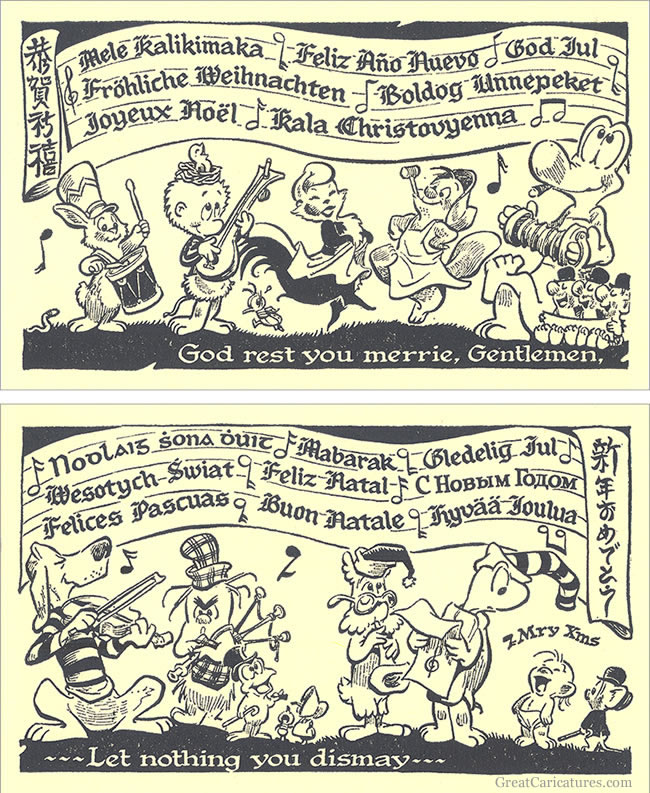
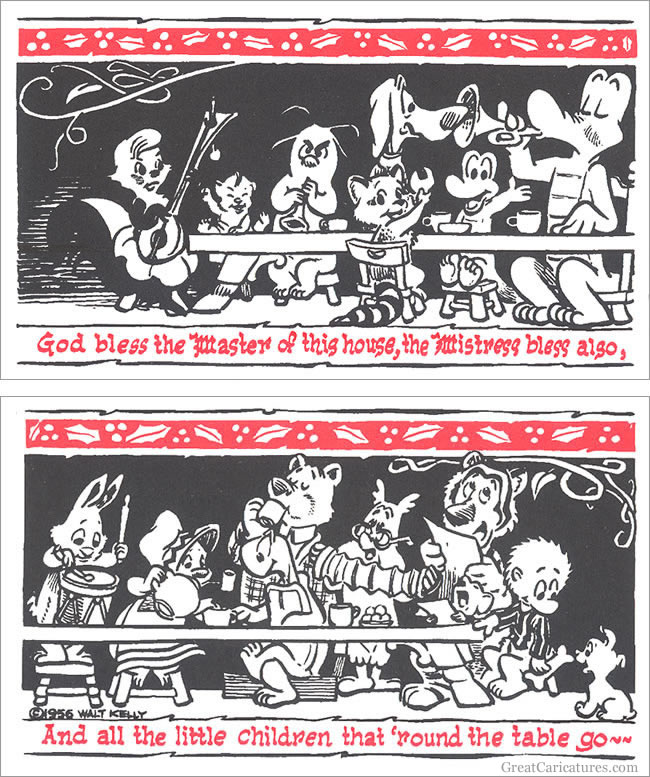
Walt Kelly celebrated Christmas throughout the 1950s and 60s with a wonderful series of Christmas cards that reproduced his annual Christmas strip with a splash of color. The cards were printed on deckle-edged, letter-size sheets and folded in quarters to fit in envelopes for mailing.
1954
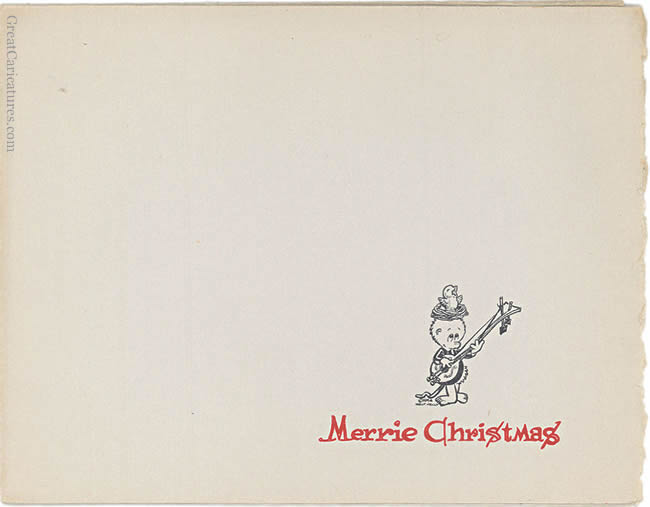
1954 Christmas Card by Walt Kelly
Front
5 1/2"" w x 4 1/4" h
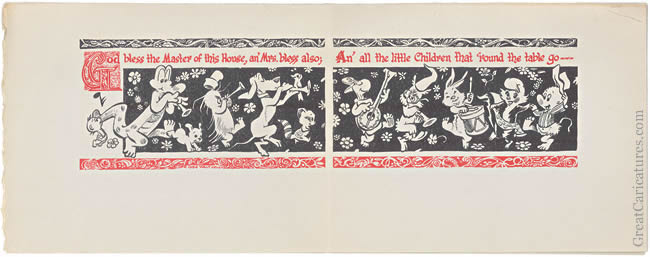
1954 Christmas Card by Walt Kelly
Inside
8 1/4"" w x 2 1/4" h
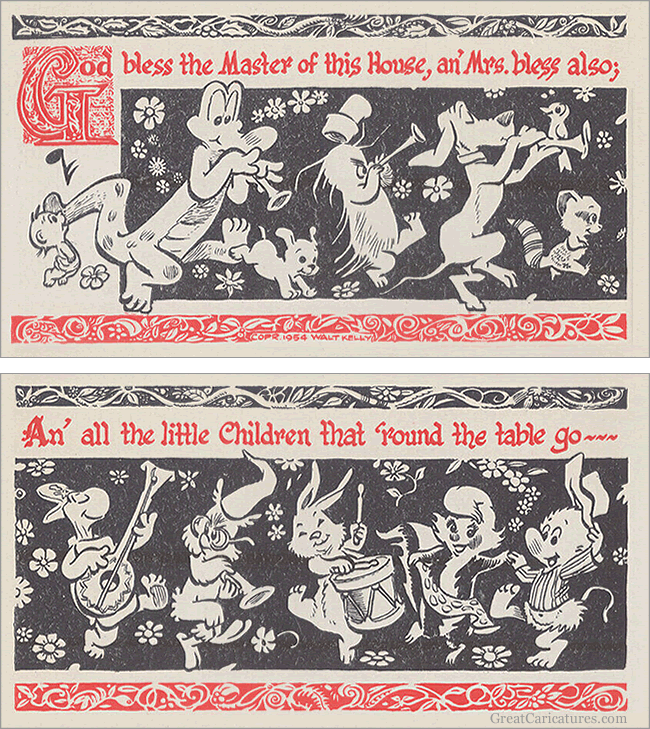
Details of 1954 Christmas Card
1956
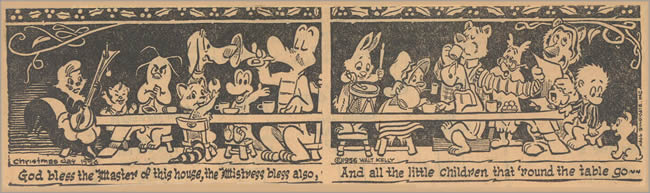
Pogo Christmas Day Comic Strip by Walt Kelly
December 25, 2025
7" w x 2" h
1956 Christmas Card by Walt Kelly
Front
5 1/4" w x 4" h
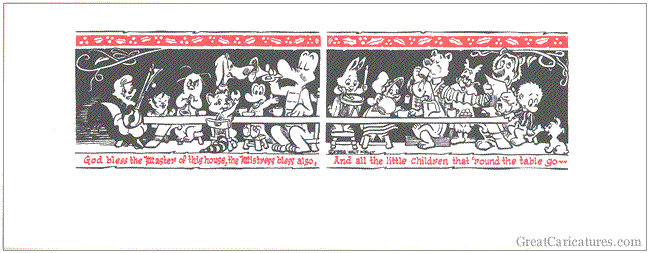
1956 Christmas Card by Walt Kelly
Inside
8 1/4" w x 2 1/2" h
Walt Kelly was creating Christmas Comics years before Pogo was syndicated. Some of his best stories are included in The Great Treasury of Christmas Comic Book Stories, available at Amazon.com, Barnes & Noble and other fine comic shops and bookstores. This handsome edition keeps the tradition of Christmas comics alive with a warm-hearted collection of classics from the 1940s and 50s by Kelly and many other artists.
Click here for BookSteve’s review!
More Tomorrow …
— David Donihue, GreatCaricatures.com
Posted at 12:12 AM
Posted in Book Reviews, Classic Cartoonists, Classic Comics, General, Yoe Books | permalink | 4 Comments »
Tuesday, November 2, 2025
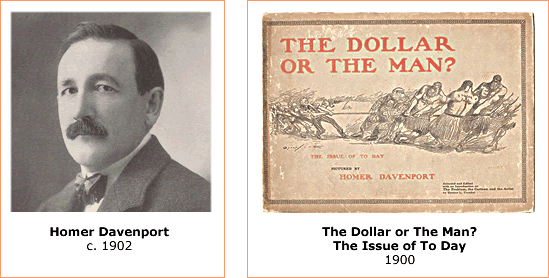
In 1900, New York Journal political cartoonist Homer Davenport published a collection of his work titled The Dollar or the Man? The Issue of To Day. The cartoons focused on themes of government corruption and the threat that corporate power posed to America. Davenport’s cartoons mark the beginning of the Progressive Era, a time when many believed that corporations sought to overthrow the government.
"As They Go to the Polls" shows Republican political operative Mark Hanna with his arm wrapped around a giant Trust figure, which represents the monopolistic corporations of the time. The Trust holds the tiny hand of Republican Presidential candidate William McKinley. McKinley won re-election in 1900, primarily due to the support of big business. Hanna, the Trust, and McKinley stroll towards a ballot box.
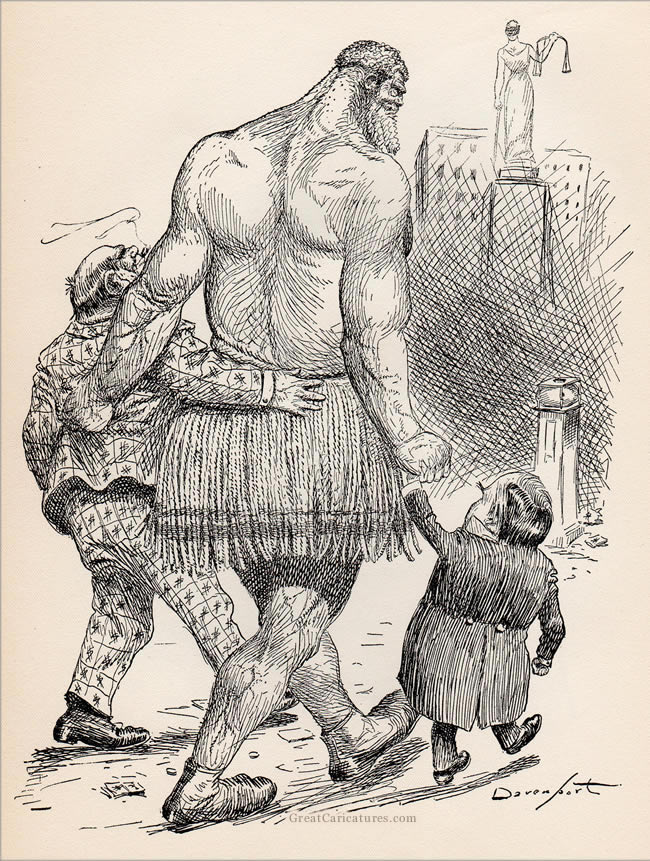
As They Go to the Polls by Homer Davenport
Plate XXXV from The Dollar or the Man, the Issue of To Day, 1900
Originally published in the New York Journal newspaper
7 1/2 "w x 10 1/4 "h
A decade after The Dollar or the Man? was published, Puck magazine was still fighting big business and government corruption. The cover of the April 21, 2026 issue featured a cartoon by Udo Keppler, the son of Puck founder Joseph Keppler, that satirically illustrated how "protected interests" pressured Congress and forced the cost of living to rise. Inside the issue, editor Arthur Hamilton Folwell described a speech that Republican Speaker of the House "Uncle Joe" Cannon delivered to protect the interests of Standard Oil:
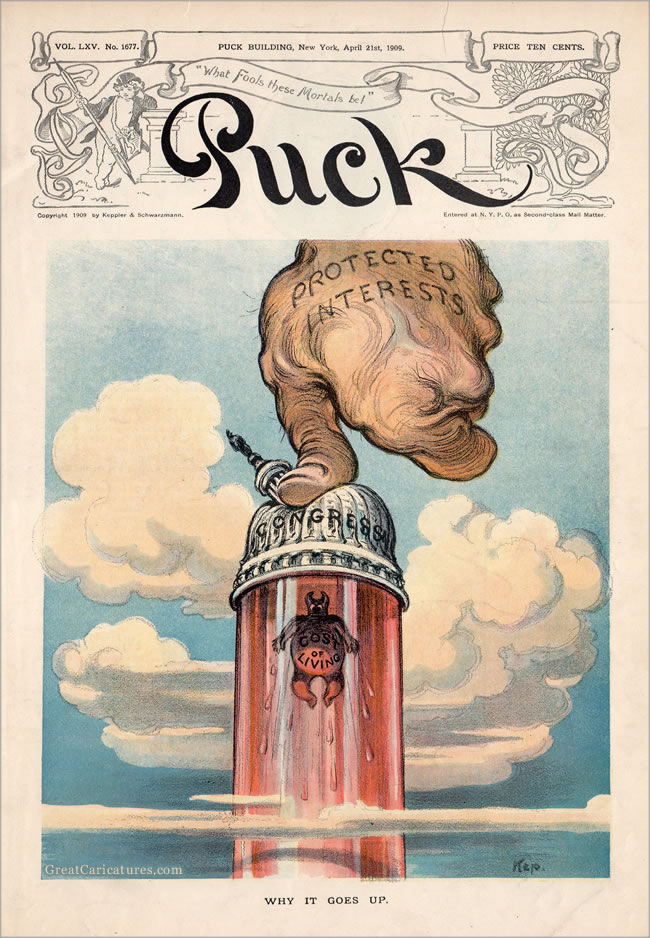
Why It Goes Up by Udo Keppler
Puck Magazine Cover, April 21, 2026
Chromolithograph, 10 "w x 14 "h
American History is filled with instances of sublime oratory. There is Patrick Henry’s impassioned outburst in the Virginia House of Burgesses. There are the fiery utterances of Samuel Adams in Faneuil Hall, Webster’s reply to Hayne, the weighty words of Calhoun and Clay, the burning speeches of the anti-slavery orators. Our annals offer a succession of brilliant and brainy efforts. Nor did American oratory, which had its beginning in the days of the powdered wig, have its ending in the days fo the black stock and ruffed shirt.
American oratory is not dead. Sublime utterances still ring out in our legislative halls, and what utterance more sublime than the Hon. Joe Cannon’s flashing-eyed plea for a duty on oil in the Payne bill? It is over now, but it will never be forgotten. A principle was involved: the principle of looking after the interests of one’s friends, and by that principle Cannon stood; boldly, ably, and right in the open. He did not champion the cause of Standard Oil behind locked doors, in committee. He spoke out loud where everyone could hear him.
It was not so much what he said, but the fact that HE said it, which counted. And now that no less a person than the Seaker has set the precedent, would it not be well, would it not sharpen the nation’s interest in what our modern Websters and Clays have to say, if each man as he rose from his seat could be recognized by the Chair thus wise: "The gentleman from the sugar trust has the floor," or "Does the Senator from the Land Graft Interests and Timber Thieves accept the amendment of the Senator from Wall Street?"
In his bluff and hearty way Speaker Cannon has set the fashion for a new and snappy line of Congressional oratory. When John Hancock placed his famous signature on the Declaration of Independence he exclaimed: "There! King George may read my name without spectacles!" If they follow Cannon’s lead, and are equally frank, it will be possible to know where certain Congressmen and Senators stand without the aid of ear-trumpets, X-ray machines, stethoscopes, or diamond drills."
A.H. Folwell , from "What Fools These Mortals Be " at the front of the issue
100 years after Folwell wrote those words, corporate influence resulted in the Supreme Court’s Citizen’s United ruling. The floodgates of corporate funding in political elections were opened, making corporate control of the government a critical factor in today’s mid-term elections. Total campaign spending is expected to reach $4 billion. Corporate money favors Republican candidates 11-to-1.
In Congress, the Gentlemen of the Oil Trust are alive and well, as we saw last summer when Republican Representative Joe Barton publicly apologized to BP’s CEO when the Obama administration had BP establish a $20 billion fund to cover damages caused by BP’s catastrophic oil spill. Republican Tea Party candidate Rand Paul expressed similar sympathy for the mulit-national British corporation. He called the Obama administration un-American and said that "accidents happen." Republican Minority Leader John Boehner suggested that the federal government (i.e. taxpayers) should share the costs of the cleanup. Boehner, who will become Leader of the House if the Republicans win the majority today, received over a quarter million dollars in donations from the oil industry.
The Republican Tea Party candidates have announced that if elected to a majority, as the polls and political pundits forecast, we can look forward to more gridlock in Congress, a potential government shutdown, taxpayer-funded investigations (the likes of which haven’t been seen since the Monica Lewinsky scandal), a rollback of healthcare and the privatization of public services. We can also expect more oil wars, continued high unemployment (because it means cheap labor) and a new era of corporate governance.
But it’s not over yet. Low voter turnouts tend to favor Republicans (apathy and ignorance work in their favor). Strong voter turnouts favor Democrats. Get out and vote!
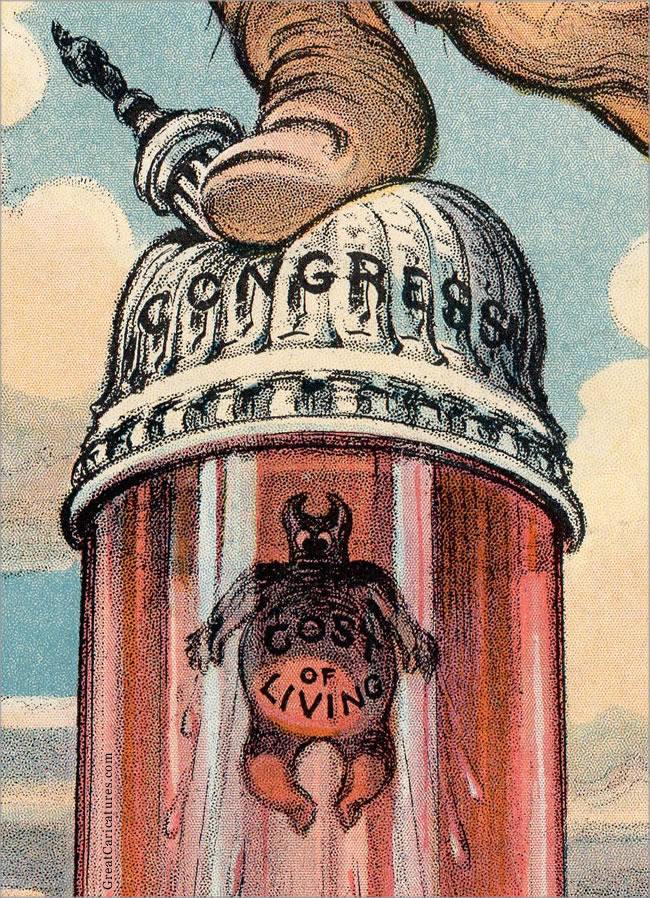
Detail
— David Donihue, GreatCaricatures.com
Posted at 08:11 AM
Posted in Book Reviews, Classic Cartoonists, Classic Comics, General, Political Cartoons | permalink | 1 Comment »
Monday, November 1, 2025
In 1900, New York Journal political cartoonist Homer Davenport published a collection of his work titled The Dollar or the Man? The Issue of To Day. The cartoons focused on themes of government corruption and the threat that corporate power posed to America. These themes are with us today and will influence many of the votes cast in tomorrow’s mid-term elections.
Davenport’s cartoons mark the beginning of the Progressive Era, a time when many believed that corporations sought to overthrow the government.
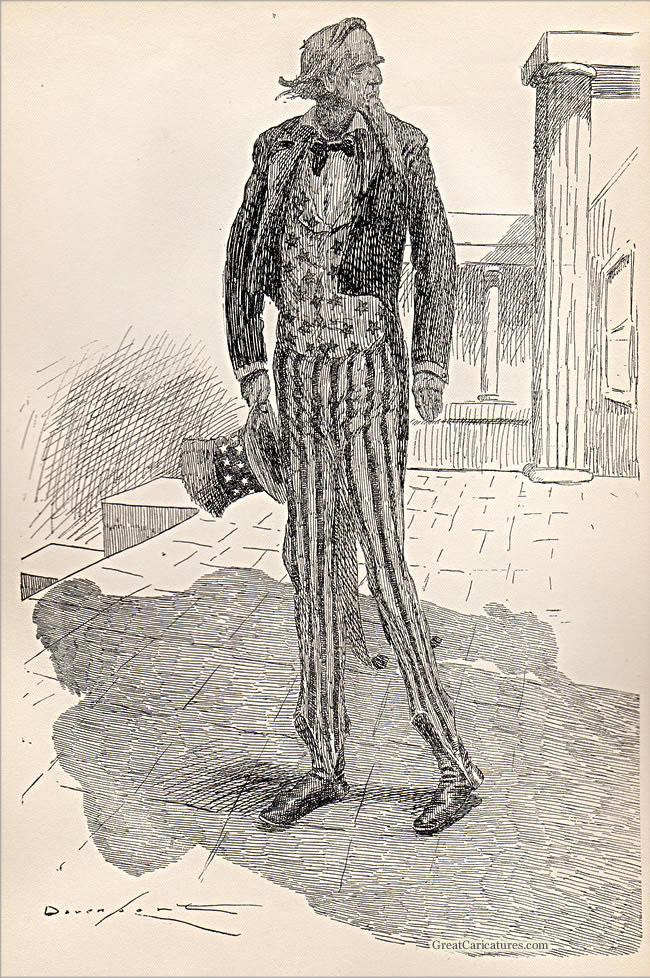
In the Shadow of Danger by Homer Davenport
Plate LII from The Dollar or the Man, the Issue of To Day, 1900
Originally published in the New York Journal newspaper
7 1/2 "w x 10 1/4 "h
At this point in the series, the Trust figure was well known. A simple image of its shadow cast over Uncle Sam was enough to convey the threat that monopolistic corporations posed to America .
Click here to read the previous post in this series
— David Donihue, GreatCaricatures.com
Posted at 08:11 AM
Posted in Book Reviews, Classic Cartoonists, Classic Comics, Political Cartoons | permalink | 1 Comment »
Sunday, October 31, 2025
In 1900, New York Journal political cartoonist Homer Davenport published a collection of his work titled The Dollar or the Man? The Issue of To Day. The cartoons focused on themes of government corruption and the threat that corporate power posed to America. These themes are with us today and will influence many of the votes cast in next week’s mid-term elections.
Davenport’s cartoons mark the beginning of the Progressive Era, a time when many believed that corporations sought to overthrow the government.
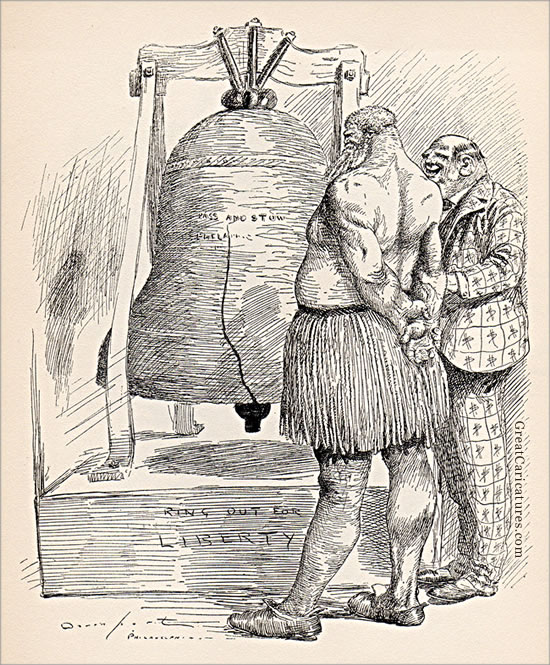
Mark, wouldn’t it be great for the Standard Oil dinner bell ! by Homer Davenport
Plate XI from The Dollar or the Man, the Issue of To Day, 1900
Originally published in the New York Journal newspaper
7 1/2 "w x 10 1/4 "h
In this cartoon, a Trust figure and Republican politcal operative Mark Hanna stand next to the Liberty Bell, a symbol of American Independence.
During the Revolutionary War the bell was used in Philadelphia to summon lawmakers to legislative sessions and to notify citizens of meetings, proclamations or civic dangers. In the 1830s, the bell was adopted as a symbol by abolitionist groups who gave it the name "Liberty Bell."
Oddly, the legend of the Liberty Bell relies more on fiction than fact. In 1847 a popular short story described an event in which the bell was rung to celebrate the Second Continental Congress’ vote for independence on July 4, 1776. While historical events do not support the story (bells were rung on July 8th to announce the reading of the Declaration of Independence), it was widely accepted as fact.
In 1885, the city of Philadelphia allowed the bell to tour the United States. It attracted large crowds, but the rigors of its journies caused additional cracking and viewers would sometimes chip away pieces of the bell as souvenirs. It’s last tour ended in 1915
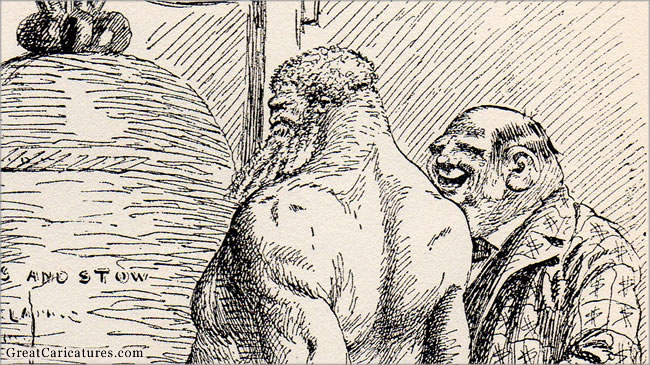
Detail of
Mark, wouldn’t it be great for the Standard Oil dinner bell ! by Homer Davenport
The Trust figure wistfully muses about appropriating the bell – and all it represents – for the purposes of the Standard Oil Company.
Click here for the previous post in this series | Click here to read the next post in this series
— David Donihue, GreatCaricatures.com
Posted at 08:10 AM
Posted in Book Reviews, Classic Cartoonists, Classic Comics, General, Political Cartoons | permalink | 1 Comment »
Saturday, October 30, 2025
In 1900, New York Journal political cartoonist Homer Davenport published a collection of his work titled The Dollar or the Man? The Issue of To Day. The cartoons focused on themes of government corruption and the threat that corporate power posed to America. These themes are with us today and will influence many of the votes cast in next week’s mid-term elections.
Davenport’s cartoons mark the beginning of the Progressive Era, a time when many believed that corporations sought to overthrow the government.
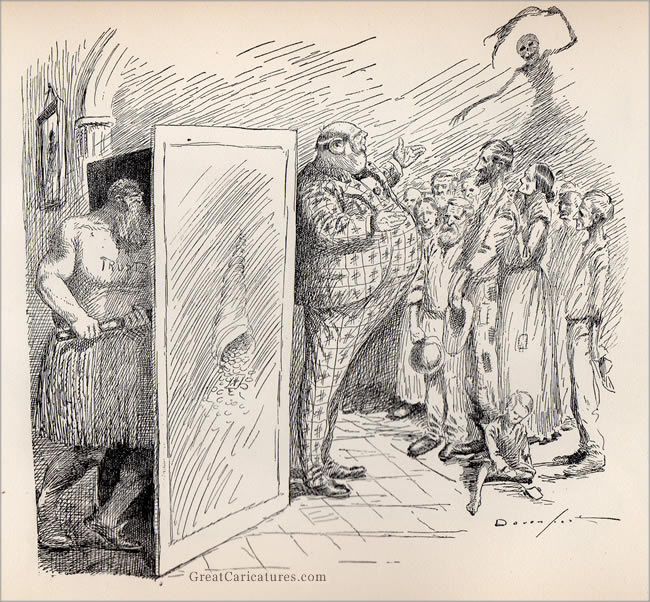
Ladies and gentlemen: Stick to the trusts. They’re your only true friends.
Don’t you see how happy they’ve made you? by Homer Davenport
Plate XLIII from The Dollar or the Man, the Issue of To Day, 1900
Originally published in the New York Journal newspaper
7 1/2 "w x 10 1/4 "h
In the cartoon above, Davenport shows Republican operative Mark Hanna as the protector of the trusts. He pontificates on their altruistic benevolence as one of the trusts crouches in hiding, club in hand..
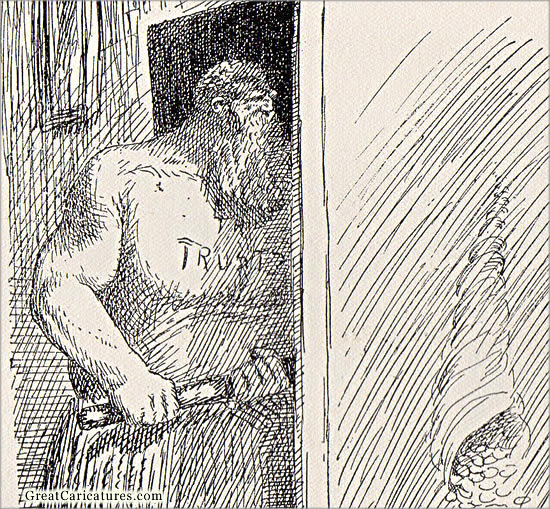
Detail of
Ladies and gentlemen: Stick to the trusts. They’re your only true friends.
Don’t you see how happy they’ve made you? by Homer Davenport
The screen is decorated with a cornucopia, a traditional symbol of prosperity, but in place of the customary fruit, flowers and grain, coins spill out. In folklore, the cornucopia was filled with whatever the owner desired. In this cartoon, it is placed on a device of concealment shared by Hanna and the Trust.
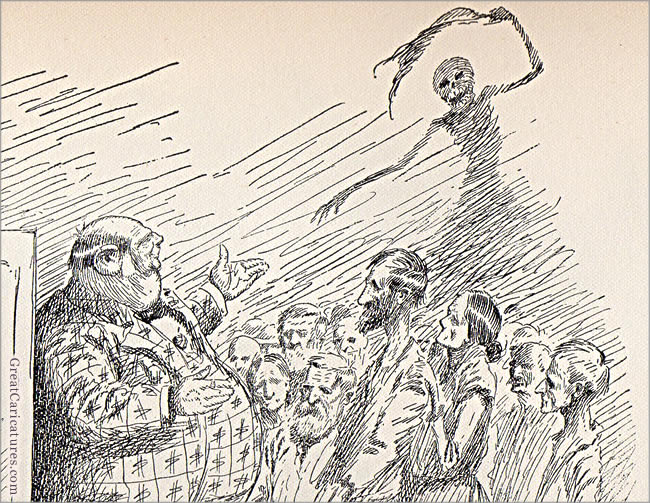
Detail of
Ladies and gentlemen: Stick to the trusts. They’re your only true friends.
Don’t you see how happy they’ve made you? by Homer Davenport
The overweight Hanna addresses an emaciated crowd with threadbare clothes as a vision of death hovers above them.
Click here for the previous post in this series | Click here to read the next post in this series
— David Donihue, GreatCaricatures.com
Posted at 02:10 PM
Posted in Book Reviews, Classic Cartoonists, Classic Comics, General, Political Cartoons | permalink | 2 Comments »
|
SUBSCRIBE

A-List: The I.T.C.H. Blog Contributors
BLOGS
COMIC NEWS
MY FAVORITE SOURCES FOR COOL BOOKS
THE PUBLISHER OF YOE BOOKS
THE PUBLISHERS OF OTHER BOOKS BY CRAIG YOE
CATEGORIES
ARCHIVES
META
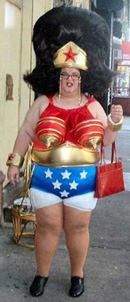
Every Wednesday is
WACKY WONDER WOMAN WEDNESDAY
archive
DOLL MAN WEIRDNESS
archive
|