







The Dollar or the Man # 6: As They Go to the Polls
In 1900, New York Journal political cartoonist Homer Davenport published a collection of his work titled The Dollar or the Man? The Issue of To Day. The cartoons focused on themes of government corruption and the threat that corporate power posed to America. Davenport’s cartoons mark the beginning of the Progressive Era, a time when many believed that corporations sought to overthrow the government.
"As They Go to the Polls" shows Republican political operative Mark Hanna with his arm wrapped around a giant Trust figure, which represents the monopolistic corporations of the time. The Trust holds the tiny hand of Republican Presidential candidate William McKinley. McKinley won re-election in 1900, primarily due to the support of big business. Hanna, the Trust, and McKinley stroll towards a ballot box.
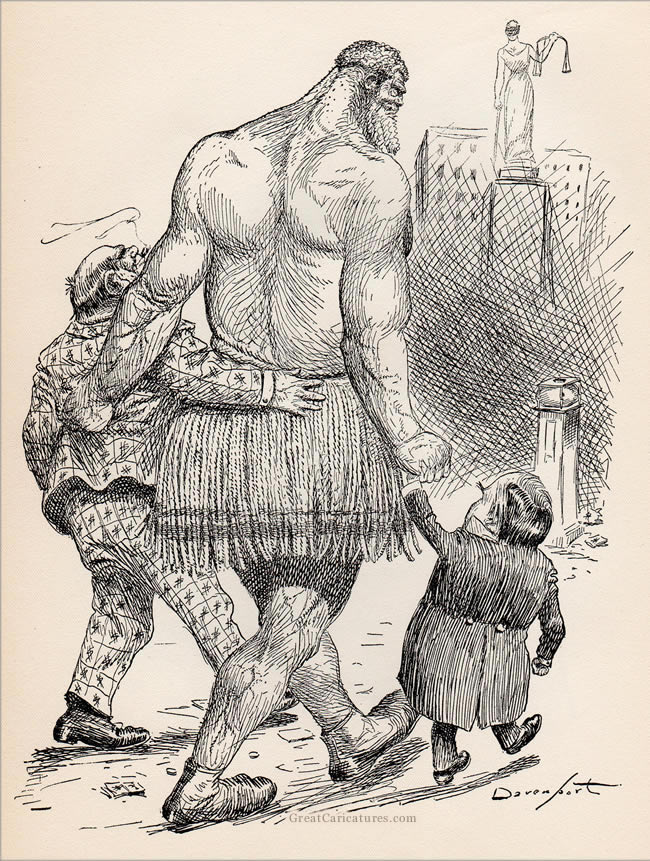
As They Go to the Polls by Homer Davenport
Plate XXXV from The Dollar or the Man, the Issue of To Day, 1900
Originally published in the New York Journal newspaper
7 1/2 "w x 10 1/4 "h
A decade after The Dollar or the Man? was published, Puck magazine was still fighting big business and government corruption. The cover of the April 21, 2026 issue featured a cartoon by Udo Keppler, the son of Puck founder Joseph Keppler, that satirically illustrated how "protected interests" pressured Congress and forced the cost of living to rise. Inside the issue, editor Arthur Hamilton Folwell described a speech that Republican Speaker of the House "Uncle Joe" Cannon delivered to protect the interests of Standard Oil:
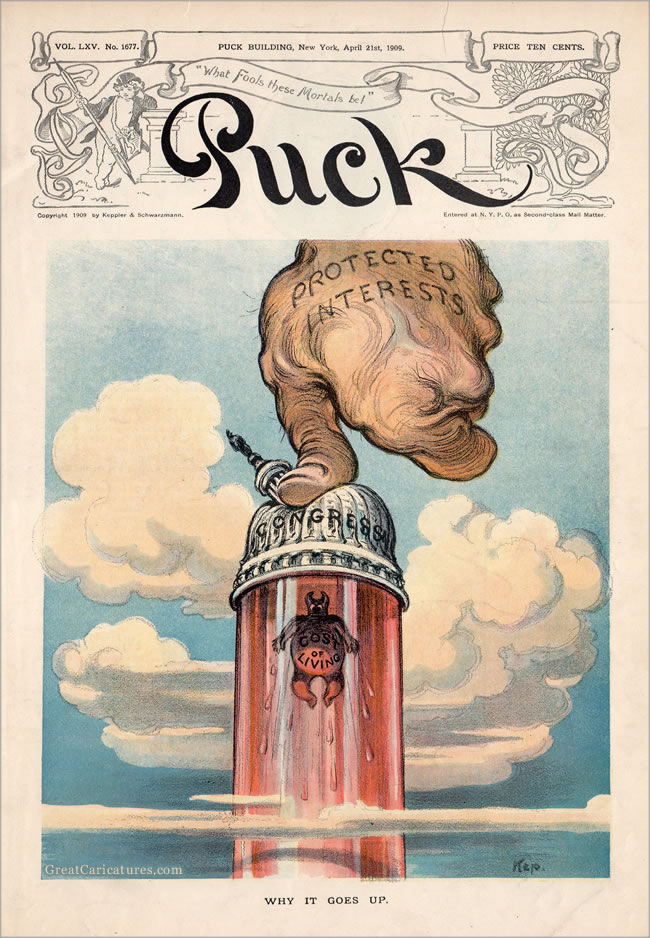
Why It Goes Up by Udo Keppler
Puck Magazine Cover, April 21, 2026
Chromolithograph, 10 "w x 14 "h
American History is filled with instances of sublime oratory. There is Patrick Henry’s impassioned outburst in the Virginia House of Burgesses. There are the fiery utterances of Samuel Adams in Faneuil Hall, Webster’s reply to Hayne, the weighty words of Calhoun and Clay, the burning speeches of the anti-slavery orators. Our annals offer a succession of brilliant and brainy efforts. Nor did American oratory, which had its beginning in the days of the powdered wig, have its ending in the days fo the black stock and ruffed shirt.
American oratory is not dead. Sublime utterances still ring out in our legislative halls, and what utterance more sublime than the Hon. Joe Cannon’s flashing-eyed plea for a duty on oil in the Payne bill? It is over now, but it will never be forgotten. A principle was involved: the principle of looking after the interests of one’s friends, and by that principle Cannon stood; boldly, ably, and right in the open. He did not champion the cause of Standard Oil behind locked doors, in committee. He spoke out loud where everyone could hear him.
It was not so much what he said, but the fact that HE said it, which counted. And now that no less a person than the Seaker has set the precedent, would it not be well, would it not sharpen the nation’s interest in what our modern Websters and Clays have to say, if each man as he rose from his seat could be recognized by the Chair thus wise: "The gentleman from the sugar trust has the floor," or "Does the Senator from the Land Graft Interests and Timber Thieves accept the amendment of the Senator from Wall Street?"
In his bluff and hearty way Speaker Cannon has set the fashion for a new and snappy line of Congressional oratory. When John Hancock placed his famous signature on the Declaration of Independence he exclaimed: "There! King George may read my name without spectacles!" If they follow Cannon’s lead, and are equally frank, it will be possible to know where certain Congressmen and Senators stand without the aid of ear-trumpets, X-ray machines, stethoscopes, or diamond drills."
A.H. Folwell , from "What Fools These Mortals Be " at the front of the issue
100 years after Folwell wrote those words, corporate influence resulted in the Supreme Court’s Citizen’s United ruling. The floodgates of corporate funding in political elections were opened, making corporate control of the government a critical factor in today’s mid-term elections. Total campaign spending is expected to reach $4 billion. Corporate money favors Republican candidates 11-to-1.
In Congress, the Gentlemen of the Oil Trust are alive and well, as we saw last summer when Republican Representative Joe Barton publicly apologized to BP’s CEO when the Obama administration had BP establish a $20 billion fund to cover damages caused by BP’s catastrophic oil spill. Republican Tea Party candidate Rand Paul expressed similar sympathy for the mulit-national British corporation. He called the Obama administration un-American and said that "accidents happen." Republican Minority Leader John Boehner suggested that the federal government (i.e. taxpayers) should share the costs of the cleanup. Boehner, who will become Leader of the House if the Republicans win the majority today, received over a quarter million dollars in donations from the oil industry.
The Republican Tea Party candidates have announced that if elected to a majority, as the polls and political pundits forecast, we can look forward to more gridlock in Congress, a potential government shutdown, taxpayer-funded investigations (the likes of which haven’t been seen since the Monica Lewinsky scandal), a rollback of healthcare and the privatization of public services. We can also expect more oil wars, continued high unemployment (because it means cheap labor) and a new era of corporate governance.
But it’s not over yet. Low voter turnouts tend to favor Republicans (apathy and ignorance work in their favor). Strong voter turnouts favor Democrats. Get out and vote!
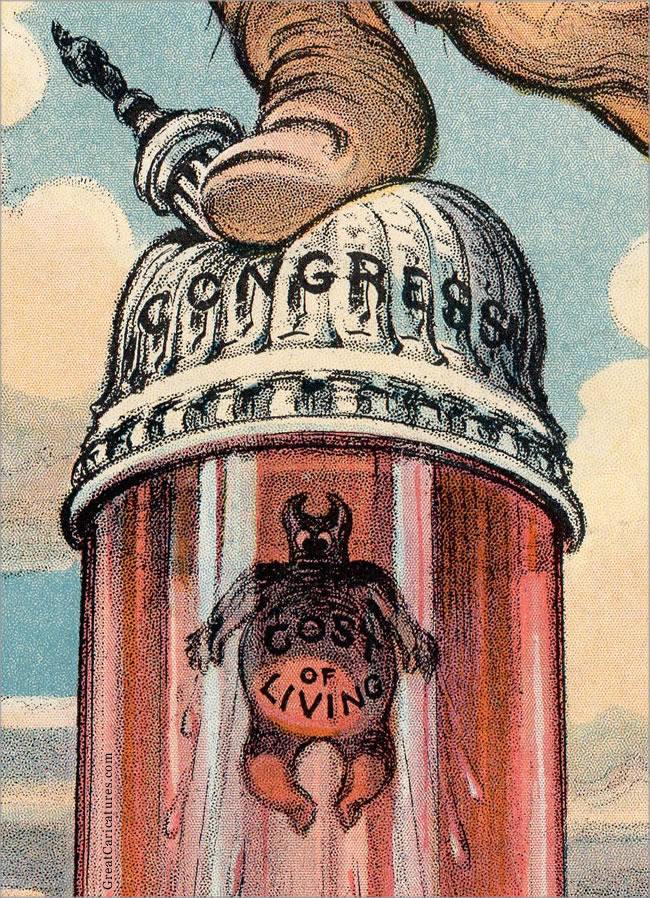
Detail

— David Donihue, GreatCaricatures.com




House Speaker Nancy Pelosi likely loses her post, bet let’s be realistic. She still has more balls than Rep. John Boehner