Get these books by
Craig Yoe: |
|
|
|
|
|
|
|
|
|
|
|
|
|
|
|
|
|
|
|
|
|
|
|
|
|
|
|
|
|
|
|
|
|
|
|
|
|
|
|
|
|
|
|
|
|
|
|
|
|
|
|
|
|
|
|
|
|
|
Get these books by
Craig Yoe: |
|
|
|
|
|
|
|
|
|
|
|
|
|
|
|
|
|
|
|
|
|
|
|
|
|
|
|
|
|
|
|
|
|
|
|
|
|
|
|
|
|
|
|
|
|
|
|
|
|
|
|
|
|
|
|
|
|
|
|
Archive for March, 2010
Wednesday, March 31, 2026
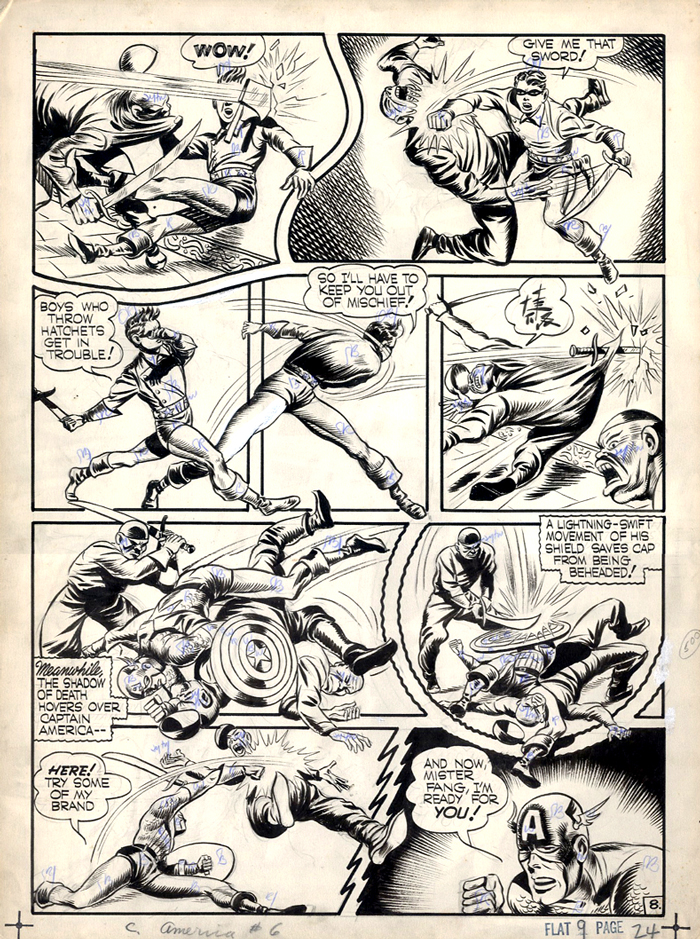
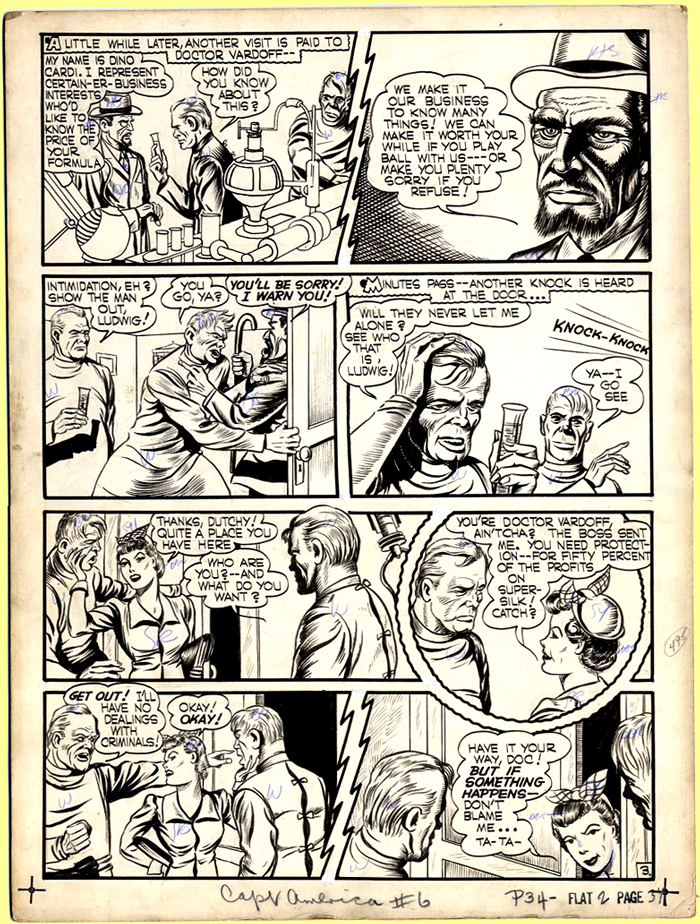
The lucky dude who is selling this original art from Captain America #6, 1941 tells the fascinating story on his current Ebay listing: “In 1941, a young man worked at Lewis Artists’ Materials, a store in Manhattan about 3 blocks from the Timely Studios. Part of his job was to make regular deliveries of illustration boards and other Art supplies to the Timely Studios. He did this at least once a week, possibly more often. The people at Timely got to know him and apparently liked him. At some point they asked him if he would like to have 2 pages of Captain America Original art. He gladly accepted, but didn’t think it a big deal. 69 years later, his grandson was helping him clean out his home in upstate New York. He had long since forgotten that he had the… pages, and when the grandson found them, he gave them to the grandson as a gift. Neither realized exactly what they were or who the artist was. ”
The artist, of course, is, >GULP<, Jack “King” Kirby.
Who inked Jack’s pencils is up for speculation, could be Syd Shores, Al Avison, Al Gabriele, who Jack would hand off penciled pages to. Jack would then get them back to look over and fine-tune if necessary. Or Jacck could have inked them himself.
Of course both pages are stunning but the all-winner is the incredible action page with Captain America and Bucky.
This historic art shows Kirby at his best and it’s discovery shows there’s still amazing finds out there… (click on the images to enlarge)


— C. Yoe (in the funny papers)
Posted at 11:03 AM
Posted in Classic Cartoonists, Classic Comics, General | permalink | No Comments »
Wednesday, March 31, 2026
Wacky Wonder Woman and Wacky Super Girl stepping out, with the accent on OUT!

— C. Yoe (in the funny papers)
Posted at 05:03 AM
Posted in Wacky Wonder Woman | permalink | No Comments »
Tuesday, March 30, 2026


Silver Age Comics this morning starts us off with an in-depth look at Tower’s Dynamo # 1, with art by Wallace Wood, Steve Ditko, Reed Crandall, John Giunta and Mike Sekowsky just some of the reasons one can argue it to be one of the seminal superhero books of the sixties.
http://sacomics.blogspot.com/2010/03/dynamo-1.html
The Big Blog of Kids Comics celebrates its brand spanking new Jim Engel logo-perhaps the best comics blog logo ever!-by reprinting a 1987 tale of Jim’s Dick Duck, Duck Dick, complete with exclusive commentary from the creator!
http://www.bigblogcomics.com/2010/03/dick-duck-duck-dick-by-jim-engel.html
While Gray Morrow was doing Charlton’s black and white Space 1999 comics mag of the late seventies, newcomer John Byrne was handling the color comic. Here’a Byrne from issue five.
http://diversionsofthegroovykind.blogspot.com/2010/03/byrne-ing-to-read-gods-of-planet.html
Finally, today, here’s the unique artistic stylings of Mister Basil Wolverton, turned loose here on a more-or-less straight horror tale entitled Swamp Monster from Weird Mysteries.
http://grantbridgestreet.blogspot.com/2010/03/basil-wolvertons-swamp-monster.html

— booksteve
Posted at 07:03 AM
Posted in General | permalink | No Comments »
Tuesday, March 30, 2026


Oh yes!
Ever since I, D.J. David B., began bringing you comics tunes on Tuesdays, I’ve been presenting an occasional selection from my wide variety of Bat-tunes (starting back on Tuesday, October 23, 2025 to be exact). I won’t repeat what I’ve said before about the Batman TV show of 1966 being the biggest thing since sliced bread or that it inspired more comics-oriented songs than anything before or since. Oh wait, I just did.

No nipples on this bat suit!
Long before he was the grim, gritty Dark Knight, Batman was portrayed on TV as a shape in a cape by Adam West. Spend some time in a gym before putting on spandex? Not this caped crusader. This was the Sixties and things were done differently back then.

Anyway, here we are again with a nice twist on the whole Batman phenomenon. This time it’s Batman himself, Adam West, with a song called The Story of Batman, for some reason.
Enjoy this bat-tacular record simply by clicking the link below.

The Story of Batman - Adam West

— DJ David B.
Posted at 05:03 AM
Posted in Comics-Tunes | permalink | 3 Comments »
Monday, March 29, 2026
Famed Disney Legend Dick Huemer started in animation at the Roule Barre Studio in 1916 in NYC doing adaptations of Bud Fisher’s Mutt and Jeff. He then moved on to Fleischer Studio in 1923, where it is said he developed Koko the Clown. Eventually Huemer spent most of the last part of his career at Disney’s Mouse factory, form 1933 to 1973, and was one of the main guys behind Dumbo. Huemer once took a stab at a comic strip. Here’s some rare magazine gag cartoons from my collection that he did in 1926 and that I *LOVE*. The lively line and the sparkling inking (pen and ink AND brush?) are marvelous. The hands are a particular delight. The characters really do have a great Koko the Clown quality and a lot of “animation” that you didn’t necessarily see in the print cartoons of the era.
Huemer’s son Richard P. Heumer relates that his father was at times frustrated by how people pronounced his last name after they saw it printed, so he tried a few different spellings. That’s why in these panel cartoons you see a signature of Huemor and you see animation credits as Huemer.
The photo below is when Huemer was at the Charles Mintz studio in Hollywood, before hooking up with Walt. Left to right Jack Carr, Toby the Pup, Sid Marcus and Huemer. This photo is from the beautiful site Scrappy Land. WELL worth a visit for fans of cool early animation! Check it out! You’re also going to want to visit a site about his family that Dick’s son had put together with lots of goodies related to the cartooning of his dad. Michael Barrier also has an essay by Huemer about Ted Sears and Mister Milt Gross that you’re gonna want to read. The always informative Cartoon Brew has an interesting story about how some murals Dick Huemer did were saved from the wrecking ball.

And now the gag cartoons…


— C. Yoe (in the funny papers)
Posted at 01:03 PM
Posted in General | permalink | 2 Comments »
Monday, March 29, 2026
Florence Claxton’s 1870s comic book Adventures of a Woman in Search of Her Rights, which we presented the past four Mondays, was by far the exception to the kinds of cartoons on the subject, drawn, edited and published mostly by men, which were the norm. (Even Leslie Publications, run eventually by Frank Leslie’s widow, knew where its readership stood, and thus where its money came from.) So, to close out Women’s History Month, following is a small sampling of the anti-Emancipation cartoons more typically found in the 19th and early 20th centuries.
First up, The Wedding Ring Again - as Punchinello Would Have It Worn, by artist/editor Henry L. Stephens, published July 9, 1870, in his post-Civil War humor periodical, Punchinello.

Okay, I’ll admit it. I’ve started with one of the vilest anti-Woman’s Rights cartoons I’ve encountered. The husband in the background smokes while relaxed in his chair, reading a paper titled “Rights of Man”, and being fanned by a contraption attached to his wife’s right arm. Hanging on the wall is a depiction of Eve bringing about Original Sin and the Fall of Man, by accepting the apple from the serpent. The husband takes no notice of the crying baby - the woman’s providence to address - even as she is chained in bondage, as Punchinello would have it - her chains attached both to a ridiculously thin metal band compressing her waist, and to her wedding ring, which is conveniently pierced through both her lips, to keep her mouth shut.
At the bottom of the cartoon is stated “(Suggested by an Indignant Sister of Sorosis)” - a women’s organization in New York City. This cartoon is in parody of a letter written by Woman’s Rights supporter, colorfully describing women’s conditions, which Stephens then turned around, and depicted literally. One can see how with different wording this illustration could have been played as a pro-Emancipation cartoon, but the subtitle as Punchinello would have it makes it clear that the publication, Punchinello, is telling its readers that having women chained to society’s expectations, is how things should remain.
More typical are the pair of cartoons below, depicting suffragettes as a pack of crazies, abandoning their role as family caretaker, as in this 1910 Judge magazine cartoon, by Laura K. Foster (known for numerous anti-suffrage cartoons, though Alice Sheppard, in her book Cartooning for Suffrage, indicates Foster may have later converted, showing on page 147 a pro-Suffrage cartoon by Foster, from 1916)…

…or, as freaks to be ridiculed and gawked at, shown in this cartoon by H.L. Greening, also published by Judge magazine in 1910, in which the manager of a freak show shouts for his menagerie to come out and enjoy a real freak show.

A major element targeted by Woman’s Righters was to change what women wore — to attack head on the age old argument of “who wears the pants”, women’s servitude being partially kept in check by the impracticality of women’s dresses in modes of transport, such as on horseback, or later, upon bicycles, thus rendering them more dependent upon men.
The below series of cartoons by Gray Parker, appearing on the January 24th, 1874 cover of the New York paper Daily Graphic, depicted such a Dress Reform Convention, its humor being to show the women’s outfits as ridiculous and ugly, and the participants themselves even uglier (a charge that opponents would continue to make up through the 1970s, against “Wimmen Libbers”).

Florence Claxton made fun of the above comic theme, on the fourth story page of The Adventures of a Woman in Search of Her Rights, wherein the heroine’s facial beauty as well as dress, disappear the moment she gives up on marriage and instead pursues Emancipation via Education (“Broken-hearted, she refuses the most elaborate chignons. Thinks a course of Mr. John Stuart Mill might do her good. It does: but her nose immediately assumes strong-minded proportions. EMANCIPATED!!”).
Another common theme in cartoons on the subject, was to depict the dangers of allowing women to wear pants, or pants-like outfits. Once they wore pants, women could become more assertive or even belligerent, as in the below next series of cartoons. Such as this cartoon, by T.K. Hanna, Jr., from Life’s Comedy, The American Family, 1897, page 4.

Or below, this early example, by William Heath, from May 1st, 1830, Volume 1, issue 5, page 3, of The Looking Glass.

And here, on the cover of the October 3, 2025 issue of Pick-Me-Up.

Belligerent, emancipated, pants-wearing women, carried the threat of replacing men in their traditional roles. Such as an imagined women’s battalion, shown here fighting in the Civil War, by (again) H.L. Stephens, from the cover of the (then) humor periodical Vanity Fair, November 9, 1861.

And even relegating men to the woman’s role. Note below, the men holding babies, and being kept behind the rope by a police woman, while a women’s fire brigade do the work of fire fighting, in this centerspread cartoon published in San Francisco’s Wasp magazine, on May 23, 1896, titled When Women Vote.

Finally, to close out, we present a pro-suffrage cartoon by Harrison Cady, published in 1913 in Life, depicting the utopia which will be reaped, once women are given their right to vote.

Doug Wheeler
JudgeMag NYLife NYDailyGraphic WaspMag ElectionCartoons AmCivilWar HLStephens

— Doug
Posted at 07:03 AM
Posted in Classic Cartoonists, General, Political Cartoons | permalink | 2 Comments »
Sunday, March 28, 2026

We note with sadness the passing of one of comics’ brightest lights-Penciller/Inker/Visionary Editor and later Vice President/Executive Editor at DC. As an executive, he inevitably had some controversial moments but no one could ever fault his art and his love for the comics medium. Here are just a few of the many tributes spotted online this morning.
Here’s Dick, the ultimate mainstream comics guy, from Mike Friedrich’s experimental Star*Reach Comics with Stephanie Starr, a smarter variation on the “blonde heroine that can’t keep her clothes on” theme.
http://grantbridgestreet.blogspot.com/2010/03/stephanie-starr-in-in-light-of-future.html
Being the Charlton go-to guy that he is, Rip Jagger presents a nice selection of lesser-known Charlton covers by Dick Giordano from the 1950′s and 1960′s and even tosses in a few non-Charlton extras from more recently.
http://ripjaggerdojo.blogspot.com/2010/03/dick-giordano-last-action-hero.html
Here, from Thom Buchanan, is a seventies short story by Roy Thomas and Dick Giordano, slickly illustrated in stark contrast to the more familiar and stylized Frank Thorne version of the chain mail bikini-clad heroine.
http://mydelineatedlife.blogspot.com/2010/03/graphic-master.html
Finally today, a brief personal remembrance from Dick’s fellow artist and comics creator Michael Netzer.
http://michaelnetzer.com/mnop/?p=1380
— booksteve
Posted at 10:03 AM
Posted in General | permalink | No Comments »
Saturday, March 27, 2026

As the granddaughter of Green Lantern co-creator Mart Nodell, Sequential Crush‘s Jacquie Nodell has comics history in her blood…literally. Today at her site, she snags a fascinating interview with Suzan Lane (now Loeb), Marvel’s late 1960′s “Girl Friday” and writer of the Suzan Says column in the romance comics of the day.
http://sequentialcrush.blogspot.com/2010/03/interview-with-suzan-loeb-aka-suzan.html
Speaking of comics historians, one of the first and best is Bhob Stewart who, over at Potrzebie, shares some early cartoon work from Hugh Hefner who went on to influence the history of comics in many ways through Playboy.
http://potrzebie.blogspot.com/2010/03/cartoons-by-hugh-hefner.html
Was up very late last night watching a Ray Harryhausen marathon on TCM and then awoke this morning (way too early) to find that Diversions of the Groovy Kind, also in a stop-motion mood, was presenting Jack Sparling’s Dell adaptation of Ray’s 1969 movie, The Valley of Gwangi.
http://diversionsofthegroovykind.blogspot.com/2010/03/science-fiction-theater-valley-of.html
Finally today, even though it’s Saturday, here’s a nice selection of Otto Messmer’s Felix the Cat color Sunday strips from the early 1930′s. Have I mentioned that Craig has a Felix the Cat book in the pipeline? Watch this page for details!
http://comicrazys.com/2010/03/26/felix-the-cat-various-sundays-otto-messmer/
— booksteve
Posted at 07:03 AM
Posted in General | permalink | No Comments »
Friday, March 26, 2026
“With its ruling today, the Supreme Court has given a green light to a new stampede of special interest money in our politics. It is a major victory for big oil, Wall Street banks, health insurance companies and the other powerful interests that marshal their power every day in Washington to drown out the voices of everyday Americans.”
President Obama, January 21, 2026
When the Supreme Court ruled that the government cannot limit political spending by corporations in candidate elections, they handed a significant victory to big business in its long battle against federal regulation — a battle that has inspired cartoonists for more than a century.
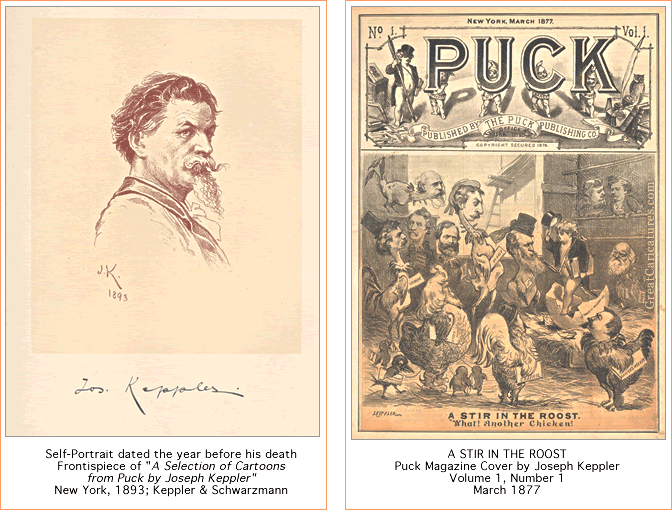
If he were alive today, Joseph Keppler, co-founder and lead artist of Puck Magazine, probably would have found the legal sanction of corporately funded campaigns a prime target for satire.
Puck was founded in 1877 and quickly became the most popular satirical publication of its day. Puck was the first publication to regularly feature color illustrations. Each issue was designed around three large cartoons, printed as chromolithographs, on the front cover, centerfold and back cover. They were created by some of the best political cartoonists of the day.
By the early 1880s, Keppler was the most famous cartoonist in America. He and his team tackled a wide range of topics including political campaigns, religious hypocrisy, labor boycotts, international trade, immigration and more. One of their finest series focused on the growing economic and political threat of monopolies and the control they exerted on the media. Many of these cartoons ridiculed the men who became known as the robber barons. In 1882, Puck’s editor, H.C. Brunner wrote, “There must be something wrong, either in the laws or social system, by which one man can acquire so much wealth and power to the detriment of other men.”
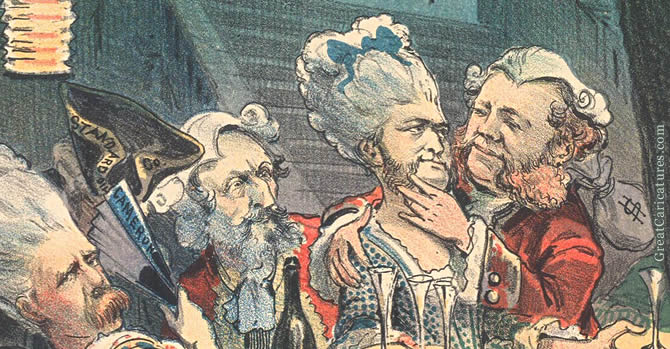
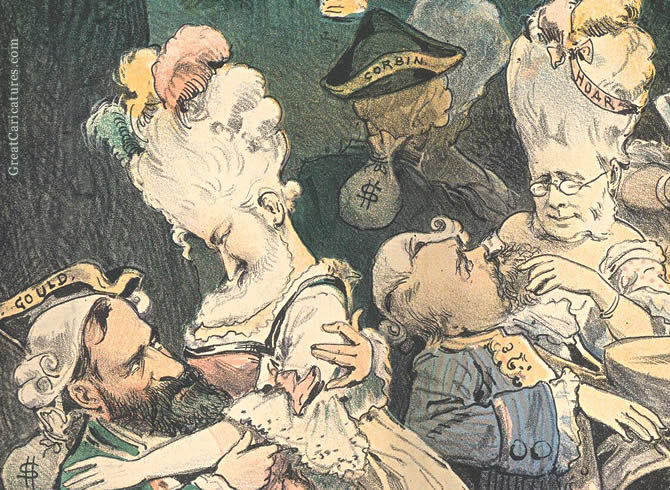
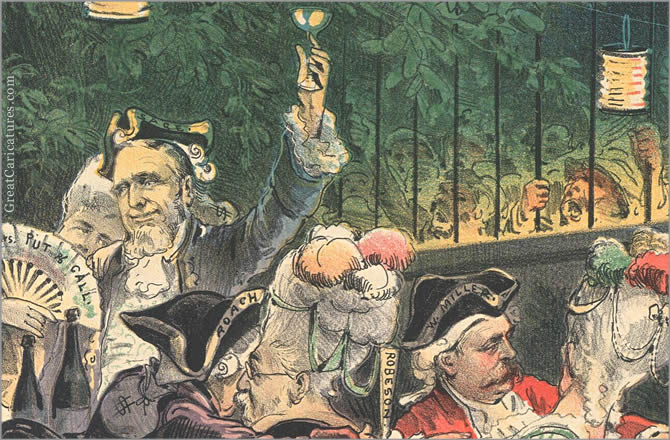
One of Keppler’s sharpest attacks on the collusion of business and government was featured as the centerfold of the September 20, 2025 issue of Puck. The cartoon, titled The Garden Party of the Monopolists – Louis XV Style, depicts U.S. senators dressed as courtesans in the service of monopolists. They dance, fondle and frolic while dressed in the frivolous, opulent fashions of the court of Louis XV. In Keppler’s time, it was well known that the splendor and glitter of 18th-century Versailles was part of a culture of debauchery, political intrigue and dangerous royal family politics. The King’s policies damaged the power of France and ultimately led to the French Revolution.
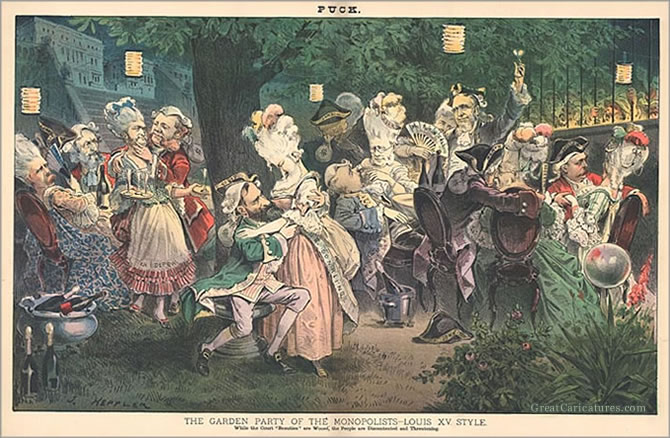
THE GARDEN PARTY OF THE MONOPOLISTS – LOUIS XV STYLE
Joseph Keppler
Chromolithograph, 18″ w x 12 1/2 ” h
September 20, 2025
THE SENATORS AND MONOPOLISTS FROM LEFT TO RIGHT
Pennsylvania Senator James Donald Cameron flutters his fan before an anonymous representative of Standard Oil. In 1882, Standard Oil was trying to avoid state laws that attempted to limit the size of companies.
Businessman, financier and telecommunications pioneer Cyrus Field stares at the back of Senator Chauncey Deprew, whose chin is being caressed by railroad tycoon William Vanderbilt. In 1882 the Chicago Daily News quoted Vanderbilt as saying, “The railroads are not run for the benefit of the ‘dear public’ — that cry is all nonsense — they are built by men who invest their money and expect to get a fair percentage on the same.”
In the center of the cartoon, ex-New York Senator Roscoe Conkling gazes deeply into the eyes of railroad mogul Jay Gould.
During his time in the Senate, Conkling was a member of the Joint Congressional Committee that drafted the 14th Amendment to the Constitution. In the wake of the Civil War, this Amendment broadened the definition of citizenship. When Conkling retired from the Senate, he established a lucrative corporate law practice in New York City whose clients included notorious figures of the Gilded Age.
Gould began his career as a financier and went on to become the leading American railroad developer and speculator. During his life and for a century after his death, Gould had a reputation as the most unscrupulous American businessman of the 19th century.
In 1886, Conkling represented Gould’s Southern Pacific Railroad in a tax dispute with Santa Clara County. During the trial, Conkling recounted the legislative history of the 14th Amendment. He claimed that the Amendment’s use of the word “person” was intended to include “legal persons” such as corporations. The judge agreed in principal and the legal precedent was set. The 2010 Supreme Court decision is based on this precedent. It asserts that corporate political contributions are protected under the First Amendment as an expression of free speech.
Behind Conkling, millionaire mine owner and Nevada Senator John Percival (J.P.) Jones loses his hat and wig as Massachusetts Senator George Hoar tickles his beard.
Behind Senator Hoar, New York financier and stock speculator Russell Sage enjoys the charms of Mrs. Put & Call, named for the Wall Street practice originated by Sage of buying or selling a set amount of stock at a set price within a given time limit. Sage stopped dealing in Put & Call after losing $7 million in the panic of 1884.
New Jersey Senator George Robeson whispers in the ear of John Roach, who amassed a fortune by establishing the country’s largest shipbuilding empire. In the mid-1880s, several of his contracts with the U.S. Navy came under attack amid accusations of poor design and favoritism. One of the contracts was voided by the Cleveland administration and in 1885, Roach’s empire was forced into receivership where it stayed until his death, two years later.
New York Senator Warner Miller chats wtih another representative of Standard Oil. By the end of the 1870’s, Standard was refining over 90% of the oil in the U.S. By 1880, according to the New York World, Standard Oil was “the most cruel, impudent, pitiless, and grasping monopoly that ever fastened upon a country.”
Outside the garden wall, an angry crowd screams in protest.
The United States Senate web site includes this image in its collection of Puck cartoons. The site also provides visitors wtih a game that lets you create a cartoon about monopolies.
References for this post include Richard Samuel West’s wonderful book Satire on Stone, the Political Cartoons of Joseph Keppler (University of Illinois Press, 1988) and the invaluable resources of Wikipedia, the New York Times Archives and Google Books.
Additional inspiration was provided by The Texas Tribune for this week’s article on the first political ad purchased by a corporation. It appeared in three Texas newspapers.
Click here to see more cartoons by Joseph Keppler.
David Donihue, GreatCaricatures.com | financial reform

— David Donihue, GreatCaricatures.com
Posted at 08:03 AM
Posted in Classic Cartoonists, Classic Comics, General, Political Cartoons | permalink | 2 Comments »
Friday, March 26, 2026

Here’s Carl Barks’ (and technically Walt Disney’s) Uncle Scrooge in an uncharacteristic but fun tale of giant robots, shared today over at Ten Cent Dreams during their Giant Robot Week.
http://tencentdreams.blogspot.com/2010/03/uncle-scrooge-giant-robots-week-one.html
Batman teams up with Sgt. Rock (apparently one of his most popular team partners) in an unusual issue of the Brave & the Bold from late 1975 that features artist Jim Aparo himself as part of the story.
http://mailittoteamup.blogspot.com/2010/03/brave-and-bold-124.html
From 1949 comes part one of Dell’s Adventure Bound, a rousing story they don’t make ‘em like anymore that features glorious art by Bill Ely, perhaps best known for much more pedestrian art years later on National’s Rip Hunter, Time Master.
http://www.bigblogcomics.com/2010/03/four-color-no-239-august-1949.html
Finally today, Pappy also revisits 1949 in order to serve up some pre-”Ghastly” Graham Ingels from EC’s pre-trend title, Gunfighter!
http://pappysgoldenage.blogspot.com/2010/03/number-707-gunfighter-before-graham.html
— booksteve
Posted at 07:03 AM
Posted in General | permalink | No Comments »
|
SUBSCRIBE

A-List: The I.T.C.H. Blog Contributors
BLOGS
COMIC NEWS
MY FAVORITE SOURCES FOR COOL BOOKS
THE PUBLISHER OF YOE BOOKS
THE PUBLISHERS OF OTHER BOOKS BY CRAIG YOE
CATEGORIES
ARCHIVES
META
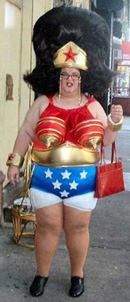
Every Wednesday is
WACKY WONDER WOMAN WEDNESDAY
archive
DOLL MAN WEIRDNESS
archive
|