Get these books by
Craig Yoe: |
|
|
|
|
|
|
|
|
|
|
|
|
|
|
|
|
|
|
|
|
|
|
|
|
|
|
|
|
|
|
|
|
|
|
|
|
|
|
|
|
|
|
|
|
|
|
|
|
|
|
|
|
|
|
|
|
|
|
Get these books by
Craig Yoe: |
|
|
|
|
|
|
|
|
|
|
|
|
|
|
|
|
|
|
|
|
|
|
|
|
|
|
|
|
|
|
|
|
|
|
|
|
|
|
|
|
|
|
|
|
|
|
|
|
|
|
|
|
|
|
|
|
|
|
|
Archive for the ‘Book Reviews’ Category
Thursday, June 24, 2025

AND

PRESENT

Talking Lines: The Graphic Stories of R.O. Blechman. Dear James: Letters to a Young Illustrator. These are landmark publications, both by R.O. Blechman, one of our greatest living animators and cartoonists. If I seem like a super fangirl about this, it’s because I am. Blechman’s work has influenced me in myriad and powerful ways. His creations have equal capacity for love and folly. His satire is equal parts devastating and compassionate. He surpasses the angry and reaches the sublime, and while it appears effortless, R.O. Blechman works his magic because he cares so much about his craft.

Talking Lines was brought to us with love by Drawn and Quarterly, insanely well-designed by Tom Devlin. The book itself presents like a Blechman cartoon, everything possible stripped away and then stripped away again and again, until only the necessary remains. It’s part autobiography and part collector’s dream — disparate cartoons gathered from the four corners and combined with previously unpublished work. The introduction by Seth is brief and peerless, and I won’t bother to attempt a duplication here. Let’s just say that in Blechman’s hands, the much-maligned and neglected “human condition” is fully redeemed. I’m into redemption. I look for it everywhere. And when you find it in Blechman, you need look no further.
You need to check your pulse before reading Dear James, because it will stimulate you and excite you, and possibly provoke you into doing your greatest work to date. It is quite simply the best book on creativity ever written. You’ll be so motivated, and feel so empowered, that you may begin working round the clock. Maybe see your doctor first, just to be sure you’re healthy enough to withstand the sudden flow of creative juice. You’d take your car to the mechanic before racing in the Grand Prix, right?

The opportunity to interview R.O. Blechman left me with priceless memories, not only because I chatted with this wonderful man, but because it provided an occasion to collaborate with one of my colleagues, J.J. Sedelmaier, a graduate of The Ink Tank. Who better to introduce Blechman than a fellow animator?
J.J. writes:
R.O. Blechman is one of this planet’s artist/designer treasures. Few people have had as much influence on their chosen industry and been witness to the transformation of their craft due to their involvement as R.O. His career launched early with the success of “The Juggler of Our Lady” as a book and soon thereafter an animated motion picture – narrated by Boris Karloff no less!

During a period when animated/cartoon characters were relatively conventional and formulaic, his collaboration with animator/director John Hubley demonstrated that a simple graphic cartooning style with broken lines could be indeed be animated. Up to this point, the consensus was if a line had a gap, the paint/color would seep out – where do you end the color if there’s no line to contain it?
What’s taken for granted in 2010 was revolutionary in the 1950’s!
To this day, Blechman continues to grow as a graphic design force. He still pushes himself and questions convention with his deceptively clean and simple (never simplistic) ideas executed in their trademark clever and witty illustration style. I’ve always seen him as an artist/writer/chemist. He puts all the elements into his centrifugal brain and distills the idea, the design, and the execution, into only what’s absolutely necessary. All the useless stuff separates from the essential.
You have to reflect on how rare it is (especially in the world of advertising) to see an artist’s point of view in such a pure form.
R.O. Blechman: Unique. Special. Totally human.

Thank you so much, J.J.! And now, without further ado, let’s get to know this man.
ITCH: What was your first comic book?
R.O. Blechman: As a kid I hardly read comic books. My parents disapproved of them, so I had to go to my Uncle Charlie’s house where his four sons had a huge collection of them.
What are you reading right now?
I’m about to read Philip Roth’s Exit Ghost because a dear friend of mine highly recommended it- and I like almost all of Roth’s writing.

What is your guilty pleasure? At least, the comics-related one!
None. My guilty pleasures are all culinary.
Who was the first cartoonist you met?
My Uncle Nat. When he came to visit us my brother and I wouldn’t let him leave the house until he had drawn a bunch of cartoons. He might have become a professional artist- maybe a cartoonist- if he didn’t enter the family business (wholesale dry goods. The building still stands: 555 Broadway, now the home of Scholastic Books).
This is a cartoon by my Uncle Nat. He’s flying his airplane, circa 1938, which he gave up when my Aunt said, “You have to give it up. It’s either me or that airplane.” He made the wrong choice.

Which dead cartoonist would you most like to meet?
My uncle. But we probably wouldn’t discuss cartooning. I suppose if I could meet a dead cartoonist it would be Saul Steinberg. I suspect that as a person he would be as extraordinary as his artwork.
What would you say?
Probably either the wrong things or nothing at all. I once met Robert Graves at an intimate dinner party, and didn’t say a word to him even though I was in the middle of reading one of his books (a great one-his memoir, Goodbye to All That). I was once seated next to Al Hirschfeld at a dinner party, and I was tongue-tied throughout the meal.

What has been the highlight of your career to date?
My animated film, an adaptation of Stravinsky’s L’Histoire du Soldat. I suppose a second would be my latest book, Talking Lines. It’s a great survey of my printed stuff, and beautifully designed.
Please tell us a little about your latest project.
No, I’m superstitious.
Well, alright, I’ll mention that Sempé asked me to animate one of his books (we show at the same gallery in Munich). I’ve already done the storyboard and now it’s a question of funding the project.
Which comics character do you most identify with?
None. I’ve never been much of a comics reader.
If you could have any superpower, what would it be?
To persuade some billionaire to part with a few million to jumpstart one of my film projects. Fat chance!

Dear reader, what we presented here today does not solve the mystery of how R.O. Blechman inspires such love, respect, and gratitude. You’ll have to read his books to find that out! But think about this: if I find his work life-changing, and I am neither an illustrator, cartoonist, nor animator, just imagine what his books can do for you! After you get home from the bookstore, drop us a line and tell us what you think.

— beth
Posted at 03:06 PM
Posted in Book Reviews, Classic Cartoonists, Classic Comics, General, Interviews | permalink | 2 Comments »
Tuesday, June 22, 2025
Ancestors of Mickey Mouse, Krazy Kat, Bugs Bunny, Pogo and all the other funny animals of the 20th century can be found in the amazing 19th-century engravings of the French caricaturist Jean Ignace Isidore Gérard, better known as J. J. Grandville.
In the 1830s Grandville worked in Paris as one of the stars of Charles Philipon’s team of artists creating political caricatures that attacked the regime of Louis-Philippe in La Silhouette and La Caricature.
Between 1840 and 1842, Grandville created more than 200 illustrations for a series of articles titled Scènes de la Vie Privée et Publique des Animaux (Translation: Scenes from the Private and Public Life of Animals). Grandville’s drawings are as anatomically precise as scientific illustrations and so elegantly rendered that they’re more than funny – they’re metaphors and parables of human experience.
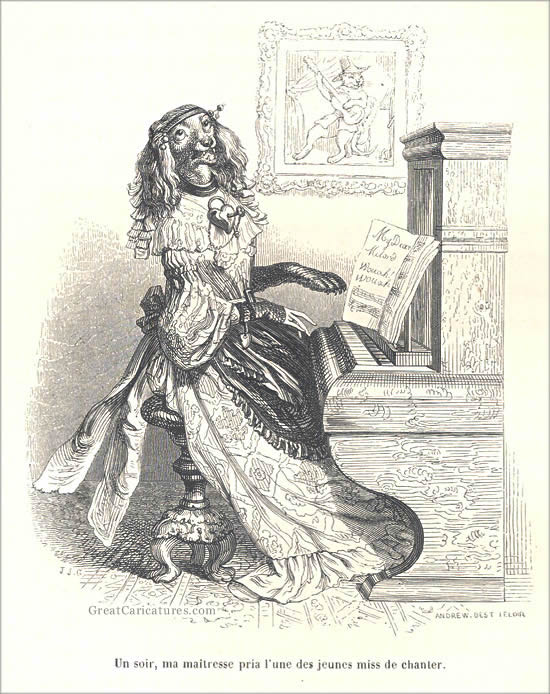
Un soir, ma maitresse pria l’une des jeunes miss de chanter. by J.J. Grandville
Translation: "One night my mistress begged one of the young ladies sing"
1841, Engraving, 4 1/2 "w x 5 1/2 "h
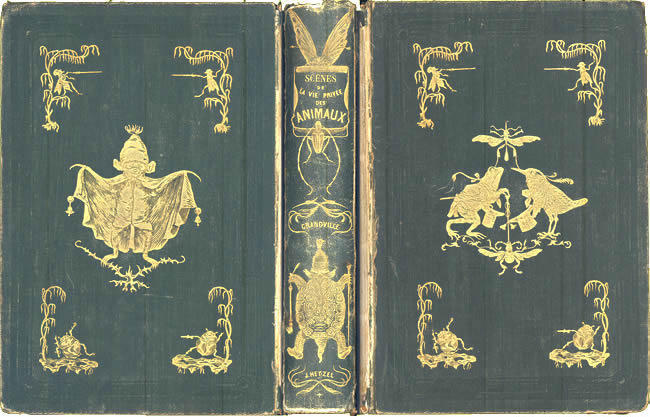
Covers of Scènes de la Vie Privée et Publique des Animaux
Translation: "Public and Private Life of Animals, Scenes of Manners"
1844 Edition, Volume 1, 17"w x 11h "
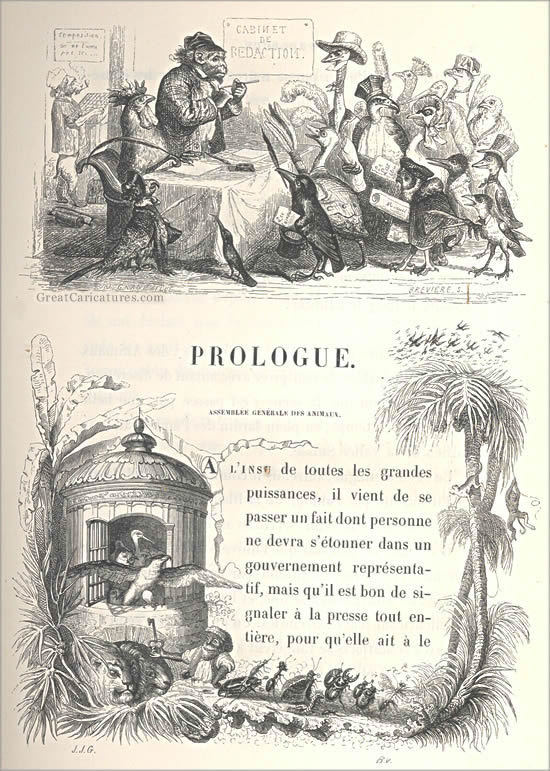
Prologue Illustrations by J.J. Grandville
1844 Edition, Engraving, 6 "w x 8 1/2 "h
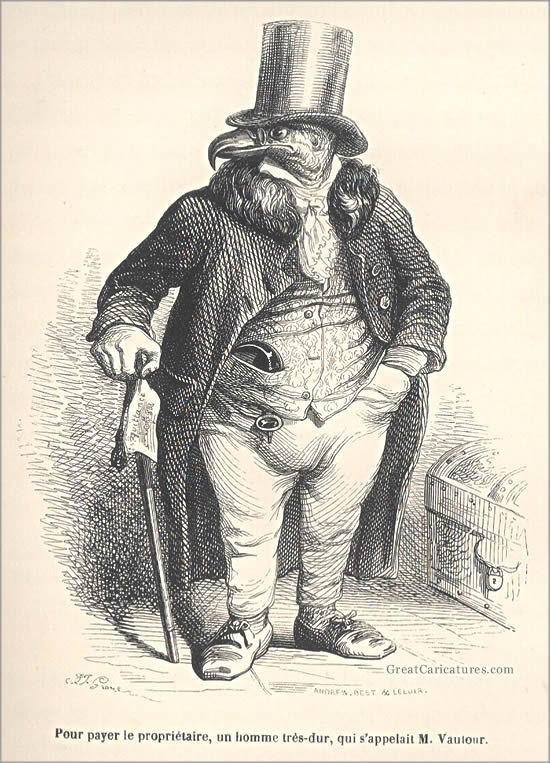
Pour payer le propriétaire, un homme très-dur, qui s’appelait M. Vautour by J.J. Grandville
Translation: "To pay the owner, a very hard man, whose name was Mr. Vulture"
1844 Edition, Engraving, 4 "w x 5 1/2 "h
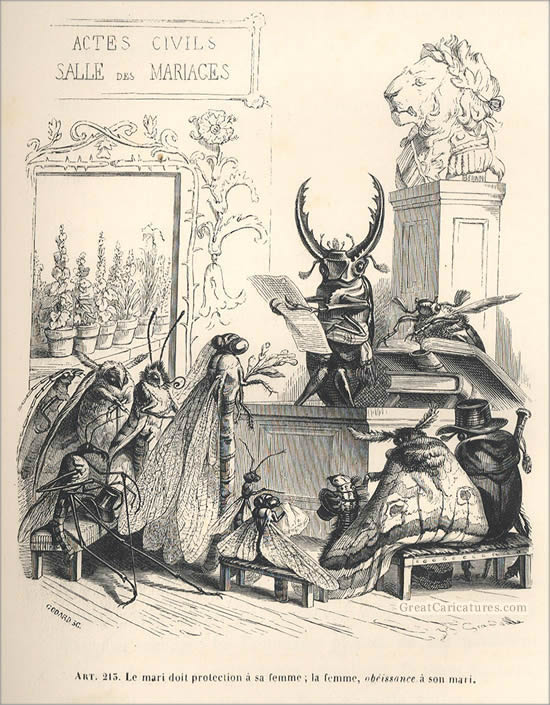
Art. 215. Le mari doit prtection à sa femme; la femme obéissance à son mari.
by J.J. Grandville
Translation: "The husband owes protection to his wife, the wife obedience to her husband."
1844 Edition, Engraving, 5 "w x 6 "h
David Donihue, GreatCaricatures.com

— David Donihue, GreatCaricatures.com
Posted at 09:06 AM
Posted in Book Reviews, Classic Cartoonists, Classic Comics, General, Political Cartoons | permalink | No Comments »
Sunday, June 13, 2025
I think Milt Stein’s (1921-1977) style in comic books shows his affinity for animation as much as Otto Messmer’s did when he was drawing the beautiful Felix comic books and strips. It’s such a round, happy style! Milt’s approach is so positive, I was surprised and saddened to hear he may have taken his own life. I don’t know much more about him, though, aside from him working on The Return to Oz animated feature. I always asked old cartoonists if they had an knowledge about his life, with no results, really. None of the people I have interviewed even remembered him at all or his comics, which just shocked me because he was so very good. Once, while talking to Vince Fago, I forgot to ask if he knew of Milt. Vince was possibly Stein’s editor at Timely and may have had some info. Regrets!
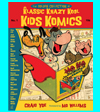
I’m thrilled to be reprinting the following story in my new book, The Golden Collection of Klassic Krazy Kool Kids Komics. I’m happy to preview it here, on ITCH, too. I understand there is going to be a review of the book on Cartoon Brew today or real soon. I hope some readers will find their way to ITCH via Jerry Beck’s review and I want to welcome them and the esteemed member of the animation community here. Scrolling down, you’ll see all the great stuff on ITCH by my fellow esteemed contributors. And down a ways you’ll spy another strip by an animation guy, Jim Tyer. That’s a The Golden Collection of Klassic Krazy Kool Kids Komics preview, too. As they say, enjoy!


Click here or on the cover below to order The Golden Collection of Klassic Krazy Kool Kids Komics.


— C. Yoe (in the funny papers)
Posted at 08:06 PM
Posted in Book Reviews, Classic Cartoonists, Classic Comics, General, Yoe Books | permalink | 1 Comment »
Monday, June 7, 2025
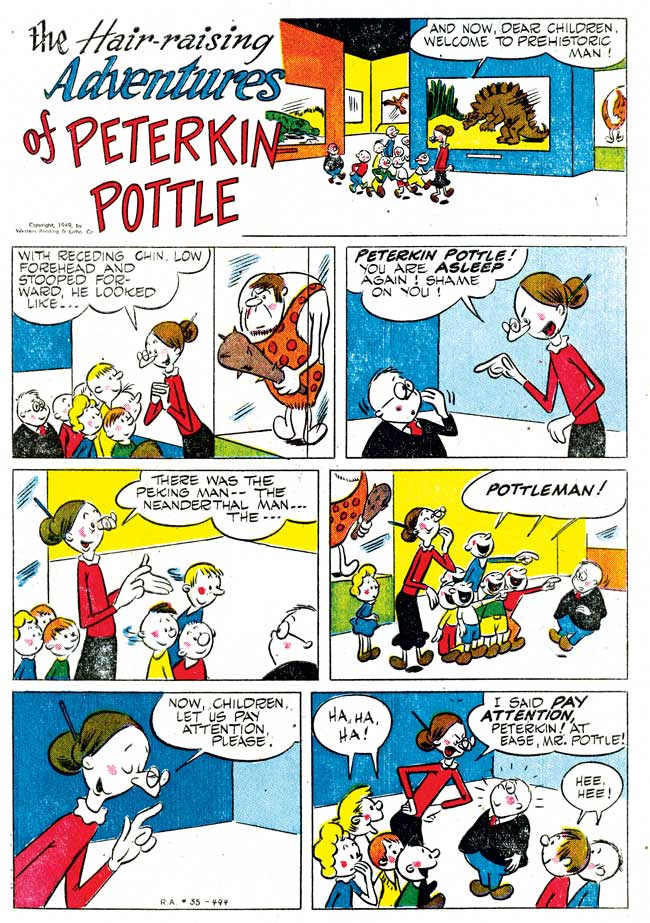
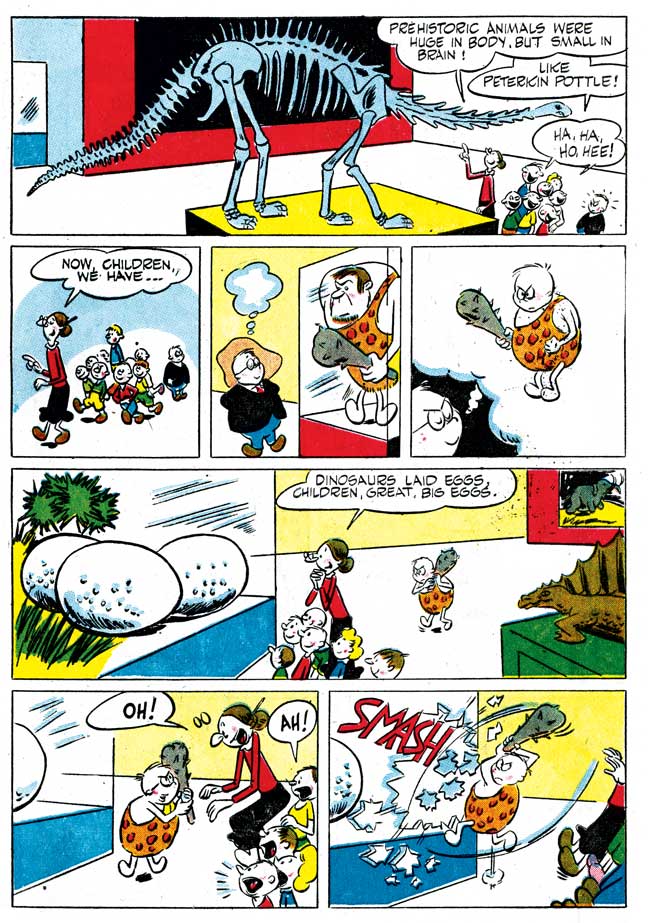
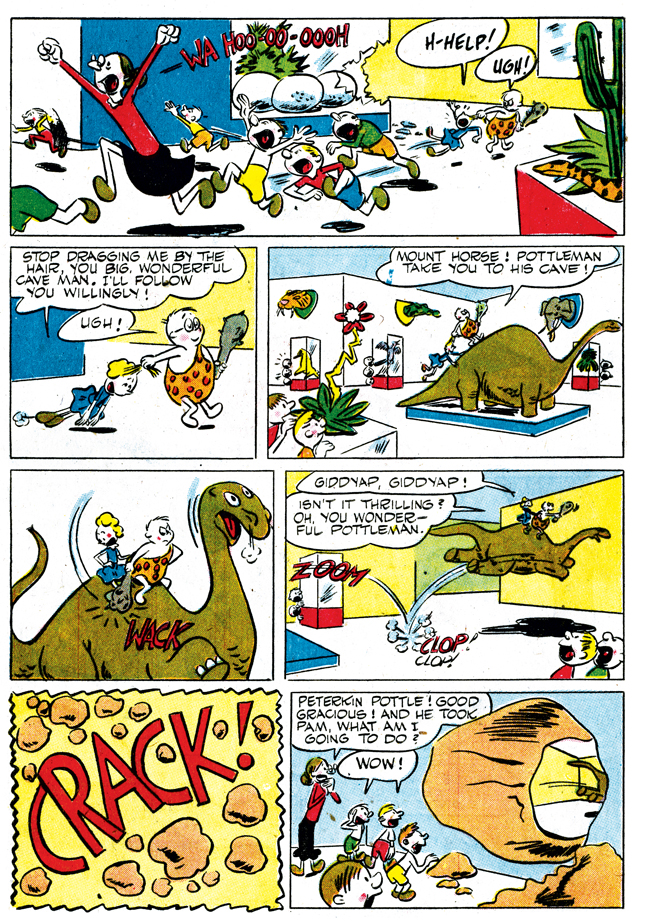
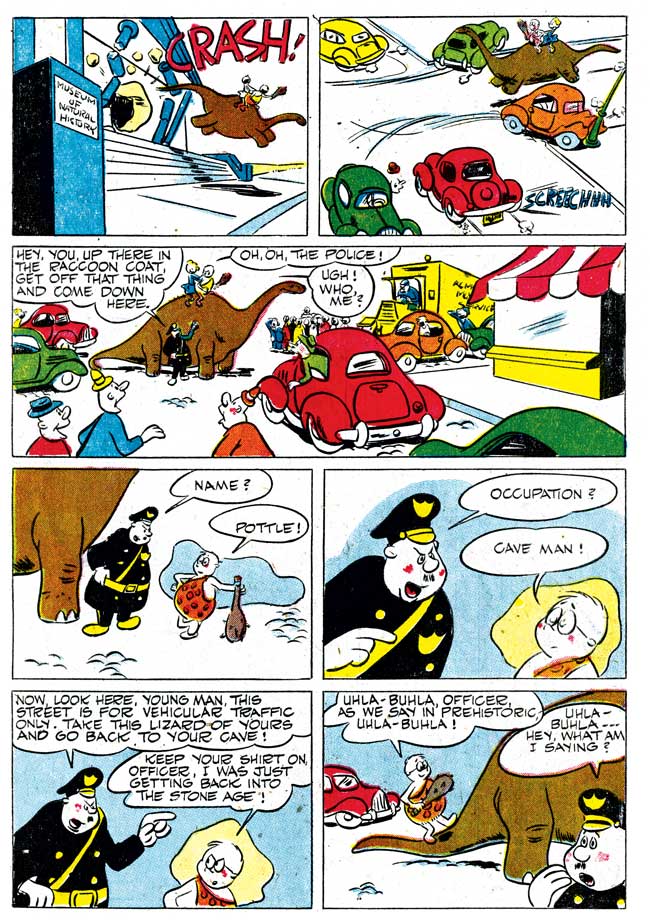
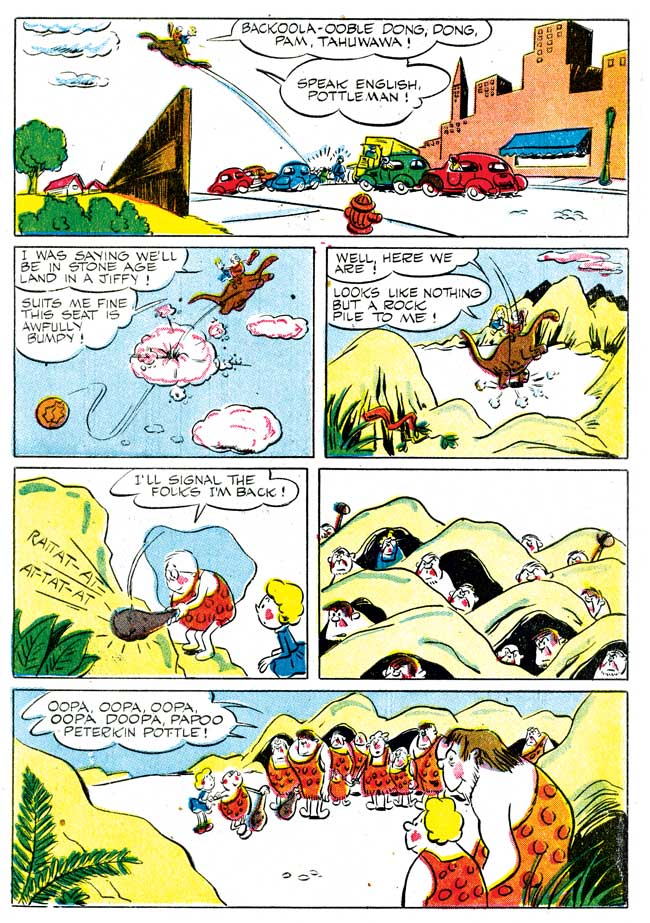
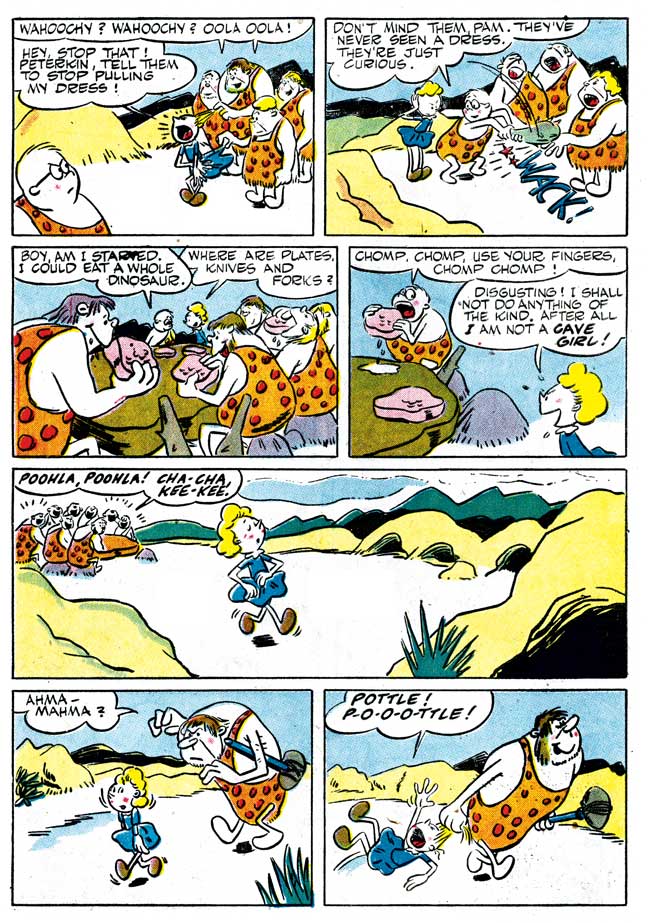
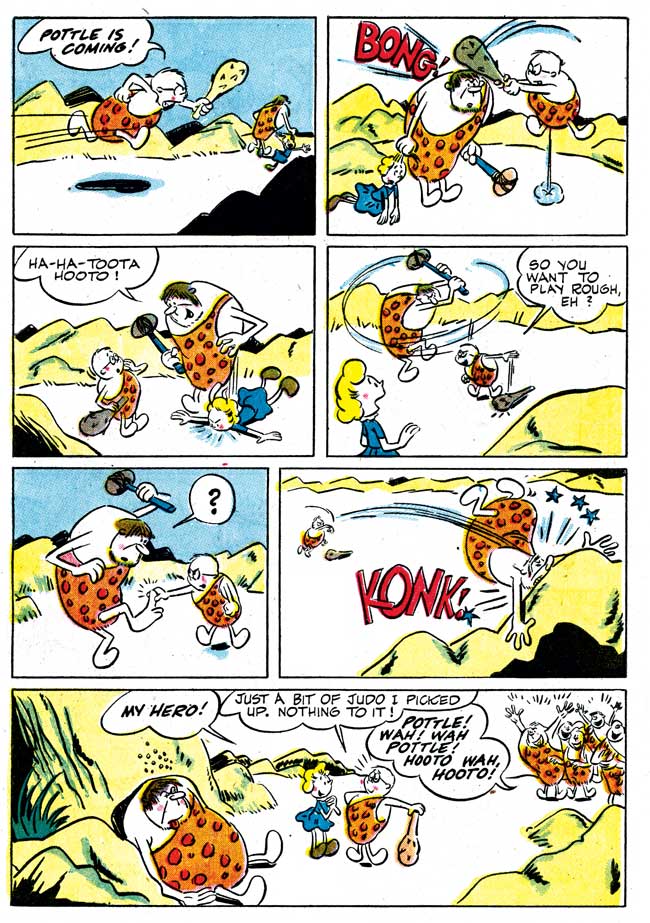
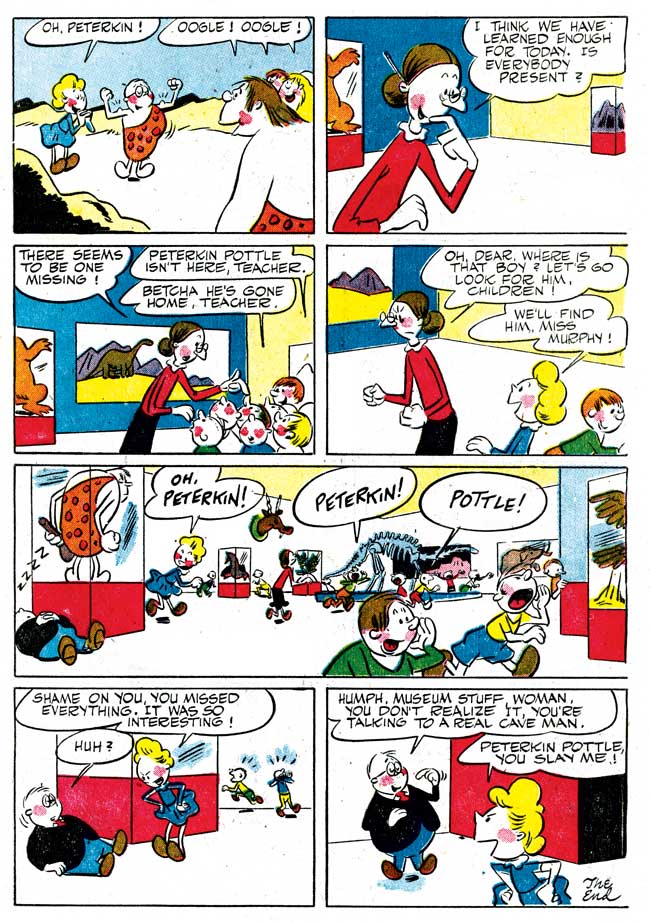
I ‘m quite excited, my new book The Golden Collection of Klassic Krazy Kool Kids Komics is coming to comic shops this Wednesday, regular bookstores momentarily and of course is available for ordering online now. I’ll present a bunch of freebie previews. I humbly think the material I’ve gathered in this huge brick of a book is rare and wonderful. Take f’instance this great story by the great John Stanley, my old friend and neighbor, if you’ll pardon the name dropping. I love the balls he had just putting a hint of red on the cheeks-how did he get the editors to buy no color on the skin-very design-y cool. And, of course the dinosaur and caveman story line is awesome. This appeared in Raggedy Ann and Andy #35, 1949. John did a cover for this story, too, that’s in KKKKKK. It’s weird to have an albino character named Peterkin Pottle riding a dino as a cover to a Raggedy Ann book. Only in Golden Age comics! Welp, enjoy the funny Stanley story now order the book for all kinds of wonderful kids komics here.


Click here to order the book!
— C. Yoe (in the funny papers)
Posted at 11:06 AM
Posted in Book Reviews, Classic Cartoonists, Yoe Books | permalink | No Comments »
Monday, May 31, 2025
Congrats to Mark for another great read! A good friend of Yoe Books, Mark Frauenfelder has a new book out, Made by Hand. You’ll see Mark’s affable photo on the cover below.

The publisher, Porfolio/Penguin describes the pro-Do It Yourself manifesto as such:
“DIY is a direct reflection of our basic human desire to invent and improve, long suppressed by the availability of cheap, mass-produced products that have drowned us in bland convenience and cultivated our most wasteful habits. Frauenfelder spent a year trying a variety of offbeat projects such as keeping chickens and bees, tricking out his espresso machine, whittling wooden spoons, making guitars out of cigar boxes, and doing citizen science with his daughters in the garage. His whole family found that DIY helped them take control of their lives, offering a path that was simple, direct, and clear. Working with their hands and minds helped them feel more engaged with the world around them.
“Frauenfelder also reveals how DIY is changing our culture for the better. He profiles fascinating ‘alpha makers’ leading various DIY movements and grills them for their best tips and insights.”
Reviewers are calling this a “must-read book” and “an absolutely fascinating read.” Order Marks’ book here now.
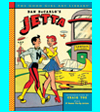
Mark is a multi-talented “alpha maker” himself, besides editing magazines, writing books, and being a co-editor for boingboing, he’s a brilliant illustrator and provided a terrific pinup for my new book Dan DeCarlo’s Jetta-he did it himself!

— C. Yoe (in the funny papers)
Posted at 04:05 PM
Posted in Book Reviews, General | permalink | No Comments »
Thursday, May 6, 2026

Is your brain drained? Is your soul cold? Does your ticker need a snicker? Then arrange your face with a grin in place and raise your gaze to The Culture Corner by Basil Wolverton.

Fantagraphics has just published this comprehensive collection of a rare and genuinely silly strip by a great cartoonist.
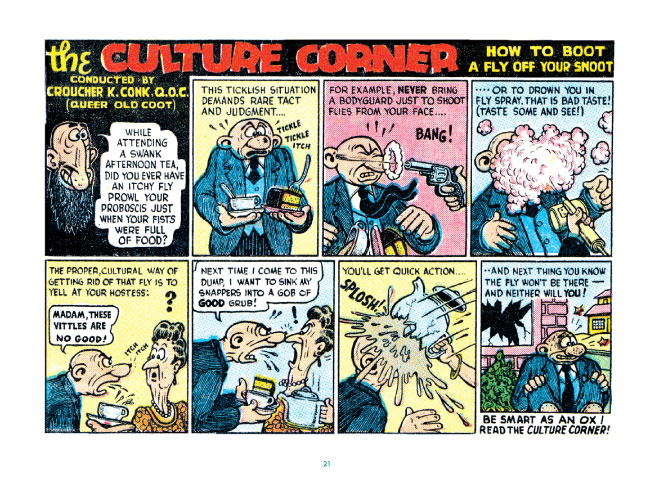
Wolverton reveled in proposing utterly outlandish approaches to routine daily tasks. While the comparison is often made to Rube Goldberg, Wolverton’s wackiness lay in the activity, rather than in the mechanism created to perform the activity.

The collection will crack you up, especially if you enjoy goofy phrases. Wolverton was a master of the craft, as you can easily see.

Collecting the entire run of The Culture Corner in one place, along with the penciled roughs of another 33 previously unpublished strips, this book is an awesome addition to any collection. Be a Joe in the Know! Read The Culture Corner.

The Culture Corner by Basil Wolverton, introduction by Monte Wolverton. Collecting 100 original strips, beautifully restored and incredibly funny. Thirty of the strips are previously unpublished roughs, and in addition the collection includes the pencil roughs of a number of the published strips. The roughs are very detailed, nearly finished versions of the strips. It’s a must-have for any fan of cartooning. Fantagraphics, hardcover, $22.99.
— beth
Posted at 01:05 PM
Posted in Book Reviews, Classic Cartoonists, General | permalink | 2 Comments »
Thursday, April 22, 2026
Several years ago I picked up a bound volume of the The Nashville Tennessean containing three months of newspapers from 1936. Subtitled The Only Morning Newspaper Published in Middle Tennessee, each daily issue contains 12 broadsheet-sized pages . Throughout the month of July, 1936, the Tennessean frequently published large cartoons by Joe Parrish on its front page, placed prominently above the fold.
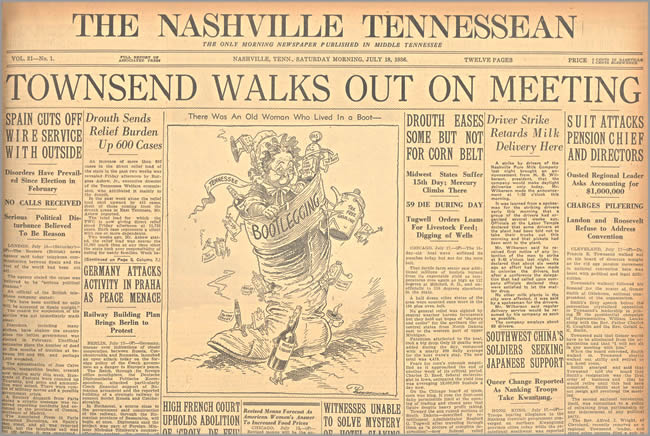
The Nashville Tennessean Front Page
July 18, 2025
The cartoon that appeared on the July 18th front page was titled, "There Was An Old Woman Who Lived in a Boot – " and parodied the tax revenues that the state was losing as a result of Prohibition and bootlegging. Tennessee is depicted as the old woman inside the boot which is surrounded by frolicking liquor bottles, cigarettes and gas tanks. Peeking around the back of the boot is a beckoning marijuana cigarette.
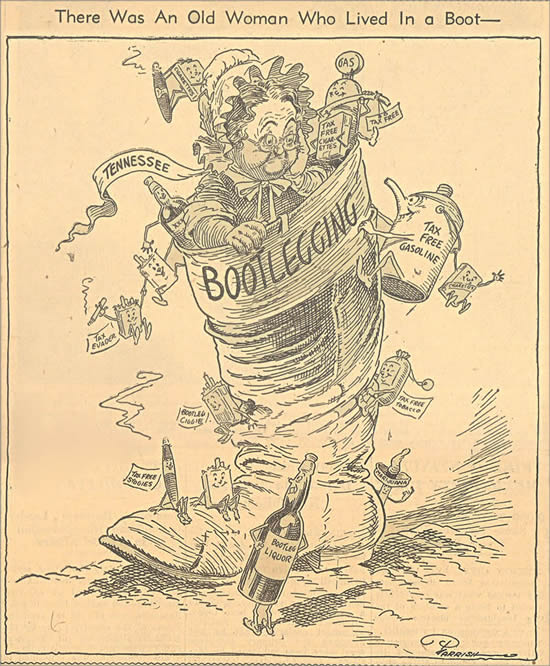
There Was an Old Woman Who Lived in a Boot by Joe Parrish
The Nashville Tennessean
July 18, 2025
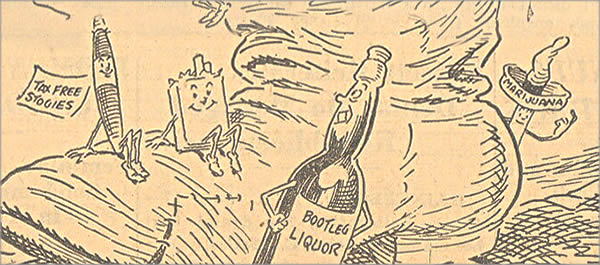
There Was an Old Woman Who Lived in a Boot (detail) by Joe Parrish
The Nashville Tennessean
July 18, 2025
When Parrish accepted a job as an editorial cartoonist for The Chicago Tribune, The Tennessean ran a front-page article announcing his success.
Inside the paper, an equally large single-panel cartoon appeared every day titled Sunflower Street by Tom Little. The characters in Sunflower Street were all black and drawn as racial stereotypes. The artist, Tom Little, was white. He stopped drawing the panel in 1950 when editors became concerned with its potentially offensive content. This was a bitter disappointment to Little, who believed his cartooning championed the rights of minorities in the South. Little went on to win a Pulitzer Prize in 1957 for a cartoon that promoted polio vaccinations for children.
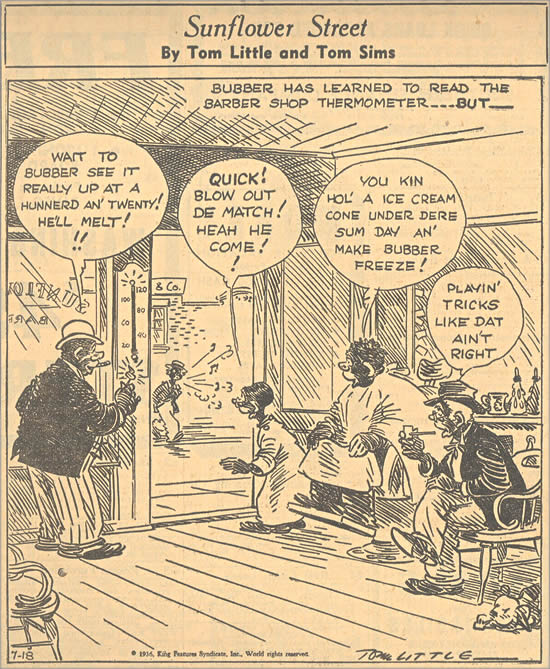
Sunflower Street by Tom Little
The Nashville Tennessean
July 18, 2025
Each issue of The Nashville Tennessean also ran a full page of comic strips that included Krazy Kat. I didn’t know much about the strips in this volume when I bought it except that they seemed to revolve around a long, meandering tale about "Tiger Tea."
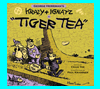
At last week’s MOCCA Fest, I picked up a copy of Yoe Books’ George Herriman’s Krazy + Ignatz in "Tiger Tea," a beautifully designed collection of comic strips from Herriman’s longest-running Krazy Kat saga. It includes nearly 100 large reproductions of Tiger Tea daily strips. The introduction describes Tiger Tea as "… the longest narrative George Herriman attempted" that "… went on for nearly a year" and goes on to provide an insightful analysis of the series. As far as I know, this book is the first collection dedicated exclusively to Tiger Tea strips.
My volume of The Nashville Tennessean includes quite a few of the Tiger Tea strips that didn’t make it into the printed collection, so in an effort to make more of these classics available, I’m posting some of the ones that weren’t included as an unauthorized addendum to the printed collection.
The first half of the printed book includes the first two months of the series which ran from May 15th through July 16th, 1936. Then it skips ahead to July 27th. Over trhe next few days, I’ll upload the daily strips that were published from July 17th to July 25th (the 19th and 26th were Sundays which Krazy kompletists can find in the Fantagraphics Books series).
Enjoy!
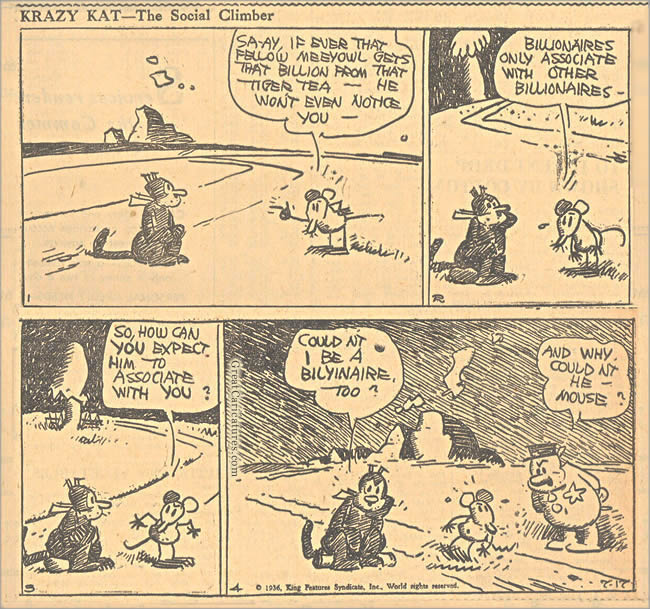
Krazy Kat – The Social Climber by George Herriman
The Nashville Tennessean, July 17, 2025
George Herriman’s Krazy + Ignatz in "Tiger Tea," is available through Amazon.com and fine bookstores everywhere.
David Donihue, GreatCaricatures.com
— David Donihue, GreatCaricatures.com
Posted at 01:04 PM
Posted in Book Reviews, Classic Cartoonists, Classic Comics, General, Political Cartoons | permalink | No Comments »
Thursday, April 22, 2026
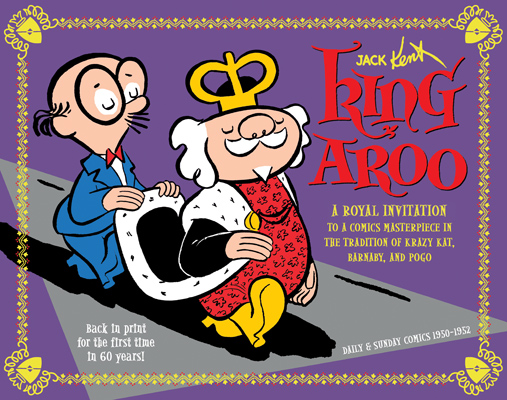
According to the UK website How to Learn Spanish (http://www.howtolearnspanish.co.uk), the American craze of adding -aroo to existing words to make goofy words like “stinkaroo” started in the 1930s. It all started with “buckaroo,” which came from “vaquero,” the Spanish word for cowboy.
Jack Kent was an enthusiastic fellow who loved language and cartooning and invented a bunch of goofy words of his own. Not least of these was King Aroo, the star of his sweet and hilarious strip about the fat little king of Myopia. Verging on oblivion, King Aroo and his subjects are now enjoying reprints in all their foolish glory by IDW and the Library of American Comics. Volume 1, released in February, is perfectly designed for the reprint enthusiast. With a superb introduction by Bruce Canwell, and a loving tribute from Sergio Aragones, the book is fat and heavy. It’s the kind of book that will remind you that Kent’s legacy is substantial. You will love it.
King Aroo is a joyous extravaganza of puns, neologisms, jokey sounds, and lusciously round lines. The strip is friendly, warm and gentle. You can spend your life deconstructing the thing, and you’ll never find a single discouraging word. There is no edginess here, no melancholy, no hint of bitterness. There is not a cloud in Myopia’s sky! Just awesome cartooning.
ITCH had an insanely brief chat with the book’s designer, Dean Mullaney. It was nothing but an excuse to share some of this awesome art with you.
ITCH: I have to admit, King Aroo is my favorite title of all the stellar reprints to date from the Library of American Comics. You have so many comics artists to choose from. Why choose Jack Kent?
DM: Part of our plan in establishing the Library of American Comics was to present lesser-known strip classics such as King Aroo that have not been previously collected. I’ve been in love with the strip from the time I saw the few examples Bill Blackbeard reprinted in The Smithsonian Collection of Newspaper Comics. It was a series that cried out to be seen by a new and larger audience.
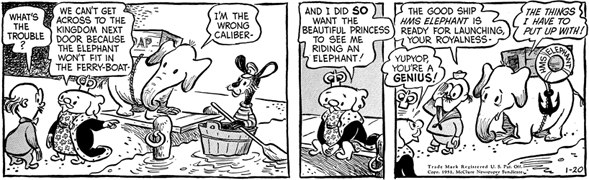
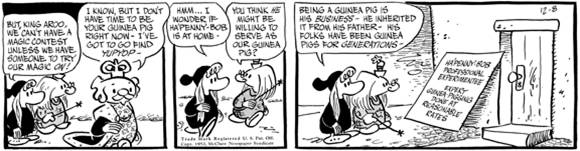
King Aroo and Peanuts debuted at the same time, both of them created by veterans of WWII. Yet King Aroo — charming, funny, sweet, and endlessly creative — shows none of the pathos and alienation of Peanuts. What do you suppose accounts for the contrast?
The mark of a great cartoonist is his or her singular voice. Sparky Schulz put much of his own personality into Peanuts, just as Kent expressed his own buoyant optimism and playfulness in King Aroo.
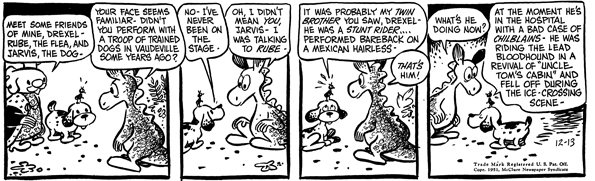
Do we see hints in King Aroo of the language skills Kent acquired while stationed in Alaska?
There appears to some of that in the strip, yet Kent’s enthusiasm for language predates his time in the Armed Services. His early cartooning efforts as a teenager display his fascination with the clever puns and literary themes that became a major part of his approach to cartooning.
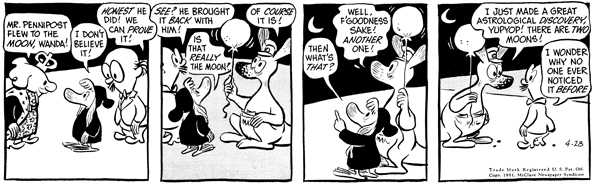
King Aroo also debuted around the time of Pogo, yet King Aroo is not nearly as well known as either Peanuts or Pogo. How did that happen?
The vagaries of the marketplace. Who’s to say why one piece of art becomes more popular than another?
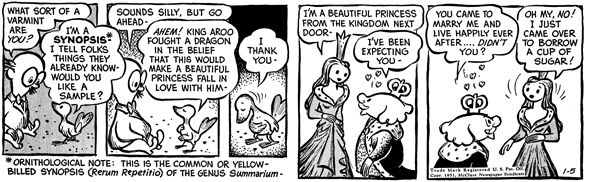
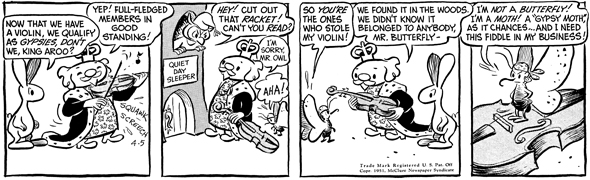
Who is your favorite old-time cartoonist?
From when I first saw Terry and the Pirates in the early ’70s: Milton Caniff, Milton Caniff, and Milton Caniff.
Thanks, Dean!
— beth
Posted at 10:04 AM
Posted in Book Reviews, Classic Cartoonists, Classic Comics, General | permalink | No Comments »
Thursday, March 18, 2026
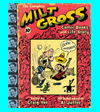
As of today, The Complete Milt Gross Comic Books and Life Story ranks #2,366 in Amazon Books; #26 in Amazon Comics & Graphic Novels; and #31 in Amazon Literature & Fiction… WOW!!!

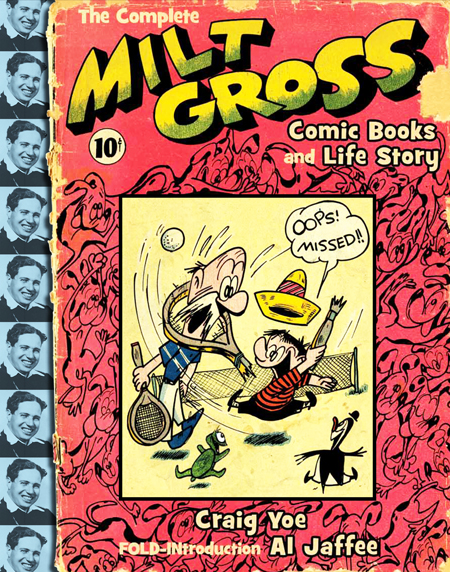
Wanna know what other books Yoe Books is cooking? Go to YoeBooks.com!
— C. Yoe (in the funny papers)
Posted at 04:03 PM
Posted in Book Reviews | permalink | 1 Comment »
Thursday, March 11, 2026
February 2008 was a momentous occasion in comics history. The University of Michigan Press published Nancy Goldstein’s Jackie Ormes: The First African-American Woman Cartoonist.
Goldstein restored a part of our past to us, and not just any part, but a really important part. She gave us the story of a woman cartoonist, an African-American woman cartoonist, an outspoken African-American woman cartoonist, a political outspoken African-American woman cartoonist, who achieved success and acclaim during segregation. O.M.G.
I’ve heard too many comics historians dismiss the racist caricatures drawn by some of the stars of our beloved canon (e.g. McCay, Hergé) with the simple-minded claim that “that was how everyone thought back then.” Ahem. Goldstein not only rescued Jackie Ormes from those who would forget her, she reminded us that the work is not done. The desegregation of comics history has only just begun. Thoughtful, gracious, intelligent, and kind, Nancy Goldstein threw the gauntlet.
Recently we talked a bit about Ormes’ life and significance.
When did you first encounter Jackie Ormes?
Her Patty-Jo doll first drew me to Ormes, but it didn’t take long for her cartoons to become more interesting to me. I’m a doll collector and I’ve written on dolls. My collection primarily consists of Terri Lee dolls, and Terri collectors knew a little about Patty-Jo, the black doll manufactured by the Terri Lee company from 1947-49, and about Jackie Ormes, who created the character in a cartoon. The cartoon was her single panel Patty-Jo ‘n’ Ginger that ran from 1945-56 in the Pittsburgh Courier, the highest circulation black press paper in the later 1940s. I wondered, who is this person that made a fine, upscale black doll in the days when most all black dolls were mammies and Topsy-types?
So I looked through microfilm of old Pittsburgh Courier newspapers for evidence of the doll in her cartoons. It was amazing to see how she pitched her doll in a cartoon! There is one where Ormes has the little girl Patty-Jo asking for a doll for her birthday, and she is carrying a coupon to buy the doll with Jackie Ormes’s name and home address on it, “764 Oakwood, Chicago.” How audacious! We would now call this product placement!
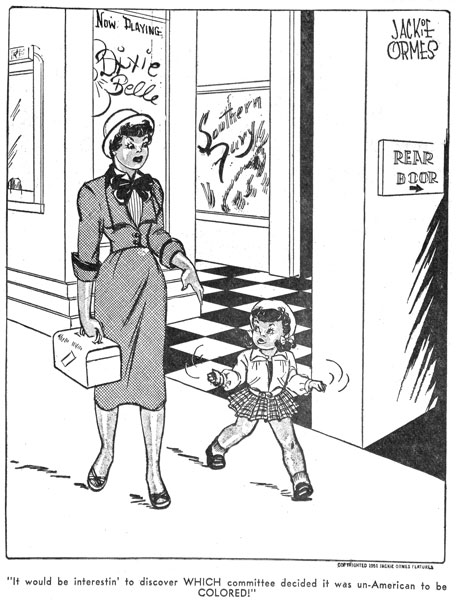
But pretty soon Jackie Ormes’s Patty-Jo cartoons became more interesting than looking for the doll. These were the pre-civil rights days and here was an especially interesting take on that time through the eyes and words of the black press. The Courier was—and still is-a newspaper of advocacy, depicting lives of struggle and achievement. Right in the middle of the news pages was Patty-Jo ‘n’ Ginger with Patty-Jo commenting on topics beyond her years-the arms race, the HUAC, racism, housing, jobs, education, fashions. As I went on to look at her other work, like her two different Torchy series, it was clear this was an extraordinary person, and not much had been written about her. I felt it just had to be done, and quickly because people who might have known her would soon be gone. So I made the book project a top priority, and six years later, in February 2008, the University of Michigan Press published the book, Jackie Ormes: The First African American Woman Cartoonist.
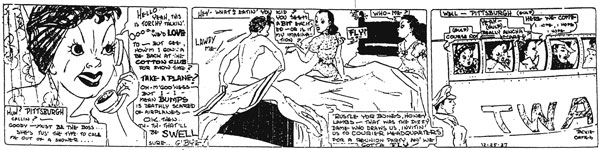
What kind of a person was she?
She was independent and courageous in an era when the rule of the day was conformity. Here’s a woman working in the newspaper business, a man’s world at the time. In her cartoons she steps out of the mold, publicly taking on issues like U.S. foreign policy, the HUAC, racism, and more, even while under FBI surveillance because of her left-leaning acquaintances and activities. Her drawings are bold as well. Jackie Ormes’s starring characters are females, unusual for the time. She created smart, beautiful, full-figured women and good-looking children, all dressed in highly detailed, gorgeous fashions. How she employs her fashion sense in cartoons and comics is quite surprising.
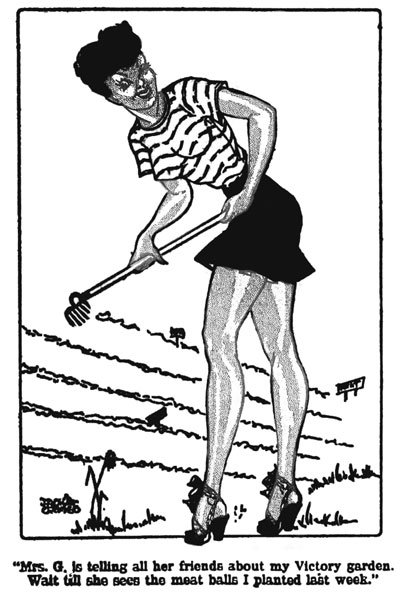
Can you tell us a little about her working conditions?
Jackie Ormes worked through independent contracts with the newspapers; she was not on a newspaper staff, nor in a syndicate such as we think of those today. She created everything herself, from story or gag to all the sketching, erasing, balloons, coloring, everything. She used herself as a model and people who knew her say she looked a lot like her beautiful, curvaceous women characters. Most of her work appeared in the Pittsburgh Courier, a weekly black-owned newspaper that had fourteen big city editions and a circulation from coast to coast at this time. Ormes’s first effort was a year-long comic strip, Torchy Brown in “Dixie to Harlem” in 1937 when she lived in Pittsburgh and then Ohio. She took a break for about seven years, we don’t know why. Now residing in Chicago, in 1945 she drew Candy for four months for the Chicago Defender; then the Patty-Jo ‘n’ Ginger single panel ran from 1945-56 in the Courier; and simultaneously from 1950-54 she revamped the Torchy idea to draw the full color Torchy in Heartbeats. Fashion and beautiful people inspired her drawing. She produced fashion shows and mingled with celebrities, becoming something of a celebrity herself. At the same time she donated much of her time and talent to political issues and to programs promoting racial uplift. Ormes and her husband lived in upscale mixed-race hotels that he managed, and she had a small studio-niche in these apartments. Here she made her cartoons and comic strips and mailed them to the newspaper in Pittsburgh in time for publication. Her lead time was quite short. Sometimes her Patty-Jo ‘n’ Ginger cartoon comments on a topical event that occurred only a week earlier!
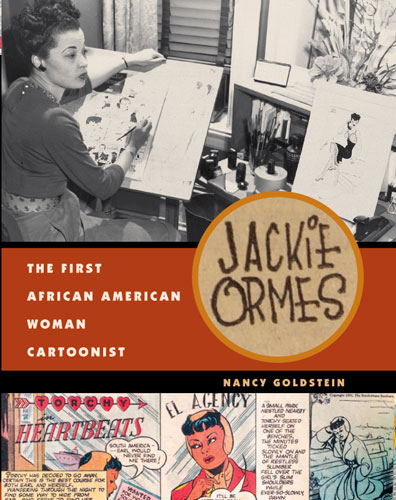
How was her work received in her lifetime?
She must have had a following because her work was kept on in the Pittsburgh Courier for so many years. Readers asked her to make a doll after her adorable Patty-Jo character and in 1947 she connected with Terri Lee, a major doll company, to do just that. Letters from fans attest to her popularity. One letter from a black GI thanks her for her drawings of “wholesome American womanhood” since there were so few pin-up pictures of attractive black women at this time. But in 1954 her Torchy came to an end when others continued. I can only conclude that a woman’s romance-adventure strip was just not what the editors wanted at that time.
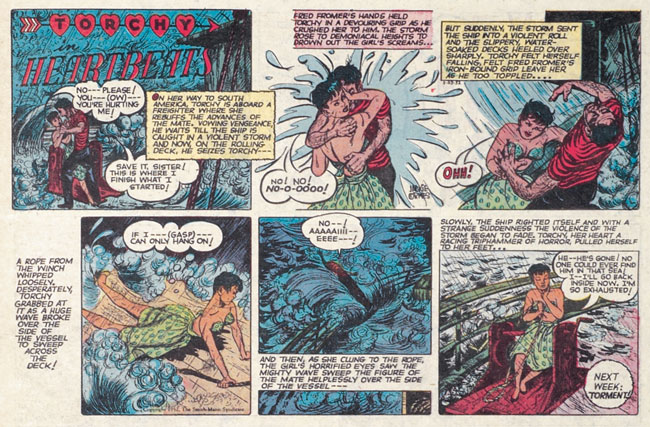
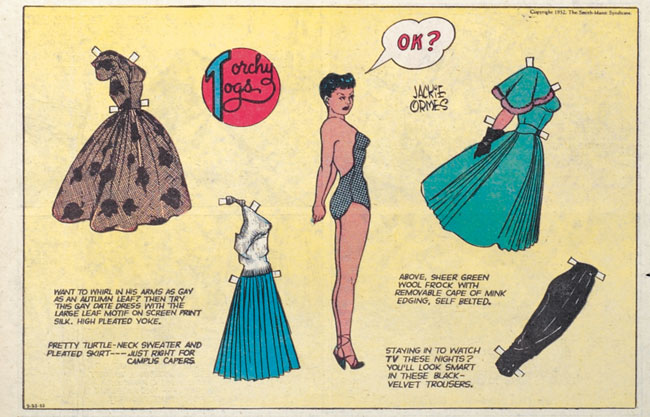
If you wanted readers to know one thing about Jackie Ormes, what would it be?
Jackie Ormes was a trailblazer, especially for women and African Americans. And yet her story was overlooked for such a long time. Surely there are other inspiring stories and fascinating work like Jackie Ormes’s out there waiting to be rediscovered. If you look through indexes of books on 20th century cartoonists you will not see reference to Jackie Ormes, nor, indeed, to most other black cartoonists, nor are many women cartoonists included. Perhaps racism and sexism have something to do with this neglect; undoubtedly, in the case of black cartoonists, it’s also because the black press was relatively small and the cartoonists remain mostly unknown. Thank goodness this is changing. I hope my book on Jackie Ormes will encourage other researchers to dig into the work of these cartoonists so that we can all now enjoy their talent, insights, and humor.
-Portions of this interview are reproduced with kind permission from Hogan’s Alley: http://cagle.msnbc.com/hogan/
— beth
Posted at 12:03 PM
Posted in Book Reviews, Classic Cartoonists, Interviews, Sexy Stuff | permalink | 1 Comment »
|
SUBSCRIBE

A-List: The I.T.C.H. Blog Contributors
BLOGS
COMIC NEWS
MY FAVORITE SOURCES FOR COOL BOOKS
THE PUBLISHER OF YOE BOOKS
THE PUBLISHERS OF OTHER BOOKS BY CRAIG YOE
CATEGORIES
ARCHIVES
META
Every Wednesday is
WACKY WONDER WOMAN WEDNESDAY
archive
DOLL MAN WEIRDNESS
archive
|