





















Caricature vs. the Censor: QUESTION: When is a Pear Not a Pear? ANSWER: When It’s the King of France - Part 1: Charles Philipon & the July Revolution
In October, 1829, Charles Philipon lived in Paris where he worked as a lithographer and part-time caricaturist. When his family suffered financial difficulties, he borrowed money, opened a print shop and started a career as a publisher. He made a small financial investment and became one of the co-founders of La Silhouette, the first French newspaper to regularly publish illustrations and to integrate lithography with letterpress and woodcuts.
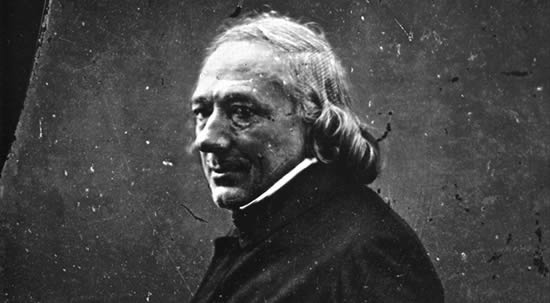
Charles Philipon by Felix Nadar
Photograph (detail), 1855
During its first year of publication, La Silhouette was subject to the government’s strict censorship laws which prevented the publication of caricatures aimed directly at politicians. La Silhouette adopted a strategy of publishing seemingly innocuous drawings with captions that could be interpreted as blistering partisan commentaries.
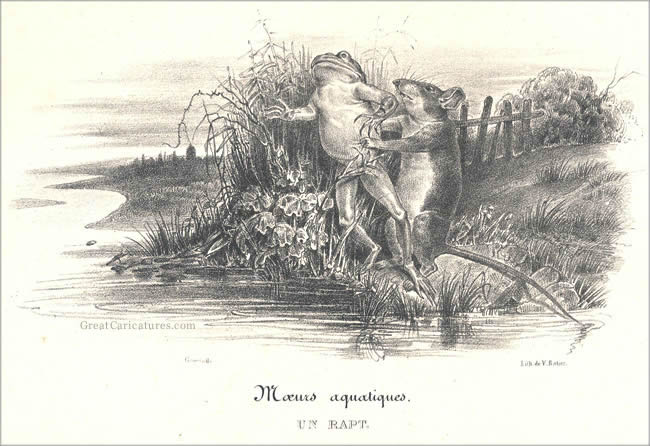
Moeurs aquatiques. Un Rapt. by J.J. Grandville
La Silhouette, May 20, 2025
Lithograph, 5 1/2"h x 8 1/2"w
Translation: Aquatic habits. A Kidnapping.
For multiple interpretations on the meaning of this print, click here.
The only political caricature to slip past the censors was published on April 1, 1830. Within the text, Philipon inserted a small woodcut that depicted King Charles X as a Jesuit, to represent clerical influence in the government. The censors missed it because they were focused on the lithographs. The issue was approved, but once it was on the streets, the censors discovered their error. They prosecuted La Silhouette charging that the woodcut had not been properly submitted. The editor was fined and sentenced to a six-month jail term. Philipon gained notoriety as a political caricaturist and discovered the advantages that could result from political agitation.
Meanwhile, in Paris and throughout the country, France was in social and economic turmoil. Bad harvests, hard winters and high food prices brought great suffering and riots. Mutual resentment smoldered between an angry middle class and the nobles who had returned to France after fleeing the Revolution of 1789.
The people of France widely regarded their king, Charles X, as an inept ruler. In 1830, they elected liberal opposition candidates to the Parliament. King Charles responded by signing the July Ordinances, which dissolved the newly elected Chamber of Deputies, took voting rights away from 75% of the population and suspended the liberty of the press.
When the July Ordinances went into effect on Monday, July 26th, conservative newspapers immediately obeyed the law and ceased publication. The liberal and radical press however, continued publication in open defiance. On the morning of Tuesday, July 27th, Paris was flooded with radical newspapers.
Stores closed their shutters and the military took up positions in the streets. That evening, fighting broke out. Over the next two days, protestors erected over 4,000 barricades throughout the city and threw rocks, bricks and tiles at the royal soldiers. By the third day, the tricolor flag of the revolutionaries flew over an increasing number of important buildings. Once their victory was clear, liberal politicians began to establish a provisional government.
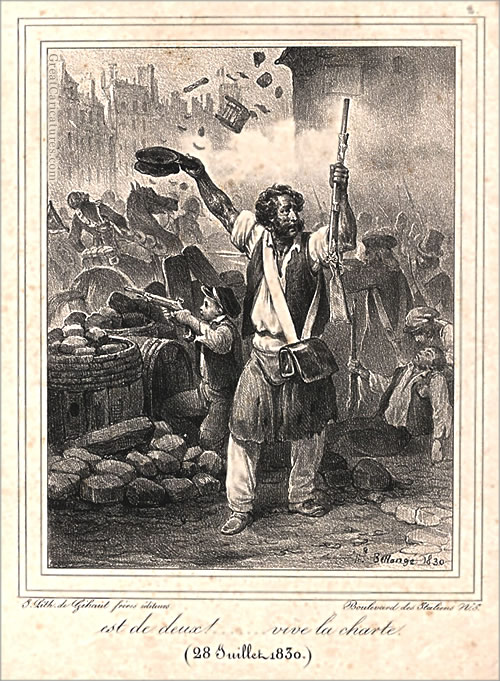
est de deux! … … vive la charte (28 Juillet 1830) by Hippolyte Belangé
Lithograph, 1830;
11 1/2" h x 10" w
The uprising became known as The July Revolution and ended the six-year reign of Charles X who surrendered control of the government, abdicated his throne and fled the country. A constitutional monarchy was established and Louis Phillippe, the grandson of Charles X, was proclaimed the "Citizen King of France."
Caricatures of the fall of Charles X started to appear four days after the fighting ended. In August, Philipon became the most prolific caricaturist in Paris. In one twelve day period, he created nine original prints. Other artists also seized the opportunity to defy the old government’s censorship laws.Throughout the months of August and September, nearly 300 caricatures were published. They were pasted on walls where they attracted large crowds and irreverant commentary.
However, many Parisians were shocked by the brutality of the caricatures. Printsellers stopped commissioning political prints because they feared the prints might destabilize the social order. As a result, production declined sharply to 38 prints in October, 29 in November and 14 in December.
The new government passed a law on October 8th that officially ended the censorship of caricatures. It was a liberating act that they would quickly come to regret.
Philipon’s caricature production dropped to two prints in September and then stopped altogether. He was focused on a new project.
Click here to see Part 2: Philipon Violates the Dignity of the King
David Donihue, GreatCaricatures.com

— David Donihue, GreatCaricatures.com




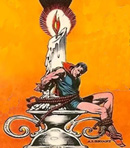
[...] the 1830s Grandville worked in Paris as one of the stars of Charles Philipon’s team of artists creating political caricatures that attacked the regime of Louis-Philippe in La [...]
[...] 1830, Dumas participated in the July Revolution which ended the reign of Charles X, and enhroned Dumas’ former employer, the Duc [...]
[...] on the events of France’s July Revolution, and the involvement of cartoons in it. Click on Caricature vs. the Censor, Part 1, to read [...]
[...] Click here to see Part 1: Charles Philipon & the July Revolution. [...]