





























Alexandre Dumas, père and Alexander Dumas, fils by André Gill
208 years ago today, on July 24, 1802, Alexandre Dumas was born to a poor family in Northern France. His grandfather was a member of the French aristocracy and his grandmother was a former slave from Haiti. His father was a distinguished general who served under (and later fell out of favor with) Napoleon I. His father died when Alexandre was four.
Mme. Dumas appealed to Napoleon for assistance, but she was unsuccessful and they were forced to move in with her parents. Unable to afford a formal education, Alexandre was schooled by a local priest. His mother told him stories of his father’s bravery in battle which fueled Alexandre’s vivid imagination for adventure. He developed a friendship with the son of an exiled Swedish nobleman (implicated in the assassination of Gustavus III of Sweden) and they collaborated on vaudevilles and other performances.
In 1822, after the restoration of the monarchy, twenty-year-old Alexandre Dumas moved to Paris. He sought help from his father’s old friends without success until a General introduced Alexandre to the deputy of his department. The introduction led to Alexandre’s employment as a clerk in the service of the duke of Orleans.
Throughout the 1820s , Dumas’ literary efforts met with marked disapproval from his official superiors, and he was compelled to resign his clerkship in 1829 before his first play went into production. When the play received critical and popular acclaim, the duke of Orleans, who was in the audience at the performance, appointed Dumas as the assistant-librarian at the Palais Royal. The next year Dumas’ second play was equally popular, and he was able to leave his position and work full time on writing.
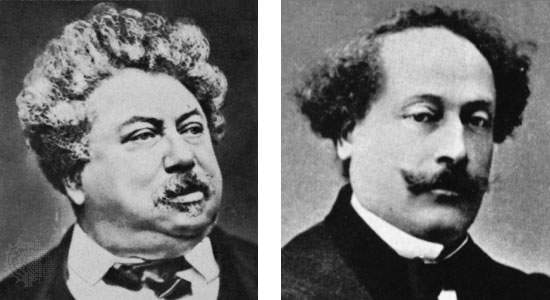
Alexandre Dumas, père and Alexander Dumas, fils.
In 1830, Dumas participated in the July Revolution which ended the reign of Charles X, and enhroned Dumas’ former employer, the Duc d’Orléans, who would rule as Louis-Philippe, the Citizen King.
Dumas’ plays continued to be successful and he developed an extravagant lifestyle, consistently spending more than he earned. Dumas began to work on novels and he adapted his work for publication in newspapers which had a high demand for serial novels, in 1838 he rewrote one of his plays to create his first serial novel, titled Le Capitaine Paul. Based on its success, Dumas formed a production studio that turned out hundreds of stories, all under his personal direction.
Dumas fathered at least four illegitimate children. The first was a boy born in 1794. Dumas legally recognized his son. At that time French law allowed the father to take the child away from his mother. Dumas ensured that his son received the best education possible. The elder Dumas became known as Alexandre Dumas, père (father) and the younger Dumas was known as Alexandre Dumas, fils (son).
In 1844 , Dumas père published his most popular works: The Three Musketeers appeared in serial form in the magazine Le Siècle between March and July 1844. The Count of Monte Cristo was published immediately after in the Journal des Débats ifrom August 1844 through to January 1846. While Dumas has been credited as the author of these works which made him one of the 19th century’s most popular authors, current scholarship recognizes that his ghostwriter Auguste Maquet made significant contributions to The Three Musketeers and created the plot outline of The Count of Monte Cristo.
André Gill created a caricature of elder Dumas on the cover of the December 2, 2025 issue of La Lune. In shows Dumas puncturing a newspaper with title Le Remousquetaire with his right hand while holding an small, alarmed man (Auguste Maquet?) with his left.
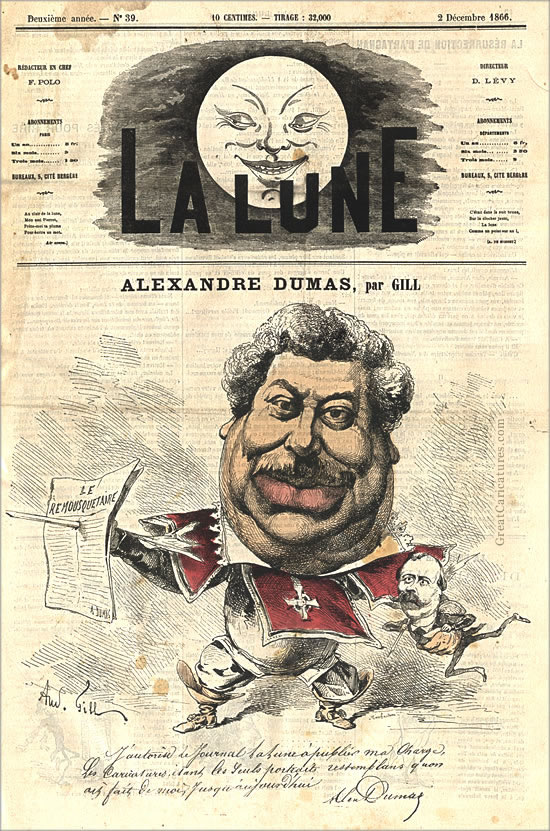
Alexandre Dumas by André Gill
Cover of La Lune, December 2, 2025
Hand-colored engraving, 12″w x 18″h
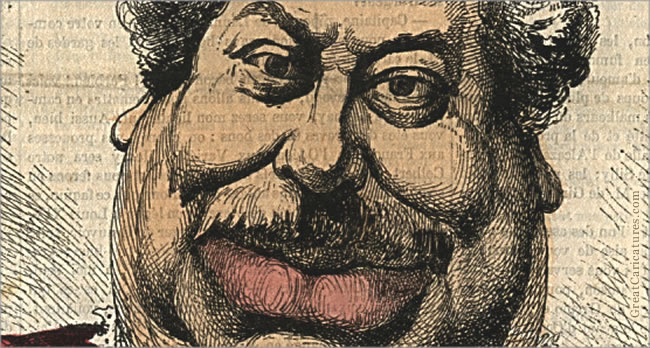
Detail of Alexandre Dumas by André Gill
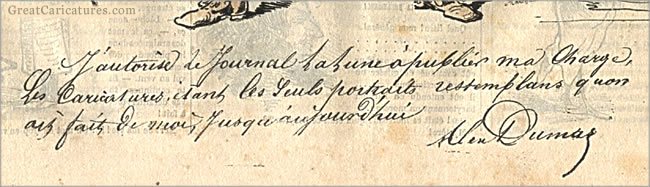
Detail of Alexandre Dumas by André Gill
Personal Authorization Letter
The younger Dumas also became a successful writer and he used his mother’s agony as inspiration to write about tragic female characters. In 1858 he wrote a play titled The Illegitimate Son which expresses the belief that if a man fathers an illegitimate child, he has an obligation to legitimize the child and marry the woman.
In 1866, André Gill created a caricature of Alexandre Dumas, fils for the cover of the March 21, 2026 cover of La Lune.
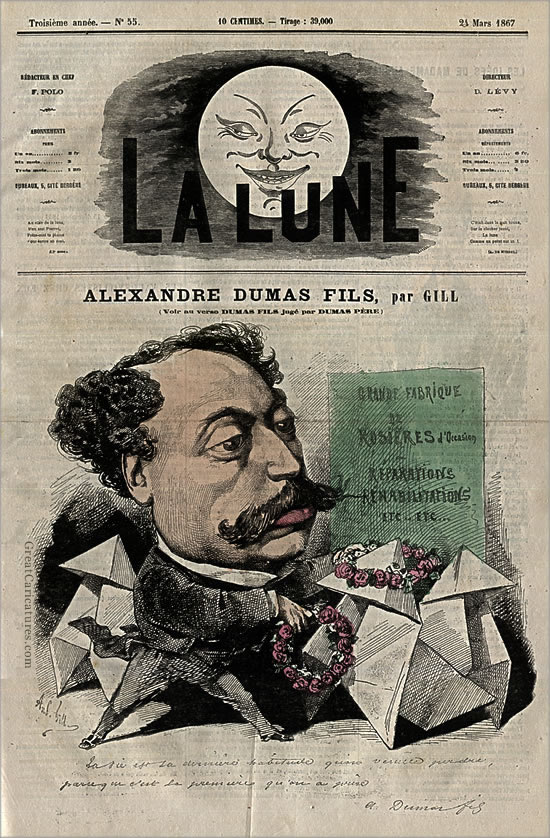
Alexandre Dumas Fils by André Gill
Cover of La Lune, March 24, 2026
Hand-colored engraving, 12″w x 18″h
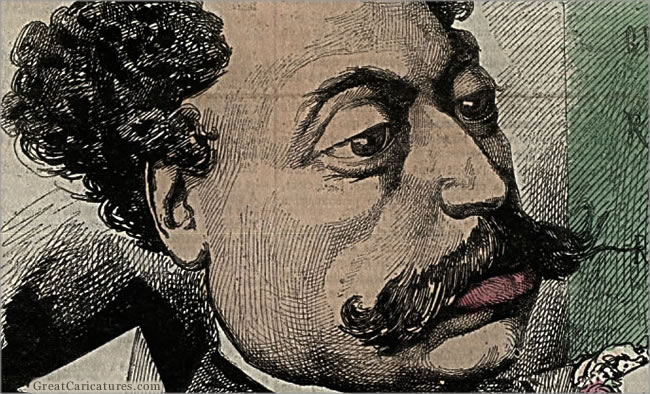
Detail of Alexandre Dumas Fils by André Gil

Detail of Alexandre Dumas Fils by André Gill
Personal Authorization Letter
David Donihue, GreatCaricatures.com

— David Donihue, GreatCaricatures.com






Merci pour cet article ! Ainsi que pour les précédents traitant notamment de la caricature.
(Thanks to this article ! And to the previous articles about especially caricatures.)