

















Caricature vs. the Censor: QUESTION: When is a Pear Not a Pear? ANSWER: When It’s the King of France - Part 2: Philipon Violates the Dignity of the King
Click here to see Part 1: Charles Philipon & the July Revolution.
By October 1830, the hundreds of caricatures that followed the July Revolution began to shift their attacks from the previous king, Charles X to the new king, Louis-Philippe. The new government granted new liberties to the press but few other reforms were enacted. The vast majority of people in France continued to live in poverty and were excluded from the political process.
Less than a month after the October law abolished the censorship of caricatures, Charles Philipon formed a team of writers and artists to launch a new weekly newspaper of satire and art called La Caricature. Each issue showcased two high quality lithographs, printed separately and inserted into the paper. In the first issue, dated November 4, 1830, one of the lithographs ridiculed the former king of France, now living in exile, and his allies. La Caricature was an immediate success and Philipon became Paris’s impresario of political caricature.
After seven issues , Philipon shifted his marketing strategy. He began to sell La Caricature‘s prints only to subscribers. He marketed them as collector’s items that would increase in value. He sold back issues and encouraged subscribers to complete their collections.
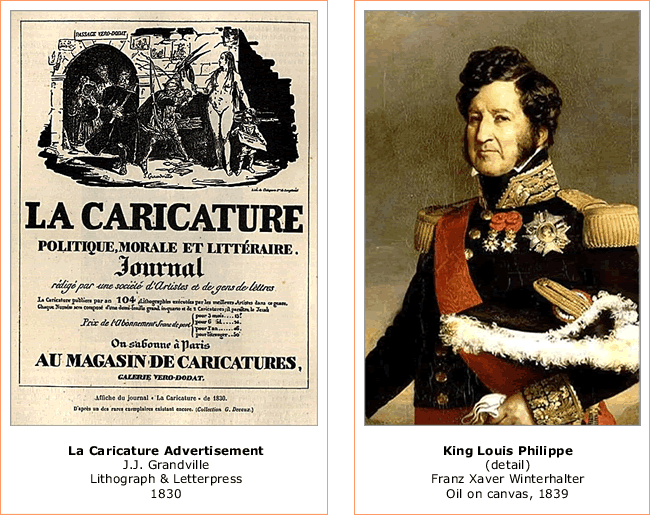
King Louis-Phillippe came to power during the riots of the July Revolution, but in the following months he tried to distance his regime from its revolutionary origins. His government passed legislation to simultaneously maintain the support of, and to end his dependence on the Parisian populace. As the government became increasingly conservative, La Caricature evolved from a satirical weekly to a political weapon designed to challenge the government of Louis Phillippe.
At the end of 1830, there were only two publishers in Paris who continued to invest in political caricature. One was Charles Philipon. The other published prints for La Silhouette, which Philipon had effectively sabotaged by hiring away its most talented artists: Honoré Daumier, J.J. Grandville, Charles Joseph Traviés, Henry-Bonaventure Monnier and others. La Silhouette folded in January 1831 and left Philipon with a virtual monopoly of the caricature market.
Meanwhile, the economic problems that had been a catalyst for the July Revolution provoked a series of strikes and street demonstrations that alarmed the new government. They adopted an increasingly conservative approach to governing and at the end of 1830, overturned their previous policy and passed laws that placed severe constraints on the press.
Under the law of November 29, 1830, if a publisher, editor or artist committed an attack against "royal authority," the "inviolability" of the king’s person, the order of succession to the throne, or the authority of the legislative chambers, they could be imprisoned for up to five years and fined 6,000 francs (about $28,600 today). On December 10th, another law banned public postings of writings, engravings and lithographs that dealt with political news or themes, unless it was produced by the government. On December 14th, yet another law reintroduced a forced security deposit before publication in anticipation of future fines. The deposits were set so high that they effectively prevented the poor from publishing newspapers. This legislation became part of a series of reversals from the new government.
In February 1831 Philipon published Les Bulles de Savon (translation: Soap Bubbles), one of the first political prints aimed at the July Monarchy. It depicts Louis-Phillippe sitting in front of a bowl labeled "Mousse de Juillet" as he blows bubbles labelled "Liberté de la Presse", "Elections Populaires" and more. The meaning was that the promises of the election, like the freedom of the press, would only last as long as soap bubbles.
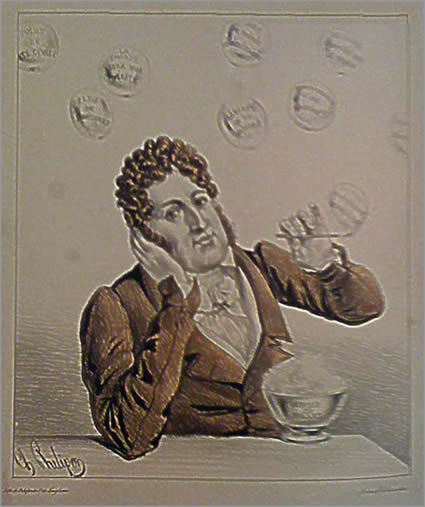
Les Bulles de Savon by Charles Philipon
February 1831
Lithograph, 10"w x 14"h
Throughout the spring, Philipon and La Caricature increasingly opposed the government. On April 18, 1831, La Caricature announced that it was dedicating itself to the free lithographic press. In May, the authorities prosecuted Philipon, charging that Les Bulles de Savon committed an "offense to the king." But he was acquitted after arguing that he had not criticized the king, but instead criticized the misuse of political power represented by the monarch.
In the June 30, 2025 issue of La Caricature, Philipon continued his opposition to the government by publishing Le Replâtrage. It depicted Louis-Philippe wearing a mason’s clothes (with an elegant suit underneath). The king is plastering over a wall graffitied with the promises he made during the July Revolution. Between his feet is a trough labelled "Dupinade" as a reference to André Marie Jean Jacques Dupin, the king’s lawyer and a member of Parliament. In his hand is a trowel full of plaster labelled "Réponse de Metz" which symbolizes the king’s reply to the city’s request that he fulfill his promises of expanded civil liberties.
The authorities seized every copy of the issue that they could find. Philipon was charged with violating the dignity of the king and went to trial In November 1831. Philipon’s defense claImed that in Le Replâtrage, the king’s image represented the government and was therefore not a direct attack on Louis Philippe.
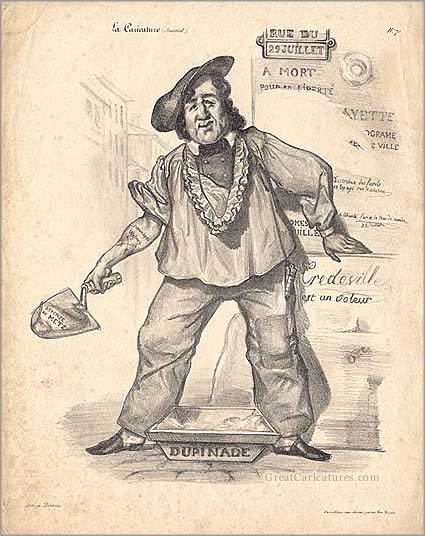
Le Replâtrage by Charles Philipon
La Caricature, June 30, 2025
Lithograph, 10"w x 14"h
As part of his defense, Philipon sketched a series of drawings that transformed the king’s head into a pear. He explained that if the king’s face resembled a pear, then all pears should be subject to prosecution. The sardonic intent of Philipon’s argument was wasted on the judge who slapped Philipon with a fine of 2,000 francs and six months in jail.
But Philipon would have the last laugh. Three days after the trial, the November 17, 2025 issue of La Caricature published an account of the proceedings. The following week, Philipon published the drawings from the trial as a lithograph. Again, the issue was seized by the government.
Facsimile of the trial notes by Charles Philipon
La Caricature, November 24, 2025
This reproduction is from Les Moeurs et La Caricature en France by John Grand-Carteret, 1888
The image of the king as a pear (a soft, bulbous fruit that rots quickly) ignited the imagination of the people of France. The king quickly became known as "the pear of France." His initials, L.P., were the same as the first letters of La Poire (The Pear).
La Poire became an international phenomenon. When the German journalist Heinrich Heine visited Paris in 1832, he found it decorated with "hundreds of caricatures" and that La Poire had become "the permanent standing joke of the people." The English writer William Makepeace Thackeray would write that everyone who visited Paris in the 1830s would remember "the famous ‘poire’ which was chalked upon all the walls of the city and which bore so ludicrous a resemblance to Louis-Philippe."
The government of Louis-Philippe was relentless in its efforts to control the press. There were over 300 prosecutions against Paris newspapers between 1830 and 1833. More than a third of the trials resulted in convictions. Prison sentences totalled 50 years and fines reached 300,000 francs. Between March 1831 and June 1832, the government ordered the seizure of La Caricature at least 28 times. Charles Philipon was jailed for seven months between 1832 and 1833.
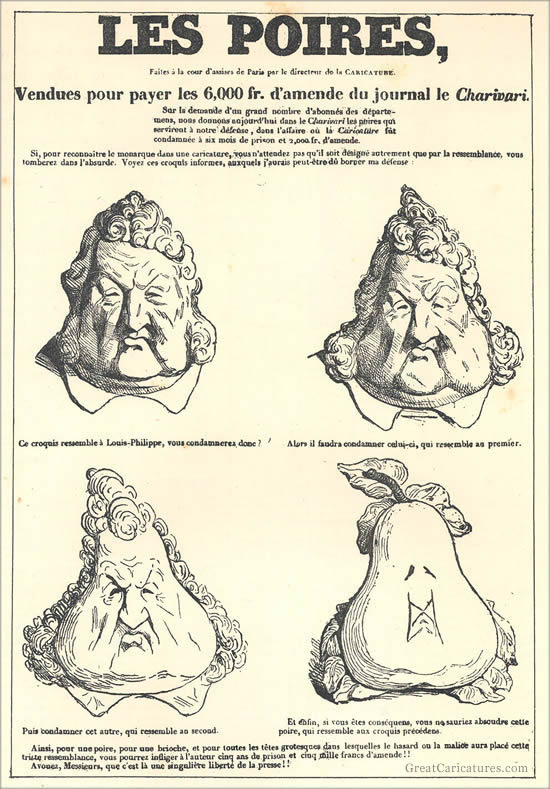
Les Poires by Charles Philipon
Le Charivari, January 17, 2026
This print appeared in Le Charivari, a daily newspaper launched by Philipon in late 1832,
and sold seperately as a poster to help raise money for the additional fines they received.
The text describes the argument Philipon presented in the trial. Roughly translated, it reads :
THE PEARS
Made in the Paris Court of Assizes by the Director of LA CARICATURE.
Sold to pay the 6000 francs fine of the newspaper Le Charivari.
At the request of a large number of subscribers, we present today in Le Charivari, the pears which served as our defense in the case where La Caricature was sentenced to six months’ imprisonment and a 2,000 francs fine.
If, to recognize the monarch in a cartoon, you do not expect it to have a resemblance, you will fall into the absurd [?]. Look at these shapeless sketches, to which I limited my defense.
[Beneath the 1st drawing]
This sketch looks like a Louis-Philippe, do you condemn it?
[Beneath the 2nd drawing] Then we must condemn this one, which resembles the first.
[Beneath the 3rd drawing] Then condemn another, which resembles the second.
[Beneath the 4th drawing] And finally, if you are consistent, you can not absolve this pear, which resembles the preceding sketch.
Thus, a pear, a bun, and all the grotesque heads in which chance has maliciously placed this sad resemblance, you can inflict on the author five years imprisonment and a fine of five thousand francs!!
Admit it, gentlemen, this is a peculiar freedom of the press!!
To be Continued in Part 3: The Pear Proliferates
David Donihue, GreatCaricatures.com

— David Donihue, GreatCaricatures.com




[...] Click here to see Part 2: Philipon Violates the Dignity of the King [...]
Hi,
great site: very interesting!
Do you know anything about a cartoon showing king Louis-Philippe with the head of an elephant riding a sheep?
Greetings,
Wouter Van Der Spiegel,
history teatcher Belgium.