Get these books by
Craig Yoe: |
|
|
|
|
|
|
|
|
|
|
|
|
|
|
|
|
|
|
|
|
|
|
|
|
|
|
|
|
|
|
|
|
|
|
|
|
|
|
|
|
|
|
|
|
|
|
|
|
|
|
|
|
|
|
|
|
|
|
Get these books by
Craig Yoe: |
|
|
|
|
|
|
|
|
|
|
|
|
|
|
|
|
|
|
|
|
|
|
|
|
|
|
|
|
|
|
|
|
|
|
|
|
|
|
|
|
|
|
|
|
|
|
|
|
|
|
|
|
|
|
|
|
|
|
|
Archive for the ‘Sexy Stuff’ Category
Wednesday, February 16, 2026
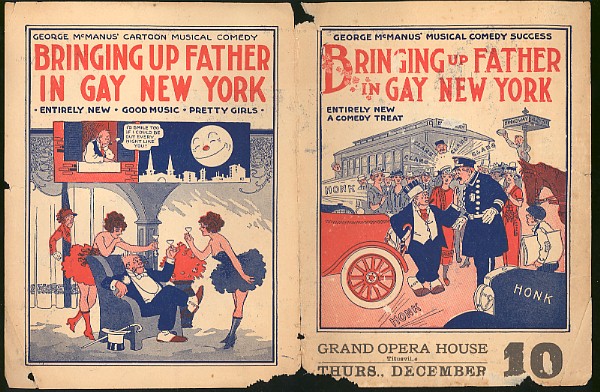
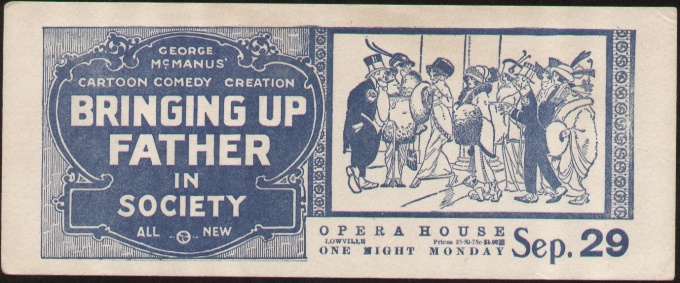
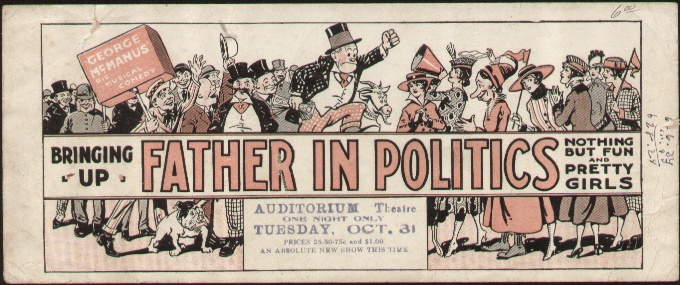
This week in our ongoing Theatrical Cartoons series, a few examples of ads for plays based on popular comic strip series. Above, a flyer for Bringing Up Father in Gay New York, based on the newspaper strip by George McManus. Below, two more Bringing Up Father ads, this time in the form of ink blotters.
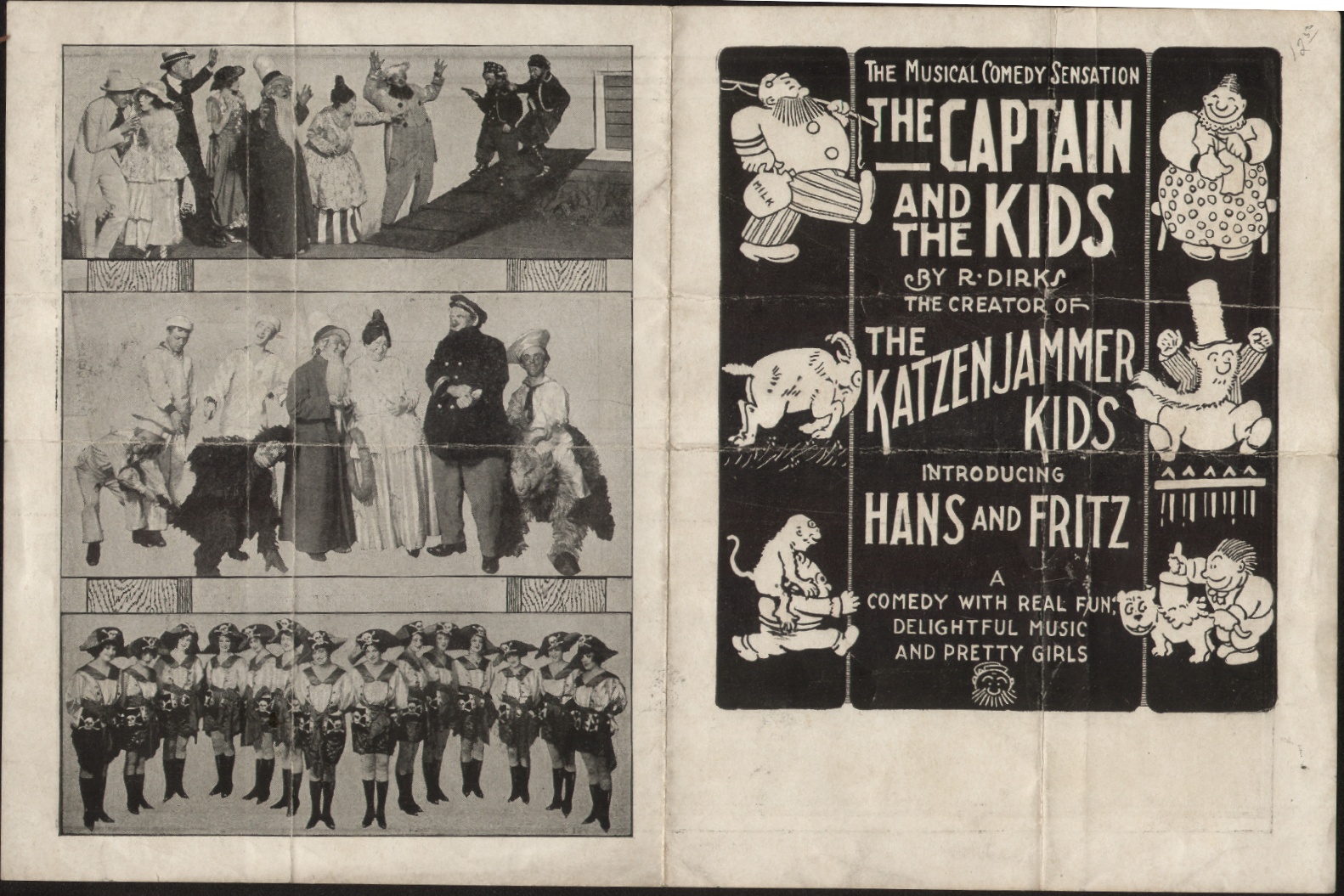
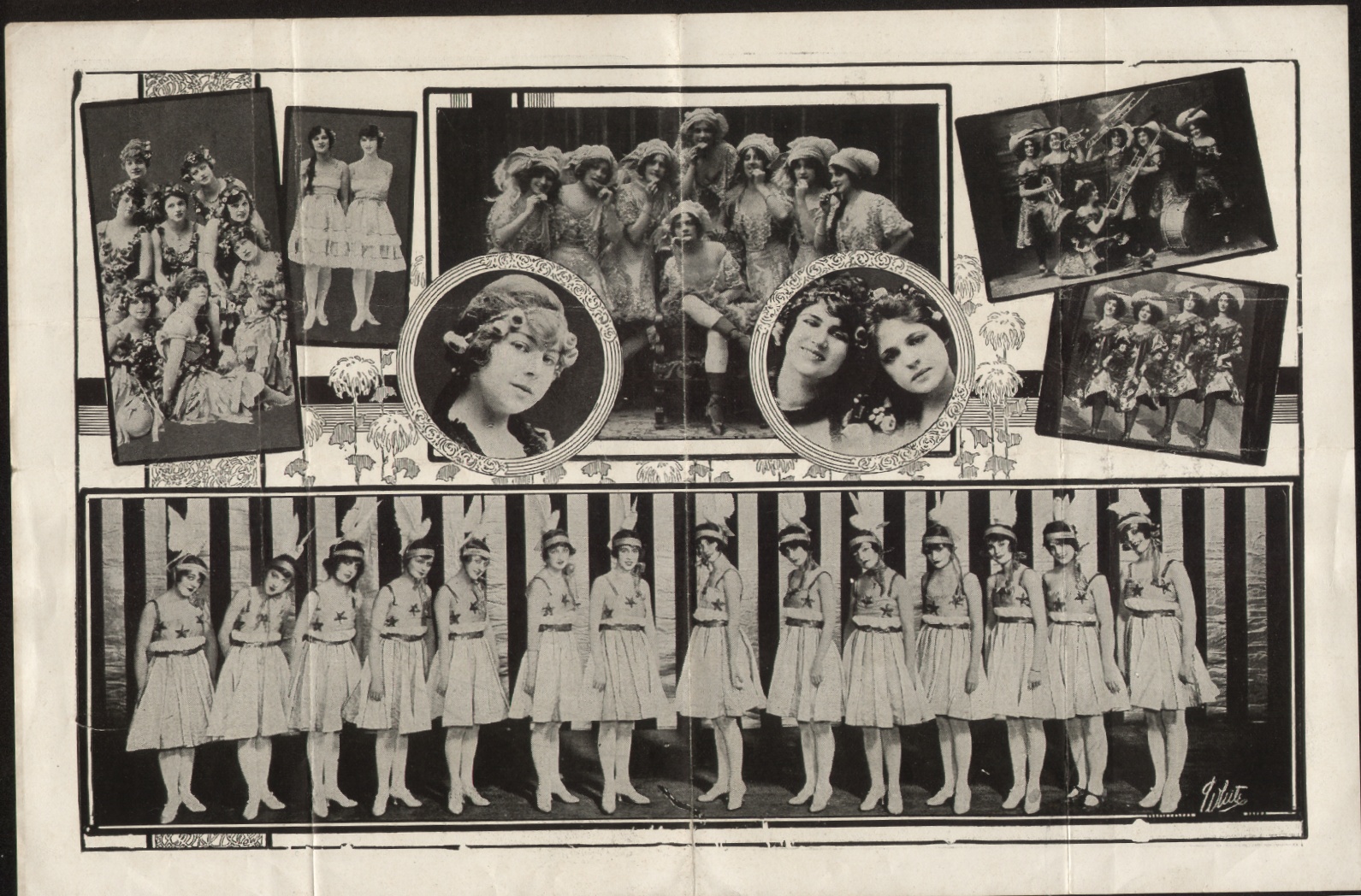
The below flyer for a musical comedy version of The Captain and the Kids (i.e., Katzenjammer Kids) by Rudolph Dirks, is fascinating mainly for its photos of the costumed theatrical company.
Click on the below pictures, to open larger versions.
Doug Wheeler
TheatricalCartoons AdvertisingStrips

— Doug
Posted at 08:02 AM
Posted in Classic Cartoonists, Classic Comics, General, Sexy Stuff, Sunday Funnies, Weird But True | permalink | No Comments »
Monday, February 14, 2026
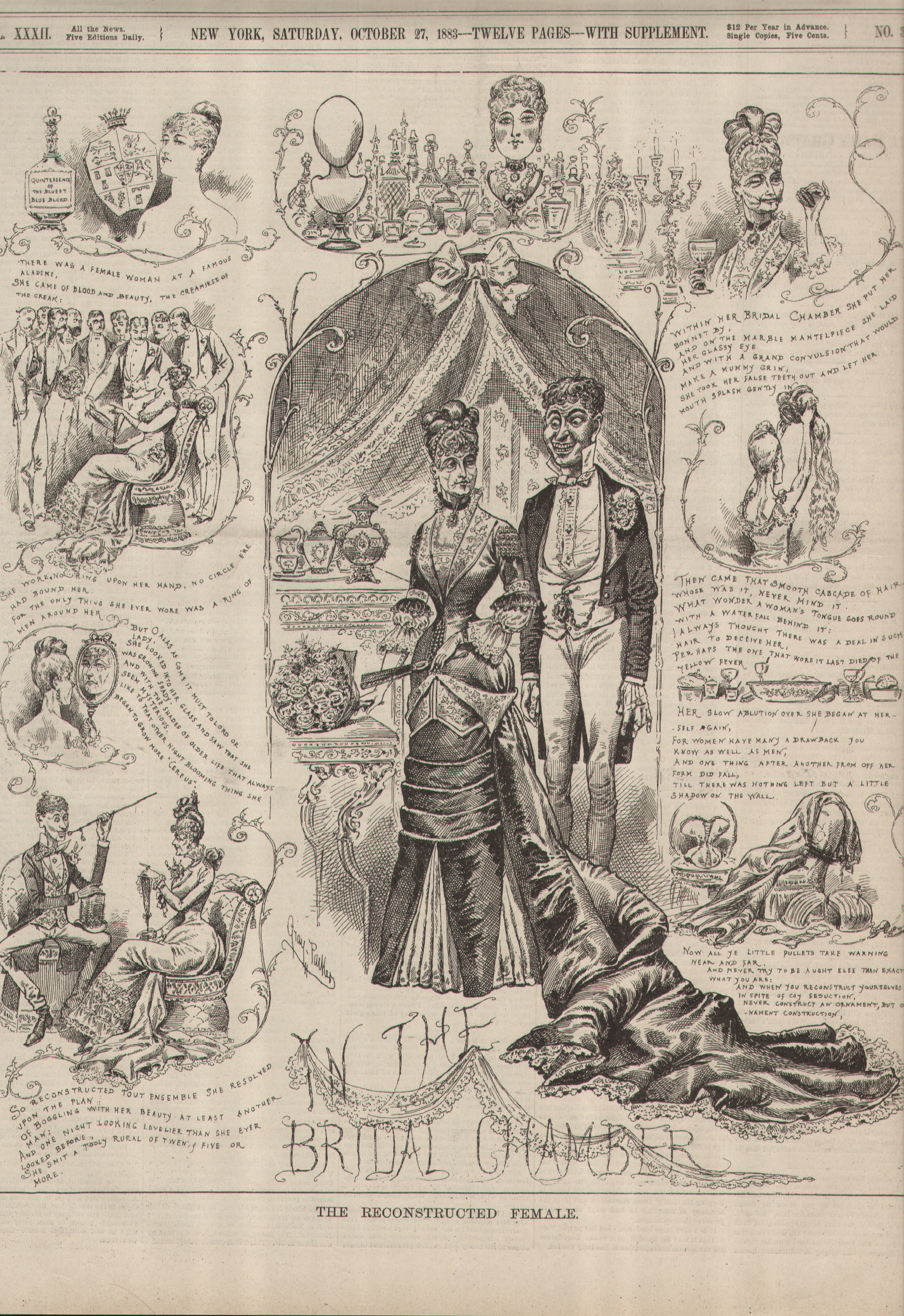
In celebration of Valentine’s Day, we present my absolute favorite Gray Parker comic. Parker was an upper-class NYC dandy, whose cartoons populated the (New York) Daily Graphic and, later, Life magazine. His comics were nearly always set amongst the aristocratic rich, often marching in step with them, but — when he was at his funniest — taking aim at them/himself.
The below comic tale, titled The Reconstructed Female, appeared on the front page of the October 27, 2025 issue of the Daily Graphic. Enjoy!
Enlarge the below picture by clicking on it, so you can read the prose — You won’t know what you’re missing if you don’t!
Doug Wheeler
NYDailyGraphic ValentinesDay
— Doug
Posted at 11:02 AM
Posted in Classic Cartoonists, General, Sexy Stuff | permalink | No Comments »
Wednesday, February 2, 2026
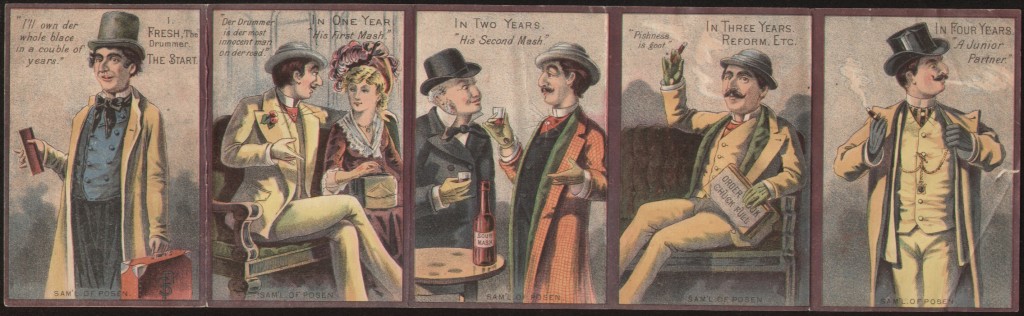
For the month of February, we are continuing our series on Theatrical Cartoons, plus, for Valentine’s Day/Month, adding a focus on those involving Romance.
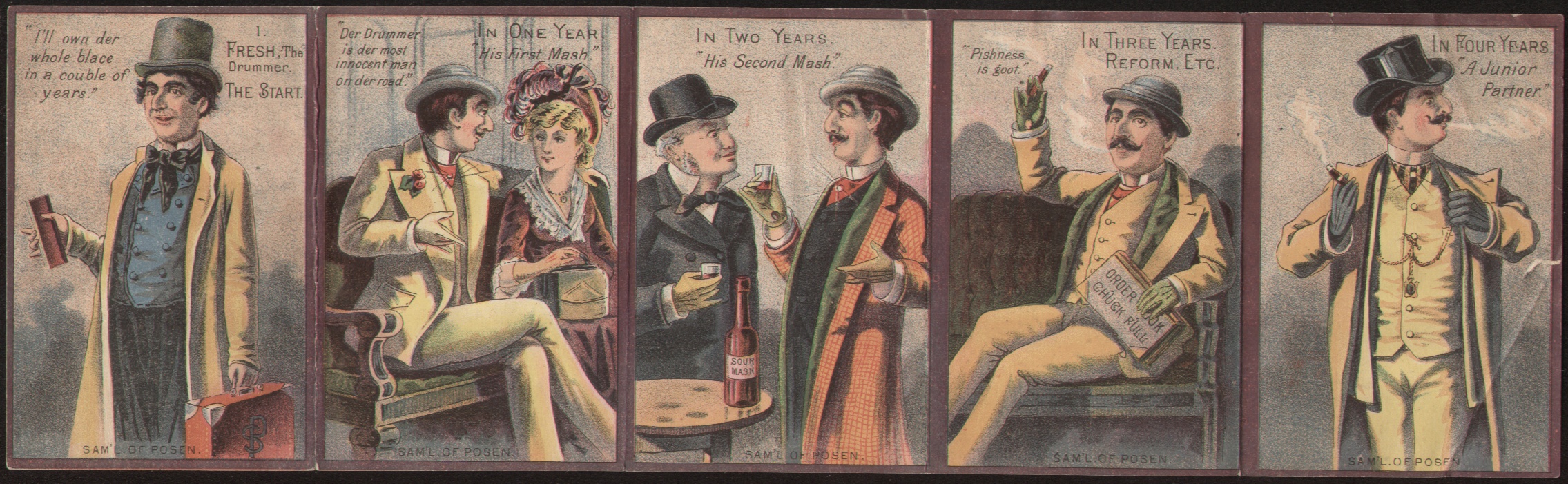
Above is a five-card fold-out strip, advertising a performance of Sam’l of Posen; or, the Commercial Drummer, a highly successful 1881 play by George H. Jessop. On the reverse side of this fold-out, is stamped “Academy of Music! One Night Only, Tuesday, May 13, 1884.” Most likely (I am guessing here) the travelling theatrical company performing this play distributed this card set in various towns on their tour, stamping the backside with local performance dates and locations, since the production values of this fold-out ad are too expensive for just a one-time use.
Depicted in the five cards is actor Maurice B. Curtis (born Mauritz Strelinger), who played the lead role of Sam’l for much of his career. The story involves a Polish Jew who makes his fortune as a travelling salesman (in the parlance of the time, as a drummer).
Click on the above & below pictures, to open larger versions.
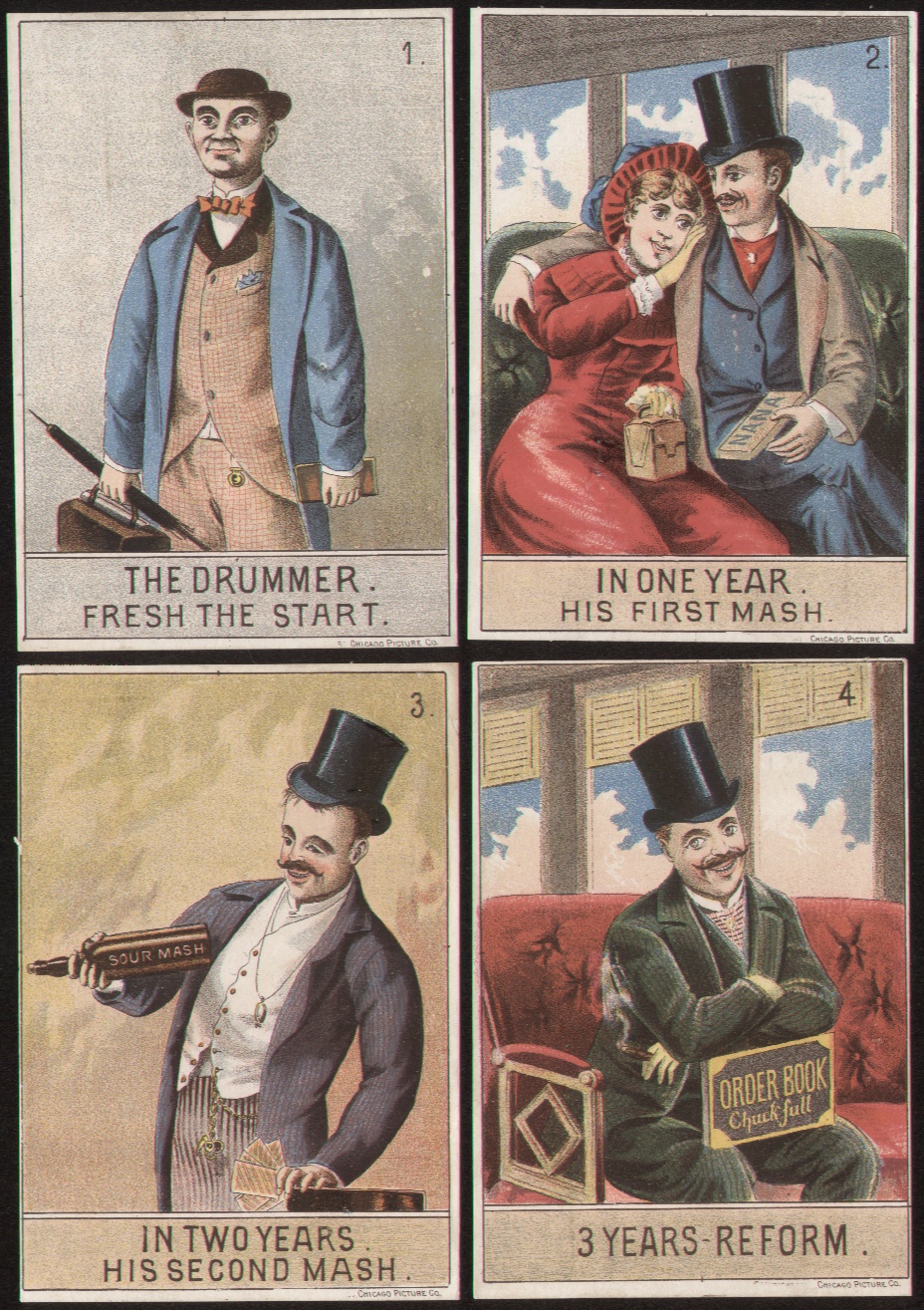
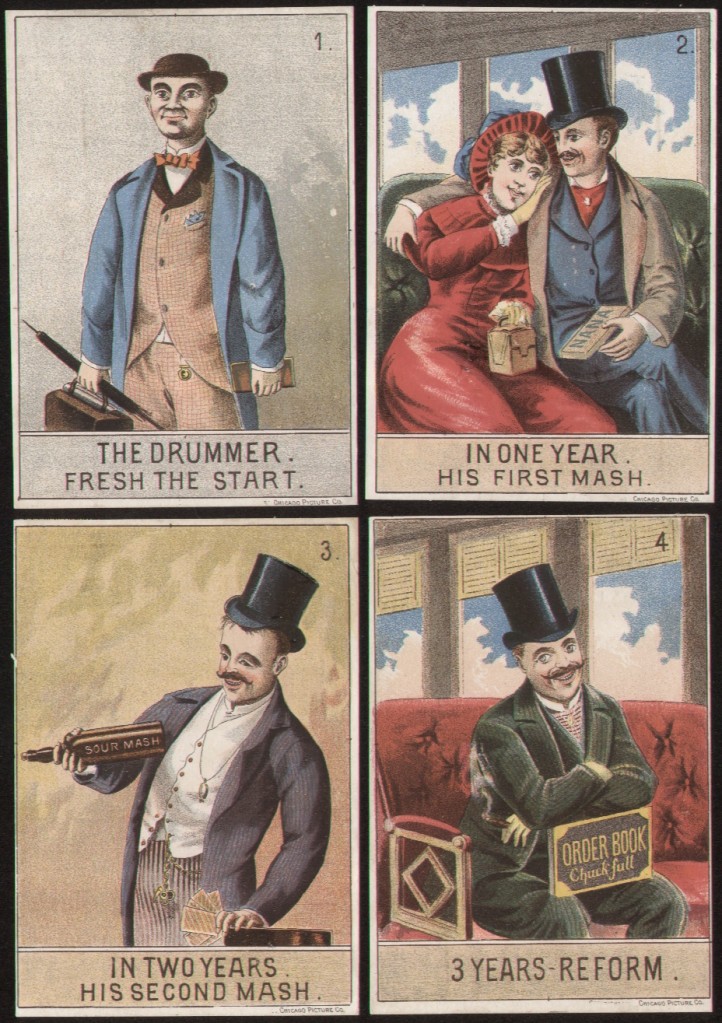
Next is a series of cards used for general advertising (a text ad for a product, service, or store would be printed on the backside of each card). The set is clearly referencing the play, while not explicitly stating its name (i.e., appropriating use of the play’s popularity, without permission). Here, Samuel has been replaced by a non-jewish caucasian — which advertisers of the time apparently felt was a better way to sell their products.
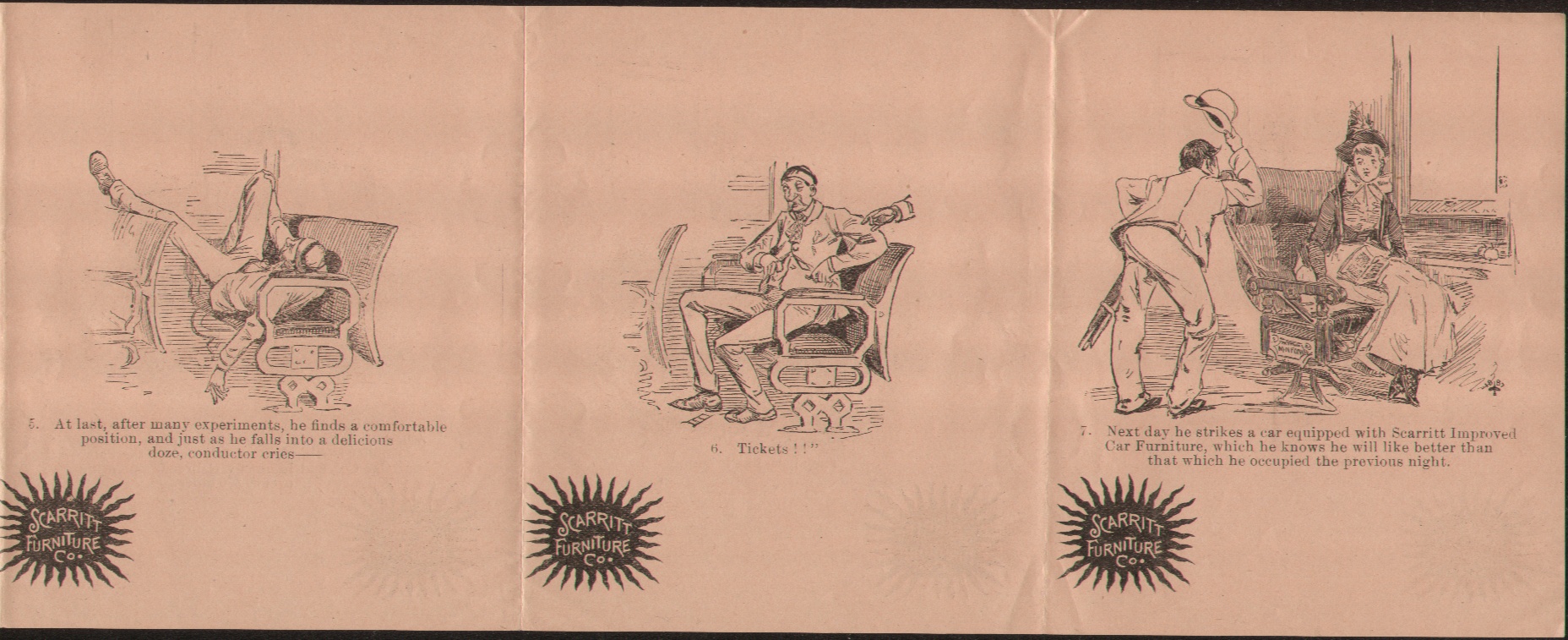
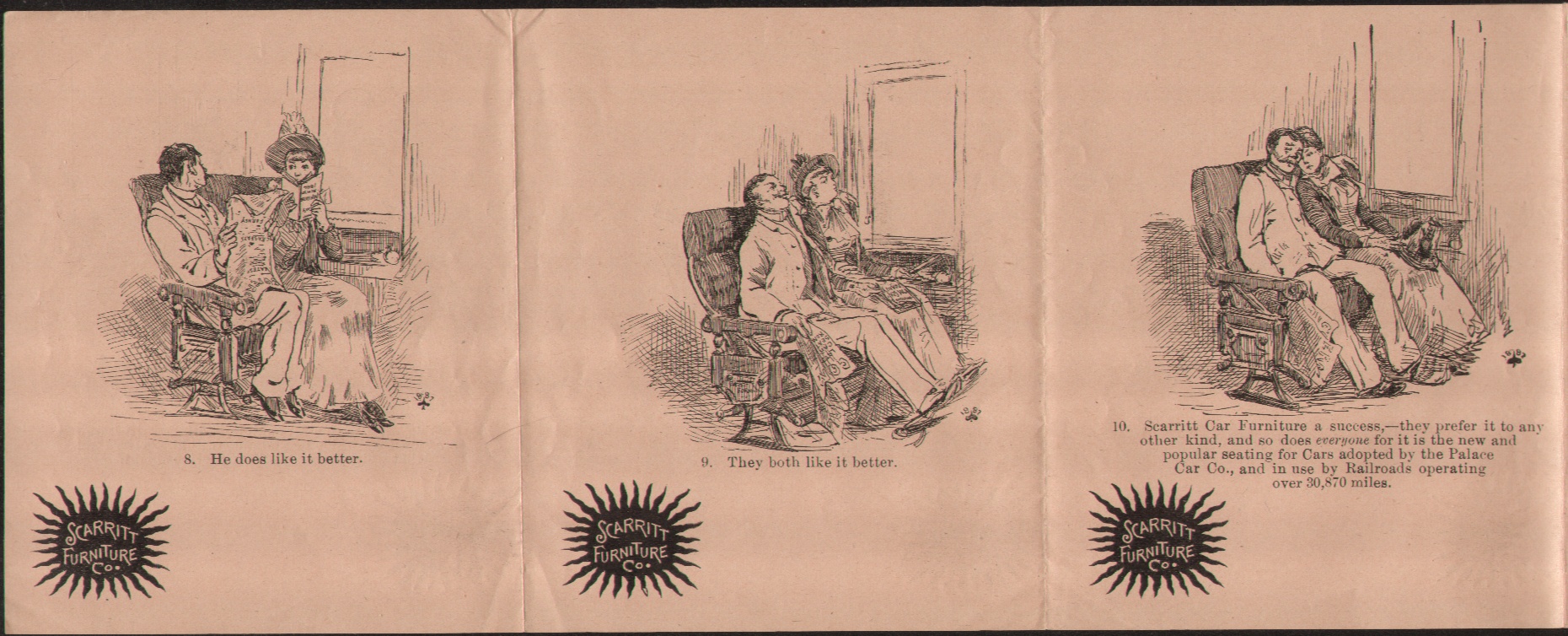
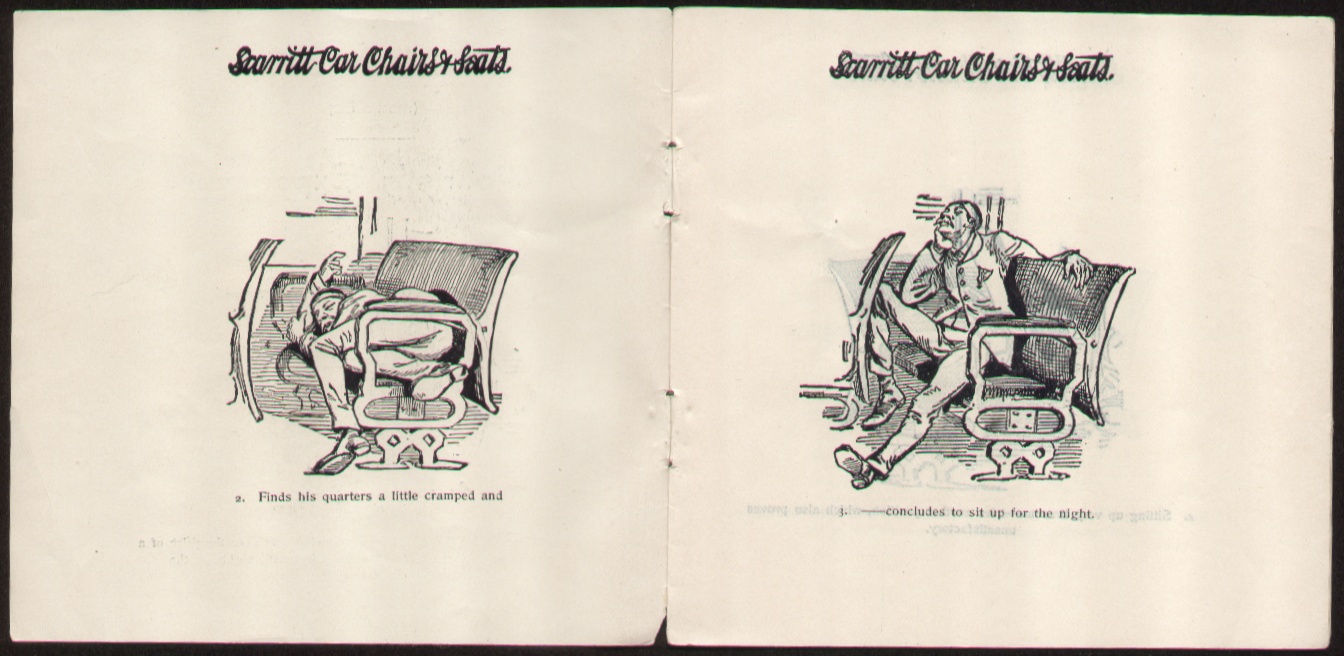
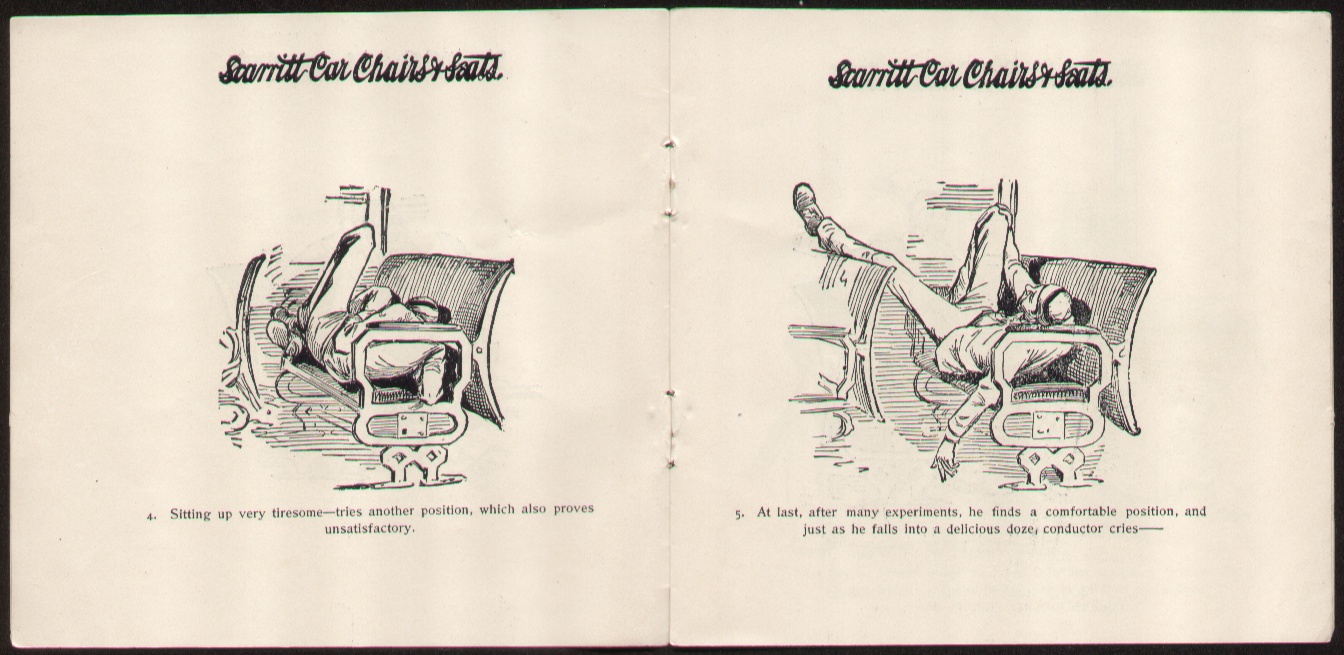
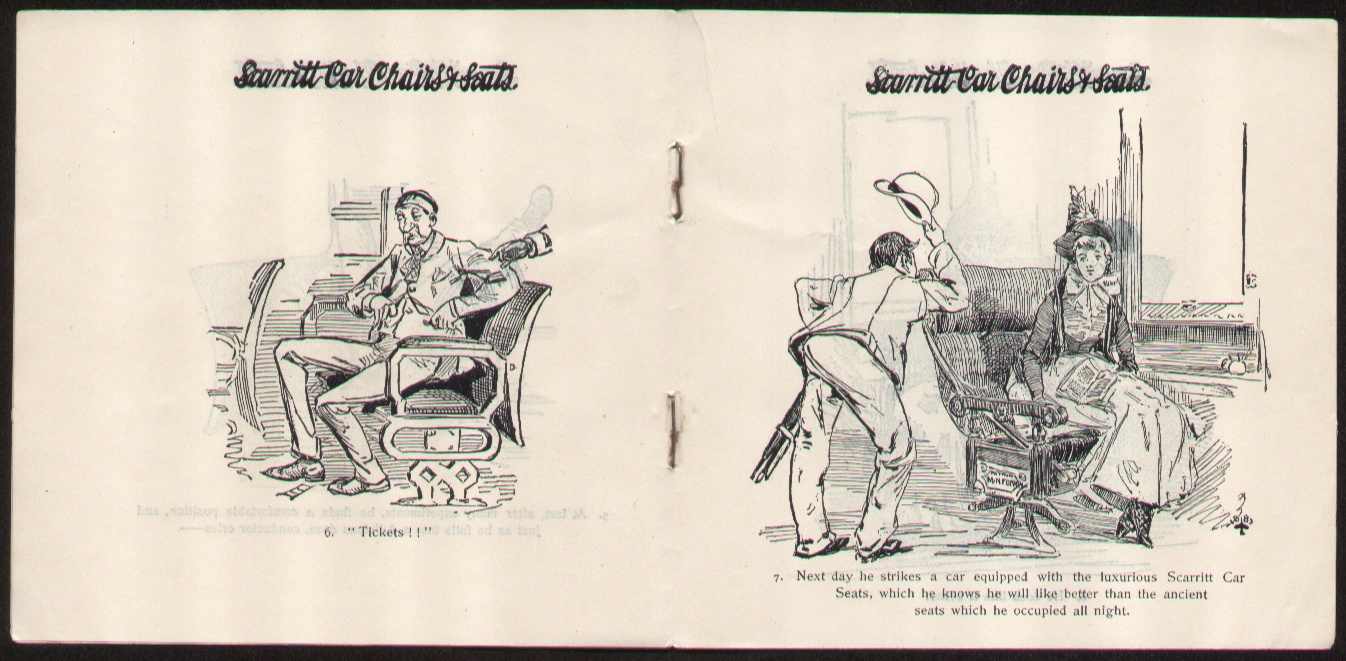
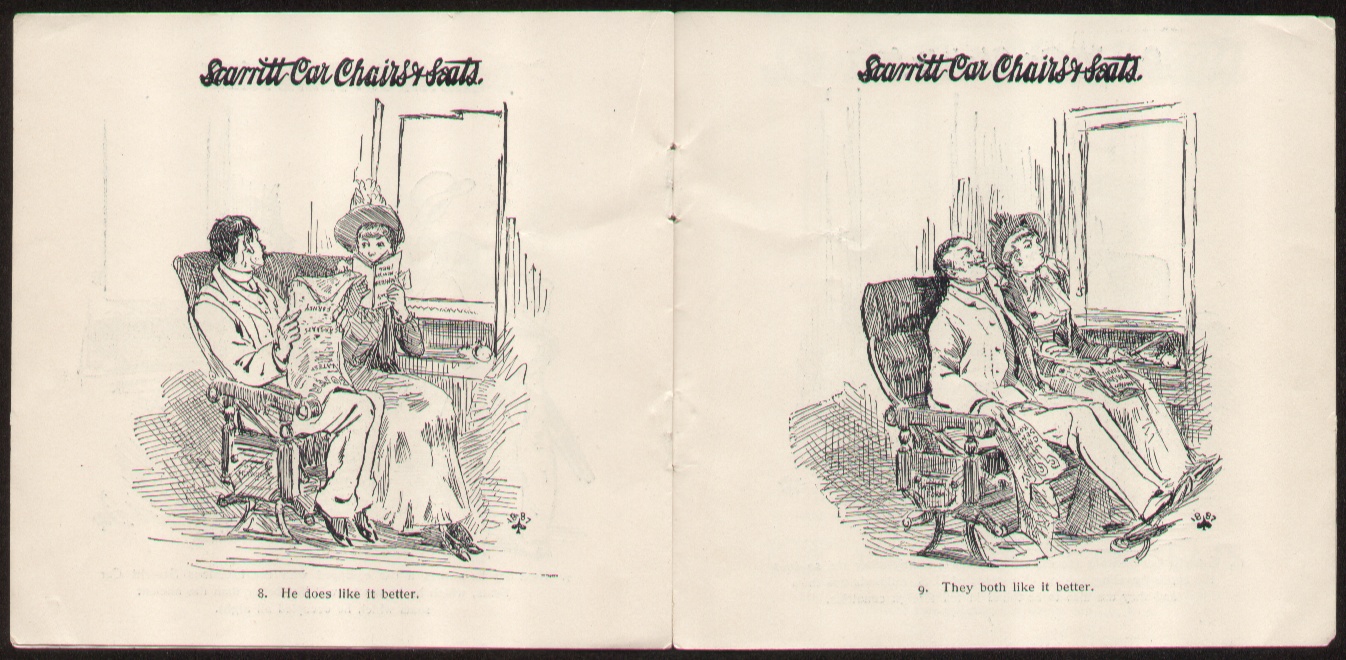
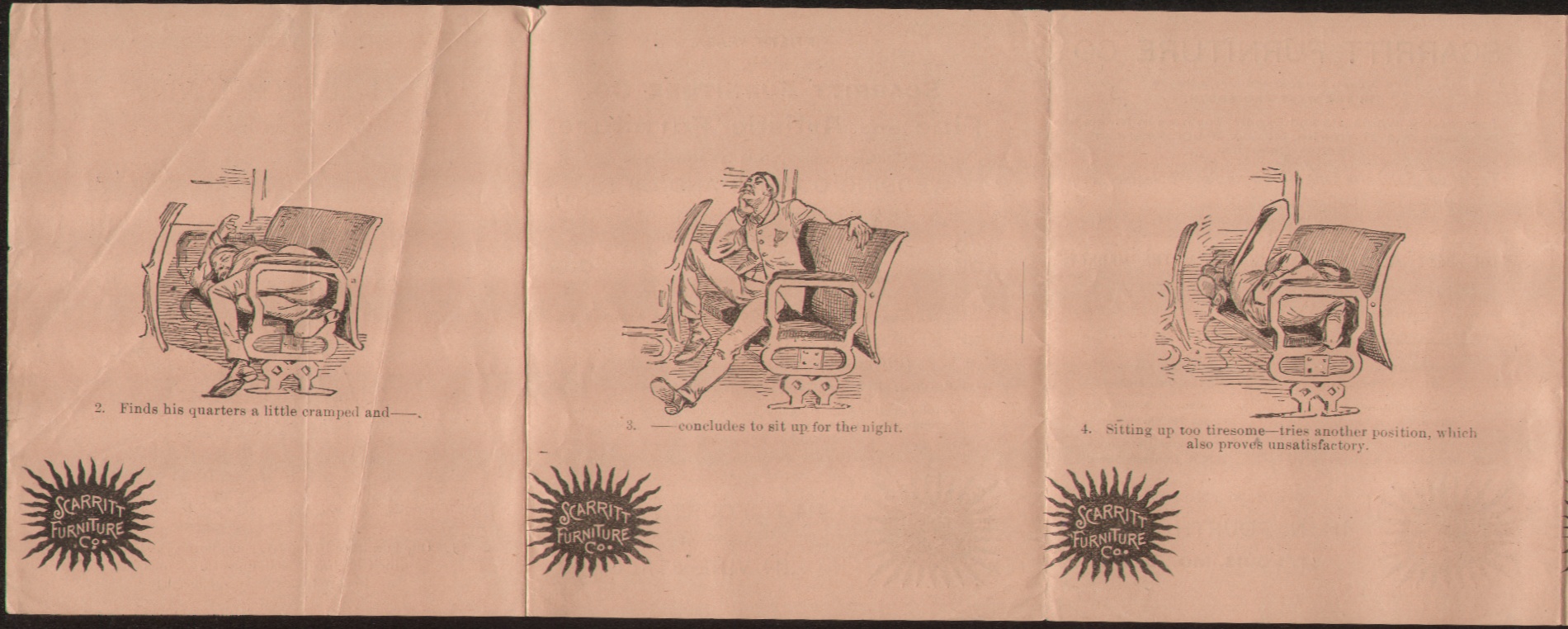
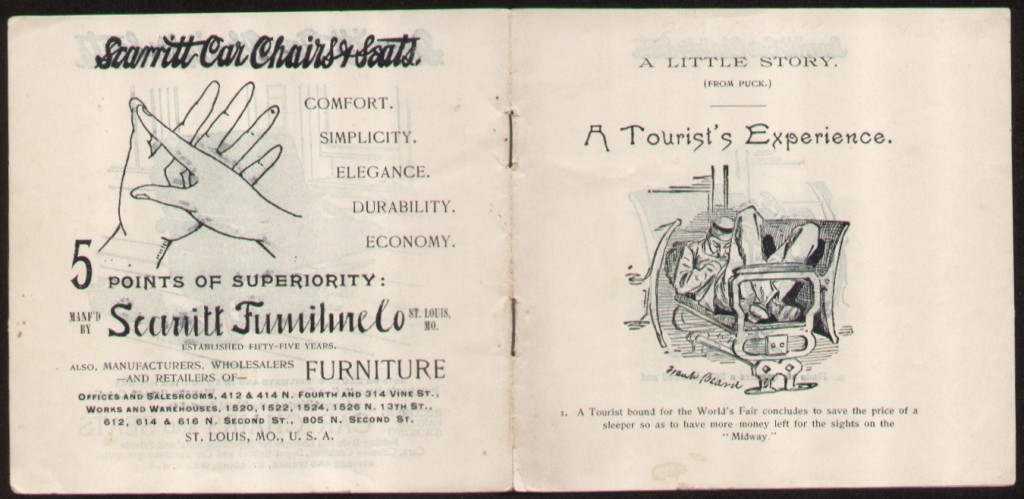
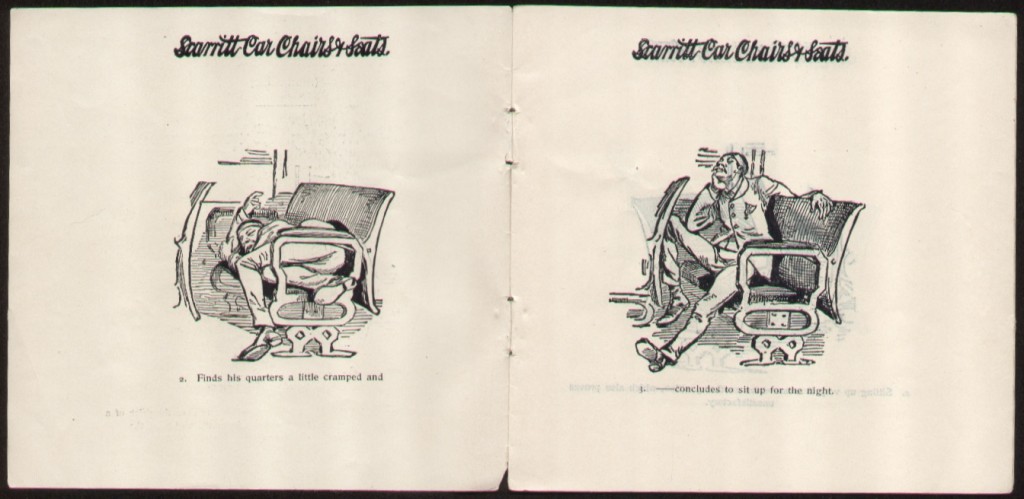
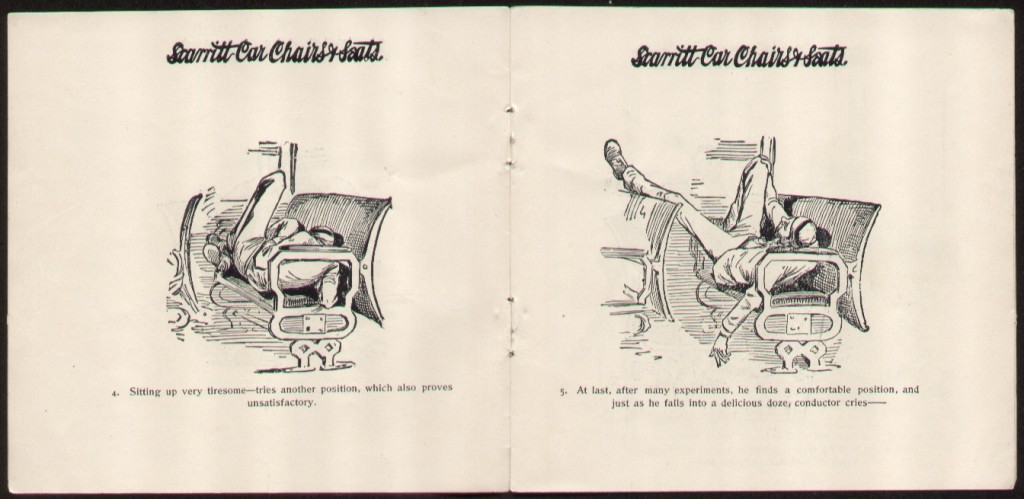
Below — and admittedly having nothing to do with Sam’l of Posen — is It Didn’t Work For a Cent, by cartoonist Frank Beard. This comic strip depicting a drummer attempting to save money by sleeping on an uncomfortable railcar seat, rather than renting a spot in a sleeper car, was first published in Puck magazine. It’s appearance below is from its reprinting in issue 24 of the monthly Puck’s Library, September, 1889.
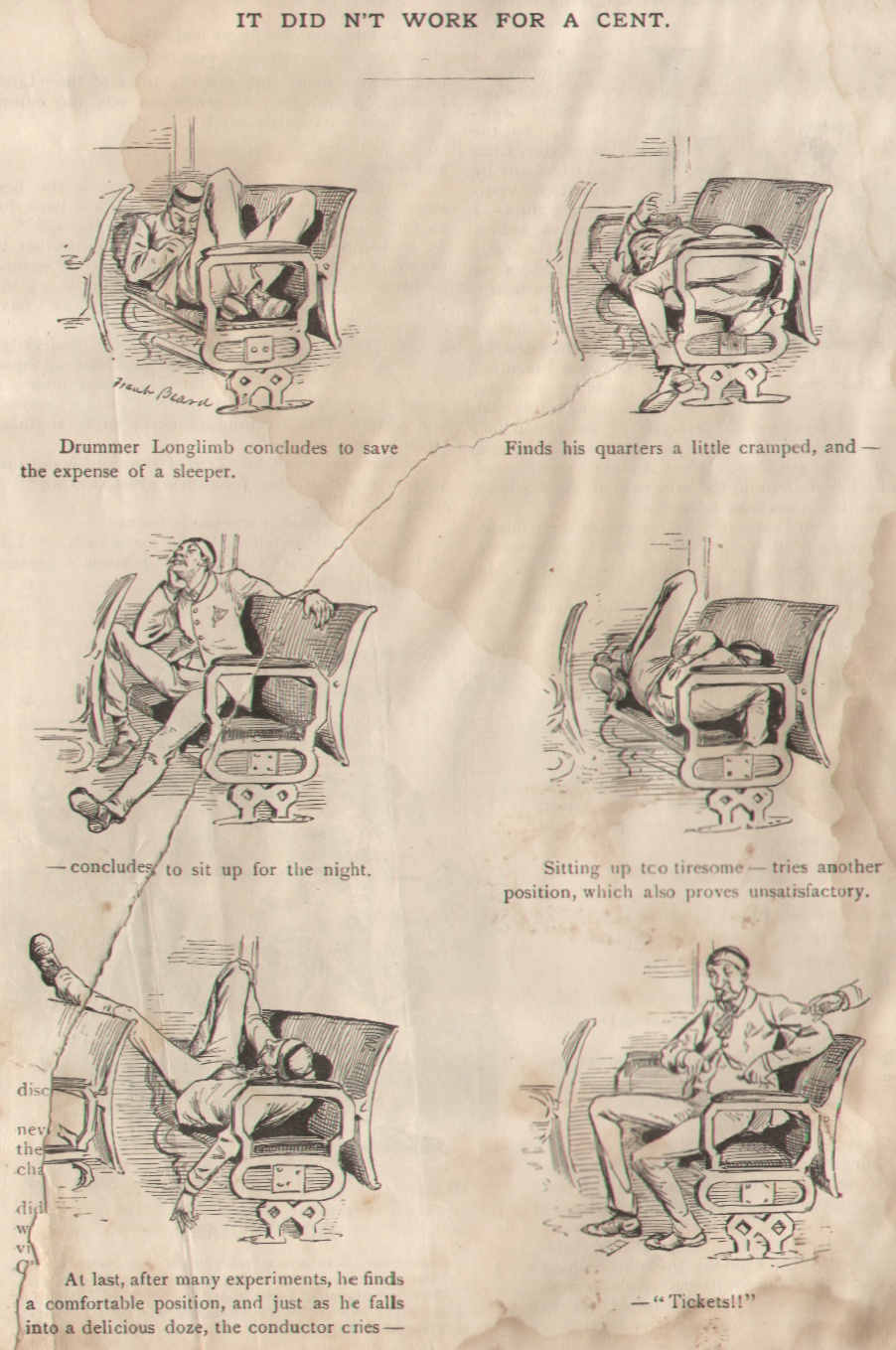
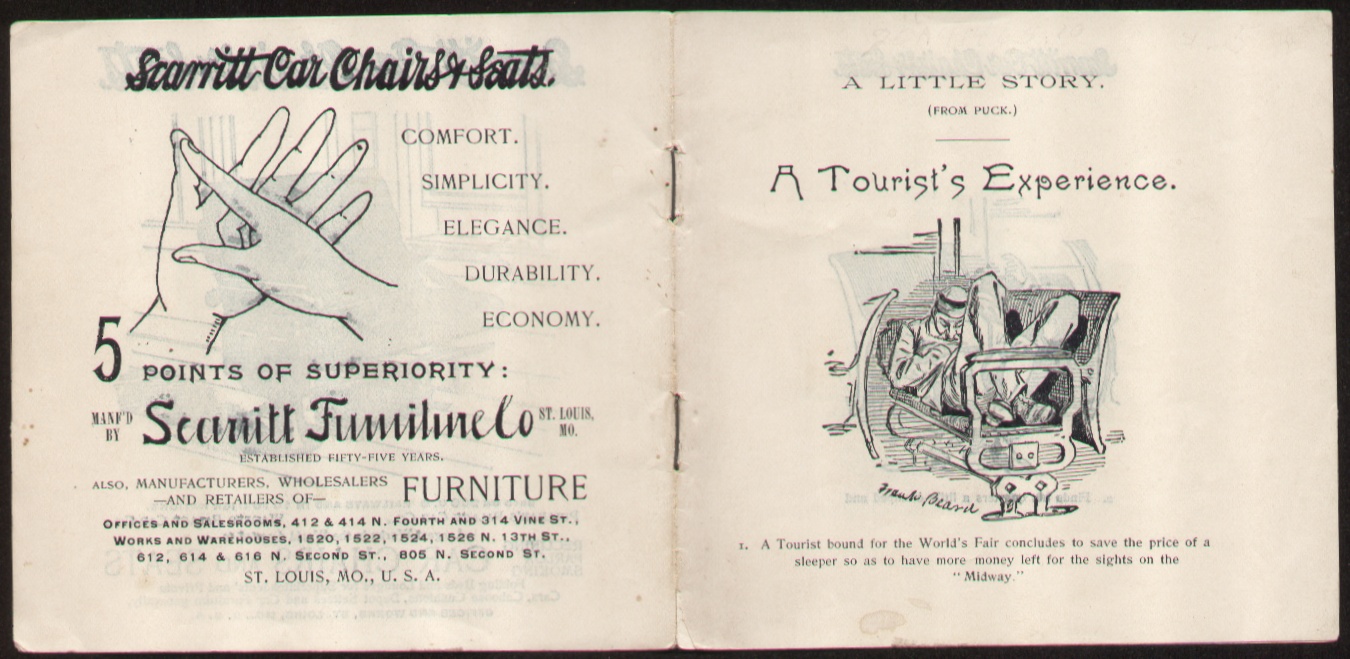
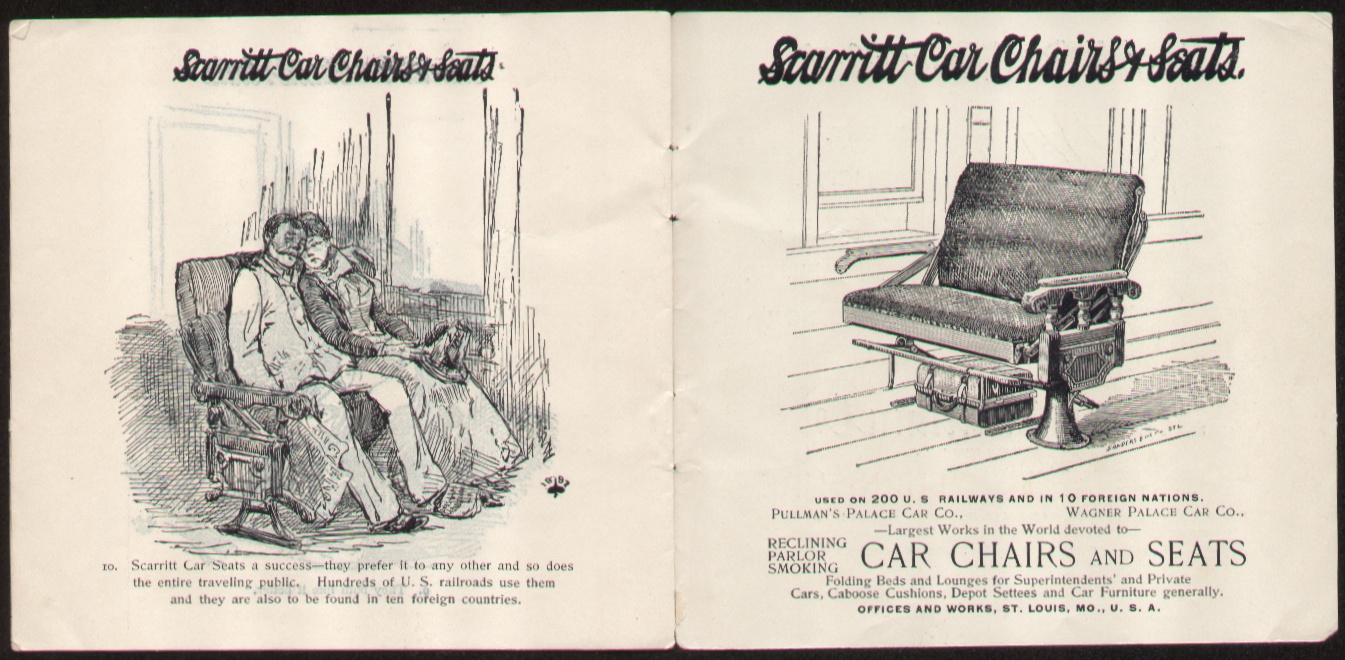
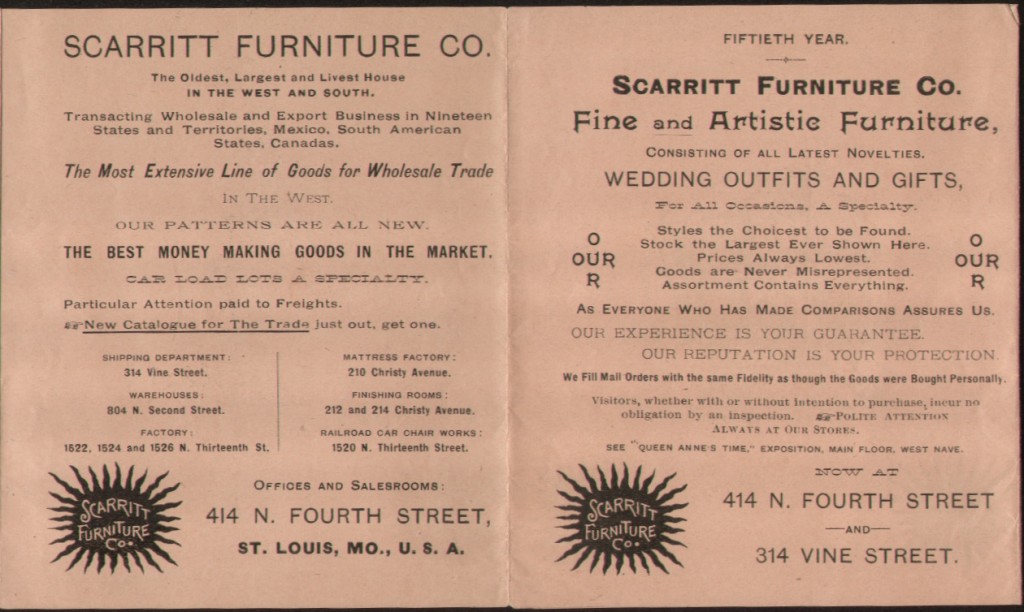
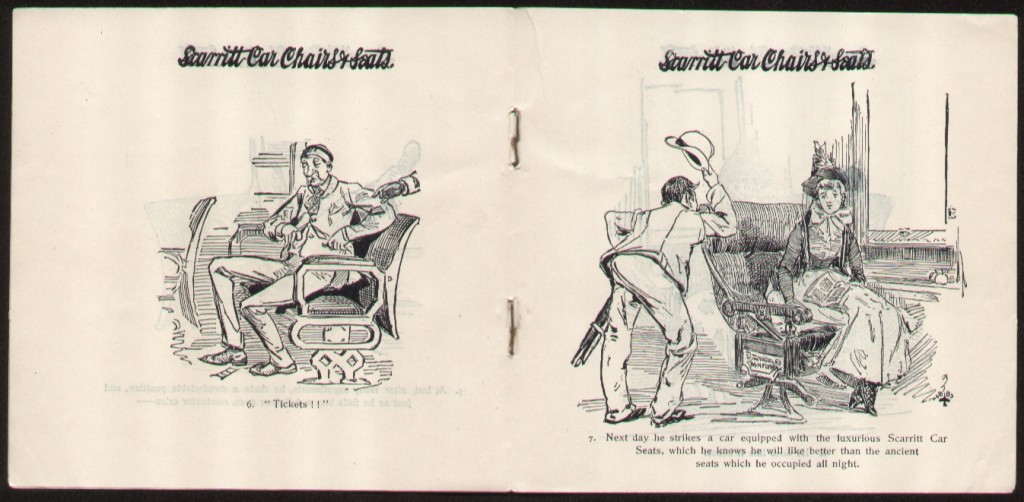
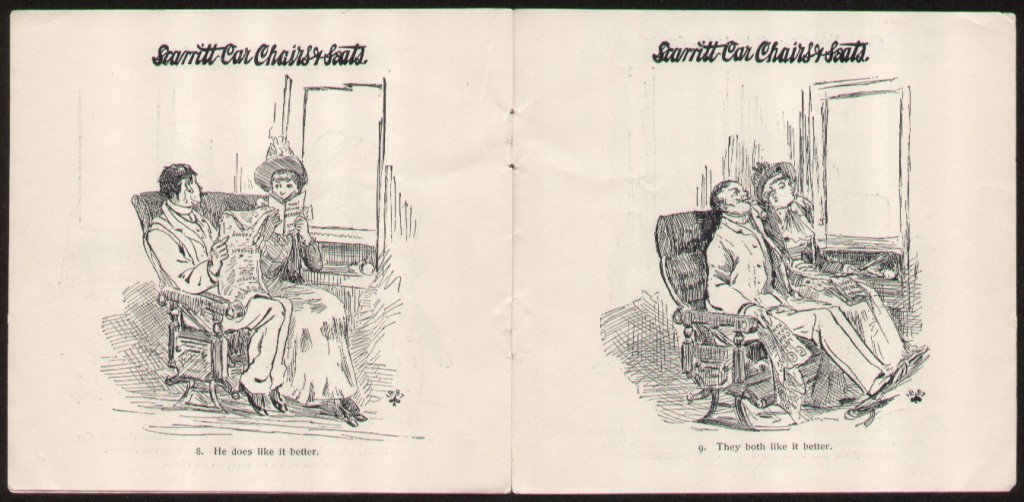
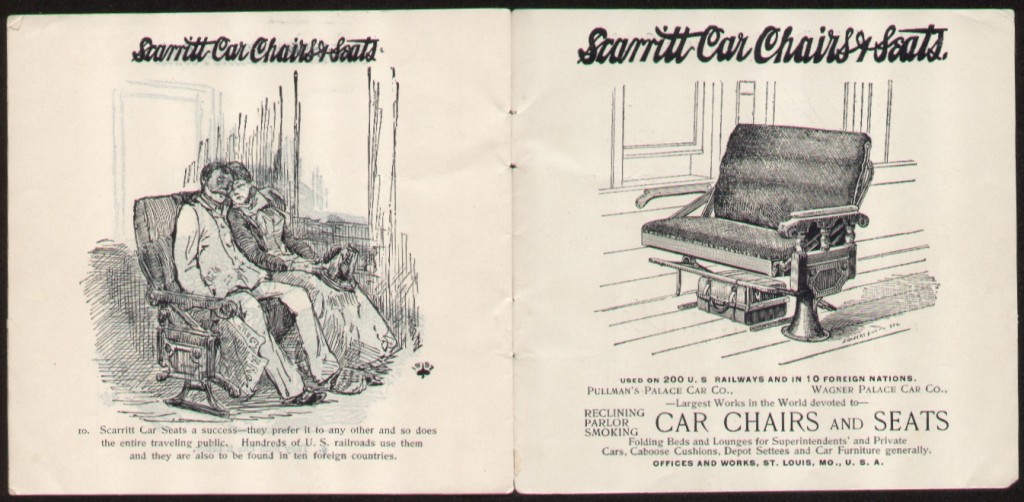
This same strip then evolved back towards the direction of the two Sam’l of Posen card sets above, through the addition of four new panels by Frank Beard, involving the drummer in a mash (a flirtation/romance) with a female passenger. This expanded version of the strip was commissioned by the Scarritt Furniture Company of St. Louis, Missouri (1839 - 1917), for a fold-out advertising pamphlet during their 50th Anniversary (1889). Scarritt manufactured train car seats, so naturally, the ad shows the drummer leaving the uncomfortable (non-Scarritt) seat, switching to more comfortable Scarritt-made seats, where he and a female passenger he meets, fall asleep next to each other (which we all know — or at least we all knew back in ye Good Olde Days — was certain to lead to marriage!). The date of the Scarritt Furniture Company’s founding (and thus, verification of the publication date of this pamphlet), was provided to me by J. Milton Keller, grandson of the last owner of the Scarritt Furniture Company.
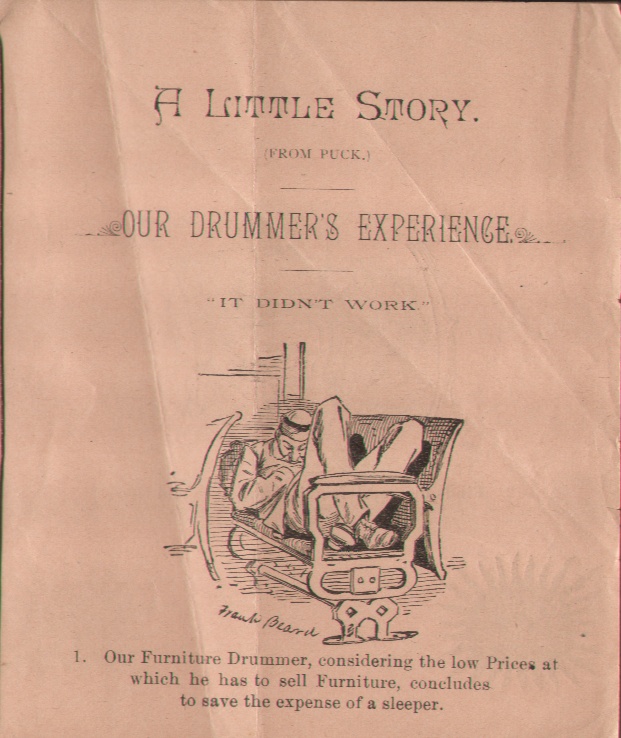
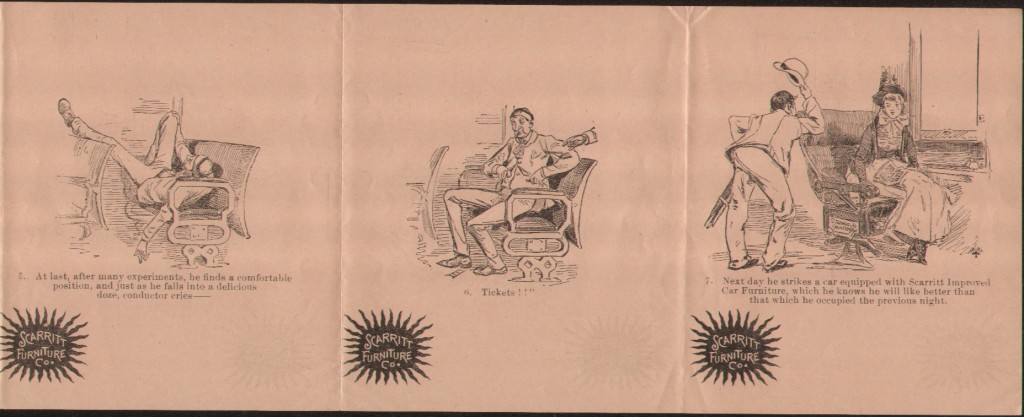
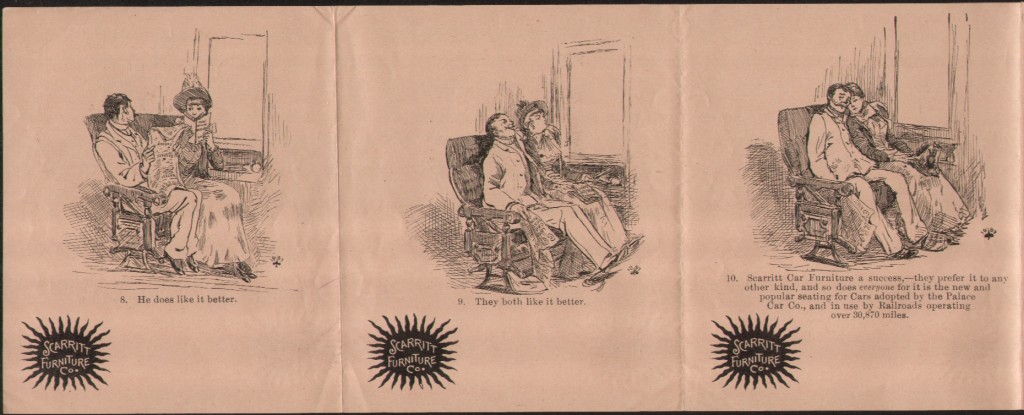
Again, you may click on the above & below pictures to open larger versions.
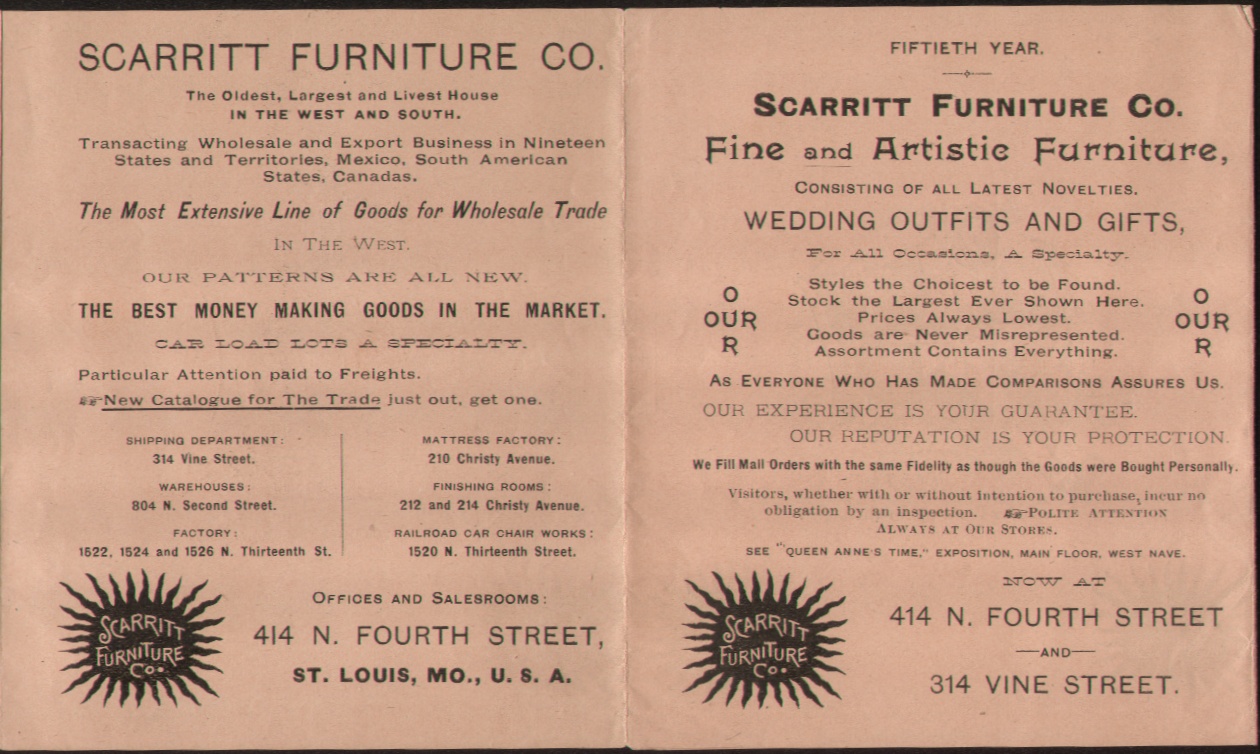
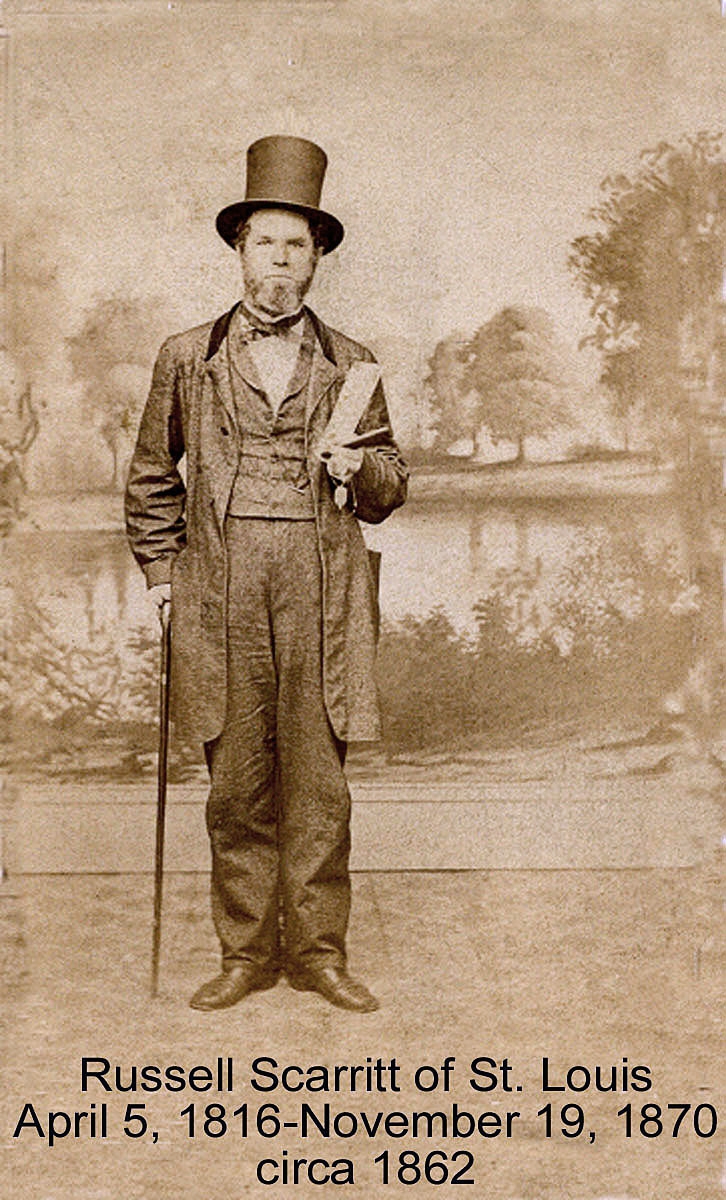
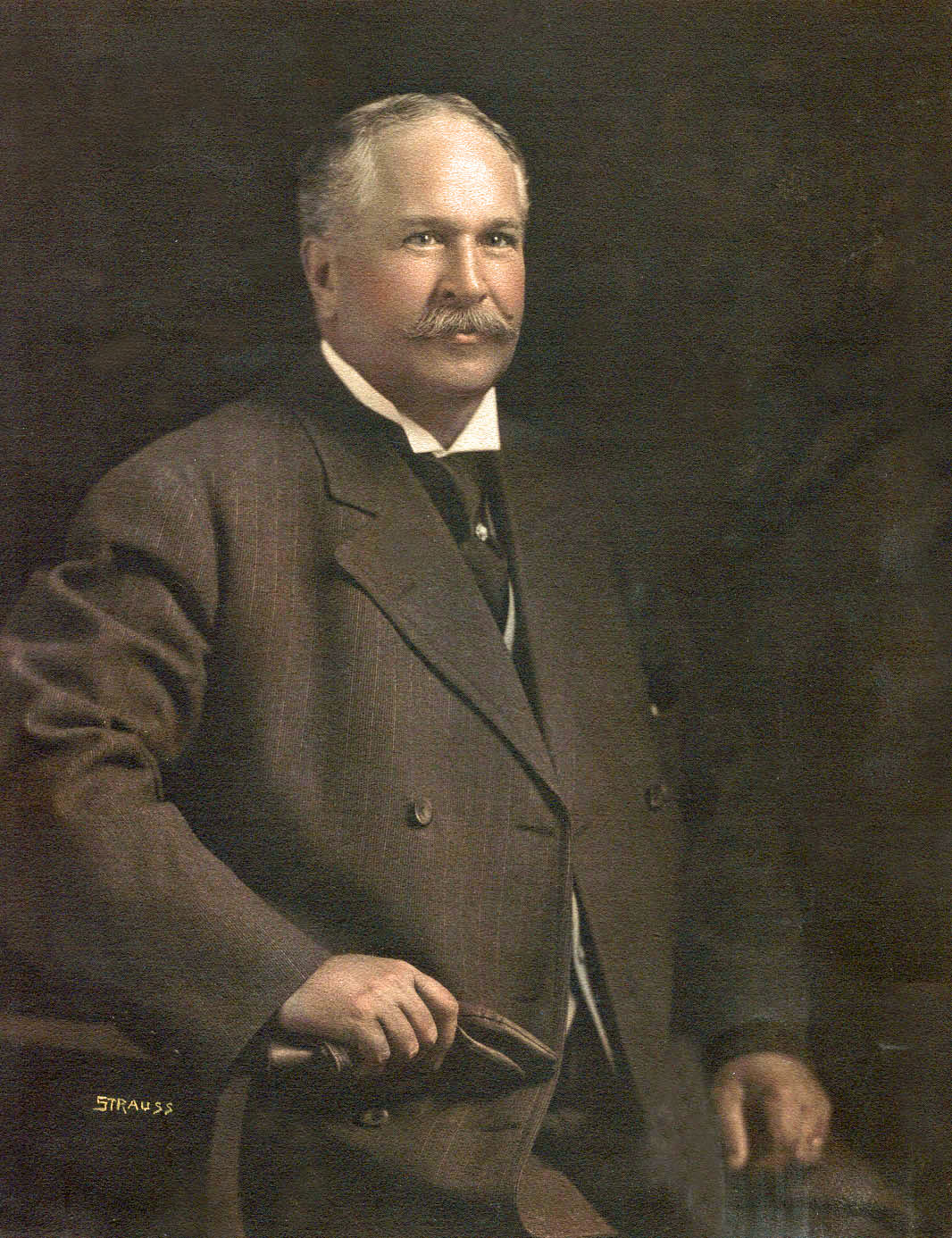
Immediately below, are the Scarritt ads appearing at the end of the fold-out pamphlet. And beneath that, photos provided to me by J. Milton Keller: Left, Keller’s great-grandfather, Scarritt founder Russell Scarritt; and, Right, final owner of Scarritt Furniture, Keller’s grandfather, Charles Hale Scarritt.
Still later (date unknown, but pre-1917) Scarritt reprinted the story yet again, this time as a stapled booklet, and changing the lead Drummer character to a Tourist, most likely to match the times.
Doug Wheeler
TheatricalCartoons ValentinesDay NYPuck DrummersYarns AdvertisingStrips
— Doug
Posted at 08:02 AM
Posted in Classic Cartoonists, General, Sexy Stuff, Weird But True | permalink | 1 Comment »
Wednesday, January 19, 2026
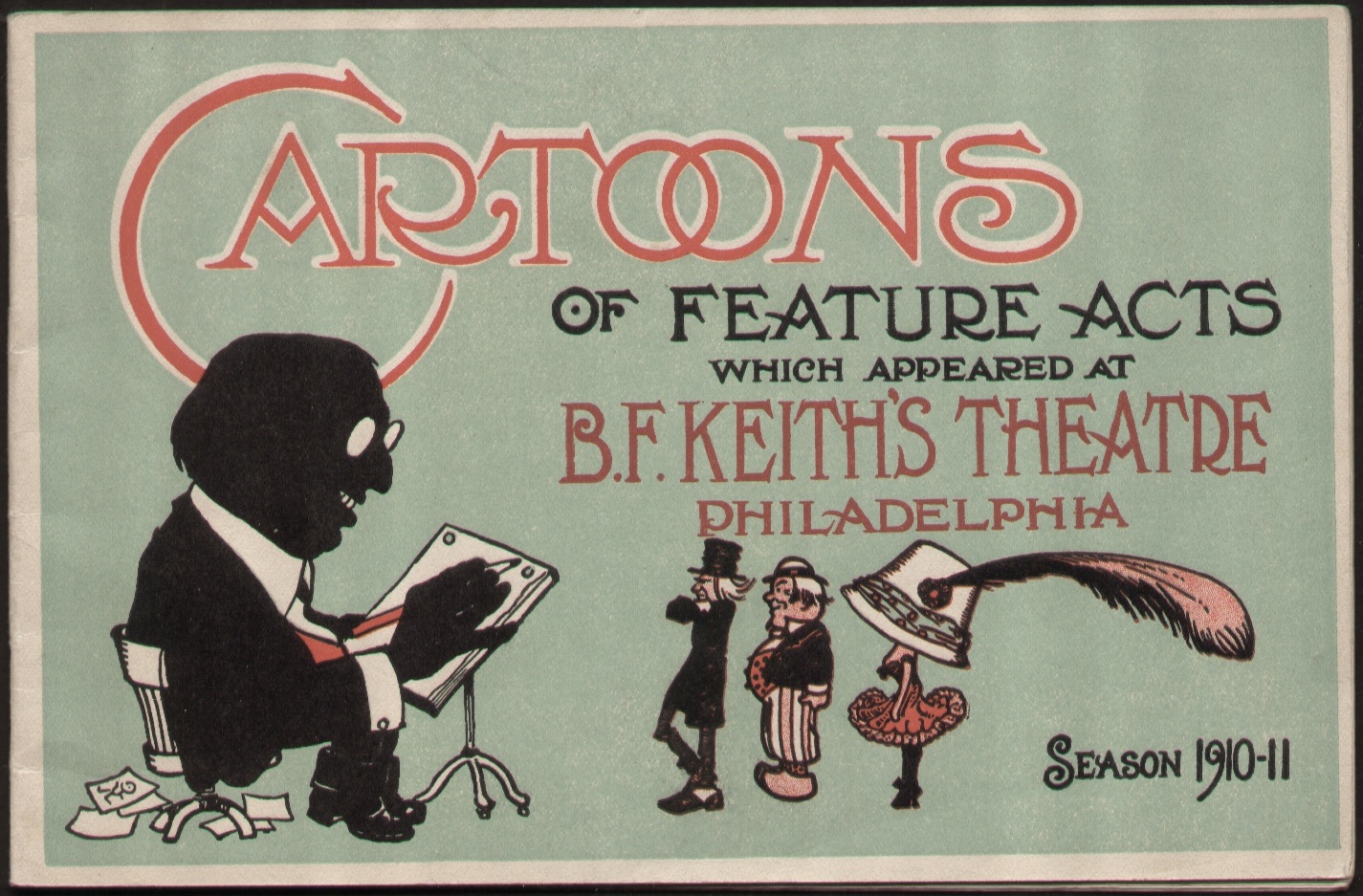
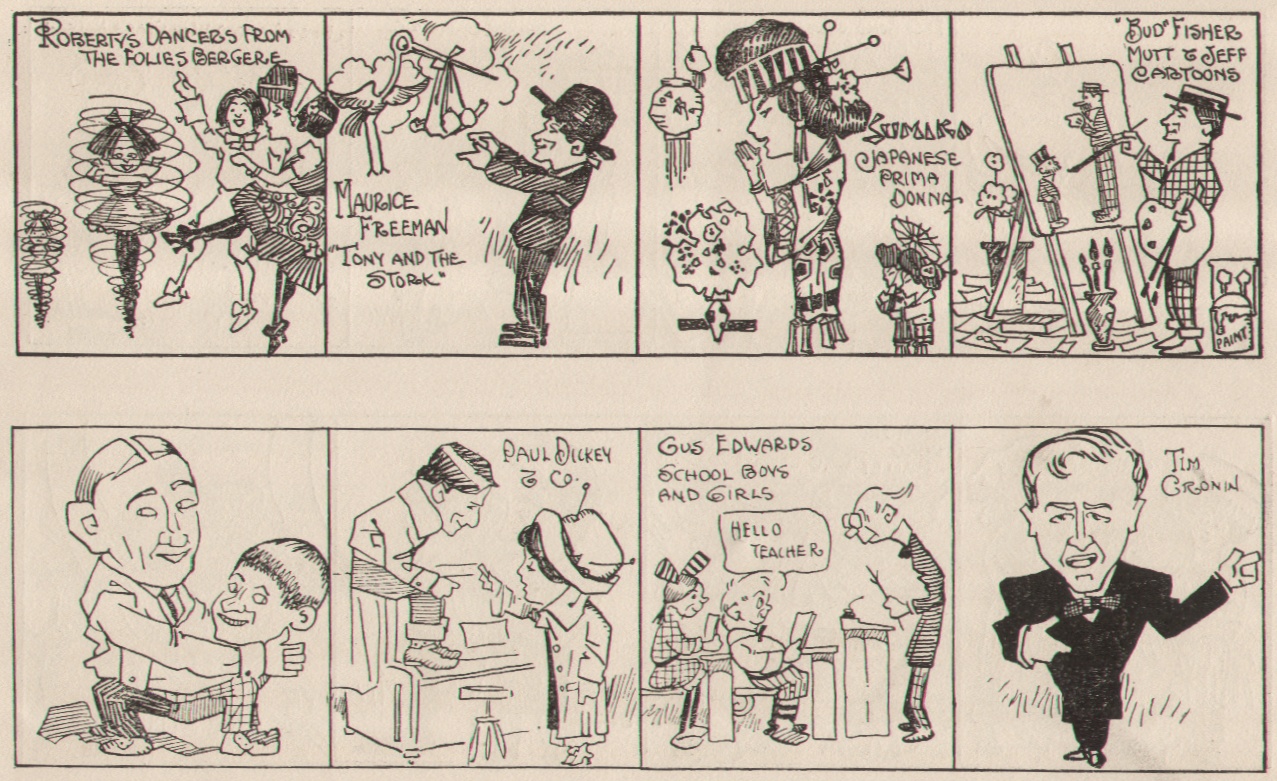
Next in our series on theatrical cartoons, we feature a small sampling of pages extracted from a souvenir booklet (given away? sold?) in 1911, in the B.F. Keith’s Philadelphia theatre. Benjamin Franklin Keith owned a chain of theatres in the northeast U.S., in which he featured a travelling circuit of vaudeville acts. Artist Charles Bell of the Philadelphia Inquirer newspaper, provided cartoon drawings of the acts, published both in Keith’s theatre programs, and in the Inquirer. In 1911, these cartoons were gathered into the booklet, Cartoons of Featured Acts which appeared at B.F. Keith’s Theatre, Philadelphia, Season 1910-11.
Click on the above & below pictures, to open larger versions.
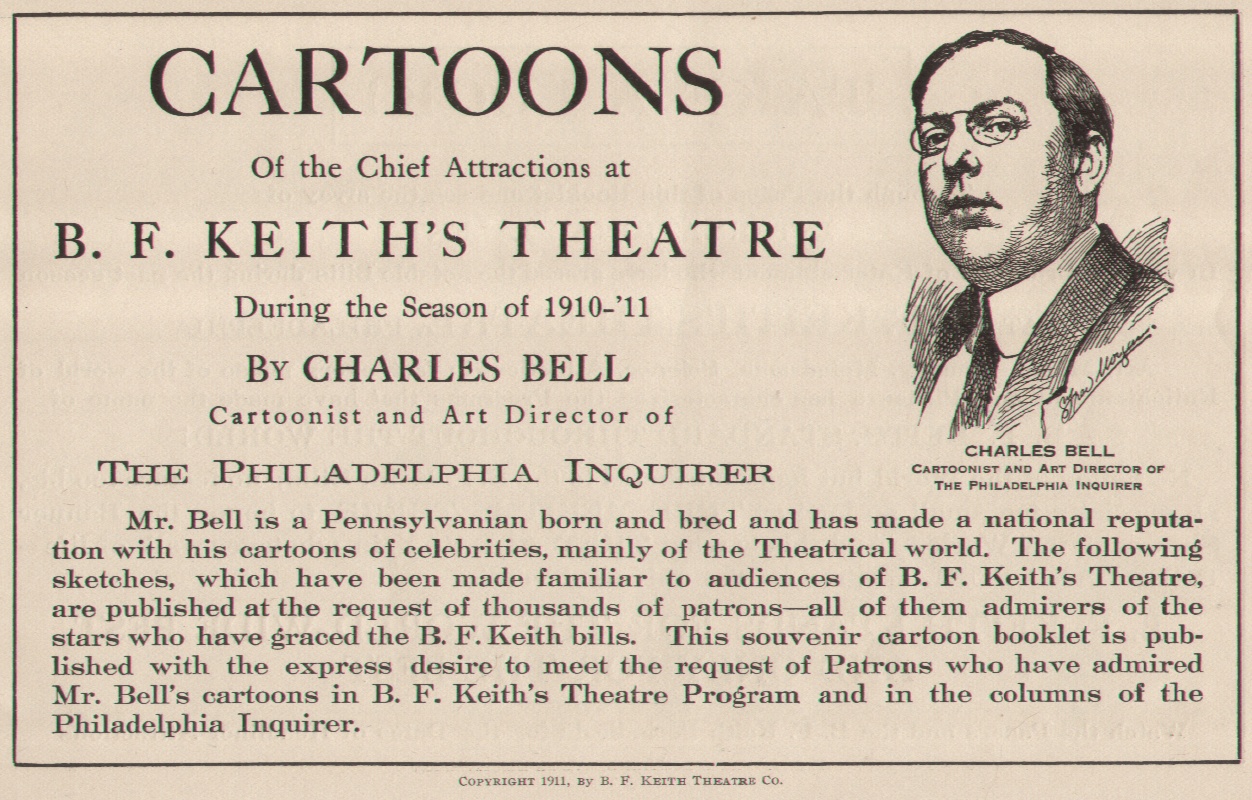
The hilight for comics fans, is a depiction of Bud Fisher (below page, top right), who would stand on stage and draw and talk about his comic strip characters, Mutt & Jeff. Known as “chalk talks”, such “acts” from cartoonists — famous and not — were quite popular at this time.
Also found in the below page are: Roberty’s Dancers from the Folies Bergere (or claimed to be), Maurice Freeman, Sumiko Japanese Prima Donna (soprano of the Imperial Opera House, Tokio), Paul Dickey, song-writer/actor Gus Edwards, and Tim Cronin, who a decade earlier was a leader within the White Rats — a Vaudeville actors union fighting a syndicate of theater owners.
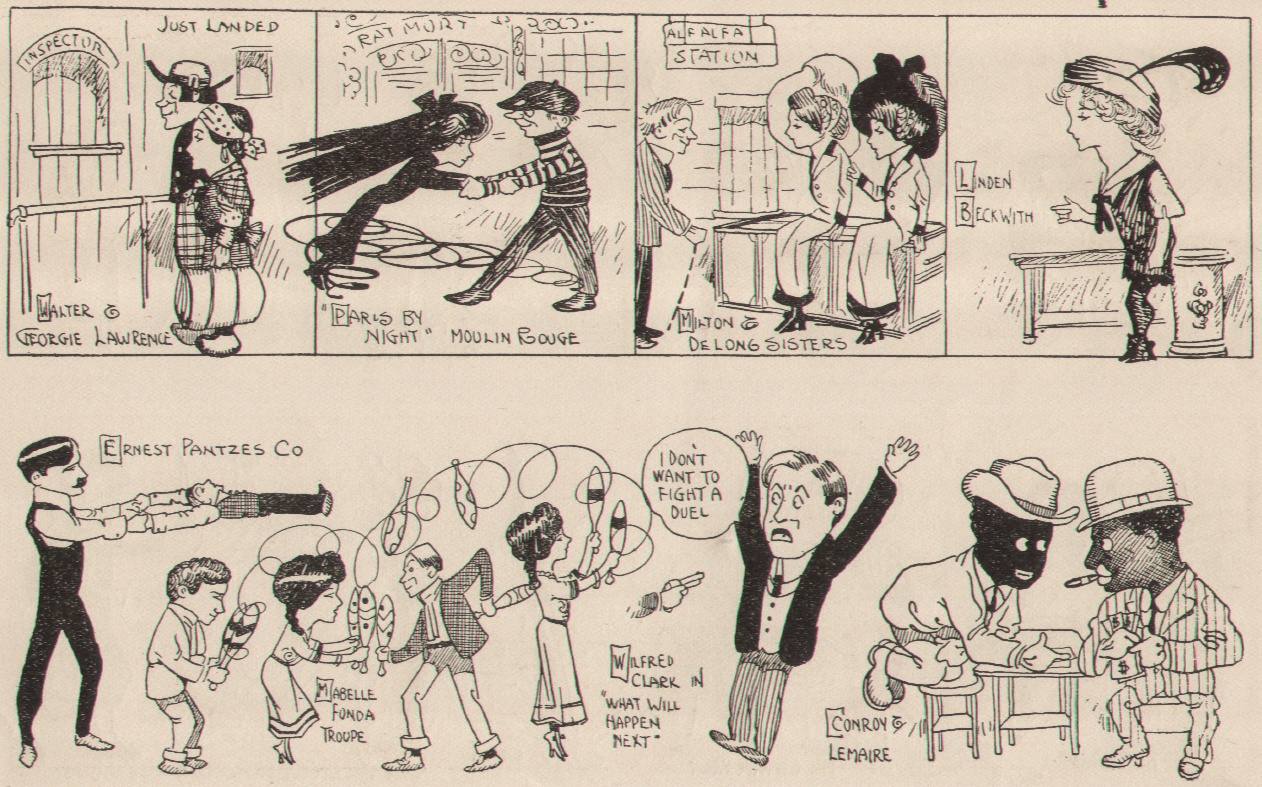
On the below page, we have: Walter & Georgie Lawrence, (Frank) Milton & the Delong Sisters, Linden Beckwith, Ernest Pantzes Company, the Mabelle Fonda Troupe, Wilfred Clark, and lastly, Conroy & Lemaire, a racist blackface comedy duo typical of the period.
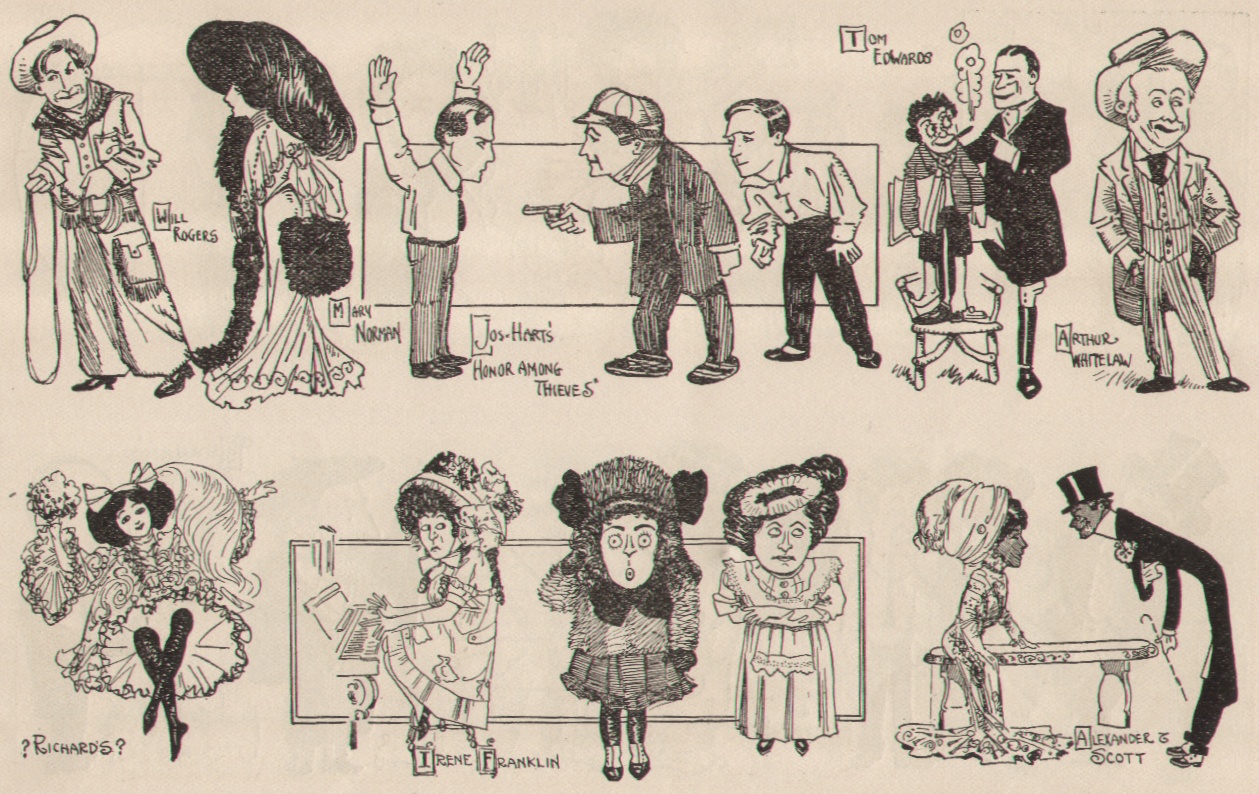
In the next excerpt, humorist Will Rogers is the most famous performer (today) found in B.F. Keith’s booklet. Also found on this page are Mary Norman, Jos. Harts, ventriloquist Tom Edwards, Arthur Whitelaw, Irene Franklin, and the team of Alexander & Scott.
The stand-out in our final sample page, is comedienne Lillian Shaw, controversial for her then-perceived “brazen sexuality”. Other acts on this page are: (Professor) Herbert’s Dogs, Edward Abeles (star of the first filmed version of Brewster’s Millions, 1914, by Cecil B. DeMille), the Armanis, the Eight Geisha Girls, Eva Tanguay, Anna Chance, and her husband, Charley Grapewin (Uncle Charley in the 1939 version of The Wizard of OZ).

Doug Wheeler
TheatricalCartoons AsWeSeeEm AdvertisingStrips
— Doug
Posted at 08:01 AM
Posted in Classic Cartoonists, General, Sexy Stuff, Weird But True | permalink | 2 Comments »
Monday, April 5, 2026
This being April Fool’s Month (why keep it confined to merely one day?), I’m picking up from my April 1 post of an 1880s amateur comic strip, to show here what even anonymous amateurs could do in the Good Old Days to earn some real money — Naughty, Risque Comics!
Below is a circa 1904-1915 comic pamphlet titled What Happy Saw Through the Keyhole in the Door. I regard this parody of Frederick Burr Opper’s Happy Hooligan, as an early predecessor of the later, far more hardcore tijuana bible pamphlets of the 1920s through 1950s, in which comics characters, movie stars, and public figures of the day were depicted in X-Rated comic satires, sold under-the-counter in drug stores, hardware stores, gas stations, etc. After the 1950s, tijuana bibles could be argued to have evolved into the underground comics of the 1960s/70s counter-culture movement.


The “circa 1904-1915″ date, is an educated guess. Happy Hooligan began publication in 1900. In art style and theme, in what the woman behind the keyhole in the door is shown wearing, the above booklet matches similarly themed post cards & other items of that time. For comparison, see the below tin platelets, part of sets sold (surreptitiously) at the 1904 St. Louis World’s Fair (one of which parodies yet another Opper comic strip — Alphonse & Gaston).

Also for Comparison, see this 1903 stereoview published by William H. Rau, in Philadelphia. It is the third card in his six-card peeking-though-a-keyhole set, In Her Boudoir.

By the post-WW I era of flappers and truly explicit comic parodies, What Happy Saw Through the Keyhole in the Door simply would have been too genteel to “do it” for anyone but Gramps.
The turn-of-the-20th-century naughtiness of peeking through a keyhole, is of course, merely a continuance of yet still earlier such motifs, such as shown in the below trade cards published in 1882, by Mrs. Nugent & Co., New York (real name, or a play on “New Gent”?)…

…and in this pair of circa 1860s hand-colored stereoview cards, which in full glorious 3-D color showed 19th century viewers not only a man attempting to peek in on a pair of young women, but also the consequences of getting caught by his victims.


Special Thanks to Melody D. Davis, PhD, from whose collection the stereoviews in this post were scanned.
Doug Wheeler
Frederick Burr Opper
— Doug
Posted at 07:04 AM
Posted in Classic Comics, Clean Cartoonists' Dirty Drawings, General, Sexy Stuff, Weird But True | permalink | No Comments »
Wednesday, March 17, 2026
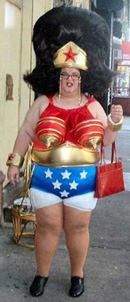
I’ll fill in for the M.C. of Mayhem today with a picture I snapped at DragonCon 2009:
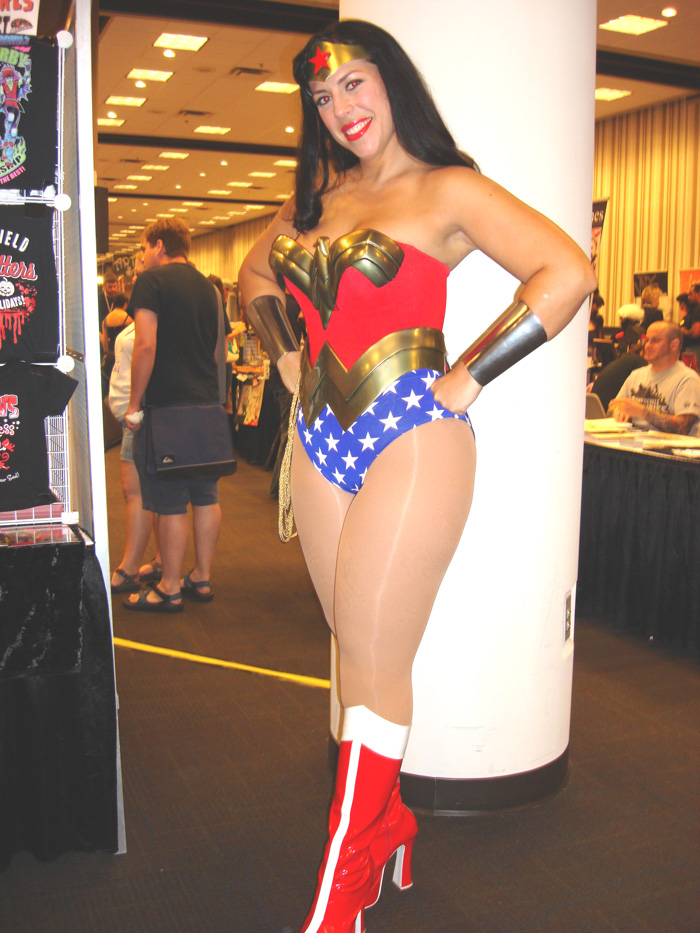
Check out those thighs…those hips…this is an Amazonian R. Crumb would LOVE!

— Tom
Posted at 08:03 AM
Posted in Sexy Stuff, Wacky Wonder Woman | permalink | 2 Comments »
Thursday, March 11, 2026

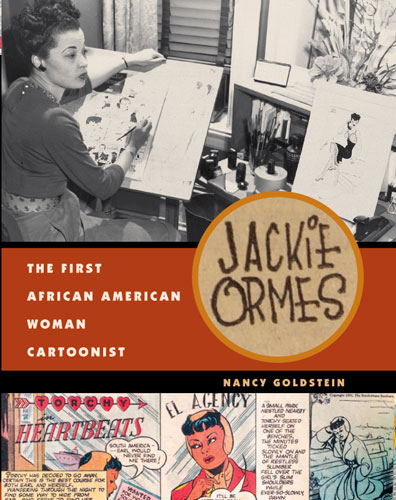
February 2008 was a momentous occasion in comics history. The University of Michigan Press published Nancy Goldstein’s Jackie Ormes: The First African-American Woman Cartoonist.
Goldstein restored a part of our past to us, and not just any part, but a really important part. She gave us the story of a woman cartoonist, an African-American woman cartoonist, an outspoken African-American woman cartoonist, a political outspoken African-American woman cartoonist, who achieved success and acclaim during segregation. O.M.G.
I’ve heard too many comics historians dismiss the racist caricatures drawn by some of the stars of our beloved canon (e.g. McCay, Hergé) with the simple-minded claim that “that was how everyone thought back then.” Ahem. Goldstein not only rescued Jackie Ormes from those who would forget her, she reminded us that the work is not done. The desegregation of comics history has only just begun. Thoughtful, gracious, intelligent, and kind, Nancy Goldstein threw the gauntlet.
Recently we talked a bit about Ormes’ life and significance.
When did you first encounter Jackie Ormes?
Her Patty-Jo doll first drew me to Ormes, but it didn’t take long for her cartoons to become more interesting to me. I’m a doll collector and I’ve written on dolls. My collection primarily consists of Terri Lee dolls, and Terri collectors knew a little about Patty-Jo, the black doll manufactured by the Terri Lee company from 1947-49, and about Jackie Ormes, who created the character in a cartoon. The cartoon was her single panel Patty-Jo ‘n’ Ginger that ran from 1945-56 in the Pittsburgh Courier, the highest circulation black press paper in the later 1940s. I wondered, who is this person that made a fine, upscale black doll in the days when most all black dolls were mammies and Topsy-types?
So I looked through microfilm of old Pittsburgh Courier newspapers for evidence of the doll in her cartoons. It was amazing to see how she pitched her doll in a cartoon! There is one where Ormes has the little girl Patty-Jo asking for a doll for her birthday, and she is carrying a coupon to buy the doll with Jackie Ormes’s name and home address on it, “764 Oakwood, Chicago.” How audacious! We would now call this product placement!
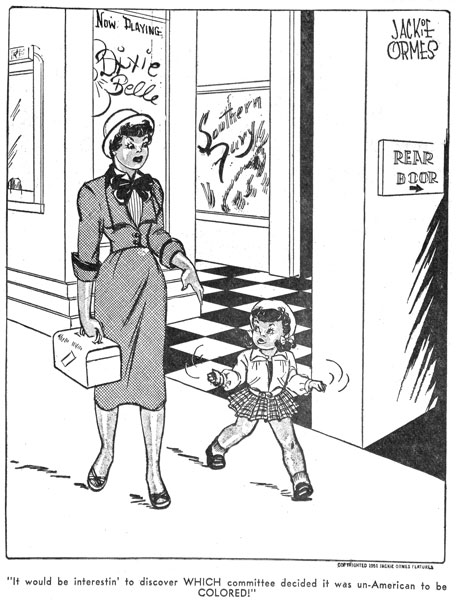
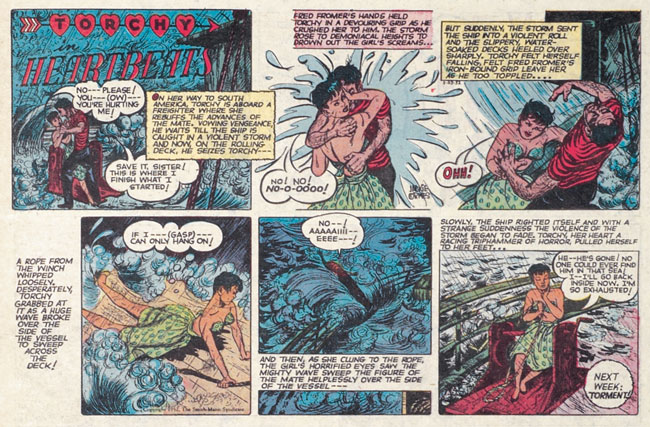
But pretty soon Jackie Ormes’s Patty-Jo cartoons became more interesting than looking for the doll. These were the pre-civil rights days and here was an especially interesting take on that time through the eyes and words of the black press. The Courier was—and still is-a newspaper of advocacy, depicting lives of struggle and achievement. Right in the middle of the news pages was Patty-Jo ‘n’ Ginger with Patty-Jo commenting on topics beyond her years-the arms race, the HUAC, racism, housing, jobs, education, fashions. As I went on to look at her other work, like her two different Torchy series, it was clear this was an extraordinary person, and not much had been written about her. I felt it just had to be done, and quickly because people who might have known her would soon be gone. So I made the book project a top priority, and six years later, in February 2008, the University of Michigan Press published the book, Jackie Ormes: The First African American Woman Cartoonist.
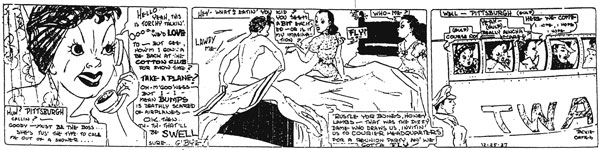
What kind of a person was she?
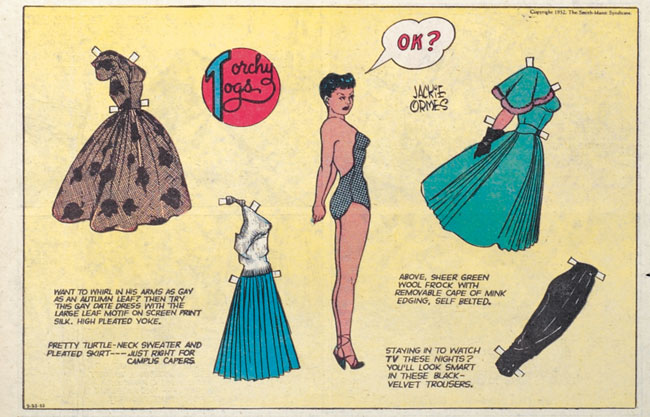
She was independent and courageous in an era when the rule of the day was conformity. Here’s a woman working in the newspaper business, a man’s world at the time. In her cartoons she steps out of the mold, publicly taking on issues like U.S. foreign policy, the HUAC, racism, and more, even while under FBI surveillance because of her left-leaning acquaintances and activities. Her drawings are bold as well. Jackie Ormes’s starring characters are females, unusual for the time. She created smart, beautiful, full-figured women and good-looking children, all dressed in highly detailed, gorgeous fashions. How she employs her fashion sense in cartoons and comics is quite surprising.
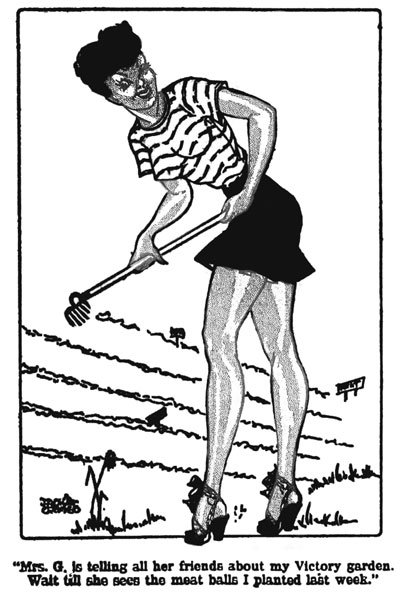
Can you tell us a little about her working conditions?
Jackie Ormes worked through independent contracts with the newspapers; she was not on a newspaper staff, nor in a syndicate such as we think of those today. She created everything herself, from story or gag to all the sketching, erasing, balloons, coloring, everything. She used herself as a model and people who knew her say she looked a lot like her beautiful, curvaceous women characters. Most of her work appeared in the Pittsburgh Courier, a weekly black-owned newspaper that had fourteen big city editions and a circulation from coast to coast at this time. Ormes’s first effort was a year-long comic strip, Torchy Brown in “Dixie to Harlem” in 1937 when she lived in Pittsburgh and then Ohio. She took a break for about seven years, we don’t know why. Now residing in Chicago, in 1945 she drew Candy for four months for the Chicago Defender; then the Patty-Jo ‘n’ Ginger single panel ran from 1945-56 in the Courier; and simultaneously from 1950-54 she revamped the Torchy idea to draw the full color Torchy in Heartbeats. Fashion and beautiful people inspired her drawing. She produced fashion shows and mingled with celebrities, becoming something of a celebrity herself. At the same time she donated much of her time and talent to political issues and to programs promoting racial uplift. Ormes and her husband lived in upscale mixed-race hotels that he managed, and she had a small studio-niche in these apartments. Here she made her cartoons and comic strips and mailed them to the newspaper in Pittsburgh in time for publication. Her lead time was quite short. Sometimes her Patty-Jo ‘n’ Ginger cartoon comments on a topical event that occurred only a week earlier!
How was her work received in her lifetime?
She must have had a following because her work was kept on in the Pittsburgh Courier for so many years. Readers asked her to make a doll after her adorable Patty-Jo character and in 1947 she connected with Terri Lee, a major doll company, to do just that. Letters from fans attest to her popularity. One letter from a black GI thanks her for her drawings of “wholesome American womanhood” since there were so few pin-up pictures of attractive black women at this time. But in 1954 her Torchy came to an end when others continued. I can only conclude that a woman’s romance-adventure strip was just not what the editors wanted at that time.
If you wanted readers to know one thing about Jackie Ormes, what would it be?
Jackie Ormes was a trailblazer, especially for women and African Americans. And yet her story was overlooked for such a long time. Surely there are other inspiring stories and fascinating work like Jackie Ormes’s out there waiting to be rediscovered. If you look through indexes of books on 20th century cartoonists you will not see reference to Jackie Ormes, nor, indeed, to most other black cartoonists, nor are many women cartoonists included. Perhaps racism and sexism have something to do with this neglect; undoubtedly, in the case of black cartoonists, it’s also because the black press was relatively small and the cartoonists remain mostly unknown. Thank goodness this is changing. I hope my book on Jackie Ormes will encourage other researchers to dig into the work of these cartoonists so that we can all now enjoy their talent, insights, and humor.
-Portions of this interview are reproduced with kind permission from Hogan’s Alley: http://cagle.msnbc.com/hogan/

— beth
Posted at 12:03 PM
Posted in Book Reviews, Classic Cartoonists, Interviews, Sexy Stuff | permalink | 1 Comment »
Thursday, February 25, 2026

Fantagraphics’ The Brinkley Girls: The Best of Nell Brinkley’s Cartoons From 1913-1940 is seductive and spell-binding, a siren call of exploding color and really, really pretty girls. I know, because my copy was stolen before I paid for it. A woman stalked me in the bookstore and took it as soon as I set it down to hide in the bathroom. Comics artist and ground-breaking herstorian Trina Robbins, editor of this phenomenal collection, took a few moments to explain to I.T.C.H. how these gorgeous women of style came to life on Hearst’s pages for almost 30 years. I.T.C.H.: When did you first encounter Nell Brinkley?
Trina Robbins: The first Brinkley pages I ever saw were very kindly given to me by Bill Blackbeard, and though they obviously were very beautiful, I saw them out of context, so I didn’t “get it.” If you see Nell out of context, all you see is beautiful art, but the writing that goes with it is necessary in order to really understand what she was doing. Then, when cat yronwode and I co-wrote the first book on women in comics, Women and the Comics, I still had very little to go on about Nell. The biggest piece of information I had came from a Los Angeles group of illustration fans, and that information later turned out to be absolutely faulty!

I.T.C.H.: What kind of a woman was she?
TR: The research I’ve done uncovers a woman whose outlook was as romantic as her writings. She seems to have been sheltered quite a bit from harsh reality by her mother, who managed everything for her. At the same time, she handled her extreme deadlines very well, and seems to have been politically aware. For instance, she was passionately angry about the mistreatment of the WWI vets during the Depression, and she also often expressed her admiration of Eleanor Roosevelt in her daily panels.

I.T.C.H.: Can you tell us a little about her working conditions?
TR: Nell had a carriage house behind her New Rochelle, NY, house, which she turned into a studio. From there she turned out her daily panels and Sunday pages, and often also her movie or stage reviews-a LOT of work! In order to meet her deadlines, she had worked out a system: as soon as she finished a page, she would roll it up and give it to her chauffeur, who would drive it to the train station in time to meet the train to NY. He would pass the art to the conductor through the train window, and when the train arrived at Grand Central station, there’d be a man from the Hearst syndicate waiting for it, to take it to the Hearst offices by deadline.

I.T.C.H.: How was her work received in her lifetime?
TR: Nell was a superstar! She had at least 3 popular songs written about her and her “Brinkley Girls,” when she traveled, newspaper reporters would be at the train station or later at her hotel room to interview her about how she liked their city, although usually the questions were simple stuff like “How do you like San Francisco girls,” to which she would of course answer, “They’re very pretty.” People, especially young women, collected and cut out her art and pasted it into scrapbooks, and little girls would cut out and color her black and white daily pages. Her fans, mostly female, also copied her art, and an obituary about her said that she had more copyists than any other artist except Charles Dana Gibson.

I.T.C.H.: If you wanted readers to know one thing about Nell Brinkley, what would it be?
T-R: Nell drew “like a girl.” My experience and research has shown me that for the most part contemporary male comics historians, scholars, and “experts” interpret pretty art as code for unimportant, trivial, “female.” The world of comics criticism needs to open up to a non male-centric way of looking at comic art, and I think that will only happen when more women enter into that world.
— beth
Posted at 02:02 AM
Posted in Book Reviews, Interviews, Sexy Stuff | permalink | 2 Comments »
Tuesday, February 23, 2026
Minnie Never Looked Like This!!
When Craig Yoe first approached me about joining the exalted ranks of The I.T.C.H. Blog posters, I humbly demurred. How could my merely human level of wit and insight possibly match that of Yoe’s? Still, he insisted he wanted me to contribute content, so I figured some agency was pressuring him to hire a minority (I’m of Dutch descent). Not wanting to get my old friend in Dutch with the authorities (any more than he can do on his own), I agreed to join. So I’ll be alienating Craig’s hard-won readership on a weekly basis.
I’ve been mulling over the topic of my first post for some time. Should I write a manifesto on what I believe makes comics special? If any of you read the magazine I publish, Hogan’s Alley, you are already largely familiar with my perspective on cartooning and its place in the larger culture. Besides, it sounds kind of pretentious, and my appreciation of cartooning is anything but. So I just thought I’d share with you some fun work I was looking at recently.
Like many comics fans, my gateway to an obsession with comics was the Disney line. When I first started reading them, I didn’t know about bylines or bullpens-just the stories. And it wasn’t until years later that I learned that many of the Disney stories I enjoyed were done by Paul Murry. Eventually, fellow fan (and occasional Hogan’s Alley writer) Germund von Wowern, filled in even more of the gaps in my knowledge of Murry’s impressive and prolific career. And imagine my delight when Germund revealed that Murry was a first-rate good girl artist!

I became acquainted with Murry through his depictions of Goofy, Mickey Mouse, Jose Carioca, and many other regulars of the Disney universe. But Murry was far more than a funny-animal cartoonist; his depictions of women might come across today as sexist relics from a less enlightened era, but DAMN he was good. (I’ve included a sampling here; if you’re at work, make sure you’re reading this while no coworkers are nearby.) Many thanks to Germund for sharing these with me so that I could share them with you years later.


And I guess that this nonlinear connection between my early love for comics and my continuing discoveries as I and others peer into every nook and cranny that our art form contains is what makes cartooning research so exciting for me: I will never know as much as I want to, and each discovery-whether my own or that of someone else-makes me want to know more (and hence the image I present at the end of my post). I look forward to continuing this journey with you here at The I.T.C.H. Blog and, if you’re so inclined, in the pages of Hogan’s Alley.
-Tom Heintjes
Publisher, Hogan’s Alley
— Tom
Posted at 09:02 AM
Posted in Classic Cartoonists, General, Sexy Stuff | permalink | 4 Comments »
Friday, February 12, 2026
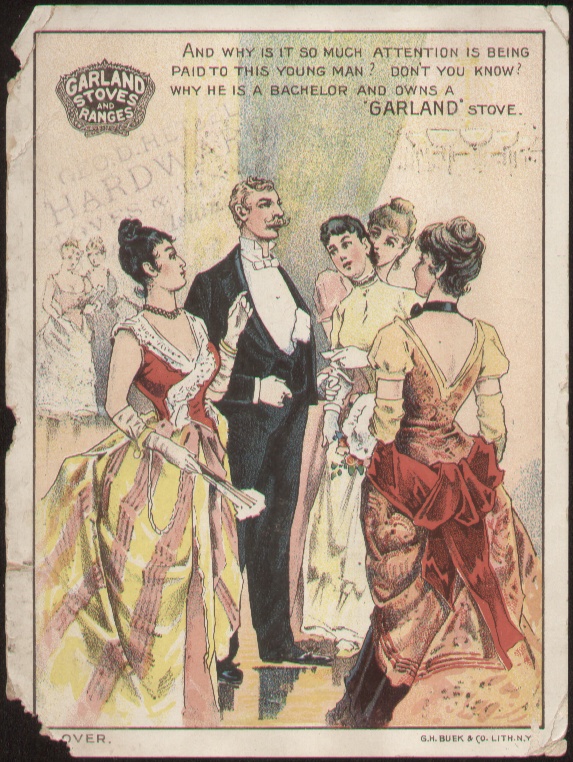
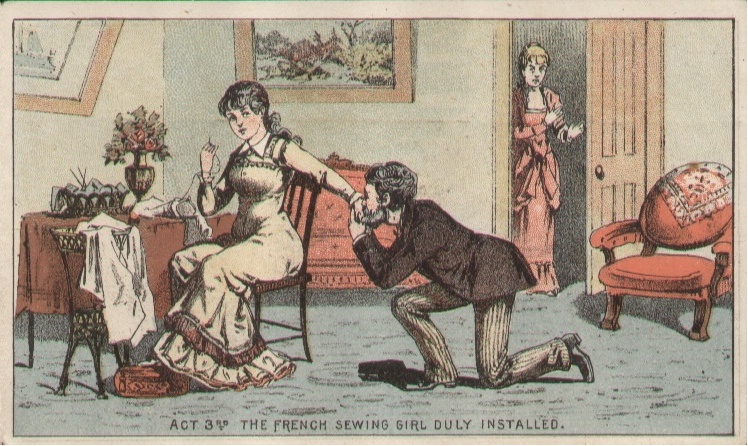
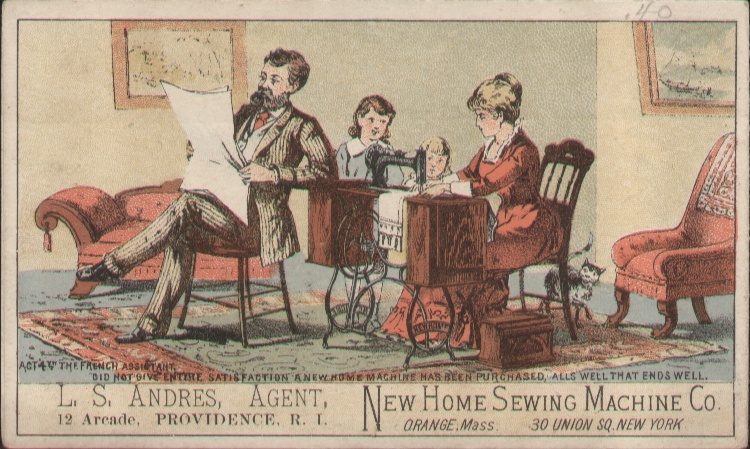
Harken back to the Good Old (Old, old, old) Days — the 1870s to 1890s — when America was God-Fearing, and Marriage wasn’t based on cheap values, but rather on the finest products money could buy!
First, two examples of heated romance, Free Enterprise-style…
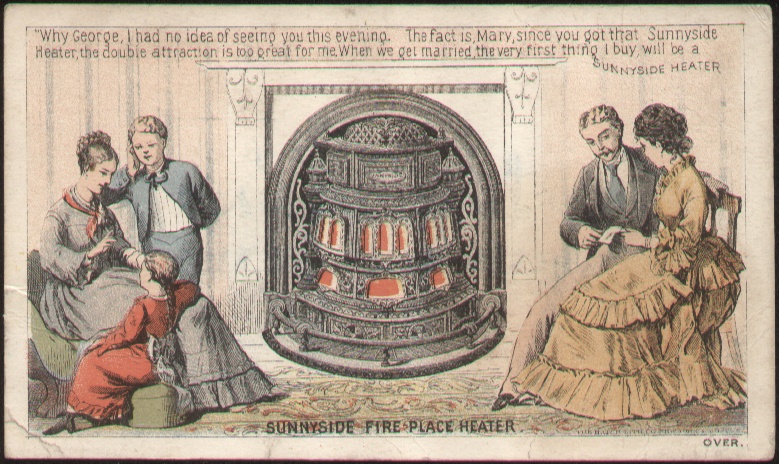
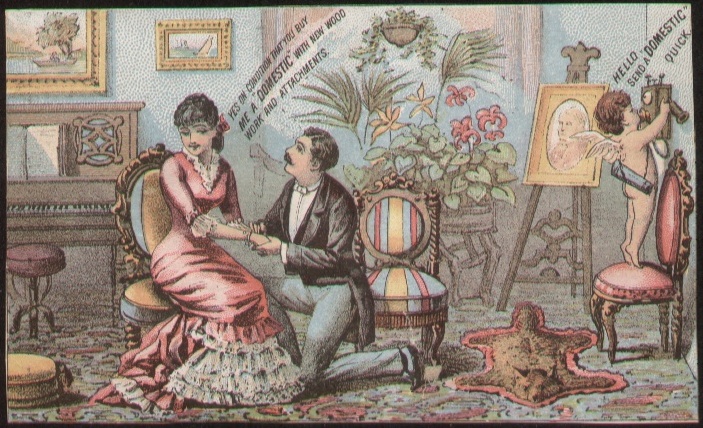
Next, this young woman knows how capitalism works, bartering herself for a dreamy “Domestic”-brand sewing machine!
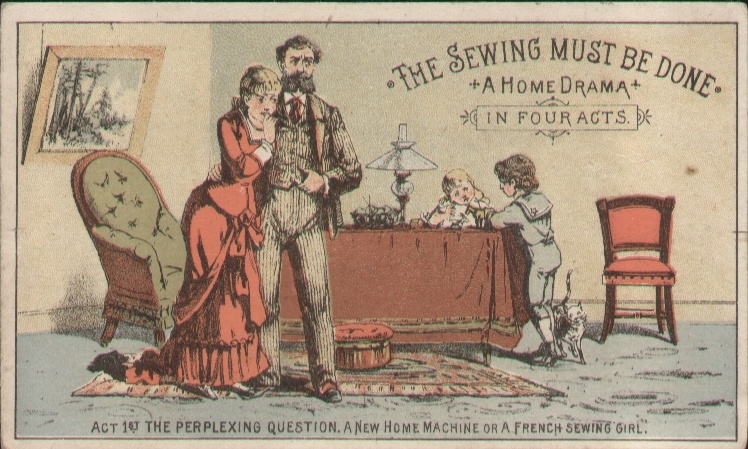
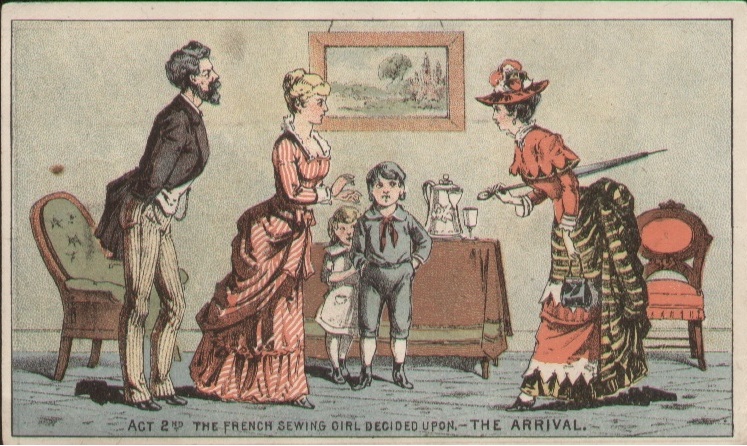
She has made a wise choice, perhaps because she read ahead, and is aware of the dangers illustrated in our final example…
…a Demonstration of how good, old-fashioned free market values defend the moral foundation of American Home & Family, against the seductive corruption of those naughty French! Take that, you shameless European harlot!
Doug Wheeler
ValentinesDay AdvertisingStrips
— Doug
Posted at 05:02 AM
Posted in General, Sexy Stuff | permalink | No Comments »
|
SUBSCRIBE

A-List: The I.T.C.H. Blog Contributors
BLOGS
COMIC NEWS
MY FAVORITE SOURCES FOR COOL BOOKS
THE PUBLISHER OF YOE BOOKS
THE PUBLISHERS OF OTHER BOOKS BY CRAIG YOE
CATEGORIES
ARCHIVES
META
Every Wednesday is
WACKY WONDER WOMAN WEDNESDAY
archive
DOLL MAN WEIRDNESS
archive
|