










From the I-Wish-I-Were-Her Desk: Nancy Goldstein Talks Jackie Ormes

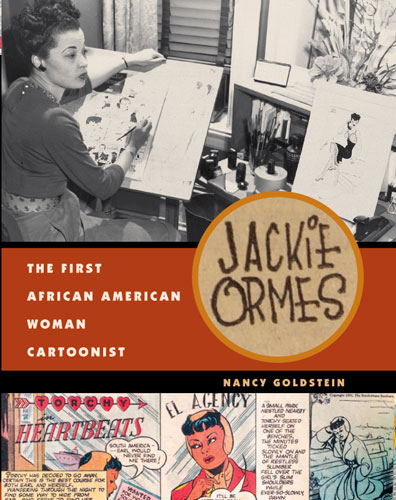
February 2008 was a momentous occasion in comics history. The University of Michigan Press published Nancy Goldstein’s Jackie Ormes: The First African-American Woman Cartoonist.
Goldstein restored a part of our past to us, and not just any part, but a really important part. She gave us the story of a woman cartoonist, an African-American woman cartoonist, an outspoken African-American woman cartoonist, a political outspoken African-American woman cartoonist, who achieved success and acclaim during segregation. O.M.G.
I’ve heard too many comics historians dismiss the racist caricatures drawn by some of the stars of our beloved canon (e.g. McCay, Hergé) with the simple-minded claim that “that was how everyone thought back then.” Ahem. Goldstein not only rescued Jackie Ormes from those who would forget her, she reminded us that the work is not done. The desegregation of comics history has only just begun. Thoughtful, gracious, intelligent, and kind, Nancy Goldstein threw the gauntlet.
Recently we talked a bit about Ormes’ life and significance.
When did you first encounter Jackie Ormes?
Her Patty-Jo doll first drew me to Ormes, but it didn’t take long for her cartoons to become more interesting to me. I’m a doll collector and I’ve written on dolls. My collection primarily consists of Terri Lee dolls, and Terri collectors knew a little about Patty-Jo, the black doll manufactured by the Terri Lee company from 1947-49, and about Jackie Ormes, who created the character in a cartoon. The cartoon was her single panel Patty-Jo ‘n’ Ginger that ran from 1945-56 in the Pittsburgh Courier, the highest circulation black press paper in the later 1940s. I wondered, who is this person that made a fine, upscale black doll in the days when most all black dolls were mammies and Topsy-types?
So I looked through microfilm of old Pittsburgh Courier newspapers for evidence of the doll in her cartoons. It was amazing to see how she pitched her doll in a cartoon! There is one where Ormes has the little girl Patty-Jo asking for a doll for her birthday, and she is carrying a coupon to buy the doll with Jackie Ormes’s name and home address on it, “764 Oakwood, Chicago.” How audacious! We would now call this product placement!
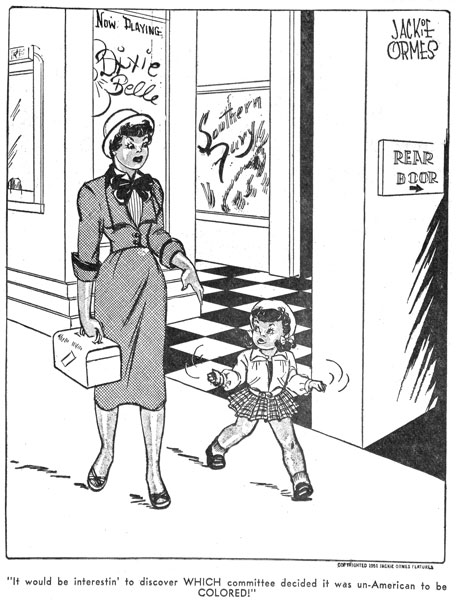
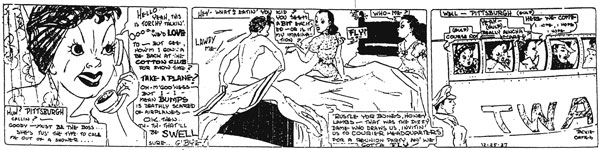
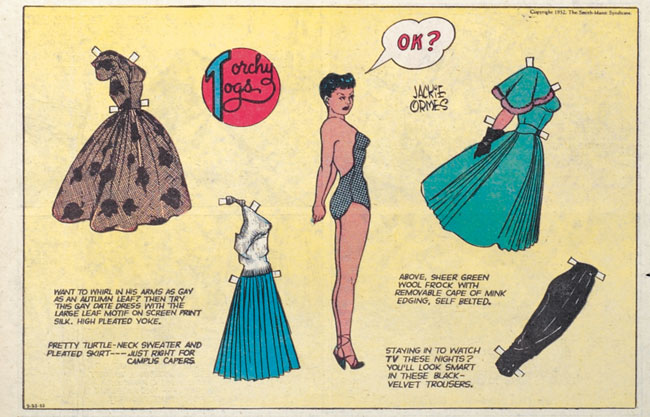
But pretty soon Jackie Ormes’s Patty-Jo cartoons became more interesting than looking for the doll. These were the pre-civil rights days and here was an especially interesting take on that time through the eyes and words of the black press. The Courier was—and still is-a newspaper of advocacy, depicting lives of struggle and achievement. Right in the middle of the news pages was Patty-Jo ‘n’ Ginger with Patty-Jo commenting on topics beyond her years-the arms race, the HUAC, racism, housing, jobs, education, fashions. As I went on to look at her other work, like her two different Torchy series, it was clear this was an extraordinary person, and not much had been written about her. I felt it just had to be done, and quickly because people who might have known her would soon be gone. So I made the book project a top priority, and six years later, in February 2008, the University of Michigan Press published the book, Jackie Ormes: The First African American Woman Cartoonist.
What kind of a person was she?
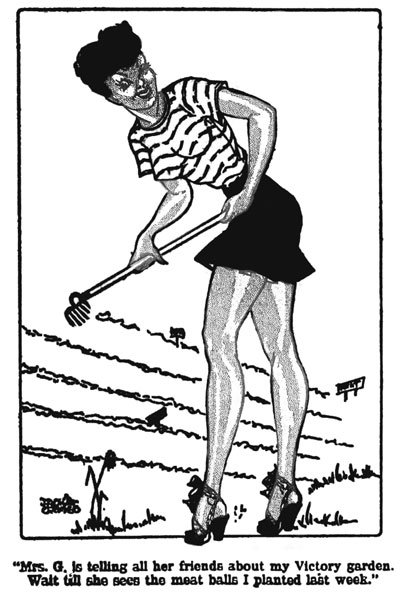
She was independent and courageous in an era when the rule of the day was conformity. Here’s a woman working in the newspaper business, a man’s world at the time. In her cartoons she steps out of the mold, publicly taking on issues like U.S. foreign policy, the HUAC, racism, and more, even while under FBI surveillance because of her left-leaning acquaintances and activities. Her drawings are bold as well. Jackie Ormes’s starring characters are females, unusual for the time. She created smart, beautiful, full-figured women and good-looking children, all dressed in highly detailed, gorgeous fashions. How she employs her fashion sense in cartoons and comics is quite surprising.
Can you tell us a little about her working conditions?
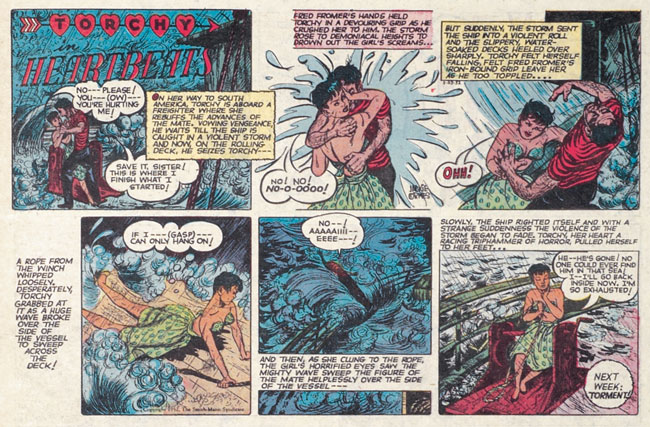
Jackie Ormes worked through independent contracts with the newspapers; she was not on a newspaper staff, nor in a syndicate such as we think of those today. She created everything herself, from story or gag to all the sketching, erasing, balloons, coloring, everything. She used herself as a model and people who knew her say she looked a lot like her beautiful, curvaceous women characters. Most of her work appeared in the Pittsburgh Courier, a weekly black-owned newspaper that had fourteen big city editions and a circulation from coast to coast at this time. Ormes’s first effort was a year-long comic strip, Torchy Brown in “Dixie to Harlem” in 1937 when she lived in Pittsburgh and then Ohio. She took a break for about seven years, we don’t know why. Now residing in Chicago, in 1945 she drew Candy for four months for the Chicago Defender; then the Patty-Jo ‘n’ Ginger single panel ran from 1945-56 in the Courier; and simultaneously from 1950-54 she revamped the Torchy idea to draw the full color Torchy in Heartbeats. Fashion and beautiful people inspired her drawing. She produced fashion shows and mingled with celebrities, becoming something of a celebrity herself. At the same time she donated much of her time and talent to political issues and to programs promoting racial uplift. Ormes and her husband lived in upscale mixed-race hotels that he managed, and she had a small studio-niche in these apartments. Here she made her cartoons and comic strips and mailed them to the newspaper in Pittsburgh in time for publication. Her lead time was quite short. Sometimes her Patty-Jo ‘n’ Ginger cartoon comments on a topical event that occurred only a week earlier!
How was her work received in her lifetime?
She must have had a following because her work was kept on in the Pittsburgh Courier for so many years. Readers asked her to make a doll after her adorable Patty-Jo character and in 1947 she connected with Terri Lee, a major doll company, to do just that. Letters from fans attest to her popularity. One letter from a black GI thanks her for her drawings of “wholesome American womanhood” since there were so few pin-up pictures of attractive black women at this time. But in 1954 her Torchy came to an end when others continued. I can only conclude that a woman’s romance-adventure strip was just not what the editors wanted at that time.
If you wanted readers to know one thing about Jackie Ormes, what would it be?
Jackie Ormes was a trailblazer, especially for women and African Americans. And yet her story was overlooked for such a long time. Surely there are other inspiring stories and fascinating work like Jackie Ormes’s out there waiting to be rediscovered. If you look through indexes of books on 20th century cartoonists you will not see reference to Jackie Ormes, nor, indeed, to most other black cartoonists, nor are many women cartoonists included. Perhaps racism and sexism have something to do with this neglect; undoubtedly, in the case of black cartoonists, it’s also because the black press was relatively small and the cartoonists remain mostly unknown. Thank goodness this is changing. I hope my book on Jackie Ormes will encourage other researchers to dig into the work of these cartoonists so that we can all now enjoy their talent, insights, and humor.
-Portions of this interview are reproduced with kind permission from Hogan’s Alley: http://cagle.msnbc.com/hogan/

— beth




Intriguing program. I’m suprised I wouldnt notice this on a large news sites first of all. Nicely played!