Get these books by
Craig Yoe: |
|
|
|
|
|
|
|
|
|
|
|
|
|
|
|
|
|
|
|
|
|
|
|
|
|
|
|
|
|
|
|
|
|
|
|
|
|
|
|
|
|
|
|
|
|
|
|
|
|
|
|
|
|
|
|
|
|
|
Get these books by
Craig Yoe: |
|
|
|
|
|
|
|
|
|
|
|
|
|
|
|
|
|
|
|
|
|
|
|
|
|
|
|
|
|
|
|
|
|
|
|
|
|
|
|
|
|
|
|
|
|
|
|
|
|
|
|
|
|
|
|
|
|
|
|
Archive for the ‘Weird But True’ Category
Sunday, March 4, 2026
WARNING: The below content reprints hate-filled anti-Catholic propaganda.
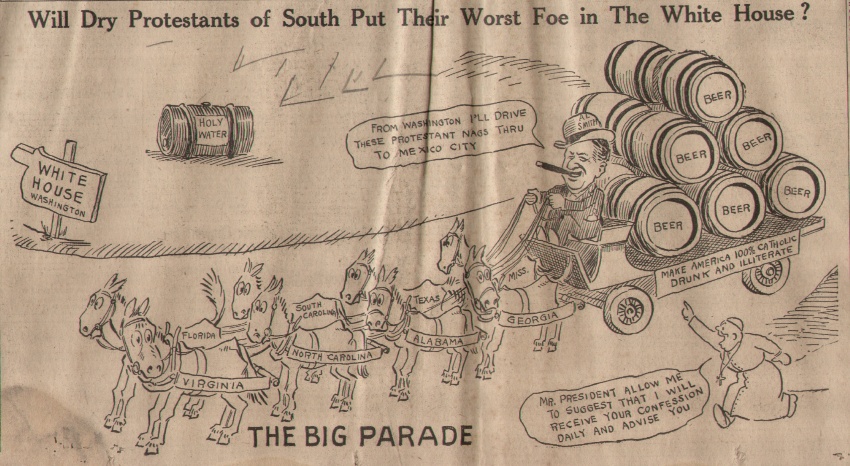
Making the news for the past week+, has been rival Republican Presidential Front-Runner, Rick Santorum, for any number of stupid, ignorant, or simply prejudiced, extremist remarks. But the remarks this post is specifically aimed at is Santorum’s reaction to John F. Kennedy’s speech about how a Catholic President (Kennedy) would keep Church and State separate, and would be the President of America, not a mere extension of the Pope. Santorum said that listening to Kennedy’s speech, makes him want to “throw up”.
Santorum either deliberately ignores, or is outright ignorant of, the fact that America had a long, long, longtime fear, that a President who was Catholic would be nothing but a pawn of the Pope, and that electing a person of Catholic faith to the Presidency, would turn the United States into a Roman Catholic Theocratic Dictatorship. Which is why John F. Kennedy — a Catholic — addressed such fears.
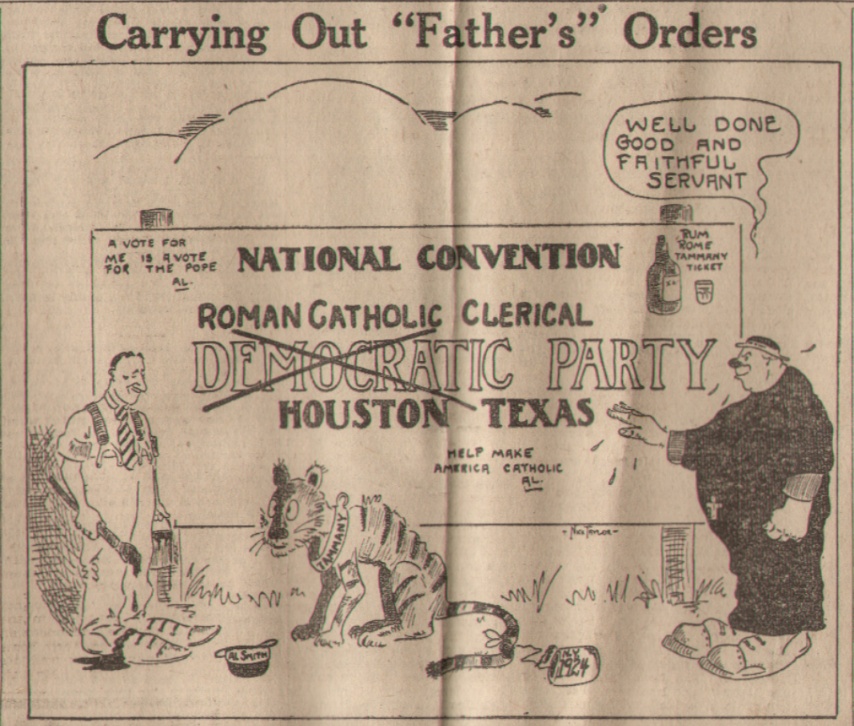
The issue of the separation of Church and State — specifically in preventing a (ludicrously) imagined American Roman Catholic Theocracy — had arose again and again in the history of this majority Protestant nation, as the cartoons from these periods reflect. The most recent pre-Kennedy time that it was a huge mainstream issue, was in 1928, when the Democratic Presidential nominee — Al Smith — was Catholic.
To illustrate what catholic politicians faced prior to John F. Kennedy, I’ve posted here, cartoons and pages from the September 1st, 1928 issue of The Fellowship Forum, a weekly newspaper published in Washington, D.C. and distributed nationally. The Fellowship Forum joined together the Republican Party, Fundamentalist Evangelical Protestants, Prohibitionists, and the Ku Klux Klan (then considered mainstream), all in support of the Republican nominee for President, Herbert Hoover.
Click on any picture, to see larger versions.
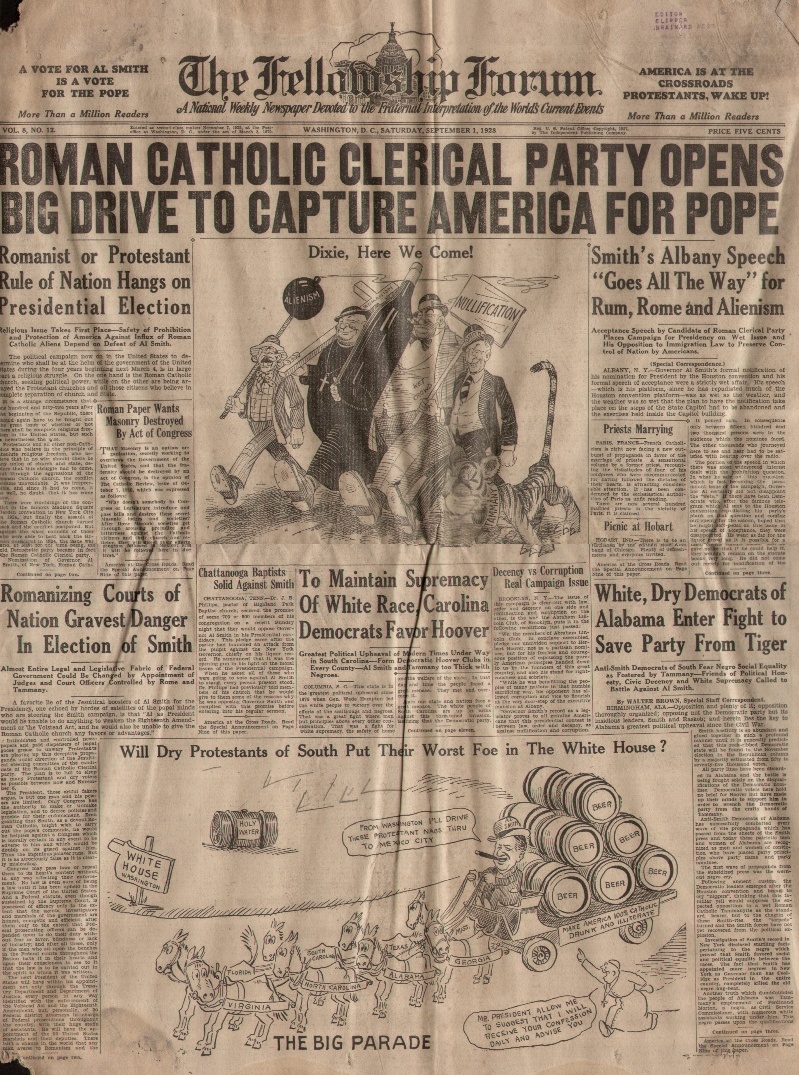
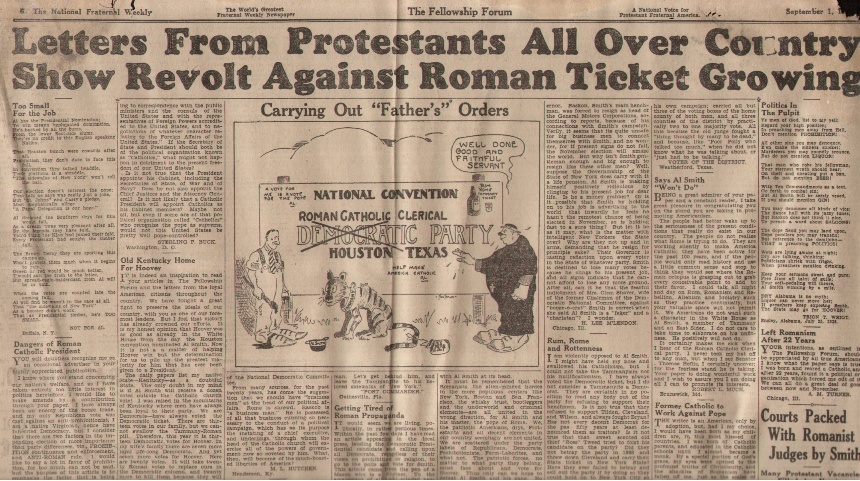
On the newspaper page sections above, I’ve deliberately provided scans at a size large enough for the paper’s abhorent headlines to be readable, but too small for the full articles to be read — I believe in exposing rather than hiding prejudicial history, so that it can be learned from; but I have to keep in mind, that there may be a few people out there who could misuse such material for its original, hate-filled purpose.
Santorum seems oblivious to this history. After J.F.K’s Presidency, the fear that catholic politicians would attempt to impose their religious beliefs upon all Americans, would destroy the separation of Church and State, or would take orders from the Pope, became a dead issue for all but the most paranoid. Santorum, in his many statements, revives this dead issue (For himself, at least, and possibly for some of his fellow GOP). As he has outright stated his desire to impose his religious beliefs upon everyone else. Whereas the below 1928 Fellowship Forum cartoon falsely took aim at the Democratic Party as being a party seeking to establish a theocracy, it is now a large segment of the Republican Party — with Santorum seeking to lead that segment — openly calling for the laws of the United States to be ruled by the Christian Bible.
On February 20th, a cartoon appeared in USA Today, which made me cringe. It showed Santorum, in bed with a Roman Bishop or Cardinal, and reminded me of the hateful cartoons of the past, such as the ones I am showing now in this post (It’s cartoon #12 in the following USA Today February Cartoons — they don’t permit a direct link to it). It also reminded me of the conservative cartoonist of a few years ago, who showed blatant ignorance of past racist cartoons (or at least claimed such) by depicting President Obama as a monkey, being shot by cops. I now see, though — in fairness to the creator of the Santorum cartoon, he was likely merely wanting to show how Santorum wants religion to rule our lives — and Santorum being Catholic, it wouldn’t have made sense to show a Protestant Pastor, instead.
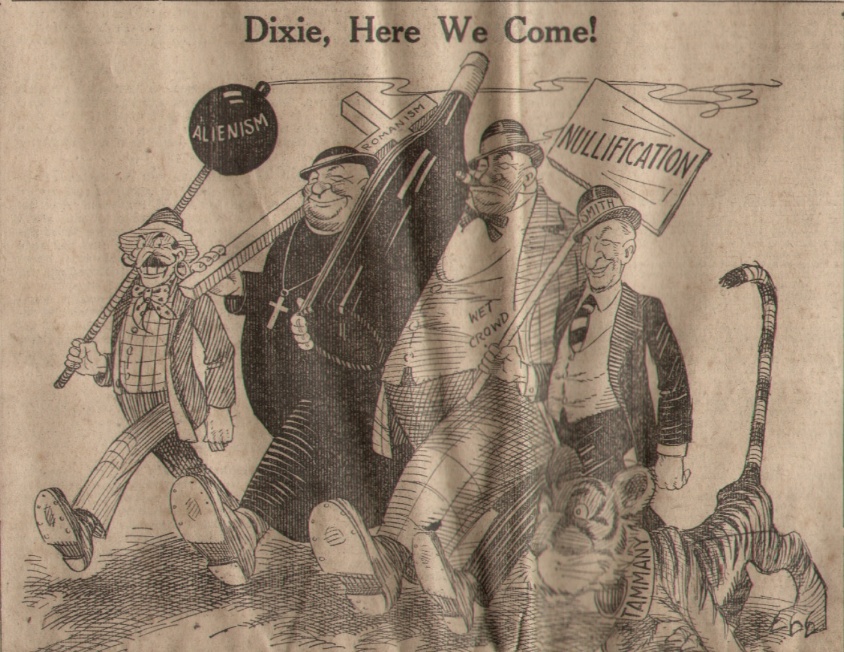
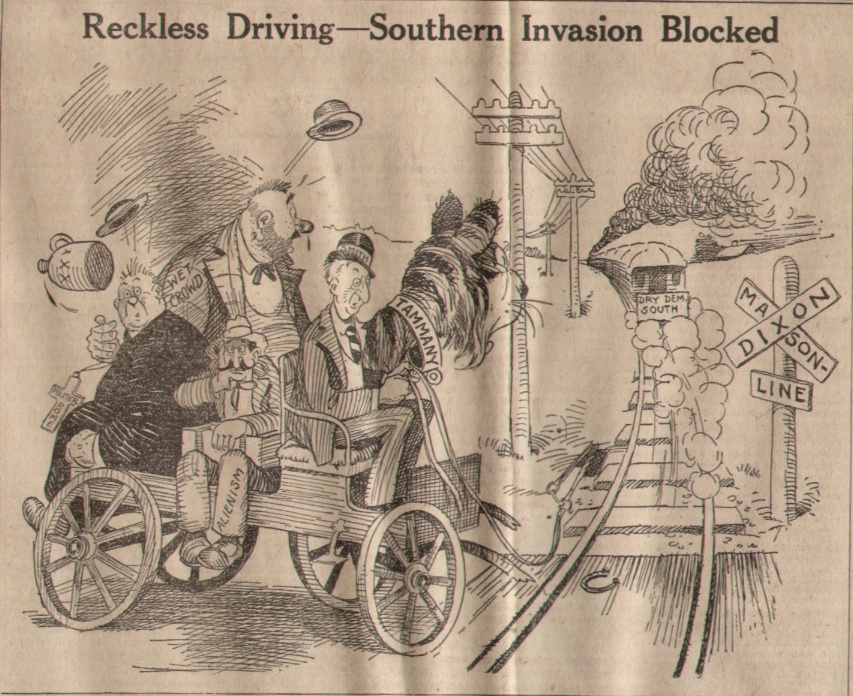
Below, the front page of the June 16th, 1928 issue of The Fellowship Forum, which I showed back in 2010, as an example of extreme Republican propaganda of the past.
While the Republican Party seems to have progressed from 1928 in regards to Catholics (their choices are currently down to two Catholics, a Mormon, and whatever Ron Paul is), in other ways, they are seeking to take the country back to the pre-T.R. 1800′s. The Right-Wing Extremists now in control, appear to want to make the Republican Party, an Anti-Science, Anti-Education, Pro-Theocracy Party. Rick Santorum, is helping define them, as precisely that.

Doug Wheeler
ElectionCartoons

— Doug
Posted at 08:03 AM
Posted in General, Political Cartoons, Weird But True | permalink | No Comments »
Tuesday, February 21, 2026

I hadn’t given thought to just how few Tuesdays are free of Presidential Primaries or Holidays the first half of this year. It’s been a month since the previous Tigwissel Tuesday, and will be a month again until the next.
Anyway, we’ll continue to sporadically present other scientists, inventors, and explorer parodies, between actual Prof. Tigwissel episodes, until we get back to a large succession of open Tuesdays.
Above, from the front page of the April 8th, 1878 issue of the (New York) Daily Graphic, The Humors of the Howgate Colonization Plan. Some Cool Reflections., by Prof. Tigwissel‘s creator, comic artist Livingston Hopkins. This parodies the plans of Captain Howard Howgate — who, lead a polar expedition in 1878, and who yes, indeed, had the goal of colonizing the Arctic…
Click on the above comic to view it in detail, and read its text.
Below, Hopkins had previously touched on the subject of Arctic exploration, in Prof. Tigwissel‘s third comic strip appearance, of July 28th, 1875. Click on the below comic, to be taken to a description of it, and find link to high resolution version.

Doug Wheeler
NYDailyGraphic Polar Exploration
— Doug
Posted at 08:02 AM
Posted in Classic Cartoonists, General, Weird But True | permalink | No Comments »
Friday, February 3, 2026
Tonight, February 3rd, from 4 to 7 pm, will be a reception for the gallery exhibit, Victorian Narrative Stereography: 1855-1910, at the Little Gallery of Sage College of Albany. It is located on campus, in Rathbone Hall, 140 New Scotland Avenue, Albany, NY. Afterwards, the exhibit will be open thru February 26, Sunday - Friday, Noon - 4 pm.
Click here for a link to the Little Gallery web page.
And here, to open a pdf file version of the catalog for the show.
Curated by Sage Assistant Professor Dr. Melody Davis, the exhibit presents original Victorian comic and genre stereoview sequences — i.e., 3D 19th century multi-photo sequential narratives, telling often comic episodes, in a fashion similar to multi-panel comic strips. Lorgnette stereoviewers, which you hold up to see through, will be available, for visitors to view the scenes in 3D.
(Above, from the April 16th, 1859 issue of the British Punch, we see a man looking through the window of a stereoview shop, knocked closer to that window by two passing boys.)
Professor Davis’ doctoral dissertation treated the subject of women in narrative stereography, focusing both upon the depiction of gender and women as patrons of the medium. Her article, “The New Woman in American Stereography,
1870-1900″, was recently published in The New Woman International: Photography
and Film, 1890-1930 (University of Michigan Press, 2011).
Click on the above & below cartoons, to view them in detail, and read the captions.
Above, from Ballou’s Monthly, October 1862, comes Beauties of the Stereoscope. Below, So Like Matrimony, by Henry L. Stephens, from the July 7th, 1860 Vanity Fair.
Below, four stereoview cards from the narrative sequence, Woman will no longer be the mere slave (title taken from the 2nd view). The full six-card sequence, published in 1900 by Strohmeyer & Wyman, is part of the show.
Click on the below stereoviews, to see them in detail, and read their captions.
In addition to the stereoviews themselves, there will be a small number of Victiorian Age cartoons & comic strip sequences, which I have lent to the show. These parallel the themes shown in the stereoviews, and in a few cases, demonstrate how one format straight out ripped off — or inspired — the other (and vice-versa).
Amongst the comics shown, is the below two-page sequence, Stereoscopic Slides, by artist Frank Bellew, Sr., joking that looking at 3D stereoviews for too long, can make one cross-eyed. It appeared in the October, 1860 edition of Harper’s Monthly. (Of the cartoons I am posting here, only the below two pages are in the show.)
In addition to the lorgnette viewers and exhibited stereoviews, the exhibit features a Victorian parlor, with the more common type of stereoviewer, and a sampling of cards for visitors to experience viewing, as shown in the cartoon below.
By artist Livingston Hopkins, the below is but one panel from a multi-panel sequence titled The Melancholy Days, found on the front page of the October 11th, 1882 issue of the (New York) Daily Graphic.
Doug Wheeler
BritPunch NYDailyGraphic
— Doug
Posted at 11:02 AM
Posted in Classic Cartoonists, General, Weird But True | permalink | No Comments »
Monday, January 30, 2026
WARNING: Some of the below cartoons contain racist imagery and slurs.


We close out our extracts from the January 1912 issue of Cartoons Magazine, with Sports, and Concrete Furniture.
Yes, concrete furniture.
When I spotted the first cartoon above, I at first thought this was a totally fascetious joke. Then I noticed a second concrete furniture cartoon, from a different newspaper, right next to it.
So I checked it out, and yes. Yes, indeed. Thomas A. Edison not only invented concrete furniture (check out this December 9th, 1911 article in the New York Times), but, he had previously invented cement houses, for that furniture to go into.
Click on the above & below pictures, to view them in detail, and read the captions.

Above, three baseball cartoons involving the 1911 World Series Ticket Scandal, in which the American League wanted the New York Giants kicked out of the National League, for having sold World Series Tickets directly to speculators and ticket scalpers, for a kick back.
Below, two cartoons from artist Clare Briggs’ Kelly Pool series.

Finally, we get an early start on February’s African American History Month, with the below page of racist cartoons concerning world heavyweight boxing champion Jack Johnson. The term “Great White Hope” was applied by boxing promoters, to a series of white opponents — all unsuccessful — that they threw at Johnson. Whites were highly resentful of his victories. The below cartoons, make reference to the return of Johnson to the U.S., from a 1911 match in England.

Next month, we continue with the February issue.
Doug Wheeler
BlackHistory Tigwissel Tuesdays Ole May baseball cartoons billiards pool
— Doug
Posted at 11:01 AM
Posted in Classic Cartoonists, General, Weird But True | permalink | 2 Comments »
Tuesday, July 26, 2025

Just a quickie this week, as we continue our chronological march towards to the first full-fledged Professor Tigwissel adventure (next week!)
Above, a close-up from the bottom right corner of a full-page of cartoons by artist Livingston Hopkins, which appeared on the front of the February 22nd, 1875 issue of the (New York) Daily Graphic. Here, Hopkins joins the long list of comic artists who have parodied themselves.
Of note, is that while the “Professor” shown having difficulty locating Hopkins’ brain, does not resemble Hopkins’ recurring Professor Tigwissel character, he does resemble the “Mr. Tigwissel” who got hit in the head with a potted plant while viewing a comet, seen in last week’s entry of Tigwissel Tuesdays — this time given the appelation “Professor”.
Perhaps just mere coincidence. Or, perhaps, Hopkins’ subconscious working towards eventually merging the name Tigwissel with the visual image of a scientific egghead, that he’d previously used for Professor Simple… ?
Doug Wheeler
ProfTigwissel NYDailyGraphic Phrenology
— Doug
Posted at 08:07 AM
Posted in Classic Cartoonists, Classic Comics, General, Weird But True | permalink | No Comments »
Saturday, May 21, 2025
Happy End of World!
As predicted by preacher Harold Camping (who, luckier than most of us, is now experiencing his personal Second-End-Of-the-World!) Harold’s world previously ended on his predicted Judgement Date of September 6, 1994. We can only guess that Camping got that date mixed up with the day the world truly ended for his alternative self in one of Earth’s many parallel dimensions — but, he and his followers feel they’re in the right time-space location now, even if others of us have some doubt…
This all is not to be confused with the other End of the World occuring later this year — December 21, 2025 — which happens to be my birthday. I’ll be passing a certain age milestone, so, believe me when I say that day is certain to be apocalyptic!
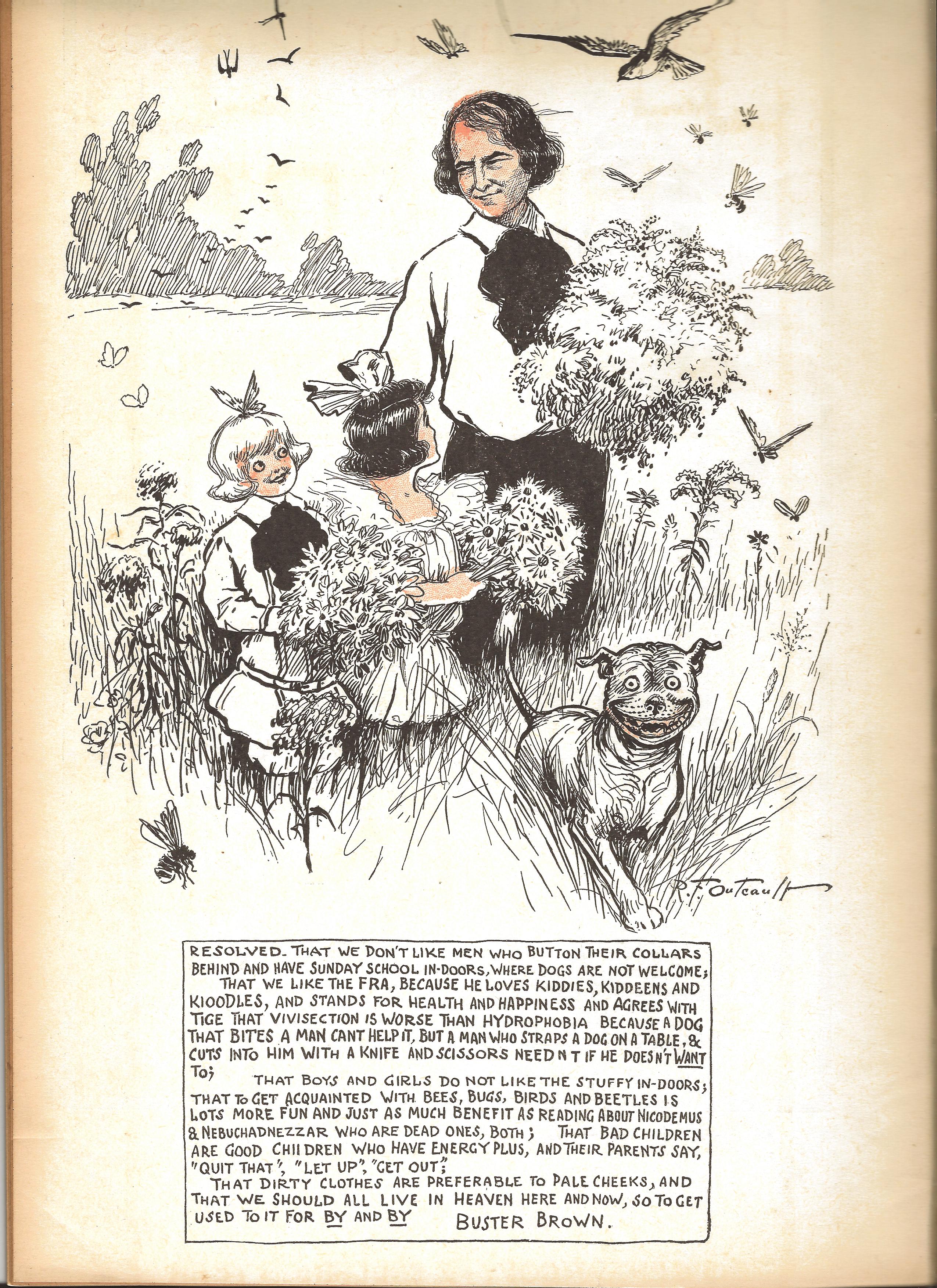
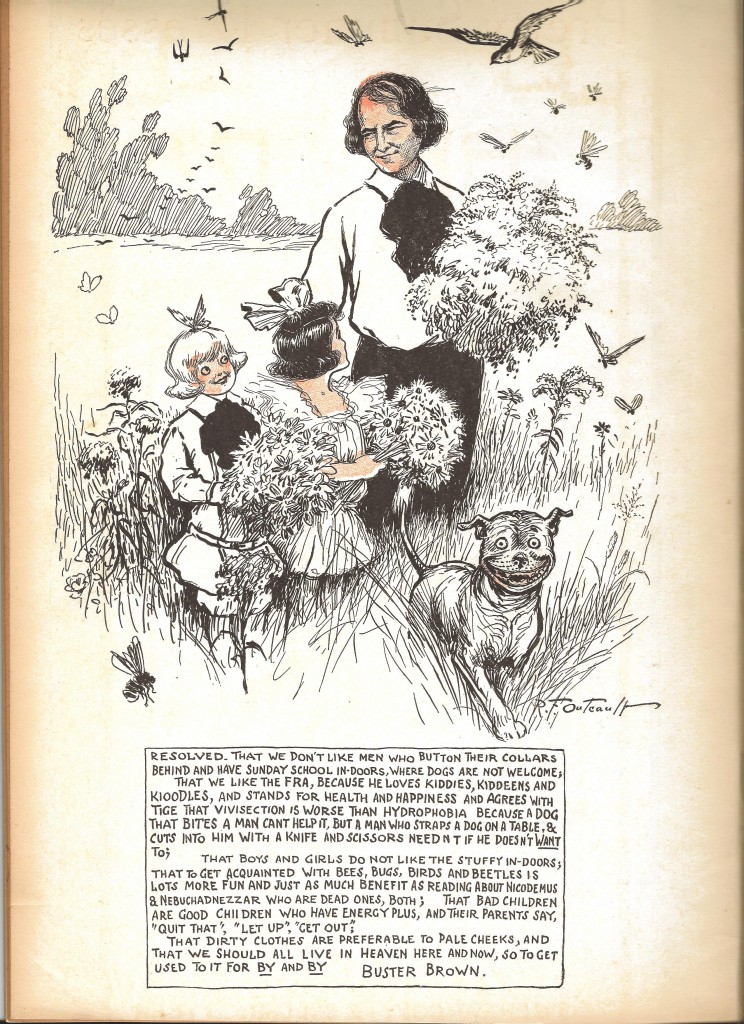
Anyway, I felt the above image by Richard Felton Outcault, showing Buster Brown, Mary Jane & Tige cavorting in a field with philosopher Elbert Hubbard, to have a sufficiently idyllic & cult-like look to match this wonderful day! A perfect last image to hold on to, as you either rise into the clouds, or, descend into the Hellish Pits of Despair! It was published on the rear cover of the July 1908 (volume 1, number 4) issue of Elbert’s publication The Fra (not for mummies) — A Journal of Affirmation. (Elbert Hubbard, by the way, should not be mistaken for cult-founder, L. Ron Hubbard — though, since no one will be around tomorrow to fact-check, I urge you to go right ahead and conflate the two!)
Forever and (less than) a day,
Doug Wheeler
P.S., I’m sure a few of you pesky fact-checkers, will point out that 2012 is actually not in 2011. C’mon — it’s the End-of-the-World — don’t you have something (or someone) better to be doing in your final remaining hours, other than reading this blog & pointing out my mistakes?
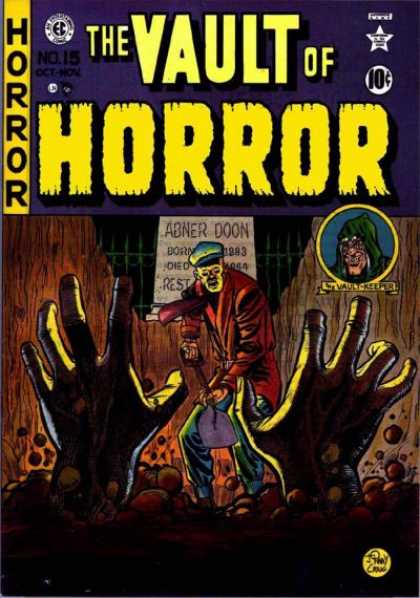
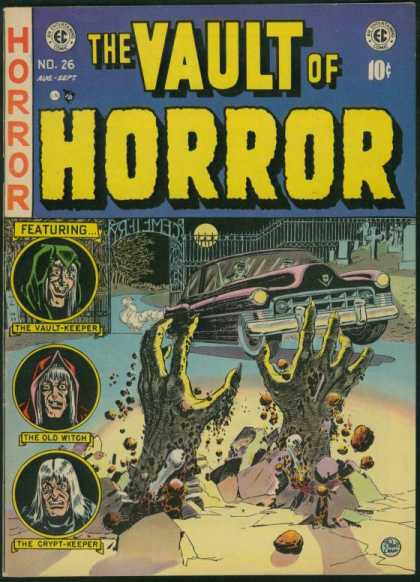
I blame it on the ecstasy of the moment! The top of me is transforming into pure energy, giving me ringing in the ears and making me light-headed. While the bottom of me is being yanked downwards by hands reaching from the grave, like some Johnny Craig Vault of Horror cover. Or maybe it’s just the vodka & tequila mix from last night.
This rubber-band stretching of my ascendant/descendant eternal soul, is proof that the end will come via a Fermilab experiment, creating a “harmless” miniature black hole they’re convinced will either dissipate, or, exit into another dimension (where an alternate, parallel Harold Camping will once again, be proven correct)! I curse my mother for not having the courage to soldier it out and carry me for 21 months instead of 9, so I could truly joke about reaching an apocalyptic milestone on my December 21, 2025 birthday. Though let’s face it, once you’re past a certain age, every birthday is apocalyptic.
— Doug
Posted at 09:05 AM
Posted in Classic Cartoonists, General, Sunday Funnies, Weird But True | permalink | 1 Comment »
Wednesday, March 23, 2026

Returning to both the themes of Women’s History Month, and Pre-YK “Talking” Comic Strips (sequential cartoons wherein the story is conveyed via pictures combined with in-panel dialogue, published prior to the supposed “invention” of same format in the October 25th, 1896 episode of The Yellow Kid), we have a few cartoon advertising strips, each aimed at women, pertaining those areas that 19th century America regarded as Woman’s Domain.
Above, we have a late 1870s/early 1880s ad for “Domestic” Sewing Machines (“Domestic” was a brand). Although single panel, the left and right halves could easily be broken into two panels, with the dialogue being voiced by Cupid (speaking into the telephone), clearly coming in reaction to the words spoken by the woman at left. Having received a proposal of marriage, the woman answers, “Yes, on condition that you buy me a Domestic with new woodwork and attachments.” In response, Cupid gets on the telephone (already in use in the 1870s), and immediately orders one.
The telephone’s distinguishing attribute — shared in the 19th century with parrots and phonographs — was as a non-human from which words could emerge. This prompted cartoonists to visually depict that uniqueness by placing such dialogue in-panel with a greater frequency than otherwise — the more normal practice of the day of placing text & dialogue beneath each comics panel, just not cutting it when dealing with a parrot or a talking machine.
Click on the pictures above & below, to see larger versions.
Below, from an 1884/85 trade card, an ad for J. & P. Coats’ Spool Cotton, clearly broken into before-and-after panels, with what is happening conveyed via the two characters’ in-panel dialogue.

Next, another example of before-and-after sequential panels, with the message told via word balloons. From the rear of an 1868 advertising flyer/4-page pamphlet, for White Wire Lines (clothes lines).

Next, for Cooley’s Cork Corset, a circa 1870s/1880s “metamorphic” trade card wherein the before-and-after panels are achieved by folding down part of the card to reveal a second image (a folding-image trick utilized years later on the rear covers of MAD Magazine). (To read the woman’s dialogue in the second image, you’ll need to click on the picture to make it larger.)
Finally, an incredibly racist circa 1880s/early 1890s ad for Arm & Hammer Baking Soda (one of several in this vein that they did). The three panels result from a tri-fold metamorphic card. As with the others above, this is being shown as an example of pre-YK multi-panel sequential comics, told via in-panel dialogue.

Next week, continuing Women’s History Month and Pre-YK Talkies, we’ll show Part One of a very early Pre-YK sequential comic novelette, told entirely via word balloons.
Doug Wheeler
PreYKStrips AdvertisingStrips
— Doug
Posted at 06:03 AM
Posted in General, Sexy Stuff, Weird But True | permalink | 1 Comment »
Wednesday, March 16, 2026

In honor (a day early) of St. Patrick’s Day, a pair of (non-Outcault authorized) Yellow Kid ephemera. Above, a rear cover advertisement, found on the back of an 1890s music sheet, featuring an obvious Yellow Kid rip-off. Below, the front & back covers plus interior from a flyer advertising one (of several) theatrical versions of McFadden’s Row of Flats. This version featured the Yellow Kid Twins, who starred in the parallel, rival Hogan’s Alley drawn by George Luks for the New York World. The World/Luks cartoon ran for a year opposite the New York Journal American/Outcault version of Yellow Kid, when William Randolph Hearst’s hiring of Outcault away from the World, resulted in a dispute over ownership of the character.
Click on the pictures above & below, to open larger versions.


Doug Wheeler
TheatricalCartoons AdvertisingStrips
— Doug
Posted at 08:03 AM
Posted in Classic Comics, General, Sexy Stuff, Sunday Funnies, Weird But True | permalink | No Comments »
Wednesday, March 9, 2026
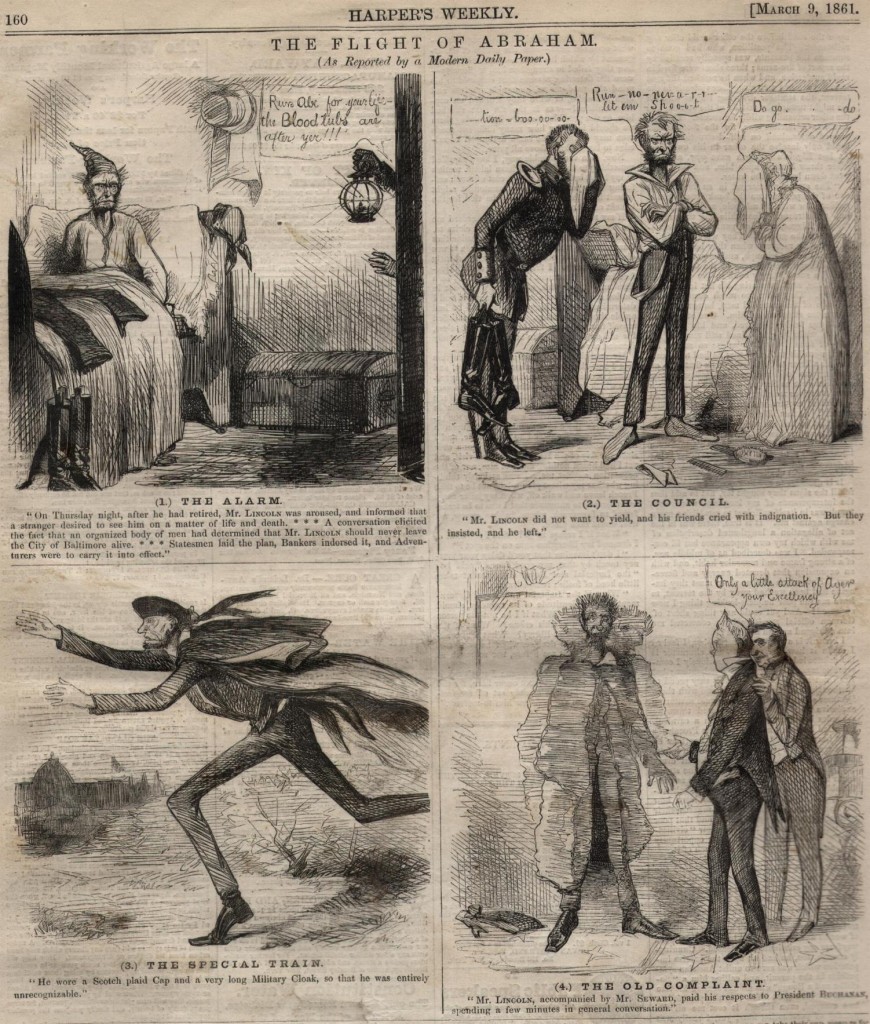
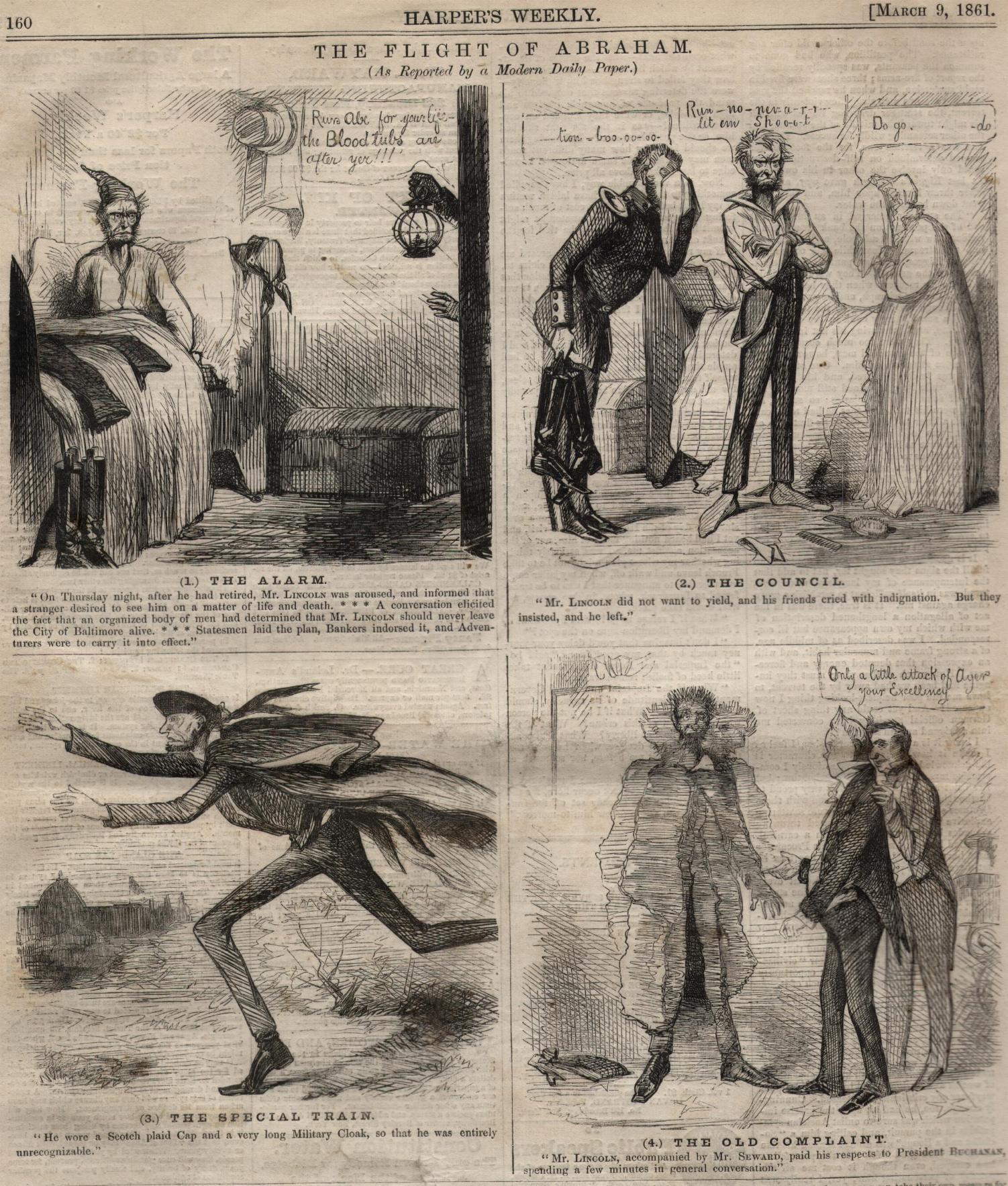
Continuing our series of American Civil War cartoons, we present — on the 150th anniversary of its first publication — The Flight of Abraham, by cartoonist John McLenan. Appearing on the rear outside page of the March 9th, 1861 issue of Harper’s Weekly, this cartoon parodies how President-Elect Abraham Lincoln (on February 21-23, 1861) snuck into Washington, D.C., evading plots to stop him from assuming the presidency. (For the true story/history behind this, listen to this February 17, 2026 broadcast of the Harrisburg, Pennsylvania local PBS radio show, Smart Talk. )
To open a larger version of the above comic strip, click on it.
Of additional interest to comic strip fans — and those engaged in the seemingly endless debate over whether the October 25th, 1896 episode of R.F. Outcault’s Yellow Kid was “the first comic strip” (I’m on the side that it absolutely was not) - the above four-panel comic strip meets the same definition used by the Yellow Kid’s proponents. That is, it must be a multi-panel cartoon story, each panel representing a part of a sequence in time, in which pictures combined with in-panel word balloons together tell a comprehensible story, which would be rendered incomprehensible if either the pictures and or the word word balloons were removed.
As to the text appearing beneath each panel, these can be removed/ignored, and the story still makes sense. If you think I am making an exception by proclaiming the text below panels to be irrelevant to the question of “comic strip-ness”, keep in mind that the October 25th, 1896 episode of Yellow Kid, also contains text beneath each panel, which YK’s proponents also ignore to meet their definition.
(There is one more element the YK proponents use — that the characters must be recurring — they must appear in more than one word balloon-driven sequential strip. What proponents don’t widely advertise — because of the ridicule it would bring — is that the October 25th, 1896 episode of Yellow Kid, is the only YK episode which actually meets the sequential word balloon comic strip definition! The second appearance of Yellow Kid inside a sequential word-balloon-driven comic strip, did not occur until his guest appearance inside a July 7th, 1907 Buster Brown comic strip — thus retroactively, a full decade later, making the October 25th, 1896 episode, and Yellow Kid, a “comic strip”!!?)
As ludicrous as that seems, I years ago questioned comics historian Bill Blackbeard (author of the definitive The Yellow Kid: A Centennial Celebration) as to whether the above “strip-by-retroactive-default” was true — and to my shock, he confirmed it! So, by the same (flawed) logic, if Yellow Kid can become a comic strip character retroactively, after a full decade, then why not this 1861 Abraham Lincoln retroactively, after any of his appearances in comic strips of the 20th century…??
Finally, before someone misinterprets my meaning, I by no means claim that the above Abraham Lincoln strip is the “first comic strip”. I state now that I am absolutely not saying that. There are a great many yet earlier strips also meeting the above definition. I do not believe that anyone should ever proclaim a “first comic strip” — beware such absolutist declarations — there are always more discoveries to be made. (And, P.S., I personally do not subscribe to any “comic strip” definition requiring the presence of word balloons — I simply enjoy finding pre-1896 examples such as the above Flight of Abraham strip, as a poke in the eye at those who insist comic strips weren’t invented until 1896… )
Doug Wheeler
CivilWar PreYKStrips
— Doug
Posted at 08:03 AM
Posted in Classic Cartoonists, General, Political Cartoons, Weird But True | permalink | 2 Comments »
Wednesday, February 16, 2026
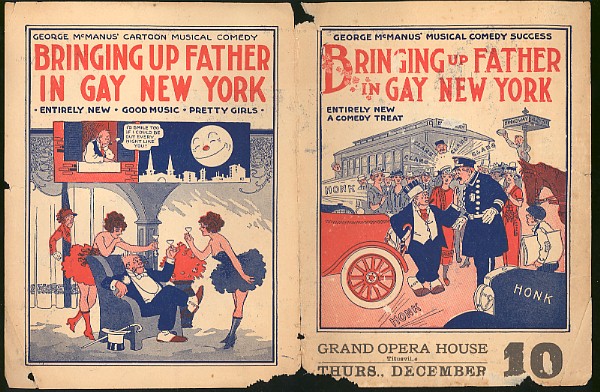
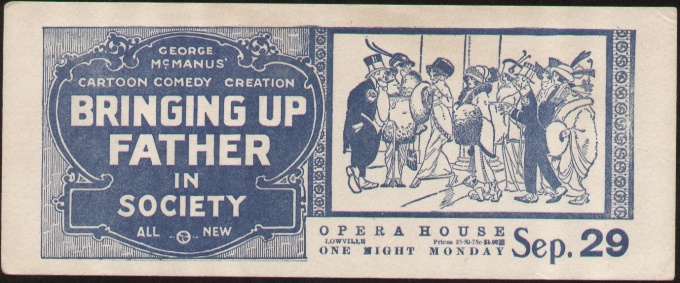
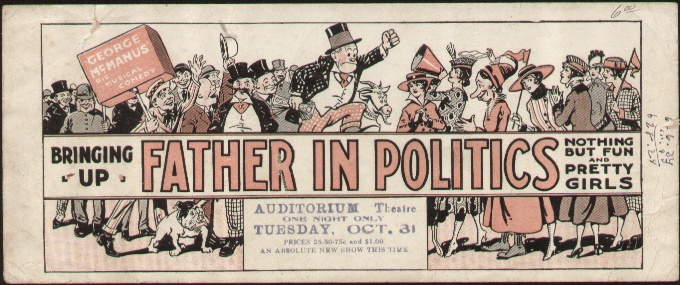
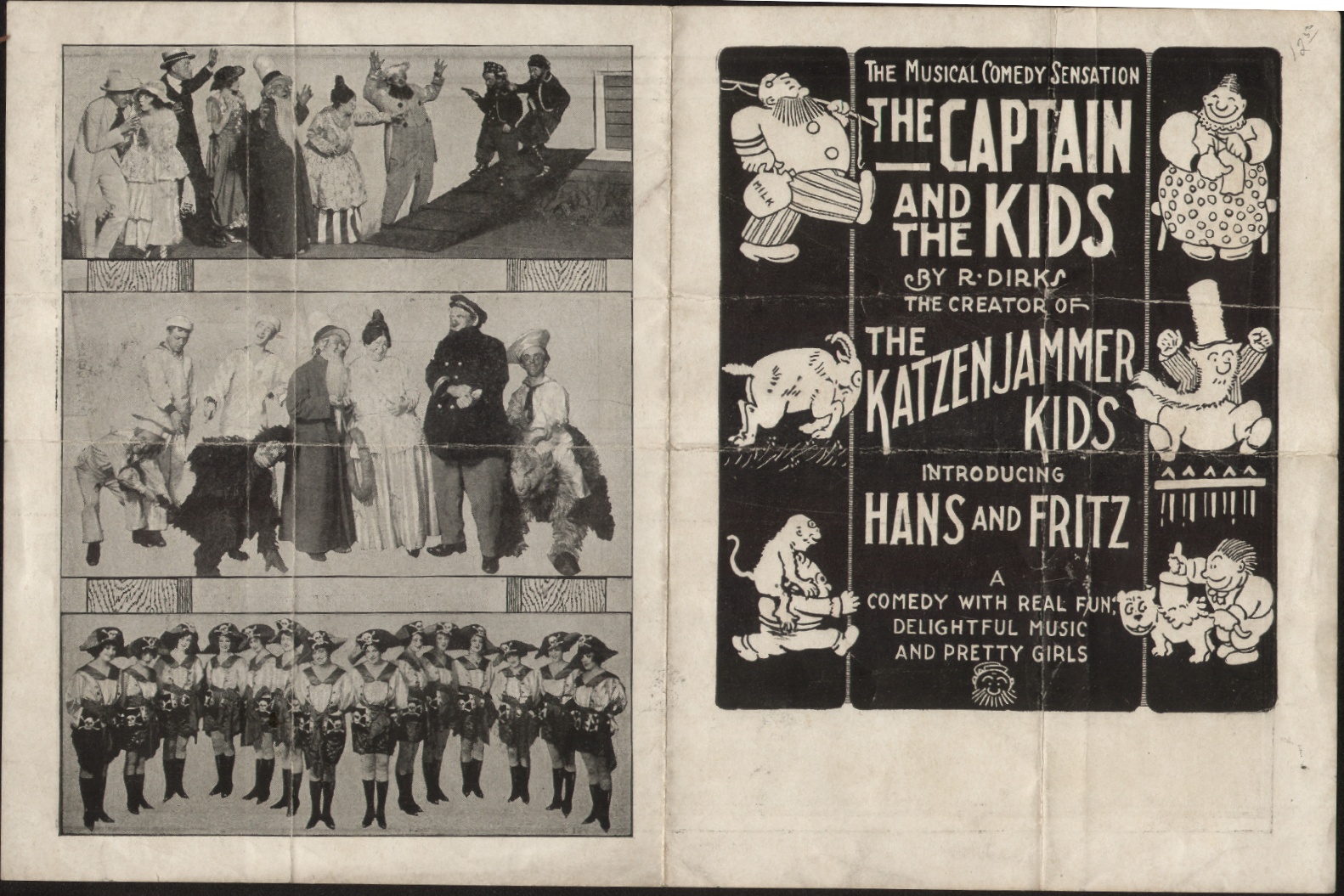
This week in our ongoing Theatrical Cartoons series, a few examples of ads for plays based on popular comic strip series. Above, a flyer for Bringing Up Father in Gay New York, based on the newspaper strip by George McManus. Below, two more Bringing Up Father ads, this time in the form of ink blotters.
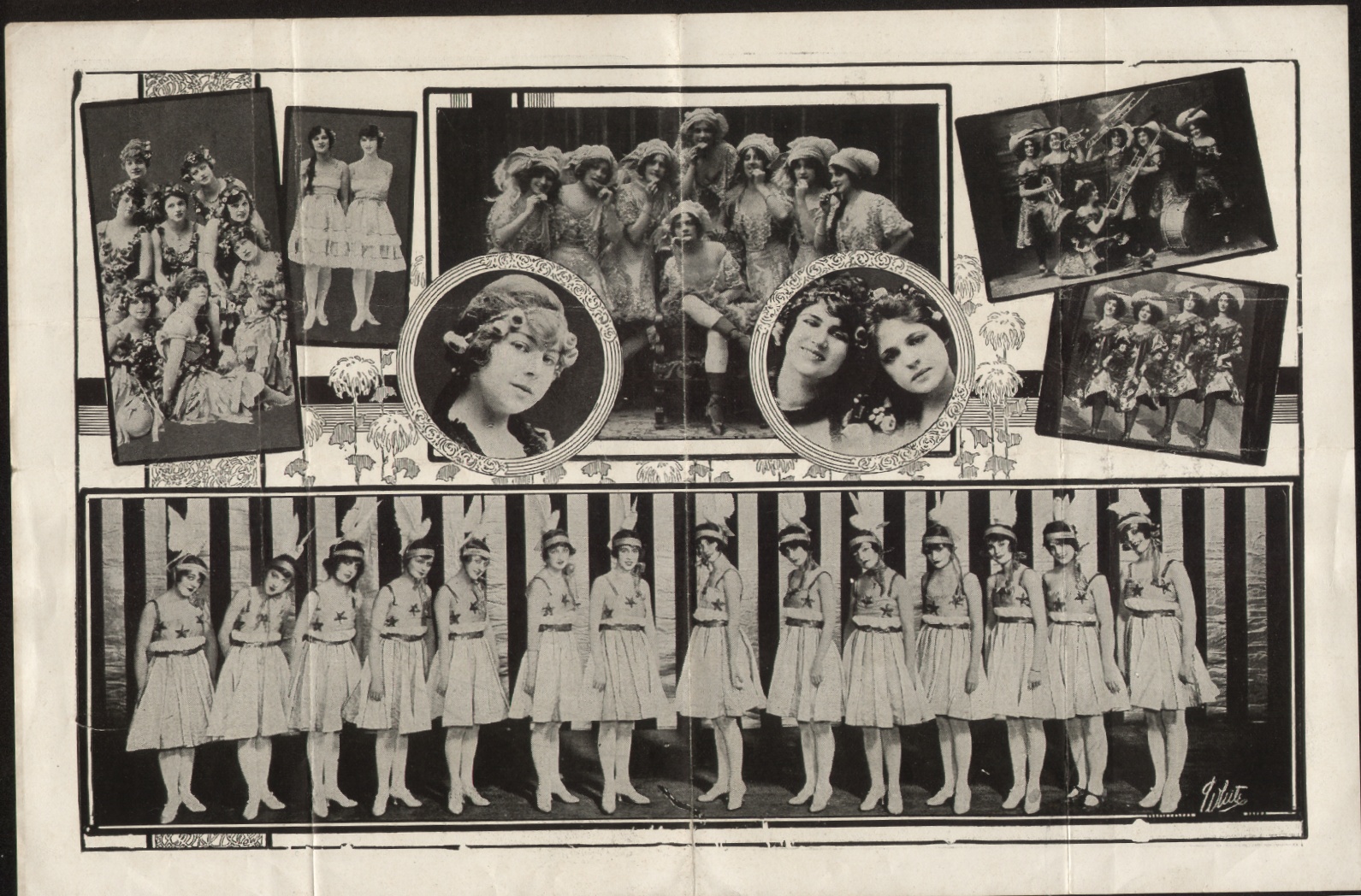
The below flyer for a musical comedy version of The Captain and the Kids (i.e., Katzenjammer Kids) by Rudolph Dirks, is fascinating mainly for its photos of the costumed theatrical company.
Click on the below pictures, to open larger versions.
Doug Wheeler
TheatricalCartoons AdvertisingStrips
— Doug
Posted at 08:02 AM
Posted in Classic Cartoonists, Classic Comics, General, Sexy Stuff, Sunday Funnies, Weird But True | permalink | No Comments »
|
SUBSCRIBE

A-List: The I.T.C.H. Blog Contributors
BLOGS
COMIC NEWS
MY FAVORITE SOURCES FOR COOL BOOKS
THE PUBLISHER OF YOE BOOKS
THE PUBLISHERS OF OTHER BOOKS BY CRAIG YOE
CATEGORIES
ARCHIVES
META
Every Wednesday is
WACKY WONDER WOMAN WEDNESDAY
archive
DOLL MAN WEIRDNESS
archive
|