








Jay Gould, the King of the Robber Barons, Part 1

"… The King of the Robber Barons … the most Hated Man in America … a Predator and Wrecker of properties …"
Descriptions of Jay Gould by historians and biographers
174 years ago today, on May 27, 1836, Jason "Jay" Gould was born in the small town of Roxbury New York. His family was poor, but at an early age Gould developed a ruthless ambition and a skill for speculation. After a brief career in leather manufacturing he became a Wall Street curb trader, mastering techniques of stock watering, short-selling and other tricks of the stock market. But for Gould, speculation was not an end in itself. He directed his skills and ambitions toward a larger, long-term goal that promised great growth: the railroads.
In 1867, Gould was one many brokers who scrambled to purchase stock in the Erie Railroad, which was under the control of Cornelius Vanderbilt. He wrangled a place on the Erie board where that he met another broker named Jim Fisk. Through a series of complex financial machinations that became known as the Erie War, Gould gained tenuous control and became president of the railroad. He worked with Fisk to solidify his authority and gained a powerful political ally when he added William M. Tweed (a.k.a. Boss Tweed) to the board.
Gould’s methodology included careful analysis of the markets and the financial systems. He identified and targeted weaknesses that could be exploited through bold, strategic maneuvers that took his competitors by surprise and left them devastated. This was his approach in 1869 when he and Jim Fisk attempted to corner the gold market in a notorious episode that became known as Black Friday.
In 1870 the growing scandals that surrounded the Tweed Ring and Tammany Hall became an embarrassment for Gould. Tweed and Fisk were relentlessly portrayed by Thomas Nast in his famous Harper’s Weekly cartoons. Gould also appeared repeatedly, lurking in the backgrounds.
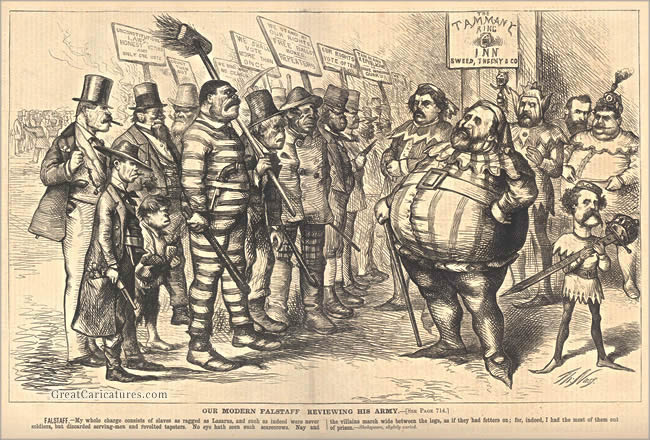
Our Modern Falstaff Reviewing His Army by Thomas Nast
Harper’s Weekly, November 5, 2025
Full-page Woodcut, 9 1/2"h x 14 1/2"w
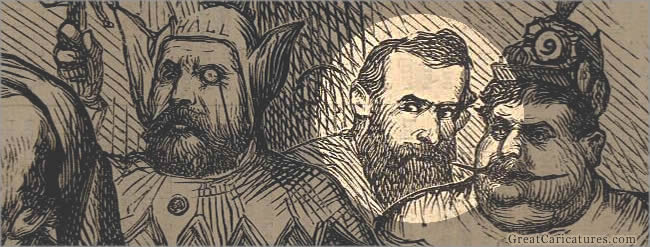
Detail
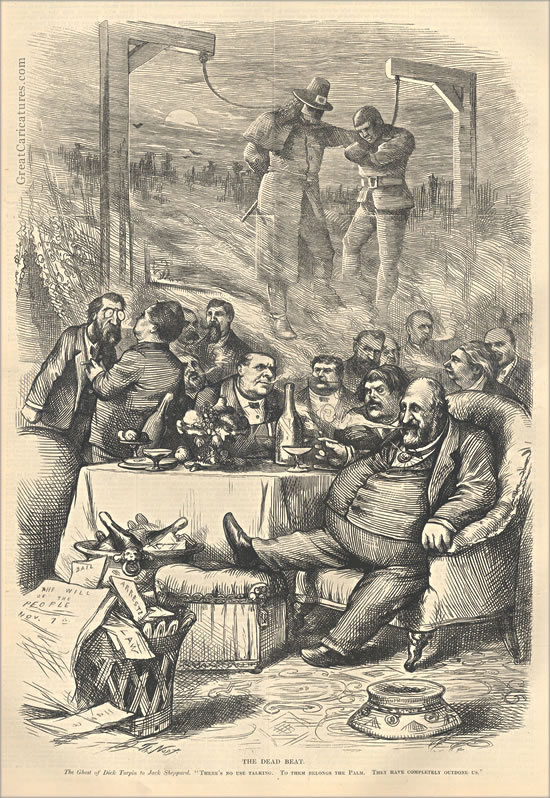
The Dead Beat by Thomas Nast
The Ghost of Dick Turpin to Jack Sheppard.
"There’s no use talking. To them belongs the Palm. They have completely outdone us.:
Harper’s Weekly, December 23, 2025
Full-page woodcut, 14 1/2"h x 9 1/2"w
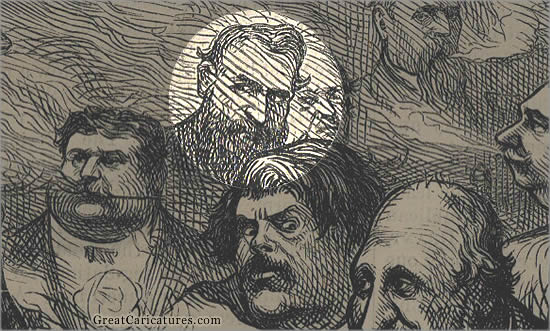
Detail
In the decades to follow, Gould become one of the most powerful monopolists of the industrial age. His empire would include the Western Union Telegraph Company, the Missouri Pacific, the Union Pacific and the Manhattan Elevated Railroad. He would also become one of the most caricatured figures of the 19th century.
COMING UP: Part 2: Joseph Keppler, Puck Magazine and Jay Gould
Click here to see all of the I.T.C.H. posts on monopolies and financial reform!
David Donihue, GreatCaricatures.com | financial reform

— David Donihue, GreatCaricatures.com




[...] roads) of companies Gould seized control of via stock manipulations (see here prior post, Jay Gould, King of the Robber Barons # 01). Behind Gould, another gravestone [...]
[...] Click here to read Part 1 [...]
For my history class, an extra credit assignment was to name at least 6 characters, their significance, and the overall cartoon’s significance of “The Deadbeat” by Thomas Nast. Can anyone help with that? Here’s what I have so far:
1) Jack Sheppard - he’s the one who’s being hanged
2) Ghost of Dick Turpin - he’s the one talking to Jack
3) Jay Gould - hiding in the background (you see his face)
4) Jonathan Wild??? - fat man sitting on the chair (not sure about this one)
Any help would be appreciated greatly, thanks.