Closing out this year’s African American History Month postings, we have more extracts from the late 1940s/early 1950s advertising bookletDreams Come True! (click here to see Part 1). It was published by the Black and White Company (which made beauty products company for African Americans), and illustrated by African American artist George Lee.
The pamphlet consists mostly of cartoon-illustrated ads, plus a number of one-page cartoon bios of African American historical & contemporary figures. Above we have a bio of Heavyweight Boxing Champion Jack Johnson, and below, musician Fats Waller. Further below are found bios on Robert Abbott and Richard Wright.
Click on the above & below pages, to make them large enough to read.
Most of the Black & White Company’s beauty products, were aimed at making African Americans appear more like whites. The ads shown in last week’s extracts involved bleaching/lightening skin color; the first two ads above are for products to slick down one’s hair, making it appear more like white people’s hair. Beneath is for an acme treatment.
I was planning to scan my copy, but then I found that the complete book is already online. So, I merely scanned my cover plus the illustration above. Clicking on cover, below, will open up Archive.org‘s fully scanned version.
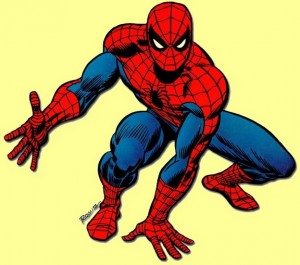
For the umpteenth week in a row I’m shining the Comics Tunes spotlight on that ol’ web-slinger himself, your friendly neighborhood Spider-Man. Why not?
My thesis is simple, there are an awful lot of songs about Spider-Man, perhaps second only to Batman. Don’t believe me? Listen to this!
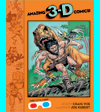
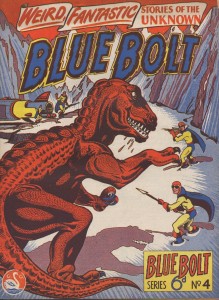
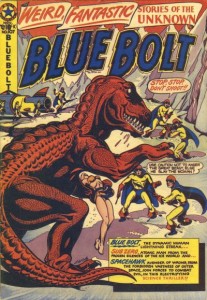
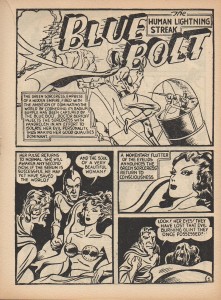
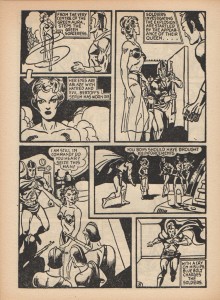
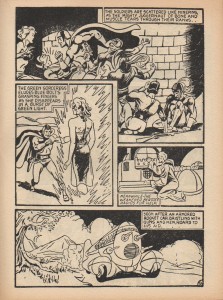
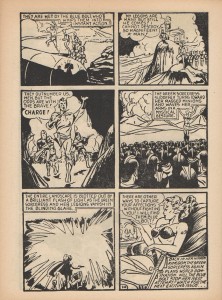
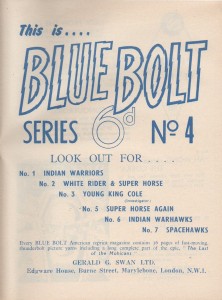
OK, this one is weird. It’s a British comic from the late 40′s. early 50′s which reprints material from the Novelty Press incarnation of Blue Boltcomics that uses the L.B. Cole from the later Star Publications version. A much, much edited version of the L.B. Cole cover. I mean, I can understand why the beautiful half naked girl is no longer in the dinosaurs claw, but why was the dialogue (“Stop, Stop, Don’t Shoot!”, “You caution not to anger the great beast, else he slay the woman!”) cut? And even one of the…guys was edited out. Speaking of which, who the hell are those guys supposed to be anyway? Members of the space based Legion of Blue Bolt Appreciators?
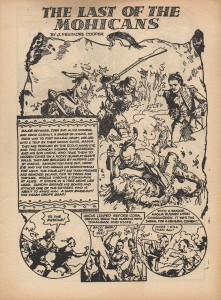
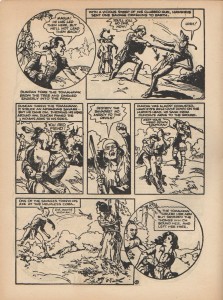
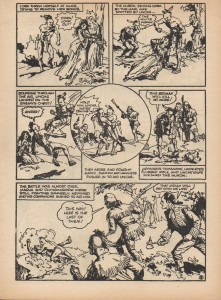
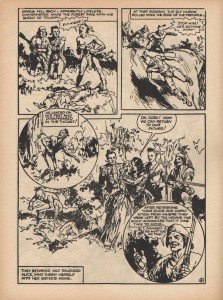
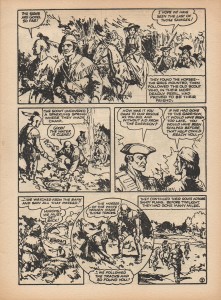
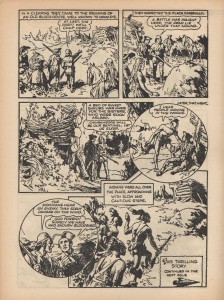
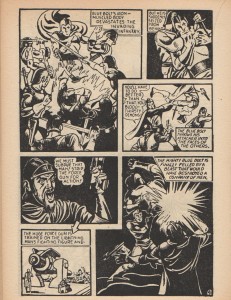
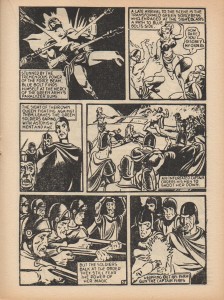
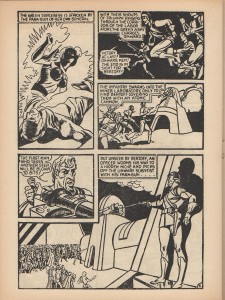
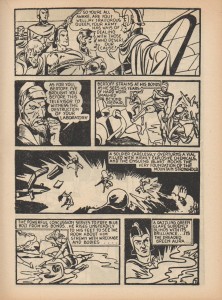
As always, blessings be upon the Grand Comic Book Database and The Digital Comic Museum (and Comic Book Plus) from providing me both the information and the materials for this weeks post. Front loaded for some reason (maybe because British comics really seemed to like these sort of historical comics back then) is an episode of the 10 part “Last of the Mohicans” adaptation that ran in Target Comics.
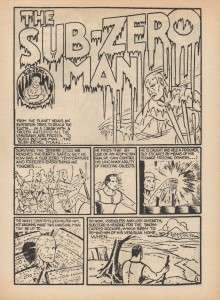
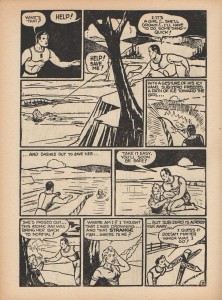
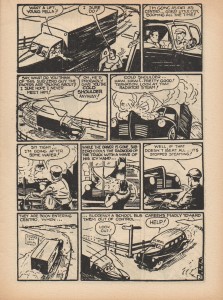
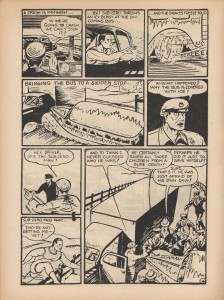
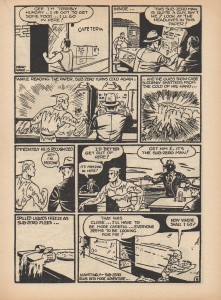
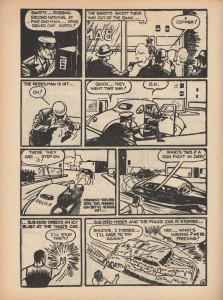
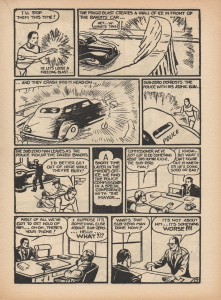
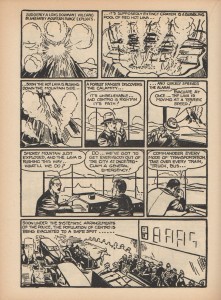
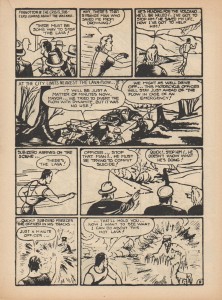
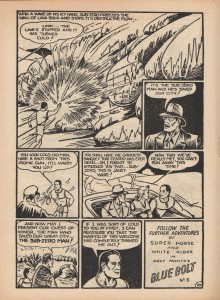
Also included is the Sub-Zero Man story from Blue Bolt #2 by Larry Antonette.
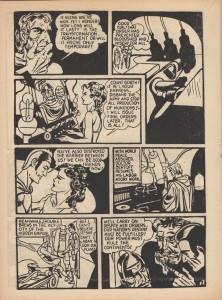
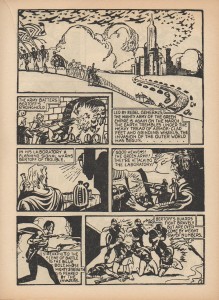
And a Simon & Kirby Blue Bolt story from Blue Bolt #3. As you all know I usually enjoy seeing American comic book art in black and white, but as much as I love the work of Simon & Kirby I’m afraid that’s not the case here.
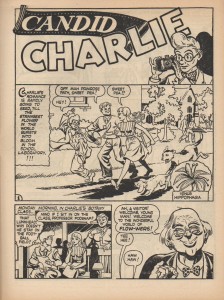
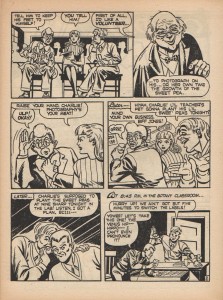
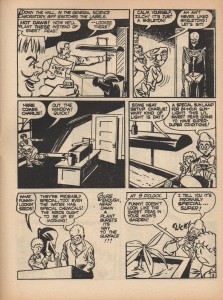
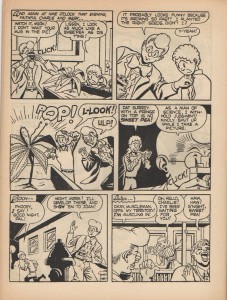
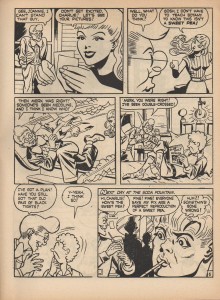
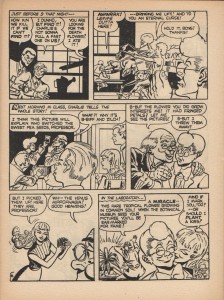
And finally here’s a much better looking story featuring one of my least favorite Novelty Press characters, Candid Charlie. He’s one of an apparently endless series of teen characters major publishers floated in the late 40′s in a desperate attempt to keep from turning off the office lights. On the plus side he’s definitely not an Archie clone, and negative, there the creators clearly over estimated how many laughs could be squeezed out of the premise of a camera crazy teenager with an insane pompadour. Can you imagine the amount of product he would have had to used to keep that thing erect? Wow.
Next in our African American History Month postings, we have the late 1940s/early 1950s advertising bookletDreams Come True!, illustrated by African American artist George Lee. Primarily targeted towards African American women, the booklet promotes various beauty products from the Black & White Company of Memphis, Tennessee, and New York City, NY. These products, such as skin bleaching cream, were largely to make African Americans appear less black, and more white, and in that sense is reminiscent of an appallingly racist 1892 promotional soap booklet we showed last year.
Click on the above & below pages to view them in greater detail.
In addition to the ad pages, there are also a number of one-page cartoon bios of African American historical & contemporary figures. Included in today’s page extracts, are musician William C. Handy, scientist George Washington Carver, and early Civil Rights Leader Frederick Douglass.
Embarrassingly, another aspect of the book is how to turn your dreams into numbers for gambling.
I attempted to find out more about the history of the Black & White Company online (such as, were its owners black and/or white?), but had no luck. Another extract of pages will be posted next week.
As I’ve been saying for the past few weeks, there are an awful lot of songs about Spider-Man. Don’t worry bat-fans, the Caped Crusader is still Number One! There are quite a number of songs about Charlie Brown and Snoopy, and Superman has his share, but from my research it’s Batman and Spider-Man that are at the top of the Comics Tunes list. Can someone prove me wrong?
This week an original song about Spidey, not a cover of the TV show theme. Take it away, Katrina!
One of my favorite comic strips is V.T. Hamlins Alley Oop but then cavemen have always ranked fairly high on my list of Always Super Cool Things since childhood*. It was one of those strips I knew only by reputation growing up, but when I finally got the chance to read large chunks of it did not disappoint. Though admittedly I’m picky; I love the time travel adventures but can barely tolerate the tepid stories set in the stone age. And while there are now quite a few legitimate reprints of the strip a lot of it has yet to be collected, which is how I’m justifying posting the bulk of the contents of Alley Oop#1
Along with being a #1 this is a fortuitously good jumping on point for anyone not already familiar with the character as it contains a rousing time travel adventure as well as an appearance by recurring villain/character Oscar Boom who will lead an expedition to the planet Venus by way of flying saucer (if you haven’t guessed from the description, this is from the 1950′s). For longtime fans we’ve apparently just missed the moment when Oop gave up cigars, theoretically for health reasons, but I have tow wonder if the actual explanation had more to do with not wanting a hero of children lighting up.
*For the record Steve’s List of Always Super Cool Things consists of:
Next for African American History Month, we have both parts of “The Adventures of Johnny Newcome”, by cartoonist William Elmes. Published in 1812, they involve an idealized (from the white perspective) depiction of the life of a British slave & plantation owner in the West Indies.
Note how happily the slave receives his flogging in panel six of Plate 1, above. This was the kind of imagery that slave-owning society used to placate their conscious’ (for those persons that had any). Such myths of “happy slaves” were disseminated and absorbed by the white culture, to justify the massive serial kidnapping, serial rape, and serial murder (to name just a few crimes) that so many participated in, saying to themselves and indoctrinating others with the conveniently false belief that Africans were a sub-species compared to Europeans, and that their lives as slaves in the Americas was better than what they would have had as “uncivilized heathen savages” in unconquered Pre-Colonial Africa.
Contrast these, with an 1830 strip on British Slavery in the West Indies that we’ve previously shown (click here to see). Here, the slave owners are again privileged, but the concentration of the strip is on their crime, and society’s white-washing of it.
Click on the above & below pictures, to view the cartoons in detail, and read their captions.
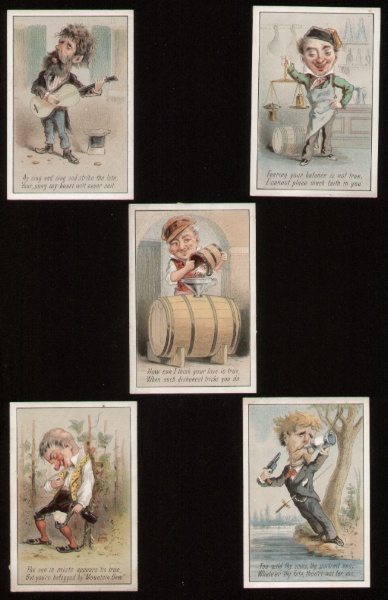
In time for the Day of Love, we have (above) a set of small late 19th century Vinegar Valentines, and (below), “Everything Comes to Her Who Waits”, extracted from the same April 27th, 1895 issue of The Standard, from which we’ve posted previously.
Click on the above & below pictures, to view the pictures in detail, and read their captions.
Click here to view previous years’ Valentine’s Day postings.
For the past few Tuesdays I’ve been exploring the possibility that when it comes to songs about comic book characters, Spider-Man runs a close second to Batman. This week is no exception. And I have a new theory about all this.
What makes a good song? Catchy melody, memorable lyrics, infectious rhythm, yadda, yadda, yadda. But to be truly great, a song has to be flexible. Adaptable. Such a strong song that it can be performed fast or slow, with a vocalist or as an instrumental… folk, classical, rock ‘n’ roll or punk. Certainly the theme from the 1966 Batman TV show fits in this category. Although it was written by jazz composer Neal Hefti, it can be performed jazzy or not.
I think the Spider-Man TV theme from 1967 has this quality as well. Submitted for your approval is this version, done as an a cappella vocal in the smooth style of a certain bubbly singer. What do you think?















![AlleyOop001[Argo]-001](../images/2014/02/AlleyOop001Argo-001-212x300.jpg)
![AlleyOop001[Argo]-003](../images/2014/02/AlleyOop001Argo-003-207x300.jpg)
![AlleyOop001[Argo]-004](../images/2014/02/AlleyOop001Argo-004-206x300.jpg)
![AlleyOop001[Argo]-005](../images/2014/02/AlleyOop001Argo-005-205x300.jpg)
![AlleyOop001[Argo]-006](../images/2014/02/AlleyOop001Argo-006-206x300.jpg)
![AlleyOop001[Argo]-007](../images/2014/02/AlleyOop001Argo-007-203x300.jpg)
![AlleyOop001[Argo]-008](../images/2014/02/AlleyOop001Argo-008-205x300.jpg)
![AlleyOop001[Argo]-009](../images/2014/02/AlleyOop001Argo-009-204x300.jpg)
![AlleyOop001[Argo]-010](../images/2014/02/AlleyOop001Argo-010-203x300.jpg)
![AlleyOop001[Argo]-011](../images/2014/02/AlleyOop001Argo-011-206x300.jpg)
![AlleyOop001[Argo]-012](../images/2014/02/AlleyOop001Argo-012-203x300.jpg)
![AlleyOop001[Argo]-014](../images/2014/02/AlleyOop001Argo-014-204x300.jpg)
![AlleyOop001[Argo]-015](../images/2014/02/AlleyOop001Argo-015-205x300.jpg)
![AlleyOop001[Argo]-016](../images/2014/02/AlleyOop001Argo-016-204x300.jpg)
![AlleyOop001[Argo]-017](../images/2014/02/AlleyOop001Argo-017-204x300.jpg)
![AlleyOop001[Argo]-018](../images/2014/02/AlleyOop001Argo-018-204x300.jpg)
![AlleyOop001[Argo]-019](../images/2014/02/AlleyOop001Argo-019-204x300.jpg)
![AlleyOop001[Argo]-020](../images/2014/02/AlleyOop001Argo-020-204x300.jpg)
![AlleyOop001[Argo]-021](../images/2014/02/AlleyOop001Argo-021-205x300.jpg)
![AlleyOop001[Argo]-022](../images/2014/02/AlleyOop001Argo-022-204x300.jpg)
![AlleyOop001[Argo]-023](../images/2014/02/AlleyOop001Argo-023-206x300.jpg)
![AlleyOop001[Argo]-024](../images/2014/02/AlleyOop001Argo-024-205x300.jpg)
![AlleyOop001[Argo]-025](../images/2014/02/AlleyOop001Argo-025-203x300.jpg)
![AlleyOop001[Argo]-026](../images/2014/02/AlleyOop001Argo-026-205x300.jpg)