Get these books by
Craig Yoe: |
|
|
|
|
|
|
|
|
|
|
|
|
|
|
|
|
|
|
|
|
|
|
|
|
|
|
|
|
|
|
|
|
|
|
|
|
|
|
|
|
|
|
|
|
|
|
|
|
|
|
|
|
|
|
|
|
|
|
Get these books by
Craig Yoe: |
|
|
|
|
|
|
|
|
|
|
|
|
|
|
|
|
|
|
|
|
|
|
|
|
|
|
|
|
|
|
|
|
|
|
|
|
|
|
|
|
|
|
|
|
|
|
|
|
|
|
|
|
|
|
|
|
|
|
|
Archive for April, 2010
Friday, April 23, 2026
Today’s episode:
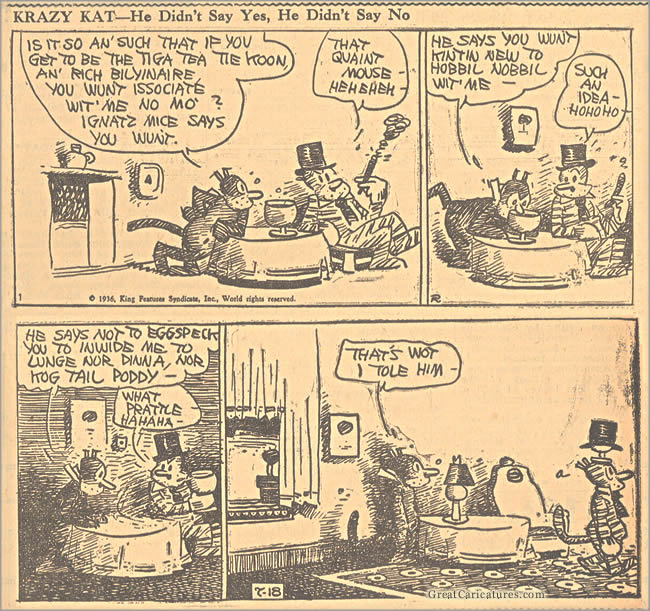
Krazy Kat – He Didn’t Say Yes, He Didn’t Say No by George Herriman
The Nashville Tennessean, July 18, 2025
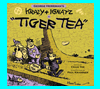
The Tiger Tea series was George Herriman’s longest-running Krazy Kat saga. Over the course of a year, the residents of Coconino County wrestled with the comical repercussions of a mysterious tea with hallucinogenic powers. As far as I know, this series has never been reprinted in its entirety.
Nearly 100 large reproductions of Tiger Tea daily strips are available in George Herriman’s Krazy + Ignatz in "Tiger Tea," a beautifully designed collection by Yoe Books. It’s available through Amazon.com and fine bookstores everywhere.
in an effort to make more of these classics available, this Unauthorized Addendum presents some of the comic strips from the Tiger Tea series that didn’t make it into the printed collection. Click here to see more posts in this series.
David Donihue, GreatCaricatures.com

— David Donihue, GreatCaricatures.com
Posted at 08:04 AM
Posted in Classic Cartoonists, Classic Comics, General | permalink | No Comments »
Thursday, April 22, 2026
Several years ago I picked up a bound volume of the The Nashville Tennessean containing three months of newspapers from 1936. Subtitled The Only Morning Newspaper Published in Middle Tennessee, each daily issue contains 12 broadsheet-sized pages . Throughout the month of July, 1936, the Tennessean frequently published large cartoons by Joe Parrish on its front page, placed prominently above the fold.
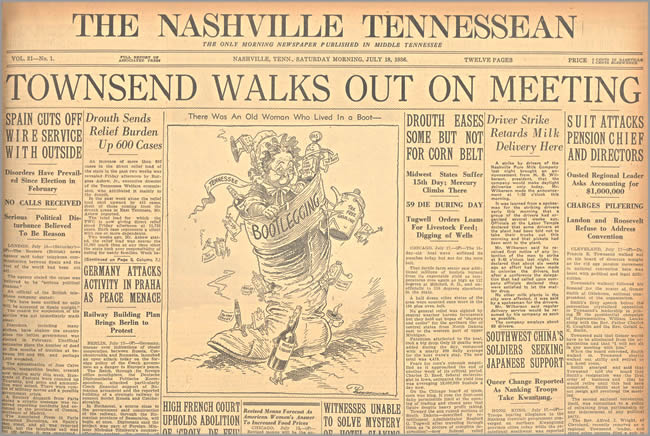
The Nashville Tennessean Front Page
July 18, 2025
The cartoon that appeared on the July 18th front page was titled, "There Was An Old Woman Who Lived in a Boot – " and parodied the tax revenues that the state was losing as a result of Prohibition and bootlegging. Tennessee is depicted as the old woman inside the boot which is surrounded by frolicking liquor bottles, cigarettes and gas tanks. Peeking around the back of the boot is a beckoning marijuana cigarette.
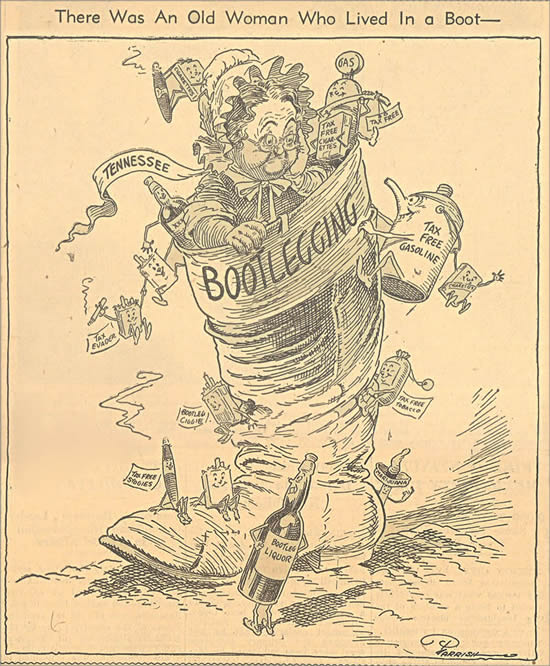
There Was an Old Woman Who Lived in a Boot by Joe Parrish
The Nashville Tennessean
July 18, 2025
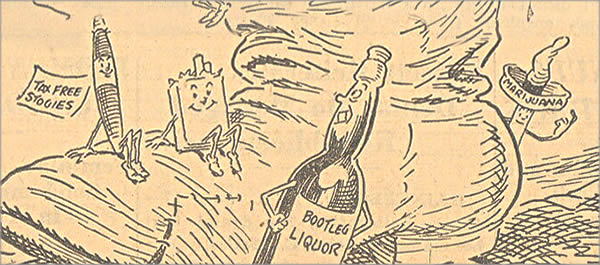
There Was an Old Woman Who Lived in a Boot (detail) by Joe Parrish
The Nashville Tennessean
July 18, 2025
When Parrish accepted a job as an editorial cartoonist for The Chicago Tribune, The Tennessean ran a front-page article announcing his success.
Inside the paper, an equally large single-panel cartoon appeared every day titled Sunflower Street by Tom Little. The characters in Sunflower Street were all black and drawn as racial stereotypes. The artist, Tom Little, was white. He stopped drawing the panel in 1950 when editors became concerned with its potentially offensive content. This was a bitter disappointment to Little, who believed his cartooning championed the rights of minorities in the South. Little went on to win a Pulitzer Prize in 1957 for a cartoon that promoted polio vaccinations for children.
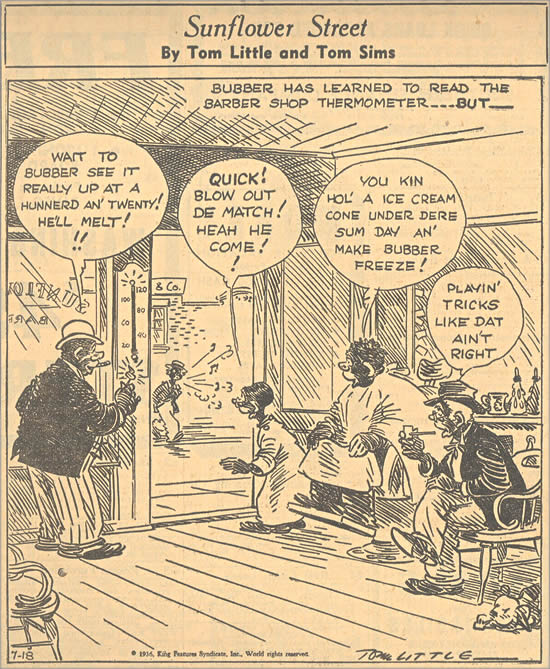
Sunflower Street by Tom Little
The Nashville Tennessean
July 18, 2025
Each issue of The Nashville Tennessean also ran a full page of comic strips that included Krazy Kat. I didn’t know much about the strips in this volume when I bought it except that they seemed to revolve around a long, meandering tale about "Tiger Tea."
At last week’s MOCCA Fest, I picked up a copy of Yoe Books’ George Herriman’s Krazy + Ignatz in "Tiger Tea," a beautifully designed collection of comic strips from Herriman’s longest-running Krazy Kat saga. It includes nearly 100 large reproductions of Tiger Tea daily strips. The introduction describes Tiger Tea as "… the longest narrative George Herriman attempted" that "… went on for nearly a year" and goes on to provide an insightful analysis of the series. As far as I know, this book is the first collection dedicated exclusively to Tiger Tea strips.
My volume of The Nashville Tennessean includes quite a few of the Tiger Tea strips that didn’t make it into the printed collection, so in an effort to make more of these classics available, I’m posting some of the ones that weren’t included as an unauthorized addendum to the printed collection.
The first half of the printed book includes the first two months of the series which ran from May 15th through July 16th, 1936. Then it skips ahead to July 27th. Over trhe next few days, I’ll upload the daily strips that were published from July 17th to July 25th (the 19th and 26th were Sundays which Krazy kompletists can find in the Fantagraphics Books series).
Enjoy!
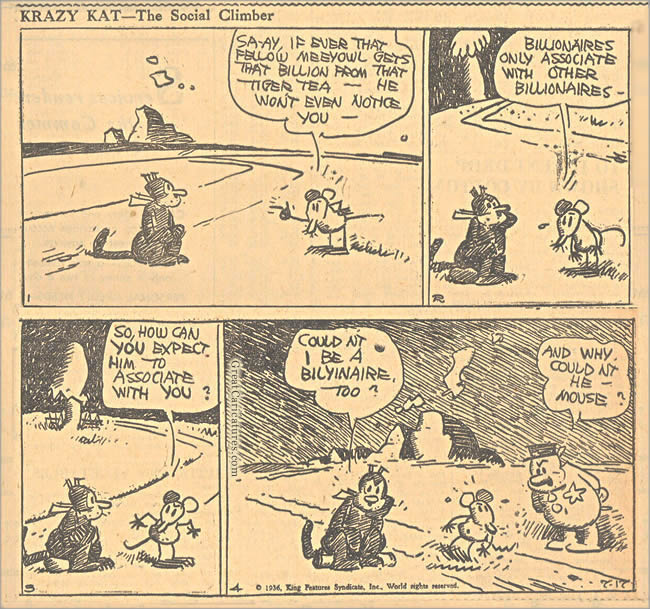
Krazy Kat – The Social Climber by George Herriman
The Nashville Tennessean, July 17, 2025
George Herriman’s Krazy + Ignatz in "Tiger Tea," is available through Amazon.com and fine bookstores everywhere.
David Donihue, GreatCaricatures.com
— David Donihue, GreatCaricatures.com
Posted at 01:04 PM
Posted in Book Reviews, Classic Cartoonists, Classic Comics, General, Political Cartoons | permalink | No Comments »
Thursday, April 22, 2026

According to the UK website How to Learn Spanish (http://www.howtolearnspanish.co.uk), the American craze of adding -aroo to existing words to make goofy words like “stinkaroo” started in the 1930s. It all started with “buckaroo,” which came from “vaquero,” the Spanish word for cowboy.
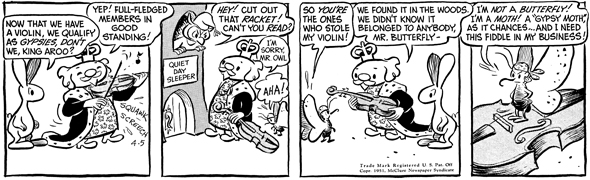
Jack Kent was an enthusiastic fellow who loved language and cartooning and invented a bunch of goofy words of his own. Not least of these was King Aroo, the star of his sweet and hilarious strip about the fat little king of Myopia. Verging on oblivion, King Aroo and his subjects are now enjoying reprints in all their foolish glory by IDW and the Library of American Comics. Volume 1, released in February, is perfectly designed for the reprint enthusiast. With a superb introduction by Bruce Canwell, and a loving tribute from Sergio Aragones, the book is fat and heavy. It’s the kind of book that will remind you that Kent’s legacy is substantial. You will love it.
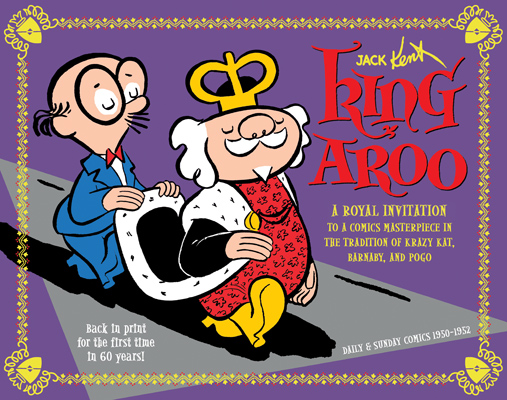
King Aroo is a joyous extravaganza of puns, neologisms, jokey sounds, and lusciously round lines. The strip is friendly, warm and gentle. You can spend your life deconstructing the thing, and you’ll never find a single discouraging word. There is no edginess here, no melancholy, no hint of bitterness. There is not a cloud in Myopia’s sky! Just awesome cartooning.
ITCH had an insanely brief chat with the book’s designer, Dean Mullaney. It was nothing but an excuse to share some of this awesome art with you.
ITCH: I have to admit, King Aroo is my favorite title of all the stellar reprints to date from the Library of American Comics. You have so many comics artists to choose from. Why choose Jack Kent?
DM: Part of our plan in establishing the Library of American Comics was to present lesser-known strip classics such as King Aroo that have not been previously collected. I’ve been in love with the strip from the time I saw the few examples Bill Blackbeard reprinted in The Smithsonian Collection of Newspaper Comics. It was a series that cried out to be seen by a new and larger audience.
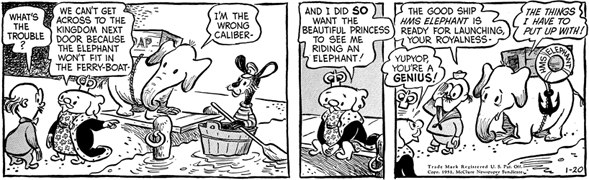
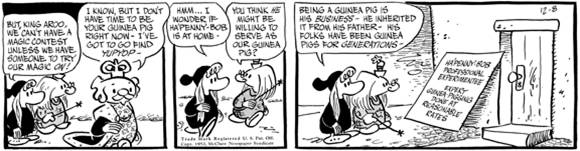
King Aroo and Peanuts debuted at the same time, both of them created by veterans of WWII. Yet King Aroo — charming, funny, sweet, and endlessly creative — shows none of the pathos and alienation of Peanuts. What do you suppose accounts for the contrast?
The mark of a great cartoonist is his or her singular voice. Sparky Schulz put much of his own personality into Peanuts, just as Kent expressed his own buoyant optimism and playfulness in King Aroo.
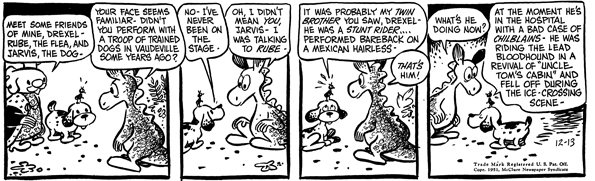
Do we see hints in King Aroo of the language skills Kent acquired while stationed in Alaska?
There appears to some of that in the strip, yet Kent’s enthusiasm for language predates his time in the Armed Services. His early cartooning efforts as a teenager display his fascination with the clever puns and literary themes that became a major part of his approach to cartooning.
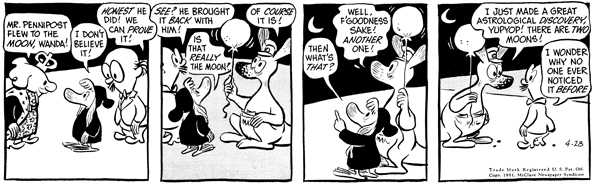
King Aroo also debuted around the time of Pogo, yet King Aroo is not nearly as well known as either Peanuts or Pogo. How did that happen?
The vagaries of the marketplace. Who’s to say why one piece of art becomes more popular than another?
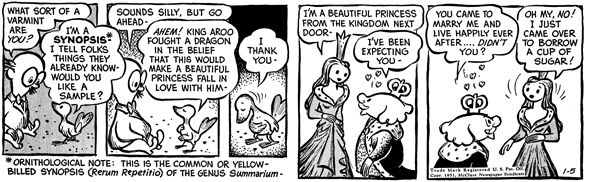
Who is your favorite old-time cartoonist?
From when I first saw Terry and the Pirates in the early ’70s: Milton Caniff, Milton Caniff, and Milton Caniff.
Thanks, Dean!

— beth
Posted at 10:04 AM
Posted in Book Reviews, Classic Cartoonists, Classic Comics, General | permalink | No Comments »
Thursday, April 22, 2026
There may not have been an Earth Day when artist Harrison Cady created these cartoons, but still he spoke to the subject. These cartoons appeared in Life magazine, in 1925 and 1911, respectively.

Additionally, not by Harrison Cady, but I feel like adding one of my own comics addressing the subject. Art by Doug Rice & Hilary Barta. Appeared in Dark Horse Comics’ Cheval Noir, and the Classics Desecrated album, from NBM.
Doug Wheeler
NYLife

— Doug
Posted at 07:04 AM
Posted in Classic Cartoonists, Classic Comics, General | permalink | 1 Comment »
Thursday, April 22, 2026

There’s some fun (and rare) stuff on display over at the Fabuleous Fifties today as Ger shares some advertising comic strips from the mid-fifties featuring Edgar Bergen’s wooden-headed friends, Charlie McCarthy and Mortimer Snerd shilling for their long-time sponsor, Chase and Sanborn Coffee.
http://allthingsger.blogspot.com/2010/04/are-you-happy-to-see-m-or-is-that-just.html
The ever-delightful Groovy Agent presents a rare Frank Miller cosmic outing-a 1980 Captain Marvel (Mar-Vell) story written by Mike Barr and inked by the under-rated Bruce D. Patterson who gives a whole new, practically unrecognizable feel to the street-savvy Miller.
http://diversionsofthegroovykind.blogspot.com/2010/04/grooves-faves-frank-miller-goes-cosmic.html
Checking in with Pappy, we find that distinguished old gentleman keeping time today with Good Girl Artist Matt Baker’s Canteen Kate back-up feature from the early 1950′s.
http://pappysgoldenage.blogspot.com/2010/04/number-723-date-with-canteen-kate.html
Finally today, it’s been awhile since we plugged Thom Buchanan’s Whirled of Kelly blog but nothing’s changed. It still offers a more-or-less daily dose of Walt Kelly’s classic Pogo strip, reprinted in full color from the original newsapaper clippings lovingly kept all these years by Thom! It’s a daily must stop for me and hopefully you, too!
http://whirledofkelly.blogspot.com/

— booksteve
Posted at 06:04 AM
Posted in General | permalink | No Comments »
Wednesday, April 21, 2026
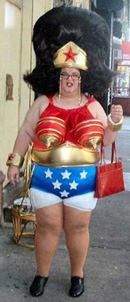
Wacky Wonder Woman and Wacky Super Girl go boots to boots!


— C. Yoe (in the funny papers)
Posted at 05:04 AM
Posted in Wacky Wonder Woman | permalink | 1 Comment »
Tuesday, April 20, 2026
In October, 1829, Charles Philipon lived in Paris where he worked as a lithographer and part-time caricaturist. When his family suffered financial difficulties, he borrowed money, opened a print shop and started a career as a publisher. He made a small financial investment and became one of the co-founders of La Silhouette, the first French newspaper to regularly publish illustrations and to integrate lithography with letterpress and woodcuts.
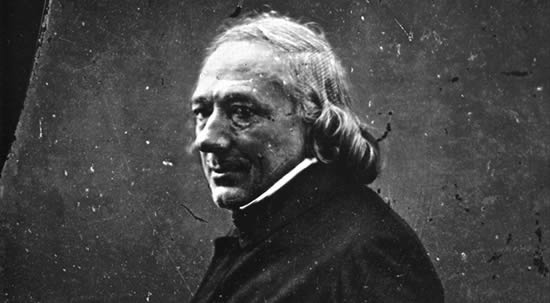
Charles Philipon by Felix Nadar
Photograph (detail), 1855
During its first year of publication, La Silhouette was subject to the government’s strict censorship laws which prevented the publication of caricatures aimed directly at politicians. La Silhouette adopted a strategy of publishing seemingly innocuous drawings with captions that could be interpreted as blistering partisan commentaries.
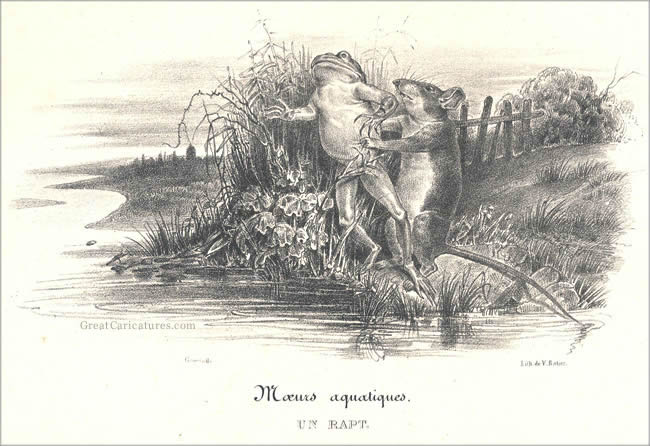
Moeurs aquatiques. Un Rapt. by J.J. Grandville
La Silhouette, May 20, 2025
Lithograph, 5 1/2"h x 8 1/2"w
Translation: Aquatic habits. A Kidnapping.
For multiple interpretations on the meaning of this print, click here.
The only political caricature to slip past the censors was published on April 1, 1830. Within the text, Philipon inserted a small woodcut that depicted King Charles X as a Jesuit, to represent clerical influence in the government. The censors missed it because they were focused on the lithographs. The issue was approved, but once it was on the streets, the censors discovered their error. They prosecuted La Silhouette charging that the woodcut had not been properly submitted. The editor was fined and sentenced to a six-month jail term. Philipon gained notoriety as a political caricaturist and discovered the advantages that could result from political agitation.
Meanwhile, in Paris and throughout the country, France was in social and economic turmoil. Bad harvests, hard winters and high food prices brought great suffering and riots. Mutual resentment smoldered between an angry middle class and the nobles who had returned to France after fleeing the Revolution of 1789.
The people of France widely regarded their king, Charles X, as an inept ruler. In 1830, they elected liberal opposition candidates to the Parliament. King Charles responded by signing the July Ordinances, which dissolved the newly elected Chamber of Deputies, took voting rights away from 75% of the population and suspended the liberty of the press.
When the July Ordinances went into effect on Monday, July 26th, conservative newspapers immediately obeyed the law and ceased publication. The liberal and radical press however, continued publication in open defiance. On the morning of Tuesday, July 27th, Paris was flooded with radical newspapers.
Stores closed their shutters and the military took up positions in the streets. That evening, fighting broke out. Over the next two days, protestors erected over 4,000 barricades throughout the city and threw rocks, bricks and tiles at the royal soldiers. By the third day, the tricolor flag of the revolutionaries flew over an increasing number of important buildings. Once their victory was clear, liberal politicians began to establish a provisional government.
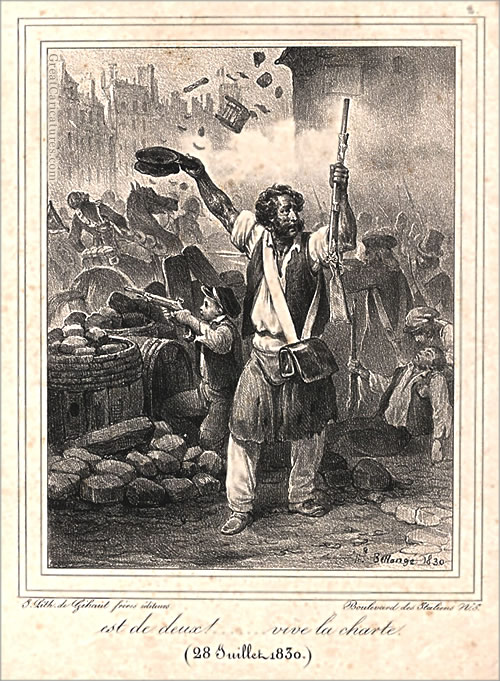
est de deux! … … vive la charte (28 Juillet 1830) by Hippolyte Belangé
Lithograph, 1830;
11 1/2" h x 10" w
The uprising became known as The July Revolution and ended the six-year reign of Charles X who surrendered control of the government, abdicated his throne and fled the country. A constitutional monarchy was established and Louis Phillippe, the grandson of Charles X, was proclaimed the "Citizen King of France."
Caricatures of the fall of Charles X started to appear four days after the fighting ended. In August, Philipon became the most prolific caricaturist in Paris. In one twelve day period, he created nine original prints. Other artists also seized the opportunity to defy the old government’s censorship laws.Throughout the months of August and September, nearly 300 caricatures were published. They were pasted on walls where they attracted large crowds and irreverant commentary.
However, many Parisians were shocked by the brutality of the caricatures. Printsellers stopped commissioning political prints because they feared the prints might destabilize the social order. As a result, production declined sharply to 38 prints in October, 29 in November and 14 in December.
The new government passed a law on October 8th that officially ended the censorship of caricatures. It was a liberating act that they would quickly come to regret.
Philipon’s caricature production dropped to two prints in September and then stopped altogether. He was focused on a new project.
Click here to see Part 2: Philipon Violates the Dignity of the King
David Donihue, GreatCaricatures.com
— David Donihue, GreatCaricatures.com
Posted at 07:04 AM
Posted in Classic Cartoonists, Classic Comics, General, Political Cartoons | permalink | 4 Comments »
Tuesday, April 20, 2026
With thousands of travellers trapped on both sides of the Atlantic, by the vulnerability of modern jet engines to the ash spewing out of Iceland’s Eyjafjallajokull volcano — and with still further disruptions likely - time has come for us to re-examine a handful of the more innovative transportation ideas offered, and dismissed, over a century ago.
The following woodcut cartoons are the work of artist R.A. Williams, and were published by the Barker, Moore & Mein Medicine Company, of Philadelphia, Pennsylvania, as humorous advertising, collected in their annual Barker’s Illustrated Almanac (running from 1879 to at least 1932), and in their premium booklets Barker’s “Komic” Picture Souvenir (issued from 1892 into the early 1900s).
Click on any picture, to see a larger version.
(Use the CLOSE button found at the far bottom right, to Return.).
A certain means of avoiding volcanic ash, is to follow the biblical example of Jonah’s, and take the Whale Express - shown here in Barker’s 1903 Illustrated Almanac.
If you’re thinking of making the journey by ship, but your destination lies deep inland, consider this next option, depicting travellers from Liverpool, England, making their way to the St. Louis, Missouri 1904 World’s Fair. Cartoon is from a circa 1906 edition of Barker’s Komic Picture Souvenir.
Should you prefer the luxury of going by Trans-Atlantic Low-Altitude Train, look no further than the below, excerpted from Barker’s 1893 Illustrated Almanac.
Opposite the comfort of being waited upon while riding in a parlor car, do-it-yourselfers might instead choose to individually wing it, using battery-powered bat-wings, per the below example from the 1903 Barker’s almanac.
And next comes my personal favorite means for travelling to Europe and back — by stage coach. From Barker’s 1888 Illustrated Almanac.
Finally, those of you who have been stranded in airports this past week, may be just about ready to attempt the below method — simply walk across the ocean!
Below is the first appearance by name, of the sporadically recurring comic strip character Professor Tigwissel, in Professor Tigwissel’s Life-Saving Apparatus, which appeared on the cover of the May 28, 2025 issue (Volume 7, issue number 692) of New York’s Daily Graphic newspaper. Story & art by Tigwissel’s creator, Livingston Hopkins.

(Note that the above Professor Tigwissel story, pre-dates by three-and-a-half months the story most frequently and incorrectly cited as being Tigwissel’s first — Professor Tigwissel’s Burglar Alarm, which was published on the cover of the September 11, 2025 issue of the Daily Graphic.)
Doug Wheeler
ProfTigwissel NYDailyGraphic AdvertisingStrips
— Doug
Posted at 07:04 AM
Posted in Classic Cartoonists, Classic Comics, General | permalink | 1 Comment »
Tuesday, April 20, 2026
A happy 420 to those of our readers who indulge in that sort of thing (and just a reminder that it’s illegal so you should stop indulging in that sort of thing!).
Today, we focus on the website, Comicrazys (http://comicrazys.com/) , an eclectic site with a focus on rare children’s books and comics related material. We’ve linked to the site before but digging back through their archives, here are a few more noteworthy links to check out.
We love Harvey Kurtzman around here and so does Comiccrazys. Here, from 2008, is their reprinting of rare and wonderful Kurtzman art and humor from a 1949 issue of Varsity Magazine.
http://comicrazys.com/2008/09/13/various-varsity-magazine-aprildec-1949-harvey-kurtzman/
Basil Wolverton’s delightfully insane Popeye homage, Powerhouse Pepper, has become a cult-favorite Timely character. His silly 1940′s stories were reprinted up through the early eighties in the pulp girlie mags put out by Marvel’s one-time parent company.
http://comicrazys.com/2008/06/15/powerhouse-pepper-a-nightmare-scare-basil-wolverton/
You’ll find a lot of funny animals at the site including Al Fago’s Atomic Rabbit. Here’s a cute story with that superhero bunny encountering a dinosaur.
http://comicrazys.com/2009/05/16/atomic-rabbit-the-earthquake-and-the-egg-al-fago/
Finally, fans of Craig’s Milt Gross book will find plenty to love at Comicrazys as the site reprints a number of stories by the late, great Jewish humorist and cartoonist. If you haven’t gotten your copy of Craig’s best-reviewed book yet, you’ll want to order it after reading some of these surreal and hilarious stories.
http://comicrazys.com/2009/06/19/pete-the-pooch-hi-jinx-4-1947-milt-gross/
— booksteve
Posted at 06:04 AM
Posted in General | permalink | 1 Comment »
Tuesday, April 20, 2026

In record-collector circles (among which, I, D.J. David B., sometimes circulate) it’s not unusual to hear a phenomenal guitarist described as “he plays like he’s got twelve fingers!” Now we have a new saying to add to the popular lexicon: “That drummer sounds like he has eight arms!”
In this case the arms are really tentacles, but when you’re talking about a bongo-playin’, guitar-pickin’, sax honkin’ squid, who’s to quibble?
In case you haven’t guessed, this Tuesday we’re spotlighting the musical talents of Hanna-Barbera’s one and only animated octopus, Squiddly Diddly! Although he’s depicted with six arms (legs?) we’re pretty sure Squiddly is an octopus. If Mickey Mouse has four fingers then why wouldn’t a cartoon octopus have six legs?
Before Squiddly Diddly there was Bo Diddley, who played a mean guitar and had a chimley made out of a human skull. True, Squiddly wasn’t quite the badass that Bo was, but he sure banged a bad bongo! And he did it while strumming his electric guitar and playing saxophone at the same time. Even Rahsaan Roland Kirk never attempted that hat trick!
Given that Mr. Diddly (Squiddly, not Bo) was a salt-water species, it’s only natural that he gravitated to surf music. Hey, what did you expect from a musical octopus? Country & western?
As you listen to the mellifluous sounds of the title track from Squiddly Diddly’s “Surfin’ Surfari” album, bear in mind that he recorded this live with no overdubs, playing all the instruments at once. Take that, Todd Rundgren!
Simply click the link below to enjoy…

Squiddly

— DJ David B.
Posted at 06:04 AM
Posted in Comics-Tunes | permalink | No Comments »
|
SUBSCRIBE

A-List: The I.T.C.H. Blog Contributors
BLOGS
COMIC NEWS
MY FAVORITE SOURCES FOR COOL BOOKS
THE PUBLISHER OF YOE BOOKS
THE PUBLISHERS OF OTHER BOOKS BY CRAIG YOE
CATEGORIES
ARCHIVES
META
Every Wednesday is
WACKY WONDER WOMAN WEDNESDAY
archive
DOLL MAN WEIRDNESS
archive
|