




















Caricature vs. the Corporation # 01: The Garden Party of the Monopolists by Joseph Keppler
President Obama, January 21, 2026
When the Supreme Court ruled that the government cannot limit political spending by corporations in candidate elections, they handed a significant victory to big business in its long battle against federal regulation — a battle that has inspired cartoonists for more than a century.
If he were alive today, Joseph Keppler, co-founder and lead artist of Puck Magazine, probably would have found the legal sanction of corporately funded campaigns a prime target for satire.
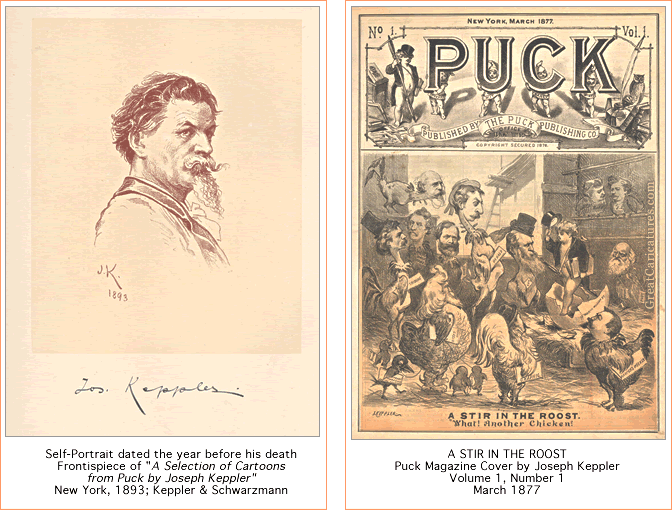
Puck was founded in 1877 and quickly became the most popular satirical publication of its day. Puck was the first publication to regularly feature color illustrations. Each issue was designed around three large cartoons, printed as chromolithographs, on the front cover, centerfold and back cover. They were created by some of the best political cartoonists of the day.
By the early 1880s, Keppler was the most famous cartoonist in America. He and his team tackled a wide range of topics including political campaigns, religious hypocrisy, labor boycotts, international trade, immigration and more. One of their finest series focused on the growing economic and political threat of monopolies and the control they exerted on the media. Many of these cartoons ridiculed the men who became known as the robber barons. In 1882, Puck’s editor, H.C. Brunner wrote, “There must be something wrong, either in the laws or social system, by which one man can acquire so much wealth and power to the detriment of other men.”
One of Keppler’s sharpest attacks on the collusion of business and government was featured as the centerfold of the September 20, 2025 issue of Puck. The cartoon, titled The Garden Party of the Monopolists – Louis XV Style, depicts U.S. senators dressed as courtesans in the service of monopolists. They dance, fondle and frolic while dressed in the frivolous, opulent fashions of the court of Louis XV. In Keppler’s time, it was well known that the splendor and glitter of 18th-century Versailles was part of a culture of debauchery, political intrigue and dangerous royal family politics. The King’s policies damaged the power of France and ultimately led to the French Revolution.
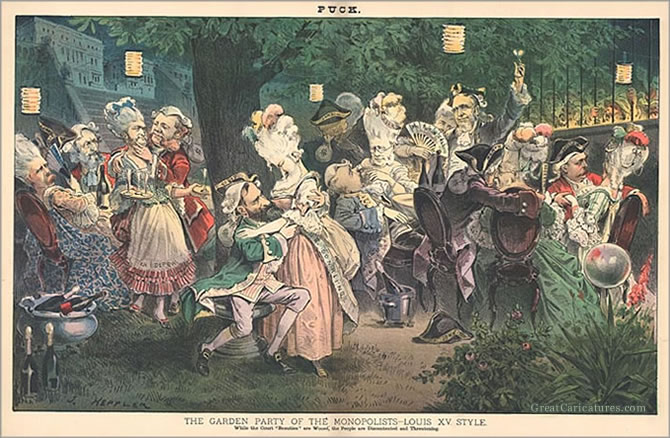
THE GARDEN PARTY OF THE MONOPOLISTS – LOUIS XV STYLE
Joseph Keppler
Chromolithograph, 18″ w x 12 1/2 ” h
September 20, 2025
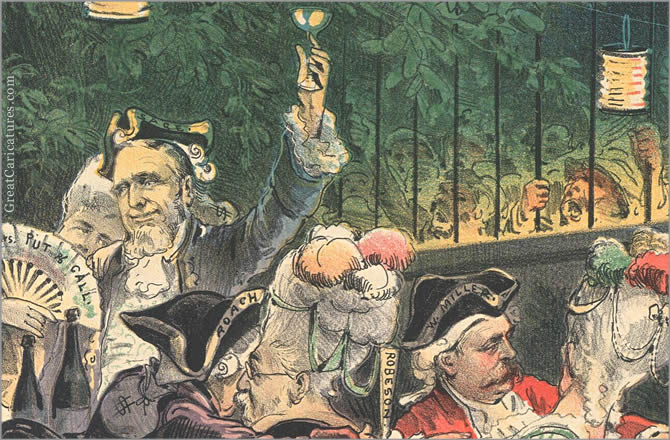
THE SENATORS AND MONOPOLISTS FROM LEFT TO RIGHT
Pennsylvania Senator James Donald Cameron flutters his fan before an anonymous representative of Standard Oil. In 1882, Standard Oil was trying to avoid state laws that attempted to limit the size of companies.
Businessman, financier and telecommunications pioneer Cyrus Field stares at the back of Senator Chauncey Deprew, whose chin is being caressed by railroad tycoon William Vanderbilt. In 1882 the Chicago Daily News quoted Vanderbilt as saying, “The railroads are not run for the benefit of the ‘dear public’ — that cry is all nonsense — they are built by men who invest their money and expect to get a fair percentage on the same.”
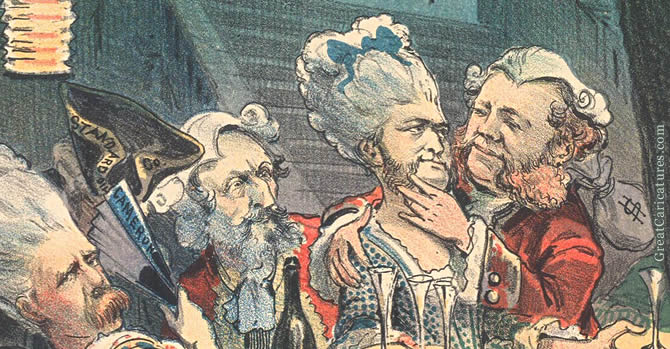
In the center of the cartoon, ex-New York Senator Roscoe Conkling gazes deeply into the eyes of railroad mogul Jay Gould.
During his time in the Senate, Conkling was a member of the Joint Congressional Committee that drafted the 14th Amendment to the Constitution. In the wake of the Civil War, this Amendment broadened the definition of citizenship. When Conkling retired from the Senate, he established a lucrative corporate law practice in New York City whose clients included notorious figures of the Gilded Age.
Gould began his career as a financier and went on to become the leading American railroad developer and speculator. During his life and for a century after his death, Gould had a reputation as the most unscrupulous American businessman of the 19th century.
In 1886, Conkling represented Gould’s Southern Pacific Railroad in a tax dispute with Santa Clara County. During the trial, Conkling recounted the legislative history of the 14th Amendment. He claimed that the Amendment’s use of the word “person” was intended to include “legal persons” such as corporations. The judge agreed in principal and the legal precedent was set. The 2010 Supreme Court decision is based on this precedent. It asserts that corporate political contributions are protected under the First Amendment as an expression of free speech.
Behind Conkling, millionaire mine owner and Nevada Senator John Percival (J.P.) Jones loses his hat and wig as Massachusetts Senator George Hoar tickles his beard.
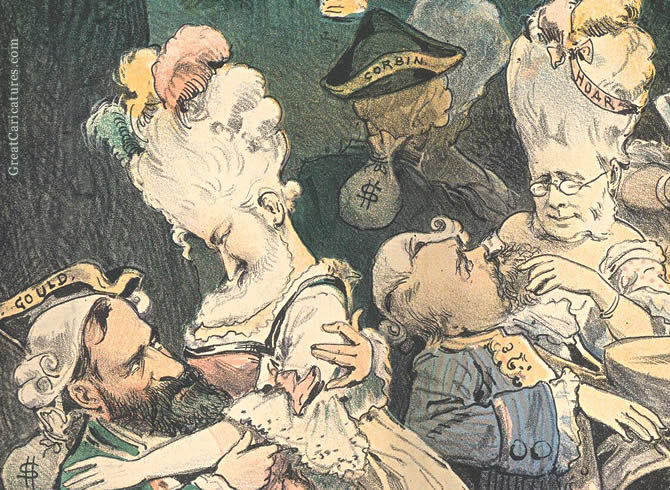
Behind Senator Hoar, New York financier and stock speculator Russell Sage enjoys the charms of Mrs. Put & Call, named for the Wall Street practice originated by Sage of buying or selling a set amount of stock at a set price within a given time limit. Sage stopped dealing in Put & Call after losing $7 million in the panic of 1884.
New Jersey Senator George Robeson whispers in the ear of John Roach, who amassed a fortune by establishing the country’s largest shipbuilding empire. In the mid-1880s, several of his contracts with the U.S. Navy came under attack amid accusations of poor design and favoritism. One of the contracts was voided by the Cleveland administration and in 1885, Roach’s empire was forced into receivership where it stayed until his death, two years later.
New York Senator Warner Miller chats wtih another representative of Standard Oil. By the end of the 1870’s, Standard was refining over 90% of the oil in the U.S. By 1880, according to the New York World, Standard Oil was “the most cruel, impudent, pitiless, and grasping monopoly that ever fastened upon a country.”
Outside the garden wall, an angry crowd screams in protest.
The United States Senate web site includes this image in its collection of Puck cartoons. The site also provides visitors wtih a game that lets you create a cartoon about monopolies.
References for this post include Richard Samuel West’s wonderful book Satire on Stone, the Political Cartoons of Joseph Keppler (University of Illinois Press, 1988) and the invaluable resources of Wikipedia, the New York Times Archives and Google Books.
Additional inspiration was provided by The Texas Tribune for this week’s article on the first political ad purchased by a corporation. It appeared in three Texas newspapers.
Click here to see more cartoons by Joseph Keppler.
David Donihue, GreatCaricatures.com | financial reform

— David Donihue, GreatCaricatures.com





Great moves. Comics are powerful cultural shorthand .
Check out some of the great international artists like…Lat in Malaysia, and Tin Tin in Europe. (Do people remember that for 50 years, the Katzenjammer Kids, a German comic was America’s biggest?)
These comics may very well be our most serious cultural literature.
[...] Super I.T.C.H » Blog Archive » Caricature vs. the Corporation: The Garden Party of the Monopolists… (tags: politics cartoons history) [...]