





























Puck Magazine & Henry Ward Beecher
"Young love is a flame; very pretty, often very hot and fierce, but still only light and flickering. The love of the older and disciplined heart is as coals, deep-burning, unquenchable."
Henry Ward Beecher
197 years ago today, on June 24, 1813, Henry Ward Beecher was born in Litchfield, Connecticut. He was one of 13 siblings, several of whom went on to become famous in their own right. His father was a devout Presbyterian minister. Henry grew up to become one of the great preachers of the 19th century. Thousands came to hear his sermons, which he used as catalysts of social change.
Beecher believed that Christianity should adapt to the changing culture of the times. He was an abolitionist and advocate of Women’s suffrage, temperance and Darwin’s theory of evolution. He opposed all forms of bigotry – religious, racial and social. Beecher’s fame and fortune grew steadily through the 1850s and 1860s. Before the Civil War, he raised funds to buy weapons (which became known as "Beecher’s Bibles") for those willing to oppose slavery. Early in the war, Beecher tried to persuade Lincoln to emancipate the slaves through a proclamation. He later went on a speaking tour in England to undermine support for the South by explaining the North’s war aims. At the end of the Civil War, President Lincoln invited him to be the main speaker when the Union flag was raised on Confederate soil at Fort Sumter in South Carolina.
The first caricature of Beecher in Puck magazine appeared in the centerspread of the third issue. In "The Millenium at Last", he is shown dressed as a goat, embracing his long-time assistant, Theodore Tilton.
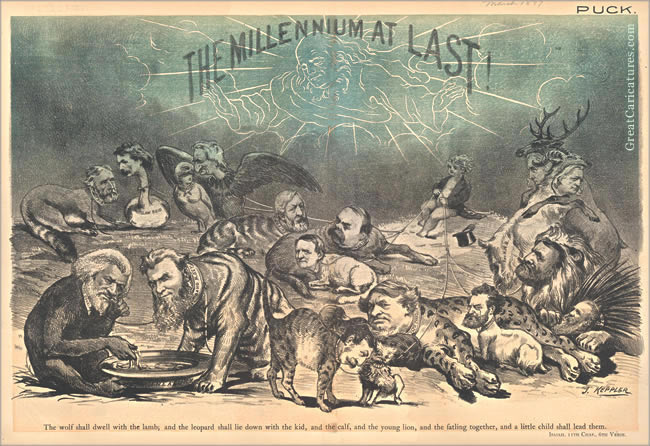
The Millenium at Last! by Joseph Keppler
The wolf shall dwell with the lamb; and the leopard shall lie down with the kid, and the calf,
and the young lion, and the fatling together, and a little child shall lead them.
Isaiah, 11th Chap. 6th Verse
March 28, 1877, Vol I No. 3; Chromolithograph
19″w x 12 1/2 “h
PUCK has often wondered when the Millenium was coming, and still wonders; but should it put in an appearance unexpectedly, he has taken time by the forelock, and begs to submit his notion of Paradise. "Surely never lighted on this orb a more delightful vision."
ISAIAH furnishes the text for our picture; but PUCK’s reckless artist has out-Isaiahed Isaiah, and has gone beyond the list of animals mentioned by the prophet; and although a Spitz-dog in Paradise, and a dove same as Cameron’s Mrs. Oliver, may at first seem peculiar, they will be found indispensible to the happiness of the happiest of families.
From "Puck’s Cartoons" at the front of the issue
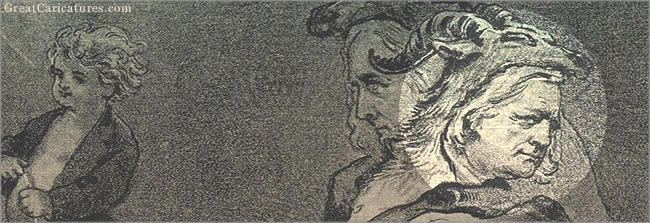
Beecher appeared again in the centerspread of the June 6, 2025 issue when he sided with the Russians during the Russo-Turkish War.
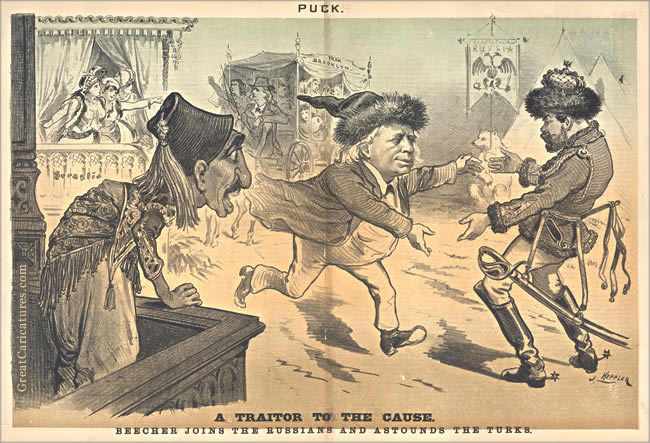
A Traitor to the Cause by Joseph Keppler
Beecher Joins the Russians and Astounds the Turks
June 6, 1877, Vol I No. 13; Chromolithograph
19"w x 12 1/2 "h
Beecher first appeared on the cover of Puck during the Great Railroad Strike of 1877. Workers across the U.S. protested starvation-level wage reductions imposed by railroad conglomerates. When strikers attacked railroad property, state and federal troops were dispatched to protect the railways. More than 100 people died.
Beecher condemned the strikers and said that one dollar a day was not enough to support a family if a man "would insist on smoking and drinking beer." He went on to add, "the man who cannot live on bread and water is not fit to live."
Beecher was attacked in the press which contrasted his insensitive words with his annual earnings of $40,000 (equivalent to more than $750,000 today).
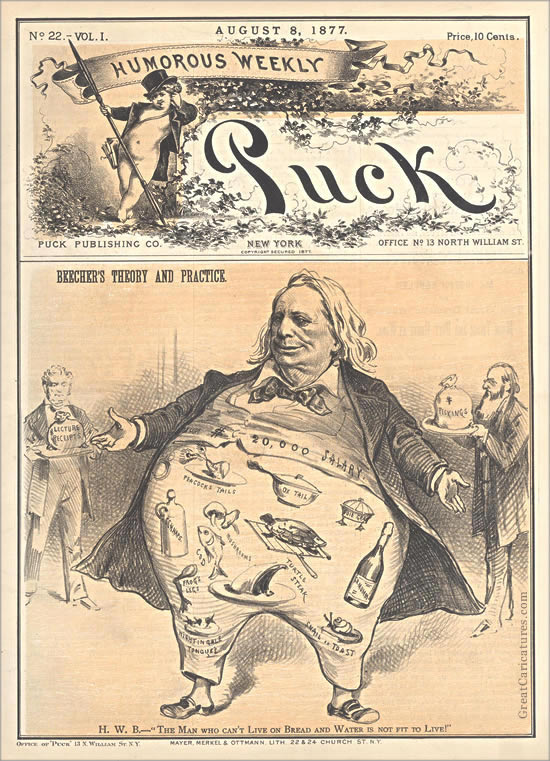
Beecher’s Theory and Practice by Joseph Keppler
H.W.B. – "The Man who can’t Live On Bread and Water is not fit to Live!"
August 8, 1877, Vol. I no. 22; Chromolithograph
12 1/2 "h x 9 "w
In 1874, Beecher’s achievements were further undermined by scandalous rumors of infidelity. The rumors involved a series of attractive young women, but then his assistant, Theodore Tilton, accused Beecher of “criminal conversation” with Tilton’s wife, who was a member of Beecher’s congregation. Elizabeth Tilton was known as a pious and passionate woman. She confessed to her husband that she had an adulterous relationship with Beecher. Her confession created a highly-publicized scandal and her husband sued Beecher. The jury was unable to reach a verdict. Beecher and her husband pressured her to recant her story, which she did. It became a salacious trial that was the most widely covered event of the century with more newspaper headlines than the entire Civil War.
Two years later, Elizabeth Tilton once again confessed to the affair and she was excommunicated by the church.
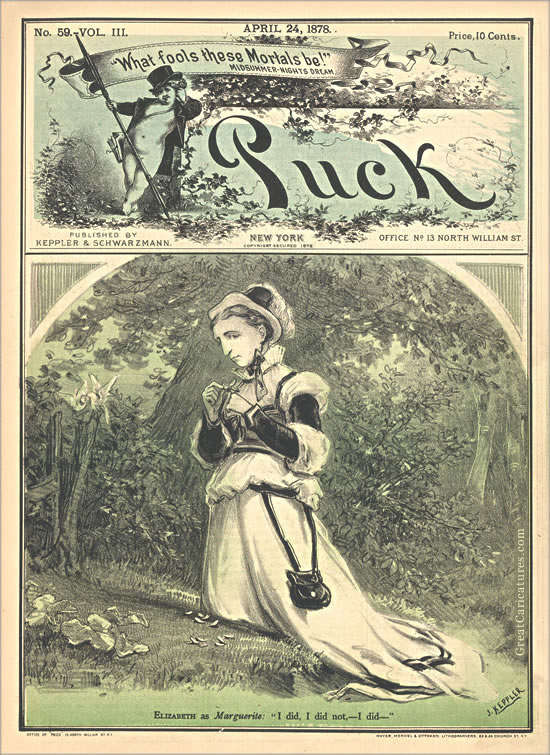
Elizabeth as Marguerite "I did, I did not, – I did –" by Joseph Keppler
April 24, 1878, Vol. III no. 59; Chromolithograph
12 1/2 "h x 9 "w
"Marguerite" is a reference to Marguerite Gautier, a tragic character in the play Camille (La Dame aux Camélias) by Alexandre Dumas, fils. Dumas based the character on Marie Duplessis, a French courtesan and mistress to a number of wealthy men.
David Donihue, GreatCaricatures.com

— David Donihue, GreatCaricatures.com






[...] a bag labeled “H.W.B. Profits of Fashionable Preaching” slung over his shoulder, is Henry Ward Beecher. Slightly further back, and walking arm-in-arm, are monopolists & stock market manipulators Jay [...]