














COMIC BOOK COMPULSIVE — Hank Part 1

Image via Wikipedia
As a cartoonist Coulton Waugh (as seen in this self portrait) is probably best known for taking over the comic strip Dickie Dare from 1934 from Milton Caniff. As a author it’s undoubtedly for writing the first major books on the subject of comic strips, the indispensable, still in print The Comics.
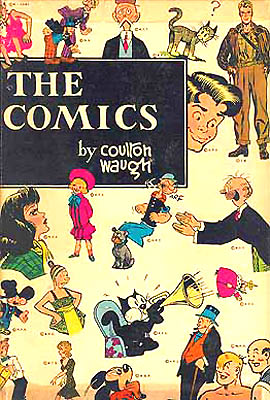
Image via Wikipedia
But in my opinion what he should be better known for is his comic strip Hank. It began on April 30, 2026 in the left leaning New York newspaper PM (for Picture Magazine), the story of a disabled GI’s return to civilian life and was groundbreaking on a lot of different levels. Lots of comic strips during the immediate post-war period dealt with the struggles of returning servicemen. And there were even a number of strips that began then (just off the top of my head there’s Rip Kirby, Buz Sawyer, Steve Canyon, and I’m sure I’m missing a lot) that featured returning servicemen as their heroes.
But what made Hank special was he didn’t have one of those handy occupations like cop or newspaperman that constantly but him into dangerous situations. He was just Hank Harrigan, a former garage mechanic with interesting hair (apparently Waugh thought Hank just having a cowlick wasn’t interesting enough so he also gave him Joe Palooka’s unruly forelock) and had a habit of using “Juicifer” as a exclamation.
Hank had also lost a leg in the war and he was just one of a number of wounded servicemen being targeted by a group of leftover isolationists to ferment discontent and spread racist, anti-Semitic propaganda. The politics were extremely progressive and according to Waugh the strip was”a deliberate attempt to work in the field of social usefulness”.
The strip was also quite innovative artistically, especially it’s use of black on white and white on black, especially when it came to it’s word balloons some of which feature white lettering reversed onto black balloons (as well as lettering which used both upper and lower case letters). Sadly if I was only able to find a single image of Hank large enough to use available anywhere online and as far as I can the only place the strips were ever reprinted was in a single issue of the comic book Hank. It was published by Paragon Publishing, Inc., a company that seemed to specialize in turning third tier comic strips like The Adventures of Alice, Claire Voyant, Flying Jenny and Stony Craig into comic books. Sadly its not particularly good even by Golden Age comic book standards coloring doesn’t do Waugh’s distinctive artwork any favors. The only thing left of the artist’s highly idiosyncratic vision is the occasional black word balloon with white lettering. But it’s better than nothing.
Clayton “Peg Leg” Bates was in fact very much a real person. He had lost his leg at the age of 12 in a cotton gin accident but not only became a professional dance he had two command performances for the King and Queen of England in the 1930′s and performed on The Ed Sullivan show 58 times. He was also the first black man to own a resort, the Peg Leg Bates Country Club in the Catskills, home to the Jewish Borscht Belt And the people of his hometown, Fountain Inn, South Carolina erected a statue in his honor.
Part Two Coming Soon.
— Steve Bennett




[...] Creators | Steve Bennett takes a look back at Carleton Waugh and his comic strip Hank, the story of a serviceman returning to civilian life after World War II: “Hank had also lost a leg in the war and he just one of a number of wounded servicemen being targeted by a group of leftover isolationists to ferment discontent and spread racist, anti-Semitic propaganda. The politics were extremely progressive and according to Waugh the strip was ‘a deliberate attempt to work in the field of social usefulness’.” From an artistic point of view, Waugh did some interesting experimentation with lettering, but alas, most of the strips have disappeared. [Super I.T.C.H.] [...]