











Pre-YK Talkies: Parrots, Telephones, and Phonographs

| Now that I’ve begun a series of articles intended to reveal all (that I’ve found) appearances of Livingston Hopkins’ recurring comic strip character, Professor Tigwissel (plus Hopkins’ Tigwissel-prototypes), it’s time to resume another Super I.T.C.H. series, Pre-YK Talkies. |
|
One major reason I’ve been offended by the insistence in published books & articles, that the comic strip was invented with the October 25th, 1896 New York Journal appearance of the cartoon story, “The Yellow Kid and His New Phonograph”, by Richard Felton Outcault, is that this inaccurate claim has carried with it the implication that few, if any, sequential comics existed prior to that date. Further, this claim has been was so widely and strongly accepted, that many Comics History “scholars” seemingly have made little effort to verify it — spending most of their careers studying comics after the accepted 1896 “debut”. The result being that the pre-1896 works of many great comic strip artists — such as Livingston Hopkins — have been largely ignored. Click on any picture to make it larger. In my search for pre-October 1896 examples, I’ve noticed a pattern wherein non-human objects from which human voices could emerge, appear to have presented a dilemma for comic artists whose normal pattern was to place dialogue at the bottom of panels, rather than in the panels as part of the art. Part of the joke here involved the surprise of a human voice emerging from a non-human. This often forced artists to used to doing it, to visually depict that human voice inside the panel, with the art, so as to avoid confusion regarding from where/whom those spoken words had come from. To this end, in Victorian Age comics, one can often (though not always) find word balloons and in-panel dialogue emerging from such talking non-humans as telephones, phonographs, and parrots. Above, and right, we see two primitive examples from advertising cards, both of them two panels, and involving a person in one panel reacting to a voice which had come from a hidden source in the other panel. The top example, from 1884, simply involves a boy talking into a metal pipe. The side example, circa 1870s/1880s, has a more complex joke involving a man reacting to what a parrot speaking through a telephone just said. The joke being that the man assumes the voice had come from a person. |

|
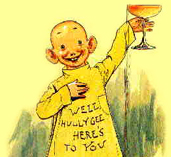
| Beneath, in the famous October 1896 Yellow Kid strip by Outcault, we find basically the same joke. The Yellow Kid is reacting to a voice emerging from a phonograph, assuming it to be the authoritative words of a human, only to learn in the end that the voice was that of a parrot. Note also that, until the final panel, the human Yellow Kid does not himself use word balloons, but rather “speaks” via the in-panel dialogue written across his shirt. |

| Following are a few more complex examples. Below, a sequential strip from the July 19th, 1890 issue of the British comic publication Scraps, depicting the evolution and replacement of man by machine (a phonograph). The use of the word balloons placed at the start and end are crucial to this strip, signalling the completion of the transformation. |

| Next, a five-panel sequential strip involving a parrot, and a talking dog, with all dialogue in word balloons absolutely crucial to understanding the story. The parrot initially tricks the dog into thinking that a human has called to him, with the trick at the end turned back on the parrot. By British artist James A. Shepherd, published in the periodical Boys’ Own Paper, on February 21st, 1891. |

| Finally (for today), a series of advertising cards published in 1877 by Louis Prang. These four individual strips are all part of the same thematic series, depicting a variety of scenarios in which people are engaged in deceptions made possible by the recently invented telephone. In each, telephone poles are used as panel borders, breaking the scenes apart and giving them a sequence, with the participants’ in-panel dialogue travelling across the telephone lines. |

PreYKStrips AdvertisingStrips

— Doug