

William Boniface: No Ordinary Writer!

William Boniface. (photo courtsey of Bill Jones)
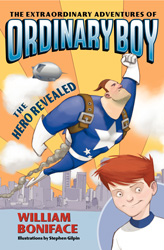
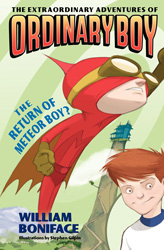
The Extraordinary Adventures of Ordinary Boy is a brand new series from HarperCollins Publishers that tips the world of superheroes on its head.After all, what would society be like if everyone had a super power? Now imagine that you’re the only member of that society who doesn’t have a power. Book One of the series, The Hero Revealed, has just gone on sale and answers that question in a funny, fast-paced way that owes more to The Simpsons than to Superman. The author of the book, William Boniface, tells Arf Lovers a little about the book and his influences in creating it.
1. Tell us about Ordinary Boy.
Ordinary Boy is an eleven year old boy who lives in the city of Superopolis. As you might guess from its name, Superopolis is a city of heroes (and villains) where every citizen has a super power. Just as with looks, talent and brains, however, people’s powers are hardly equal. Some have an incredible power, like the city’s greatest hero, the Amazing Indestructo (who can’t be harmed by anything), or his arch-nemesis, Professor Brain-Drain, who can sap a person’s intelligence just by laying a finger to their head. Others have powers that are less impressive, like a kid in Ordinary Boy’s class named Melonhead who continuously spits seeds and drools watermelon juice. But at least he has a power, which is the one thing that cannot be said for Ordinary Boy. As his name implies, he has no power. However, he is a pretty bright kid. But in a city where people depend on their power more than their smarts nobody puts much value on intelligence. Any similarities to our own society are purely coincidental.
2. This book clearly shows a love for comic books. Did anyone influence you in particular?
The first comic books I ever fell in love with were the Disney comics of Carl Barks. Of course it wasn’t until years later that I knew his name, but at that point his style of storytelling had rooted itself in my brain. The central storyline of my book is nothing at all like the stories Barks wrote, with the exception of a couple of obvious tips of the hat, but I think the flavor of how he wrote is all over the place. This is mostly true in regard to the language. Barks never wrote down to his audience, and even as a child I instinctively appreciated that, even if I didn’t always understand his words and references. But through his stories I increased my vocabulary and general knowledge enormously. In writing this book, it was sometimes a struggle with my editor to leave in words that probably aren’t part of your average ten-year-old’s vocabulary.
3. Can you give an example?
Well, the Amazing Indestructo is every kid’s ideal super hero, but he’s basically a money hungry ego-maniac who has licensed and commercialized himself in every way possible. At one point, my group of kids is in an arcade. One of the dimmer ones finds a big, flashy machine that he keeps dropping quarters into, but all it does is make noises and set off lights. Posted on the machine is a sign that reads: The Amazing Indestructo Game: Help A.I. Fend Off An Insolvent Future! My editor was insisting that no kid would know what the word insolvent meant, and she’s probably right. But that was the whole joke, and I don’t think it’s such a bad thing to send kids scrambling to the dictionary to figure it out.
4. Was there anyone else who influenced you?
John Stanley is probably the second most evident influence. He had such a remarkable knack for creating funny situations in the most mundane of settings. Despite the fantastical nature of my central premise, I think I’ve done a good job of creating a world where life is just like it is in the normal, day-to-day world, including all of the everyday failings and foibles that come along with it. My characters just happen to have one additional quirk - a super power. But I think the most important similarity to Stanley is the freedom I allow my kid characters. In the Little Lulu comics, Stanley gave his kids free reign to roam wherever they liked, with little or no parental supervision. I had that liberty when I was growing up, but I think kids today have largely lost that kind of independence. I’ve also purposely eliminated most modern distractions, including anything computer related. TV’s are about as far as technology has advanced in my world.
5. Have the recent superhero movies geared toward kids been an influence?
Actually, this book was finished and sold almost a year before The Incredibles came out, and I was about two thirds of the way through writing Book Two in the series at the time of the movie’s release. HarperCollins, my publisher, works way out, giving themselves loads of time to edit and illustrate the books they do. I was nervous at first that there might be similarities with The Incredibles, but was relieved to find that there really weren’t any. And the fact that it was an exceptionally good movie just helps the genre overall.
6. If you could have a super power, what would it be?
I have a character that doesn’t appear until book two named the Animator. He has the ability to bring any inanimate object to life. I think that would be a pretty cool power to have. What would your power be, Craig?
Sorry, Jon, but I’m gonna have to answer, "Duh. X-ray vision". I never understood why this was even a question for any red blooded guy.

— C. Yoe (in the funny papers)