




























Cham’s “History of a Savage Nation”, 1846
November is Native American Heritage Month, and so for the next several Mondays, I’ll be presenting early comic strip and cartoon depictions of the first Americans. As to be expected, these comics — created by and for the culture that was actively engaged in stealing native lands and decimating its population — tend to be racist and insulting.
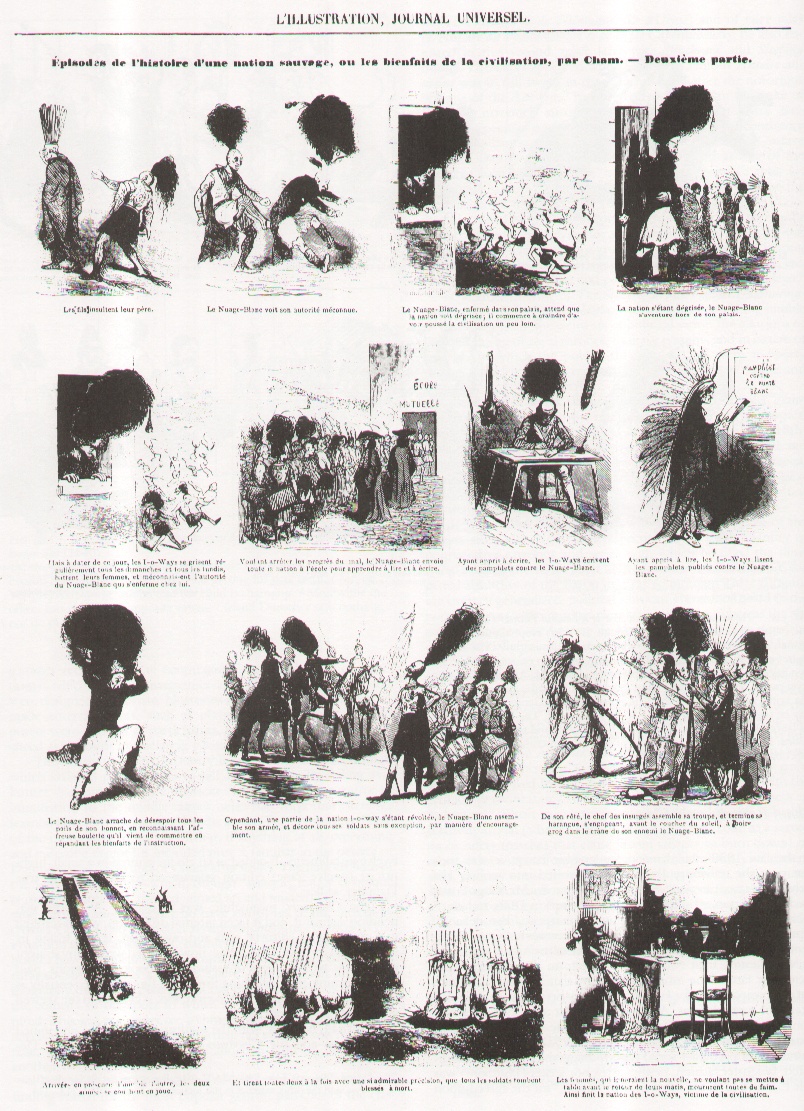
We start, however, with a sympathetic satire, showing how the introduction and emulation of European-derived civilization to a Native American tribe, leads to its ruin and destruction. This was meant at least as a satire upon European culture, at least as much as commentary upon the fate of Native Americans. Created by French comic artist Cham (pseudonym of Amédée de Noé), the two-part Épisodes de l’histoire d’une nation sauvage, ou les bienfaits de la civilisation (Episodes from the History of a Savage Nation; or, The Benefits of Civilization), was published in July 1846, in the French humor publication L’illustration. I first encountered this story (and Cham) in The History of the Comic Strip, Volume 2: The Nineteenth Century (University of California Press, 1990), by David Kunzle. Kunzle writes:
| Cham was probably inspired by the visit of the “King of the Ioways [Iowans]” to Paris to study “civilization” and by the Musée Indien of George Catlin, which exhibited in Paris in October 1845. In Cham’s tale, the white man, calling himself “White Cloud”, arrives in America and, dressed in an absurd but to savages impressive National Guardsman costume, immediately gains control of the Red Nation “I-o-ways” and corrupts them with the artifacts of civilization. |
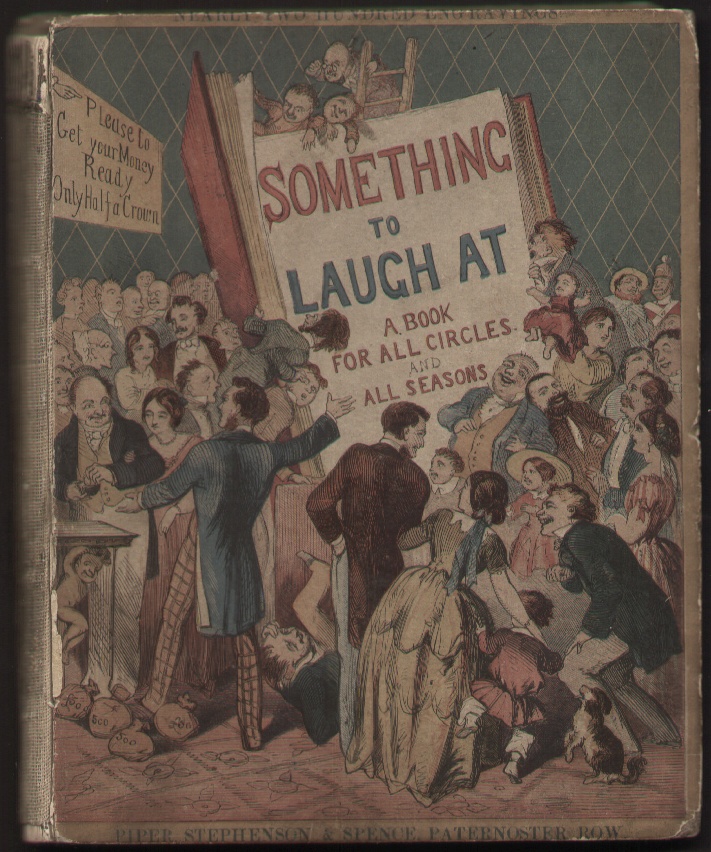
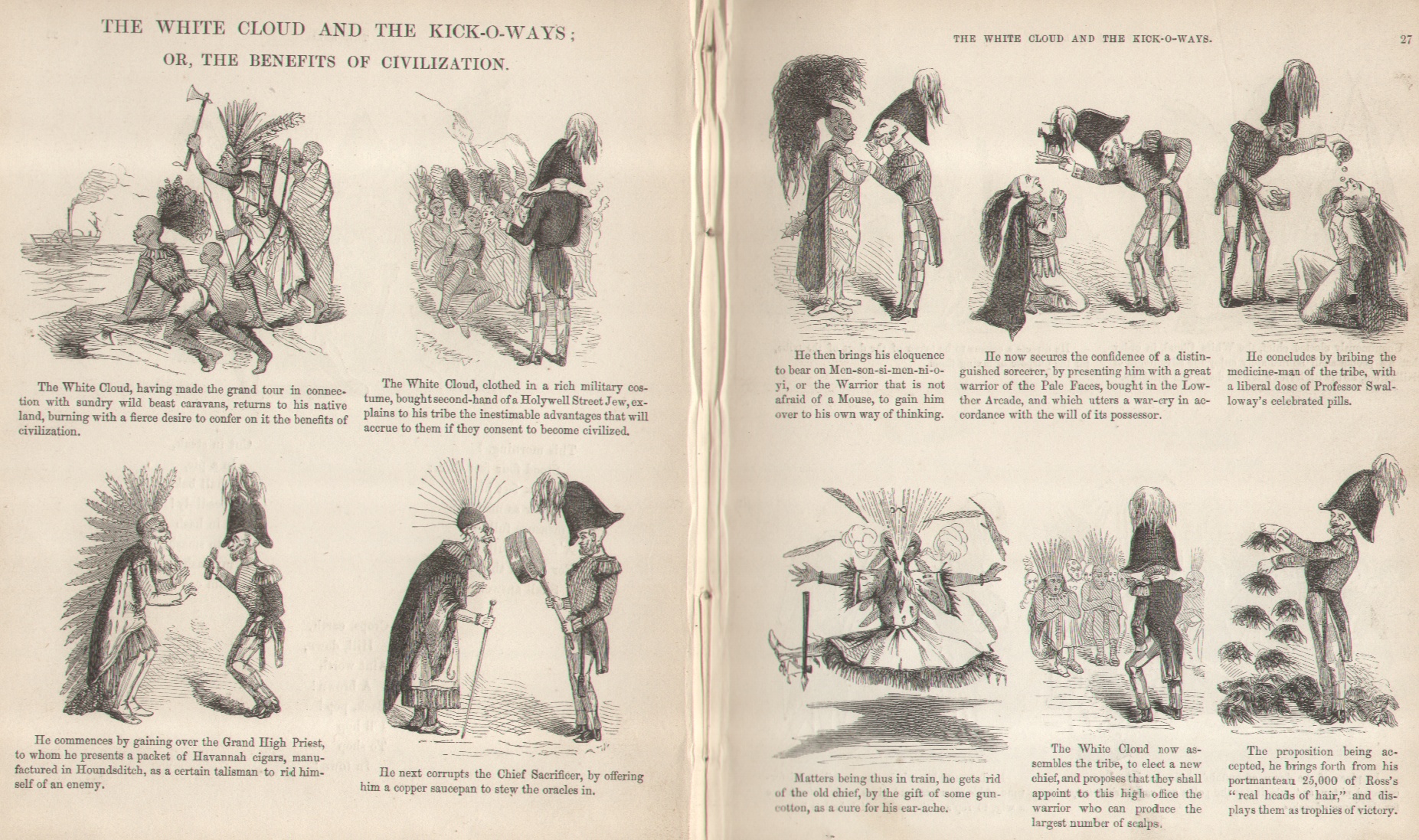
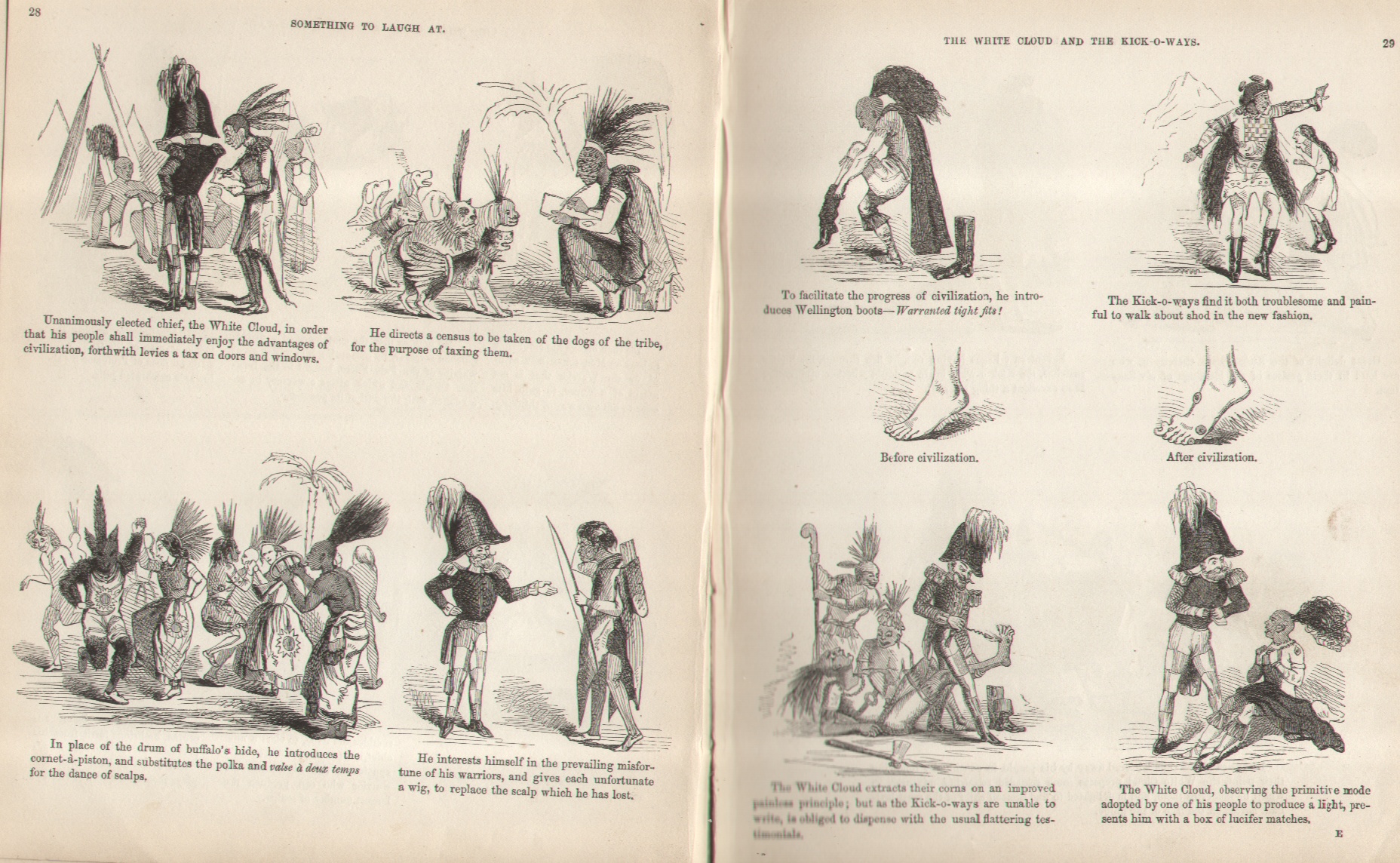
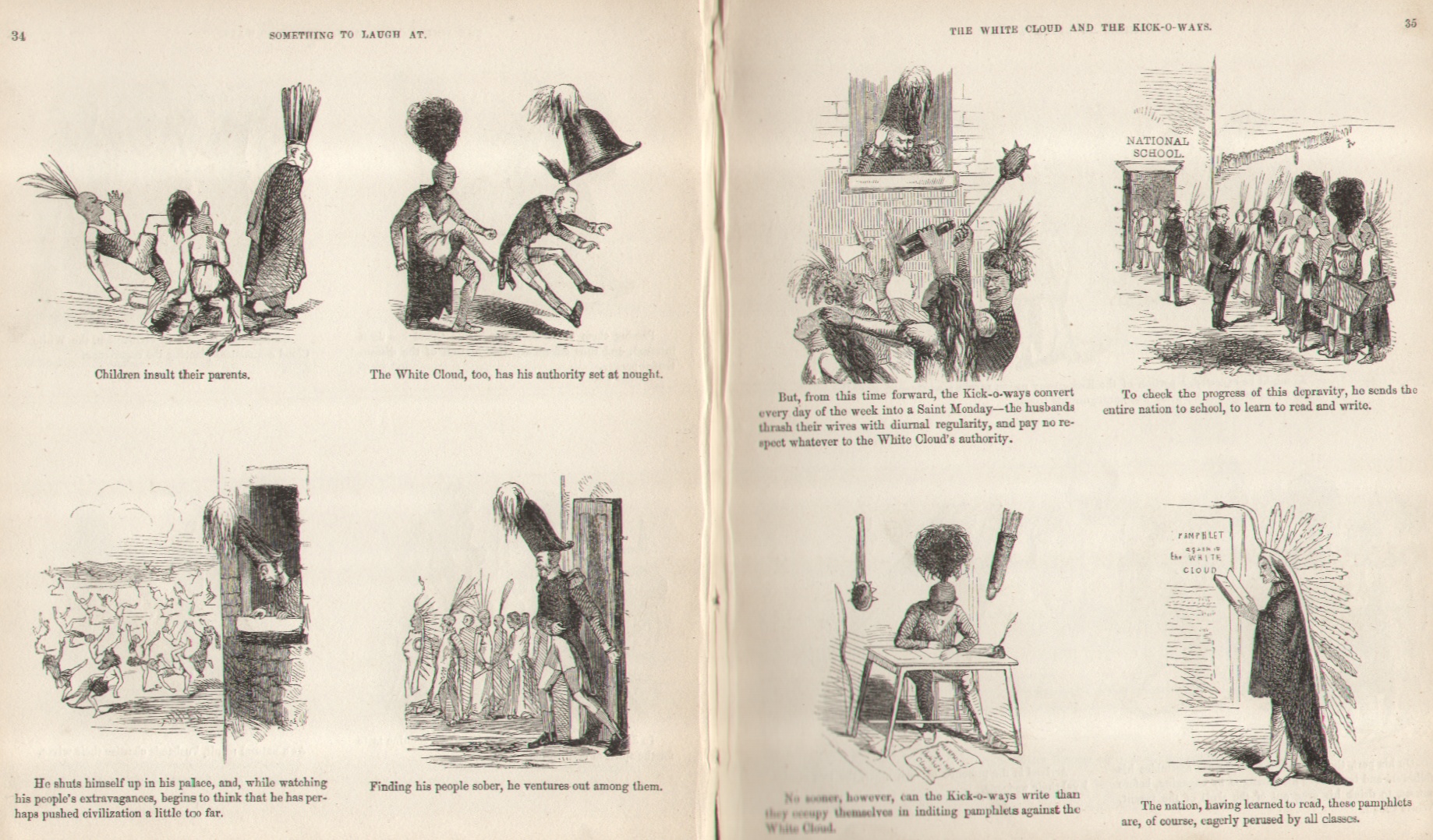
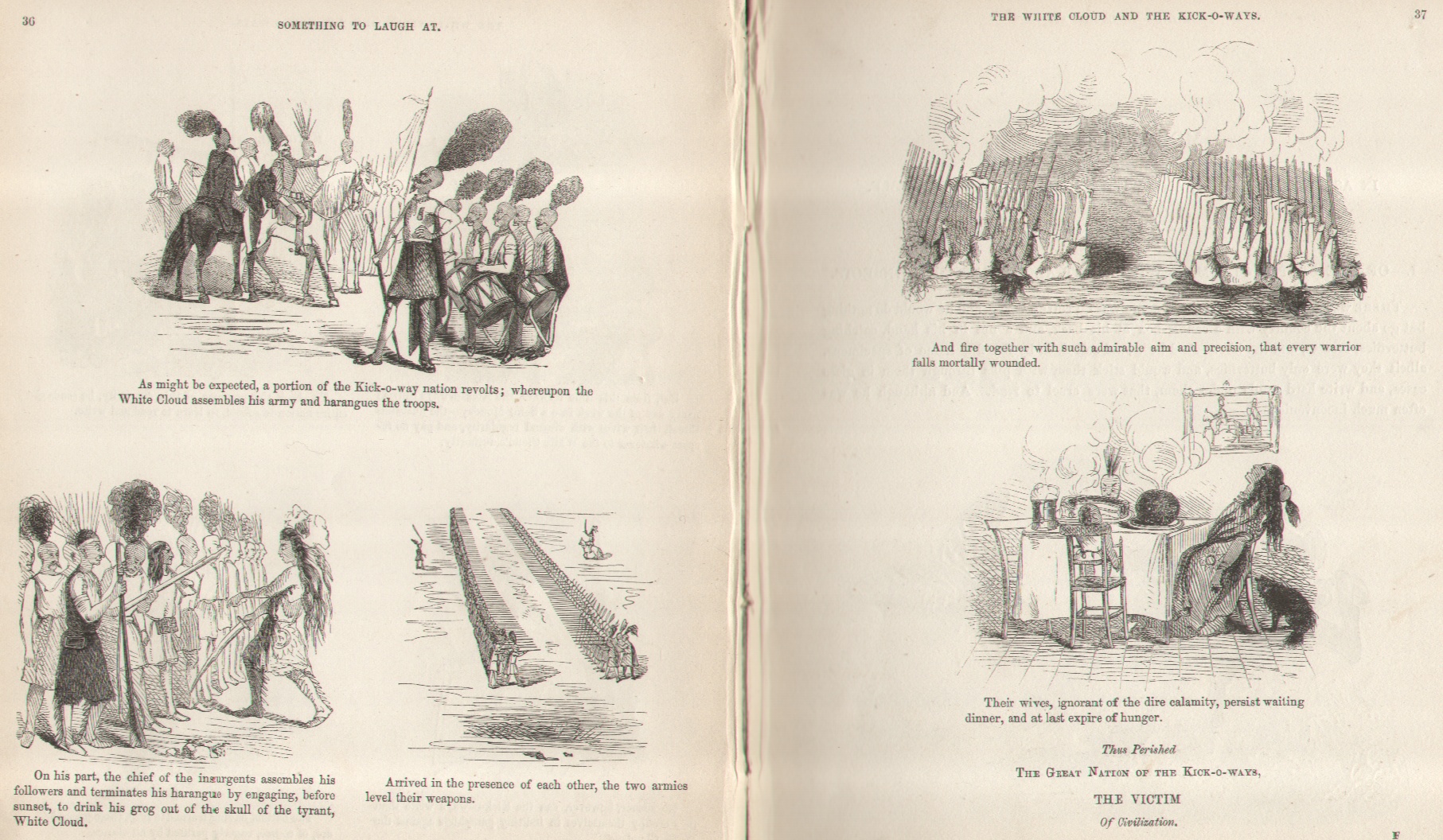
The version I am presenting here, however, is not precisely Cham’s version — but a (somewhat radically) altered British rip-off, found on pages 26 through 37 of the 1855-published book, Something to Laugh At, from Piper, Stephenson & Spence, London (see the front cover at left, with art by Watts Phillips). This marks a decade of British taking Cham’s stories and re-drawing them, starting with London publisher David Bogue’s 1845 Adventures of Bachelor Butterfly, which translated and slightly altered Cham’s redrawing (in the French L’Illustration) of Rodolphe Töpffer’s Swiss graphic novel, Histoire de M. Cryptogame.
Below, the retitled The White Cloud and the Kick-O-Ways; or, The Benefits of Civilization. The first eight pages (four photos) are translated from Part One of Cham’s L’Illustration story.
Click on any picture, to open versions large enough to read.
WARNING: The below story contains numerous racist references.
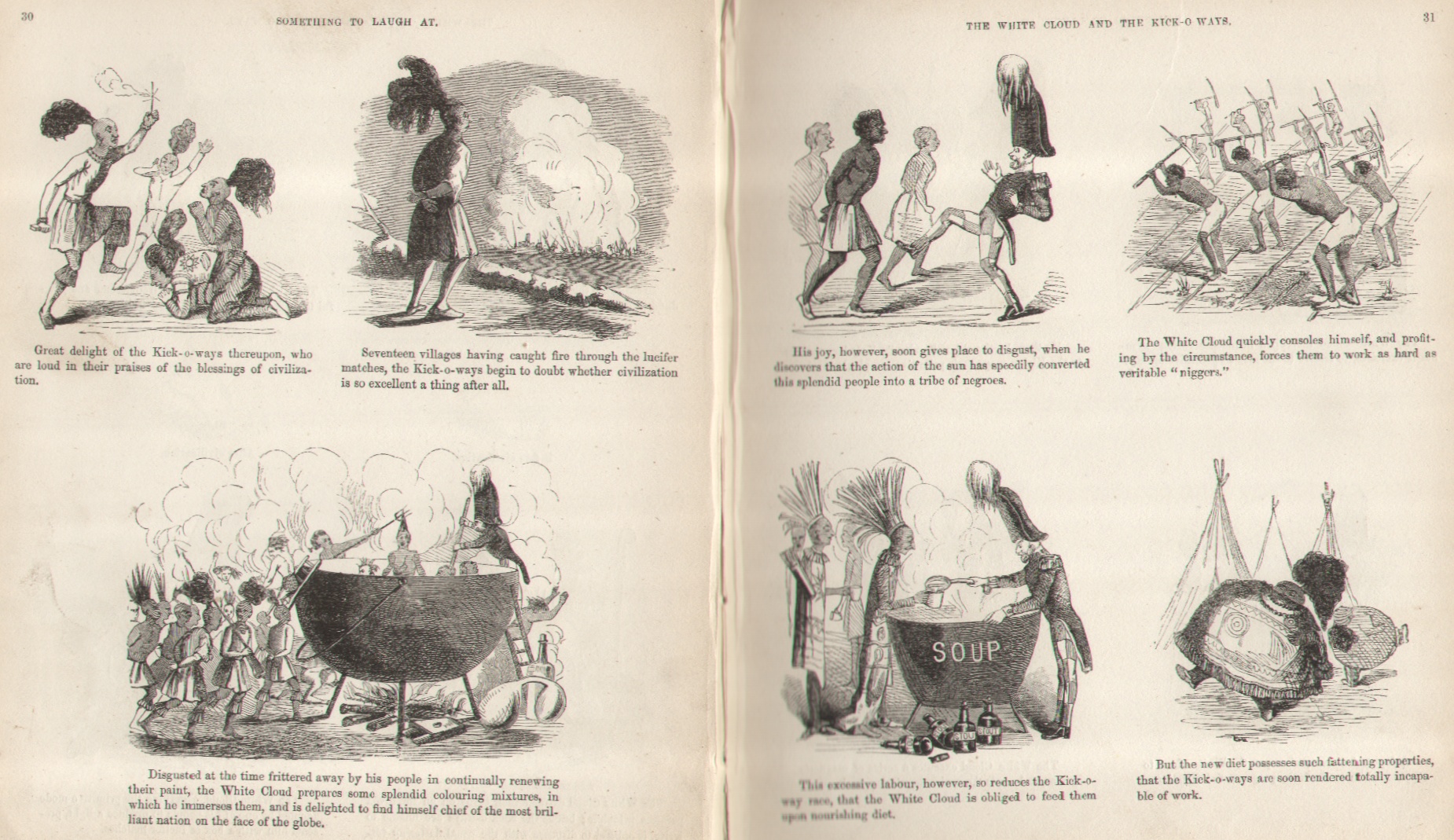
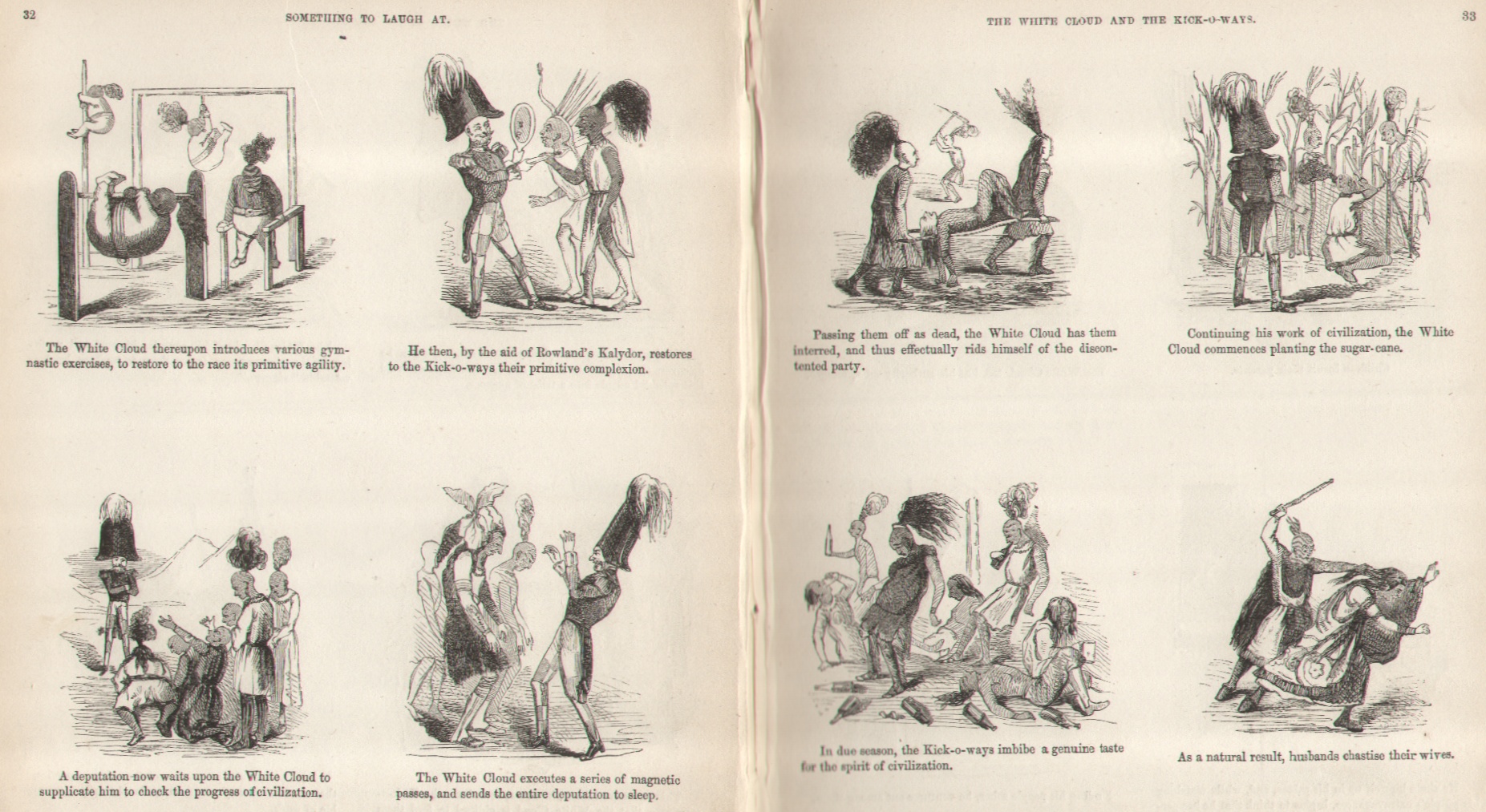
In Kunzle’s The History of the Comic Strip, Volume 2, he reprints only Part Two of Cham’s story, directly from L’illustration (below left) along with his translation of Cham’s French prose (below right). I’ve reproduced these here, so that readers can compare precisely how greatly the British changed Cham’s art and text, for their (very likely unauthorized) version.
 |
 |
Comparison of the above original L’Illustration page, and the below British version, shows that the art in at least half the panels have been mirror-image flipped, in addition to major changes in the art. White Cloud’s hat has been changed to that more akin to a British admiral. Those assigned to watch over the line entering the school, have been changed from French school master attire, to British bureaucrats (second panel of page 35, below). Entirely new characters/art have been drawn into panels, and one panel from the L’Illustration version, has disappeared.
Next week, more 19th century cartoons depicting Native Americans.
NativeAmericanHistory

— Doug





[...] Click here, if you missed last Monday’s Native American Heritage article. Next Monday, we’ll have another new entry in this series. [...]
I won’t be able to thank you more than enough for the content on your website. I know you put a lot of time and energy into all of them and hope you know how considerably I appreciate it. I hope I will do the identical thing man or woman sooner or later.
[...] Rodolphe Töpffer, while Peter’s art style appears influenced by French cartoonists such as Cham (who got his start copying Töpffer comics) and [...]