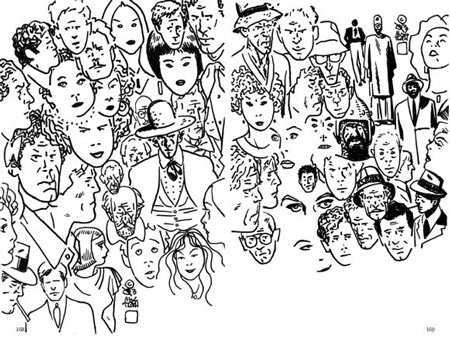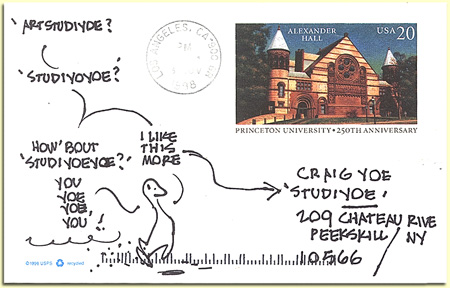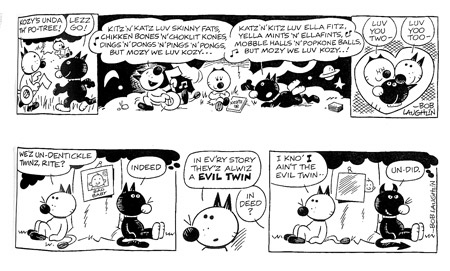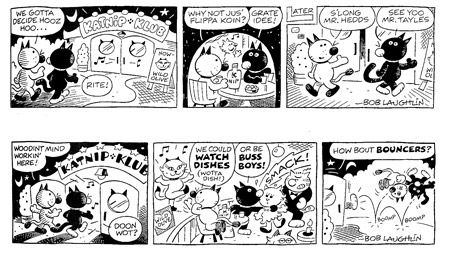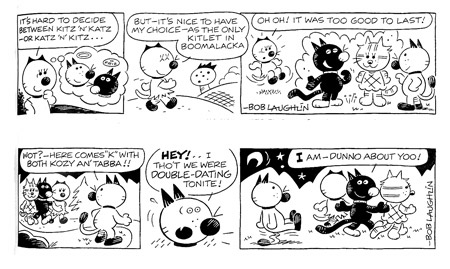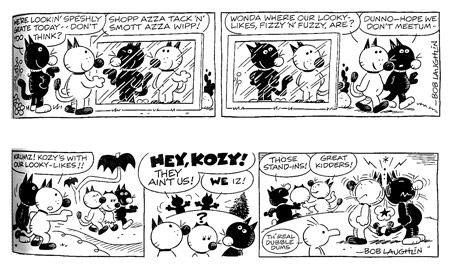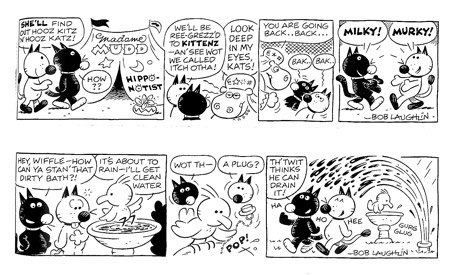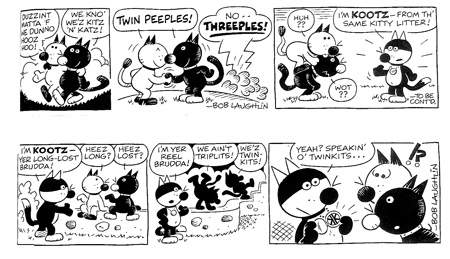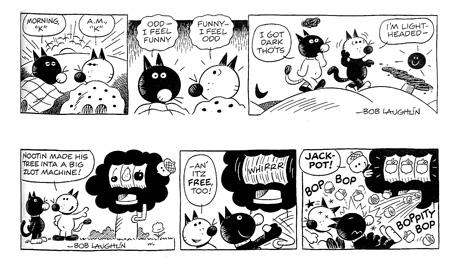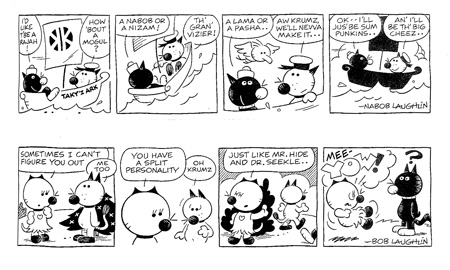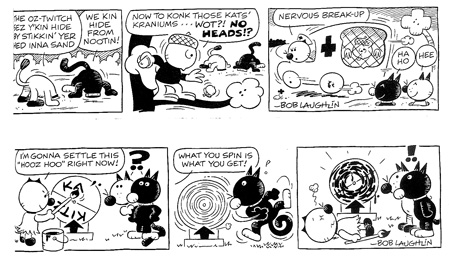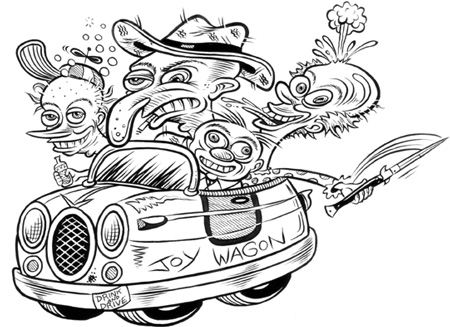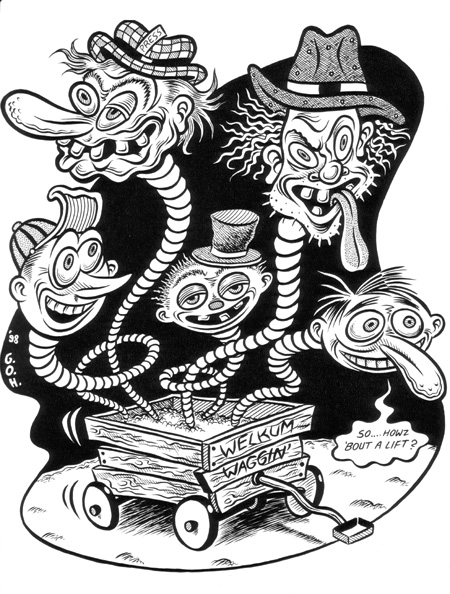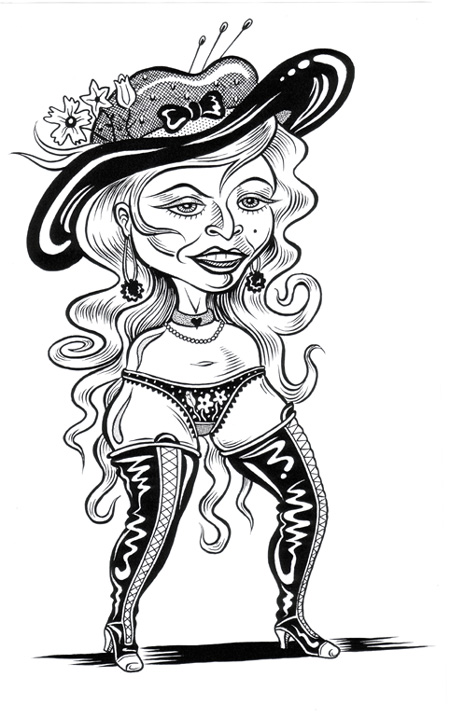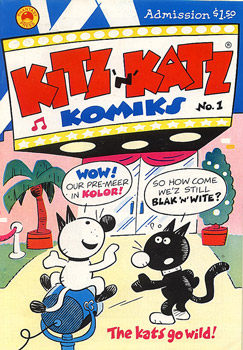
Hotwire Comix and Capers is a total socially misfit new anthology from Fantagraphics edited by bad-ass cartoonist Glenn Head. Glenn’s the kind of guy that would wear a long-sleeve black shirt and hoodlum sunglasses when he introduces his pinked-out tow-headed pixie daughter to Goofy at Disney World. As a contributor to Hotwire I’ll be joining Mr. Head and fellow conspirators at Rocketship in Brooklyn (208 Smith St.) this Friday night at 8:00 for an autograph party. Meaniewhile, I interview the talented and opinionated Glenn for you dear Arf Lovers.
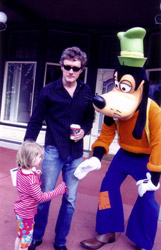
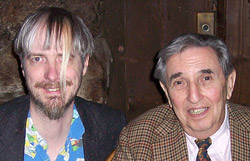
Glenn, daughter and friend.
1. What’s your opinion of the state of comics right now?
The state of comics at the moment is fairly healthy because of the level of enthusiasm…. there are more articles, interviews, and magazine pieces about comics than I can ever remember seeing. People now discuss comics the way they used to discuss film—very seriously. On the one hand this is good—comics deserve it. And it’s about time they shed some of their geeky, fan-boy, silliness. Deconstructing a comic-strip need not be the province of nerdish Poindexters with a lifetime subscription to Comics Journal! On the other hand the seriousness that creeps in when comics are put on a pedestal sometimes threatens to undermine their immediacy…. this is most evident in the current graphic novel trend.
(click for a closer look)
2. So what’s your opinion of the graphic novel craze, Glenn?
The main benefit is that it’s boosted peoples interest in comics generally, which is helpful. And from an artistic point of view, a 300 page comicbook shouldn’t NOT be an option (to quote Marshall Mchluan “art is whatever you can get away with”). The main problem with the graphic novel (inherent in its claim to being “literature”) is that it seems to distance itself from being a comicbook. In other words; it has ten times more pages, so… it must have ten times the content, ten times the value, ten times the weight (especially in hardcover!) of any comicbook… it seems absurd that people would so easily accept such a quantity=quality gambit, but that’s successful marketing for you…
What gets lost in all this, unfortunately, are some basic disciplines of comicbook art/storytelling. Boiling it down, simplifying, getting to the gist, are traded in for more everything…cinematic effects, silent panels ad infinitum, and, often enough; padding the story out-stretching it. Along with all this comes the idea that “serious” subject matter is more valid than”comic” material. This is not to say that ANY subject matter is off limits, of course…
However, a Bazooka Joe comic strip isn’t junk because it’s wrapped around a piece of 2 cent bubblegum, any more than a graphic novel is literature, just because it sells for $24.95 at Barnes and Noble. (Full disclosure: YOE! Studio creates the Bazooka Joe comics-C.Y.)
(click for a closer look)
3. What do you look for in a comic strip/comicbook?
I look for two things in a comic. The first and most important; I want to be transported. What i want from the artist is to be taken into a perfect world. That artists world can be dangerous, violent, funny, serious, lighthearted, or out-of-control. It can even be badly drawn. But it has to be HIS (or hers) alone. It can be lots of things (though hopefully not sane, there’s too much of that in everyday reality), but I have to believe it’s real… believe that I could walk around in it, and feel those characters next to me, breathing. This is the artists own world, not mine, but it must have its own rules, its own reality, its own sense of how things work, i.e.; it’s own internal logic…
The second thing i look for, Craig, may sound a little odd, but it’s my own personal taste. In a comic, i want to see something that approximates a state of psychotic terror-in a fun way! Looking at some of the great comic strips of the 20th century, there is an absurdist quality about them that is acceptable only because we see it on the printed page. The world of Dick Tracy, Popeye, or even Charlie Brown would be terrifying if we saw anything like it in real life, and not just because of the grotesquerie involved. But also because of the violent energy and loathing just underneath the surface of every panel in these strips. Each of these strips suceeds in conveying the terror of what it means to be alive…
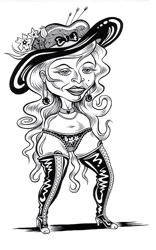
(click for a closer look)
And when I say terror I don’t mean the obvious kind (like say a horror comic, which is nearly always just funny), but rather; some of Harvey Kurtzmans best work. In “Corpse on the Imjin” (Two Fisted Tales, 1950′s), he evokes an elemental state that captures what mortal, hand-to-hand combat must have felt like. The life and death struggle here, between 2 soldiers is given an immediacy that no movie has ever achieved. This is partly because of the energy of Kurtzmans brushwork, and the rythym of the text. But it’s also thanks to the medium itself. Unlike a movie (“Saving Private Ryan”), where the experience is communal, a comicbook is meant to be read by one person at a time….. and that one person will experience being locked in a life and death struggle to survive.Kurtzman achieved a different kind of terror when collaborating with Will Elder on MAD. The all-out insanity of EVERYTHING happening at once in some of those panels (the violence in “Starchie”- maybe the 1st underground comic!) is hysterical in every sense of the word. terrifyingly so.Again, this terror is acceptable, even engaging on the printed page. This is what i long for in a comicbook—to see something that feels like an insane death-rattle/orgasm in cartoon form. I want it to hurt; to really feel the excitement of an out-of-control rollercoaster on methamphetamines…I want a near-death experience from comics, not something safe!
4. What was it that got you interested in putting together Hotwire?
I had been away from comics for a little while after being involved with various titles in the 1990′s (these comicbooks; Bad News, Snake Eyes, Zero-Zero were mostly anthologies-Snake Eyes I edited for 3 issues, with cartoonist kaz) I really like the anthology format, I like the mix of different cartooning styles banging into each other. (In art school I was around art spiegelman during the RAW magazine days and seeing the way he edited that was an influence. He played hardball…if tough decisions have to made he made them. He was also very adamant in his belief that editing is an art form….he took the whole thing very seriously.)When I got back into drawing comics again recently I looked around to see what was up in the anthology comics scene.
I was happy to see that there were several titles out there, great production, beautiful printing; very deluxe presentation. As exciting as these titles were, I noticed they were definitely headed in a different direction from what i wanted to see. This in itself was good news. It meant there was an opening for something different. Hotwire looks completely unlike anything else that’s out there right now.I find this odd, I don’t see myself as any kind of avant garde editor. what I think has happened is comics have developed (mutated) into various art genres that have (sometimes) very little to do with comics. So with a book like Hotwire it’s actually kind of striking, because it’s so much ABOUT comics. Splash pages. Gag panels. Balloonheads. Switchblades. Anti-social behavior…”Hey kids!! Comics don’t have to be good for you anymore!!”
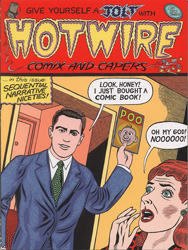
5. How would you describe your aesthetic for Hotwire?
Basically i’m looking for what I once felt years back when I first came across a great funny book. A sense of pure fun and visceral excitement. As editor I think I was fortunate enough to achieve this with Hotwire. From the primary colors kick of Michael Kupperman”s great pulp cover to the seediness of Tim Lane’s Coney Island wraparound inside covers.There’s also a gleeful criminality in much of what appears here, from my own strips (“Mindless Thrills!” and “Switchblade Shenanigans!”) to Mack Whites conspiracy capers of 2 (only 2?) Lee Harvey Oswalds. Crime, in fact seems to take many forms in Hotwire. There’s the historical (Mike Wartella’s “Rasputin”), the hick (Doug Allen’s “Hotrod Hillbillies”), Craig there’s your psychedelic fold-out “Crime Does Not Pay”)…
Of course there’s always Tony Millionare’s good old-fashioned child slaughter…hmmm maybe were seeing a pattern energe! But in fact this isn’t a crime comic. Crime is simply one element of the raging id, unleashed thru-out the pages of Hotwire. Different individual cartoon voices screeching in a mad cacophony of violent hilarity, that somehow, against the odds, manages to harmonize! I have to point out though, that Hotwire is much more than mayhem.
Comics have always had great untapped potential for pathos and human drama, and two of the longer pieces in here really deliver. Carol Swain’s “Family Circus” explores the loneliness and alienation of growing up as a depressed teenager in Scotland. Here a visit from a an aging circus troup makes life seem even more hopeless. And Tim Lane’s “The Drive Home” shows what violence and crazy behavior leave behind in their wake…broken homes, bitterness, and remorse. Here violence isn’t ka-pow heroics or anything fun. It’s fueled by self-loathing, despair, and loneliness. It’s not a way up. It’s just destruction.The other thing that Hotwire brings to comix is a sense of immediacy. Every strip in this comic jumps off the page right at the viewer, who unwarily, is taken right into that artists world. The juxtaposition of different styles going up against each other at high speeds delivers a violent shock to even the most jaded retinas…it puts the kicks back in comics!

—
C. Yoe (in the funny papers)