







COMIC BOOK COMPULSIVE — Uncle Sam Quarterly #2
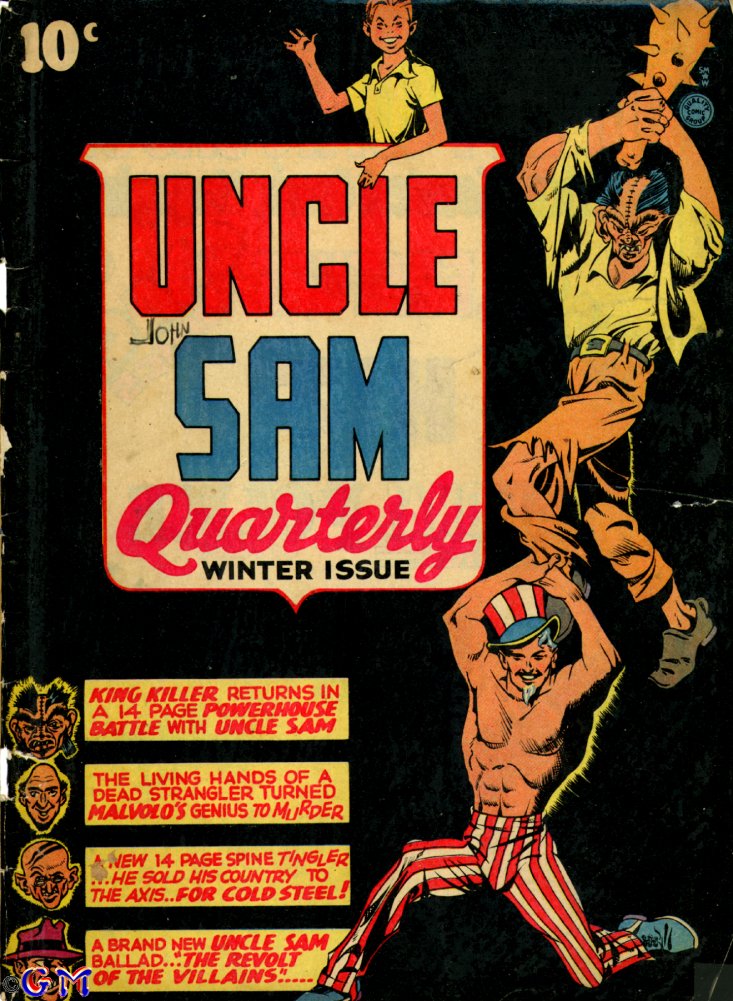
One Golden Age character who always fascinated me back when I was a kid and obsessively pouring over the pages of Steranko’s History of Comics was Quality’s Uncle Sam who appeared in National Comics and eight issues of his own title Uncle Sam Quarterly. Part of it was purely a matter of optics; it’shard not to appreciate the beauty and dynamism that artist Lou Fine put into his work, especially in covers like this…
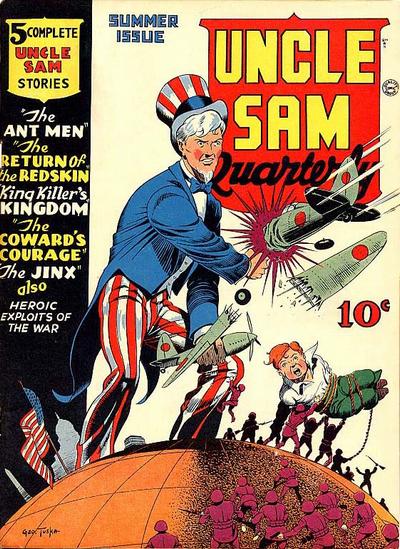
…and this…
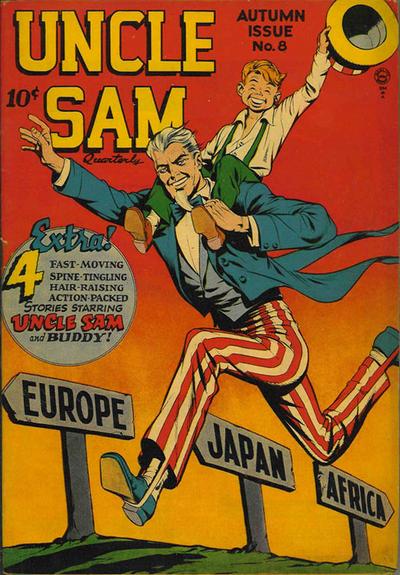
But I was also struck by the pathos and wish fulfillment of the premise created by Will Eisner in 1940. In Sam’s first appearance,”The Coming of Uncle Sam”, young Buddy’s father is killed for speaking out against a domestic fascist group (which unfortunately has a “torn from today’s headlines” quality to it these days) called The Purple Shirts. When he cries out for someone to protect America he’s visited by Sam who after telling him “men don’t cry” (which even given the rigid gender roles of the time seems a tad heartless to me) and together they bring his father’s killer’s to justice.
Following this Sam and Buddy go off on a series of patriotic adventures which frequently put the ten year old Buddy in harm’s way in the fight against the Axis. And for kids who were too young to enlist during the war wish fulfillment couldn’t get much richer
While other star spangled heroes managed to survive well past the end of WWII Uncle Sam’s career was fairly brief, his last appearance coming in National Comics #45 in 1944.
If I had to guess I’d say at least part of the reason for his short-lived career was due to the fact that while Uncle Sam was clearly a great idea for a comic book character, the actual execution was problematic. No doubt the writers and artists had an increasingly difficult time figuring out how to create suspenseful adventures for someone who was essentially all-powerful and had no weaknesses (other than the editorially dictated blow to the back of the head which for purposes of plot convenience could temporarily incapacitate anyone this side of The Spectre). There were basically two different kinds of Uncle Sam stories; the ‘serious’ ones and those that were more wildly fantastic.
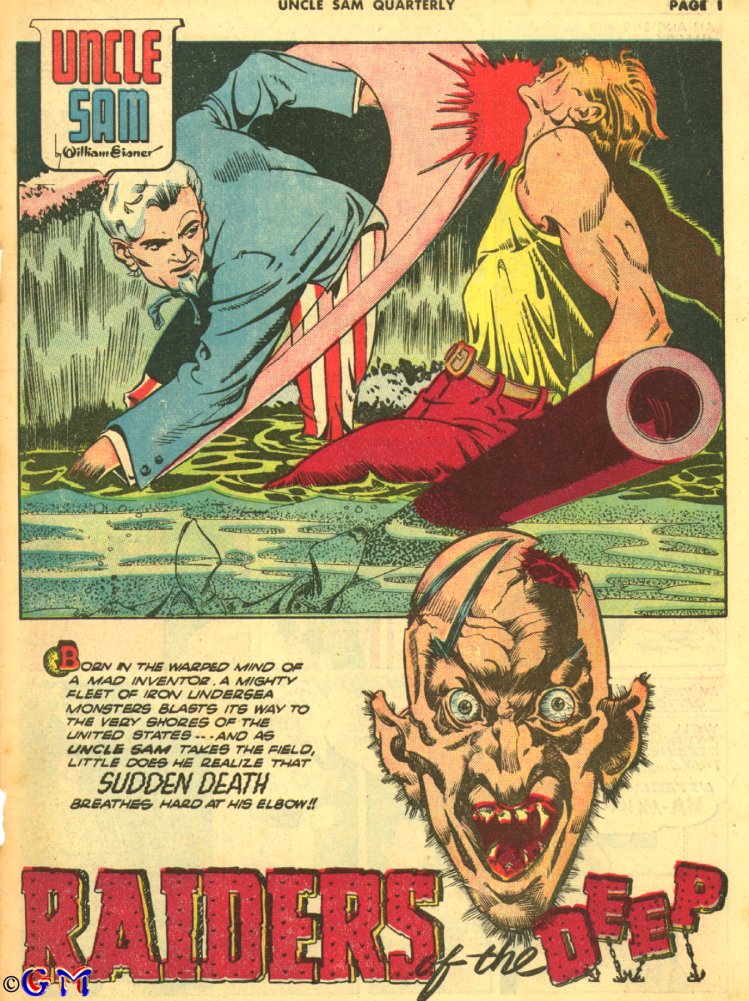
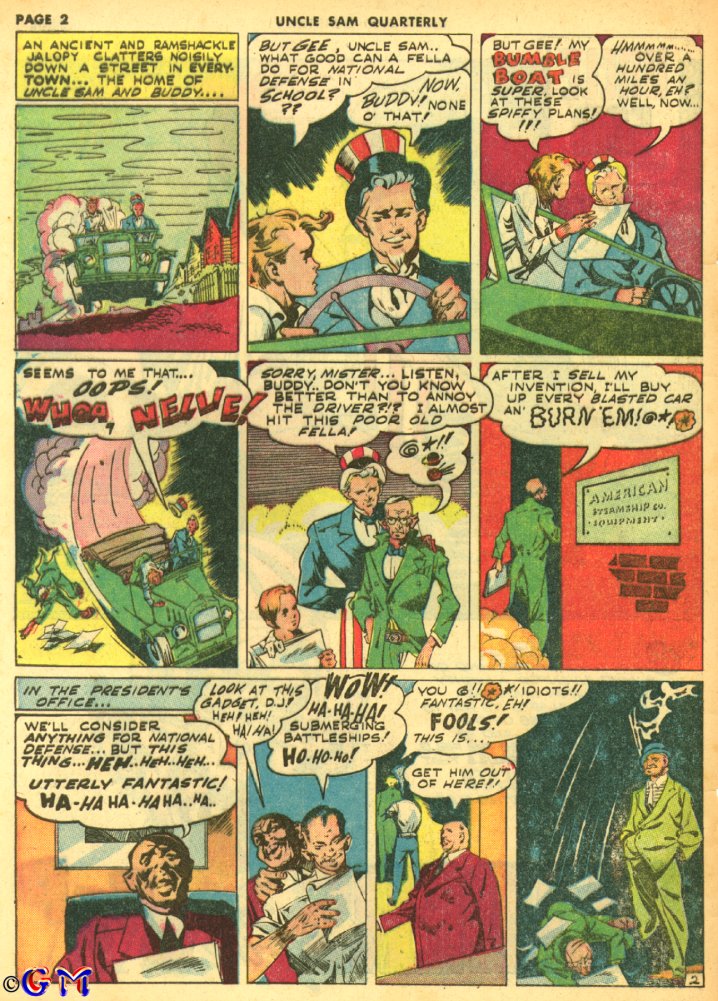
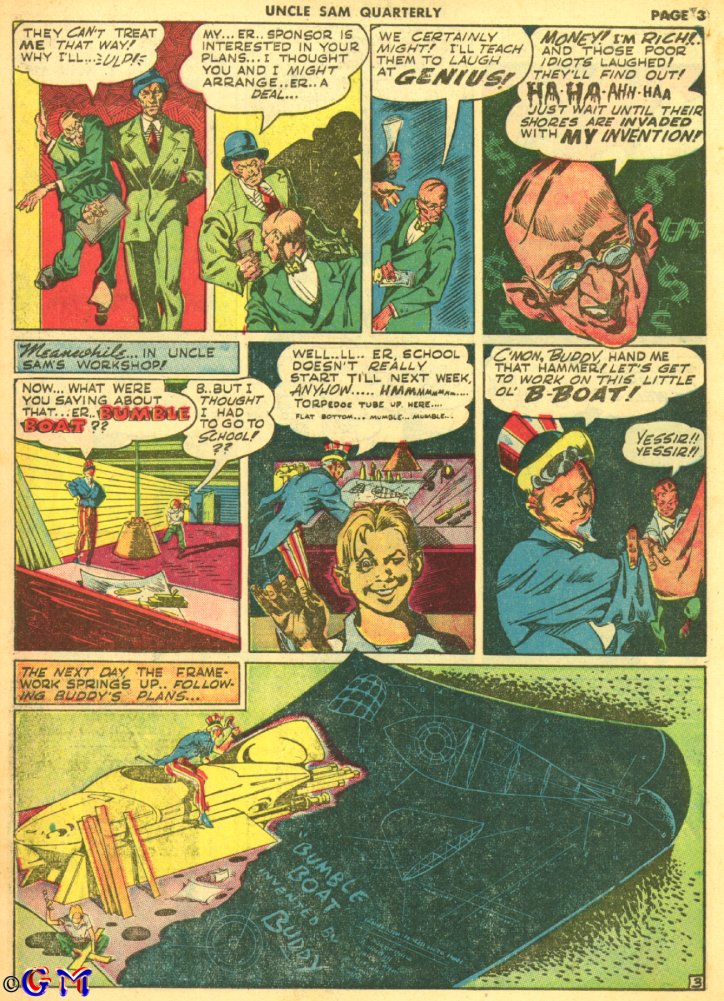
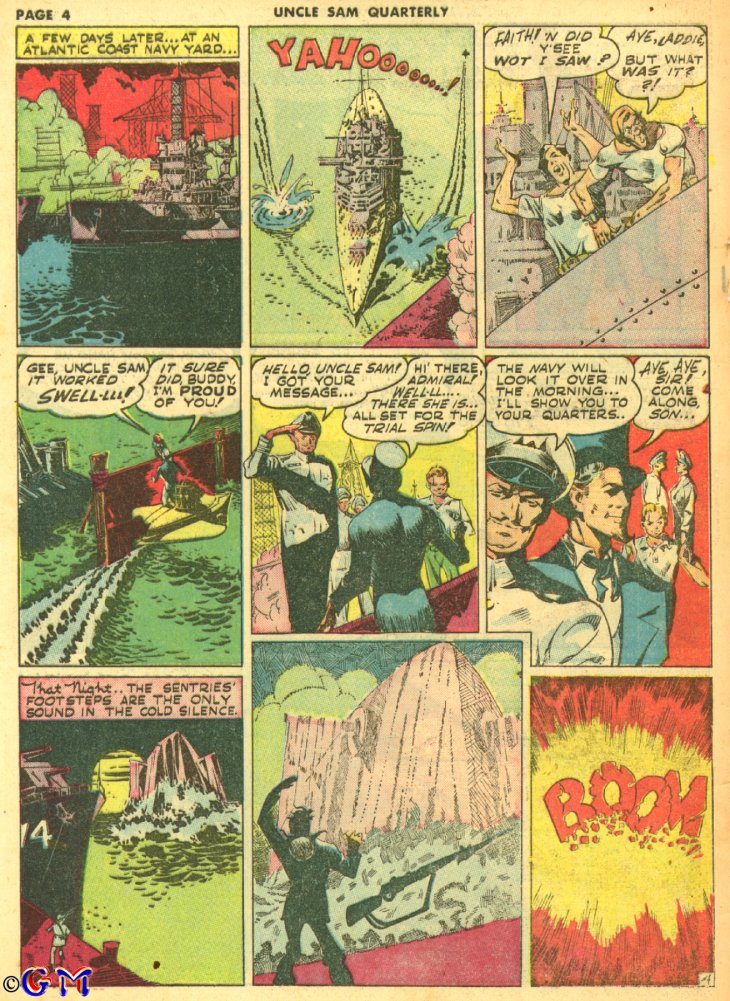
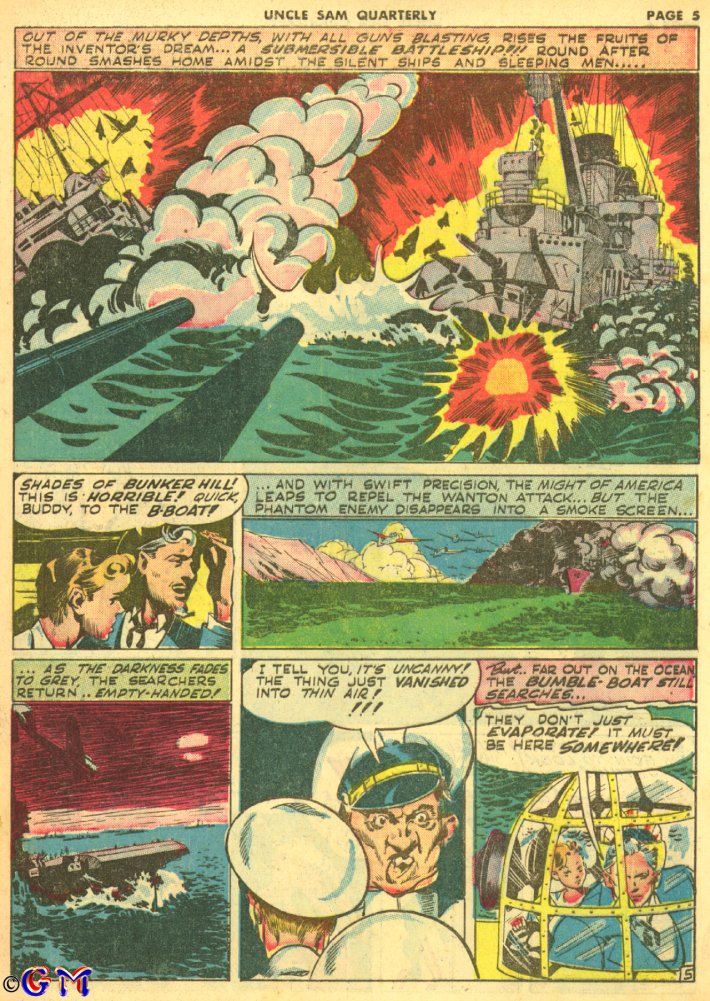
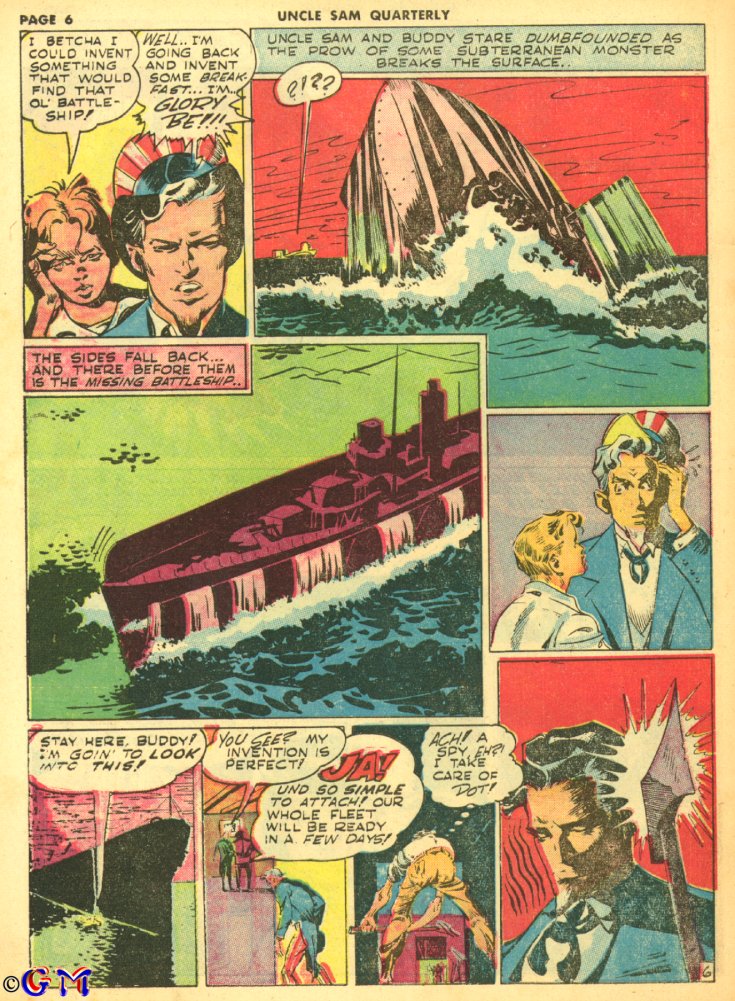
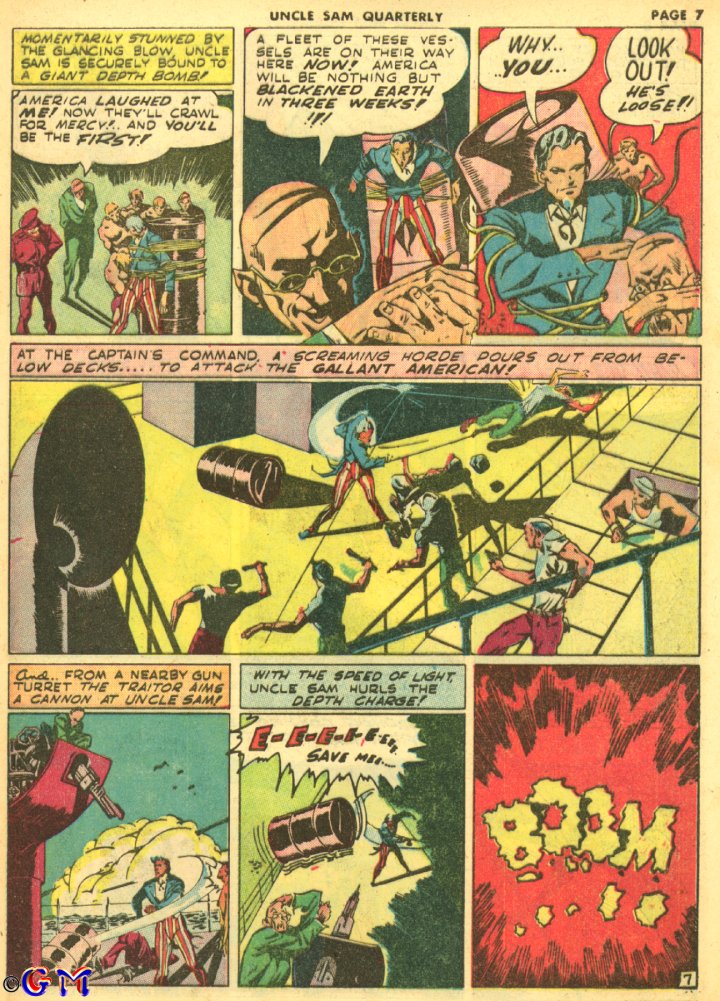
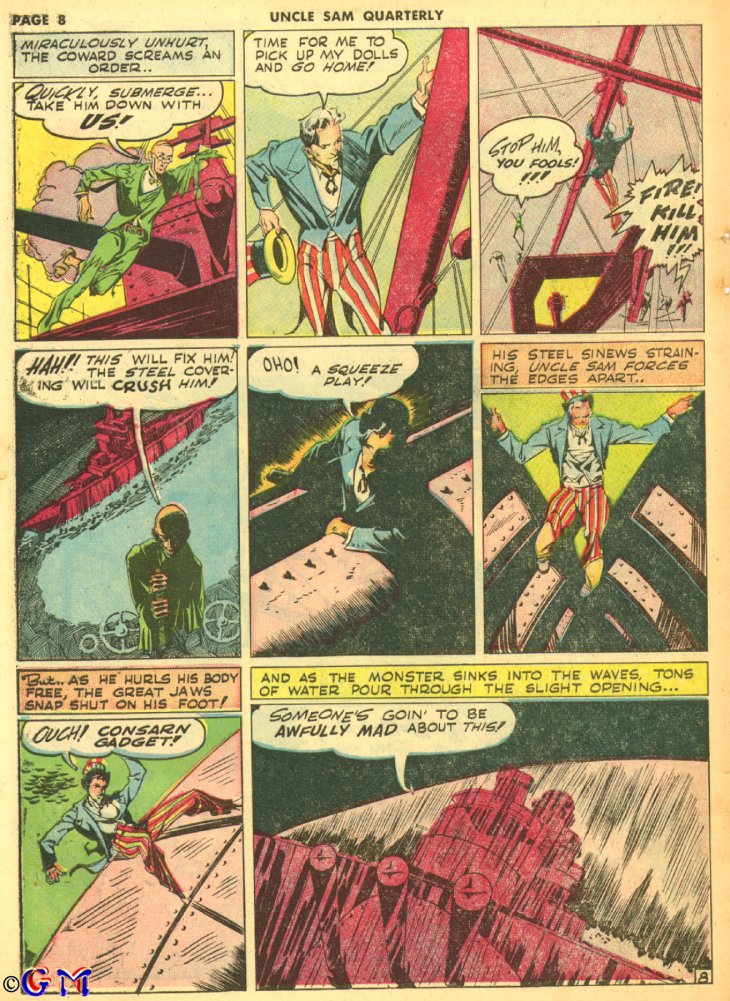
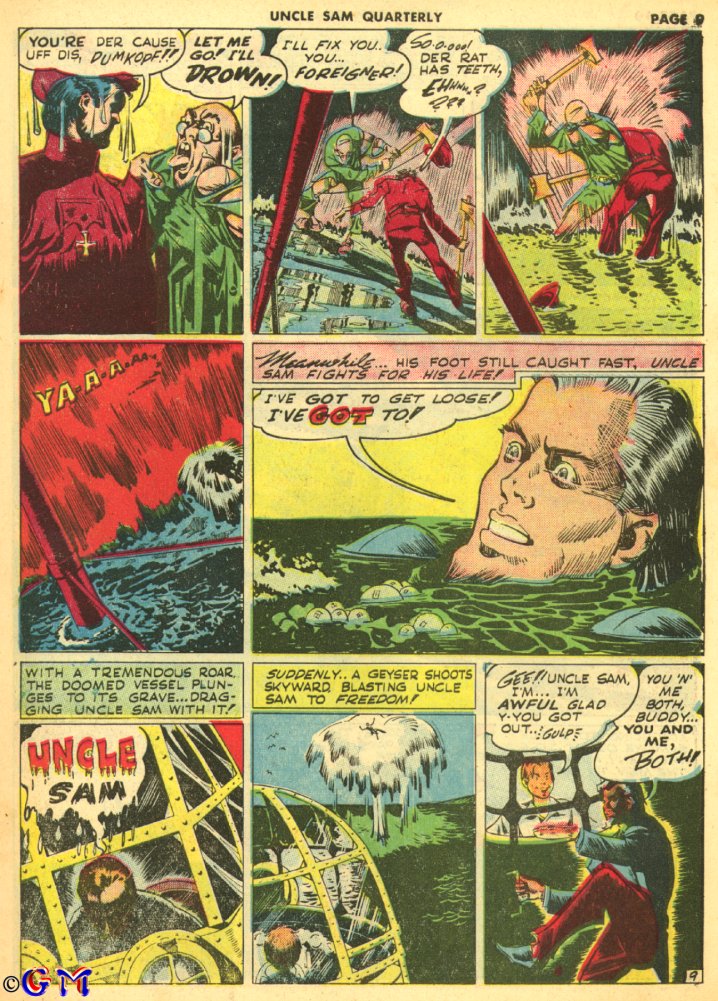
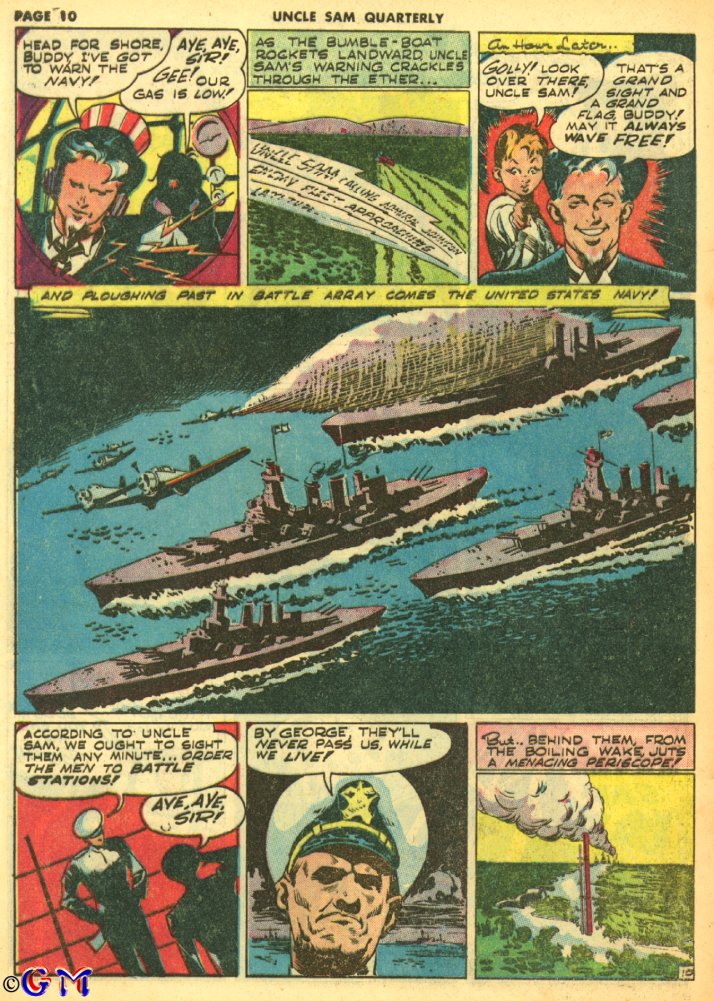
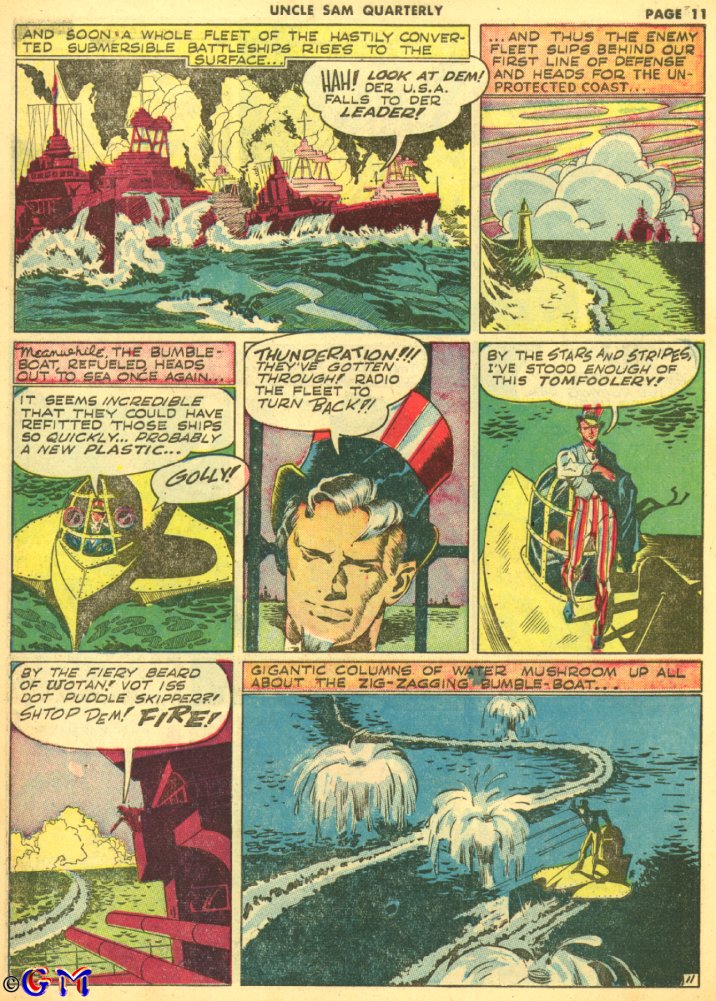
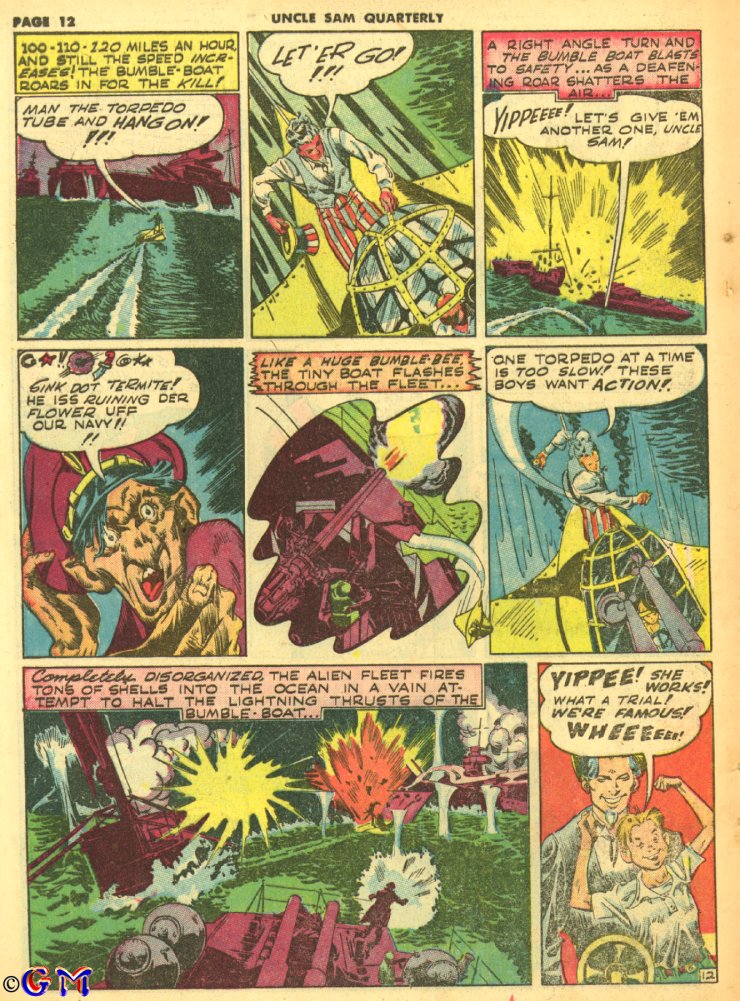
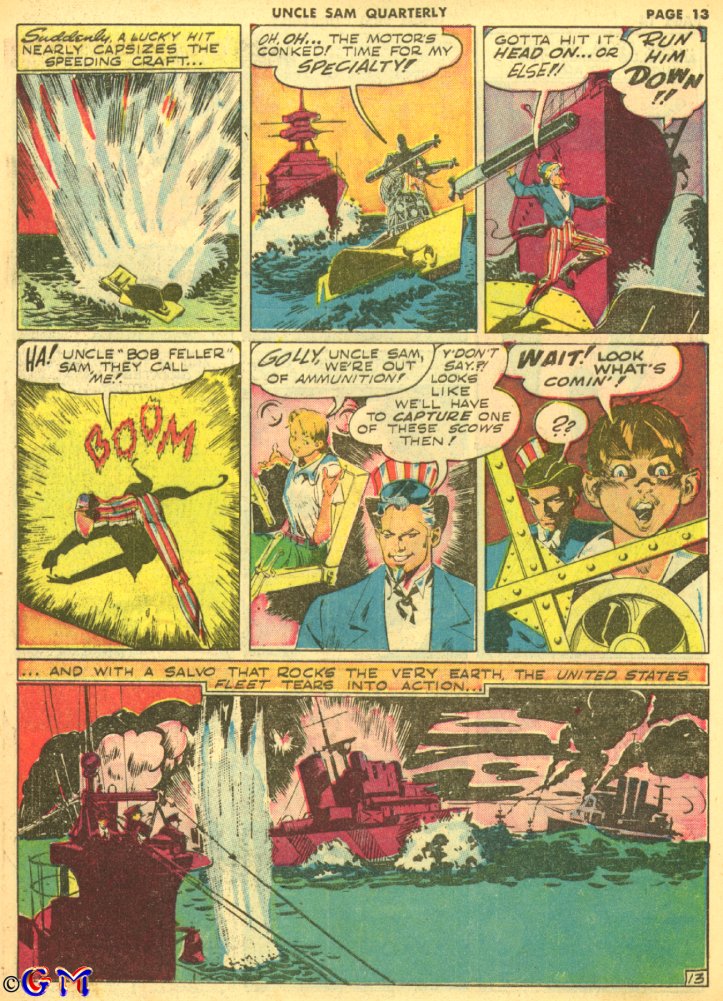
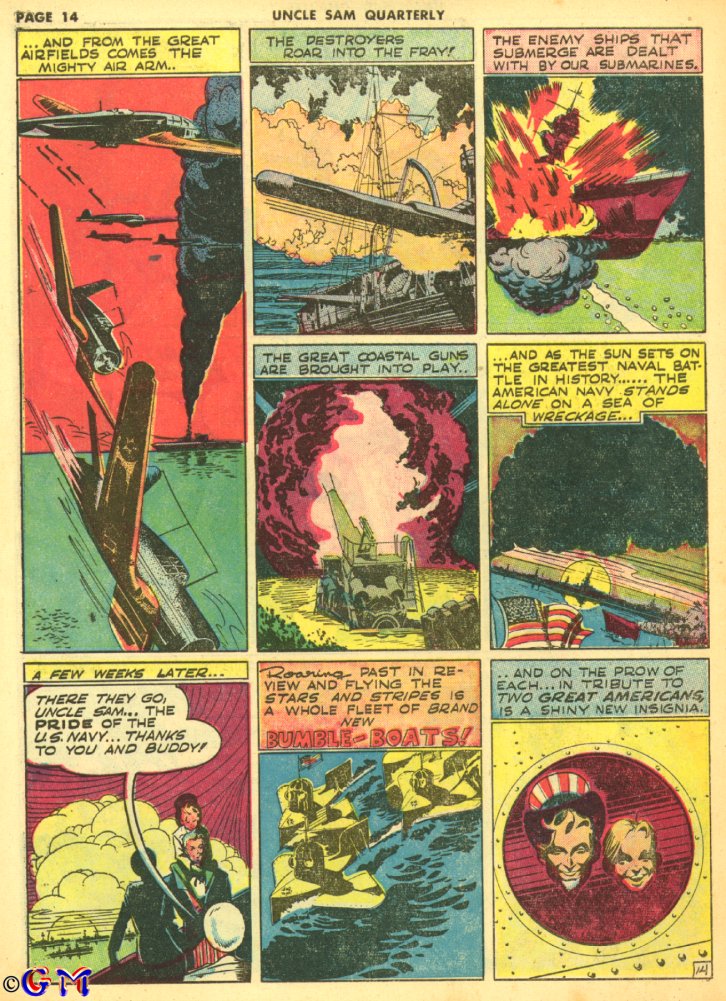
“Raiders of the Deep” drawn by Lou Fine (and according to the Grand Comic Book Database possibly written by Will Eisner) is a pretty solid example of a ‘serious’ Uncle Sam story. I’m putting ‘serious’ in quotes because while they dealt more directly with the war (and could be fairly violent even by Golden Age comic book standards) they were just as wild, frantic and kinetic as the most fantastic ones.For instance “Raiders” opens with Buddy and Uncle driving through the streets of their home (they have a home?) “Everytown” in Sam’s “ancient and ramshackle jalopy” (of course there’s no explanation why someone who was capable of bounding great distances like the 1939 Superman would need a mode of transportation, let alone this one). Sam is just enough of an authority figure to Buddy that he’s trying to get him into school but but the boy has a better idea. I’m sure like a lot of boys his age at the time he’s drawn up plans for a new kind of Navy vessel that’ll win the war; the “Bumble Boat”. And naturally Sam decides to whip up a prototype in his “workshop” (hey, if Santa has one, why not Sam?).
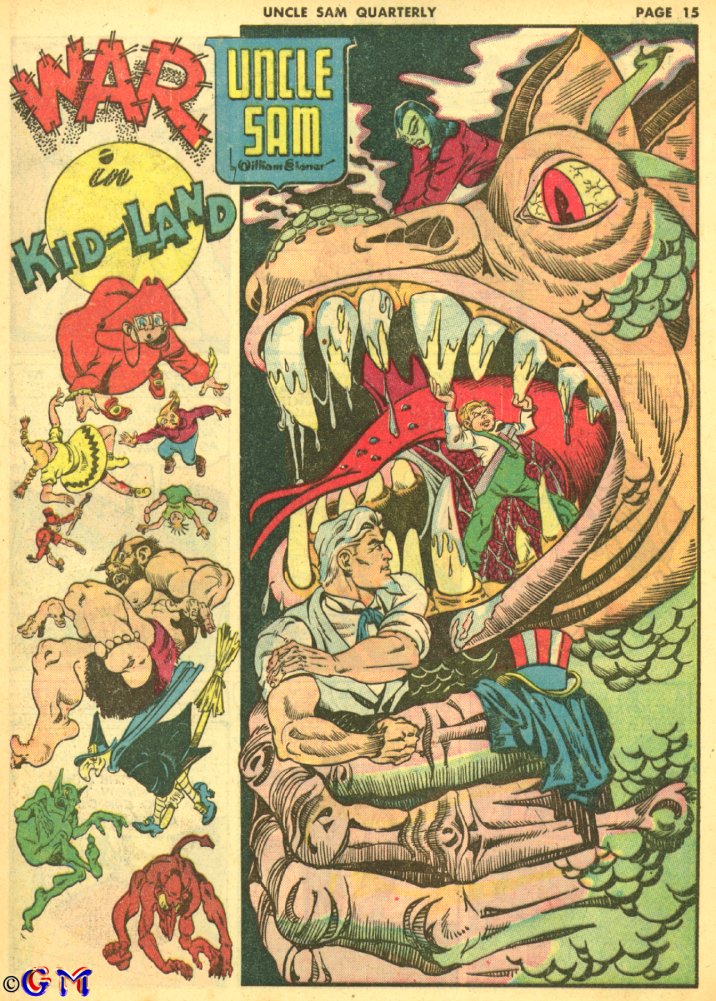
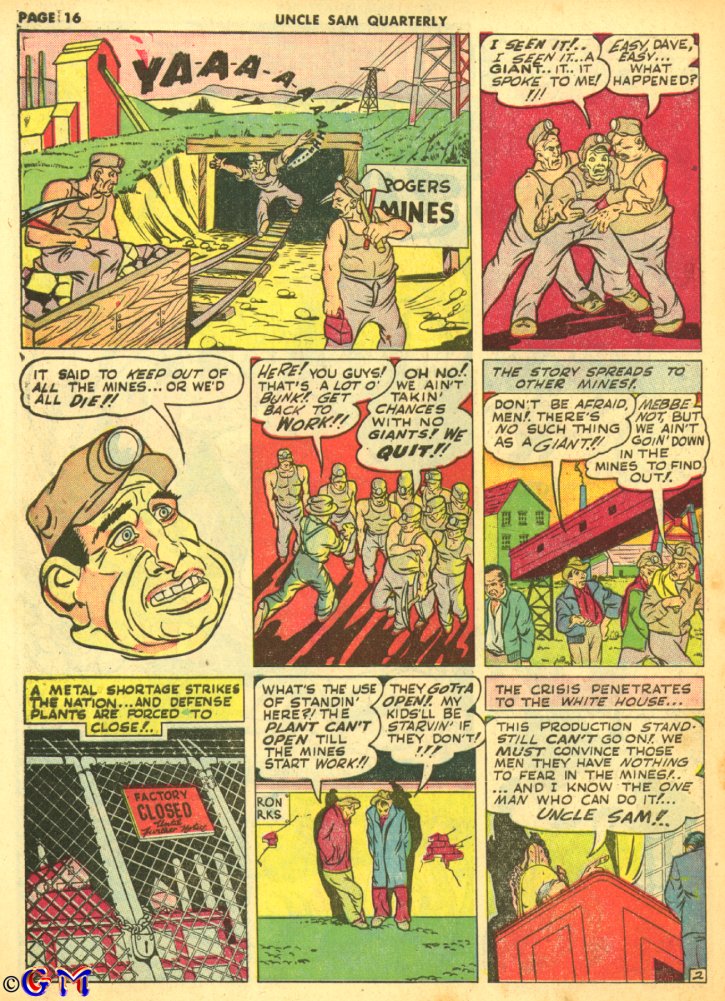
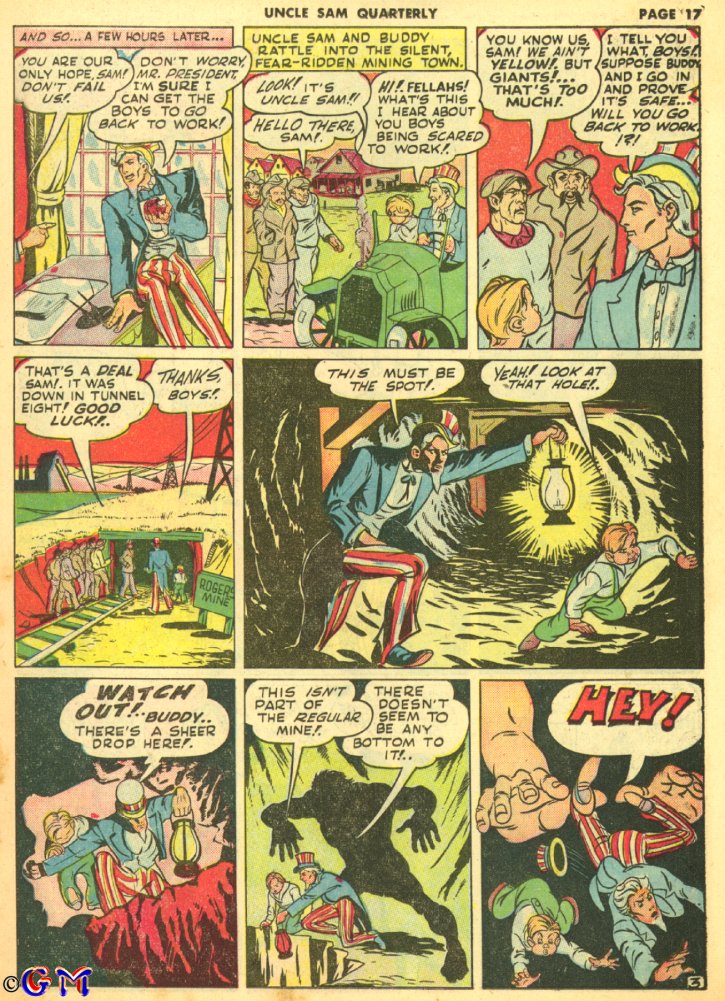
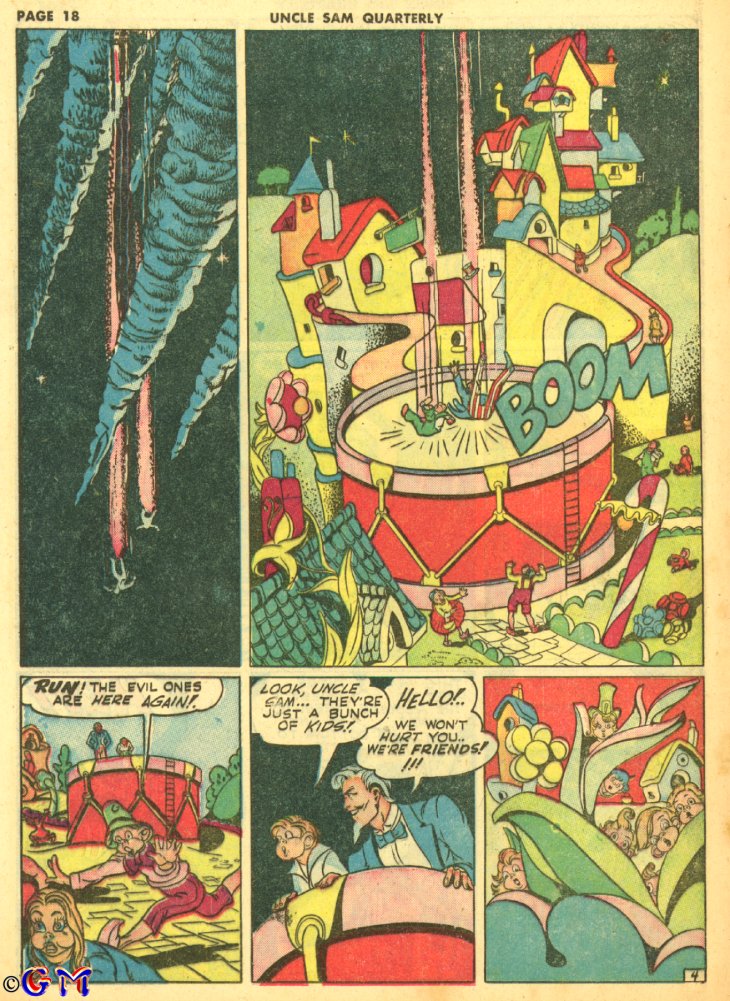
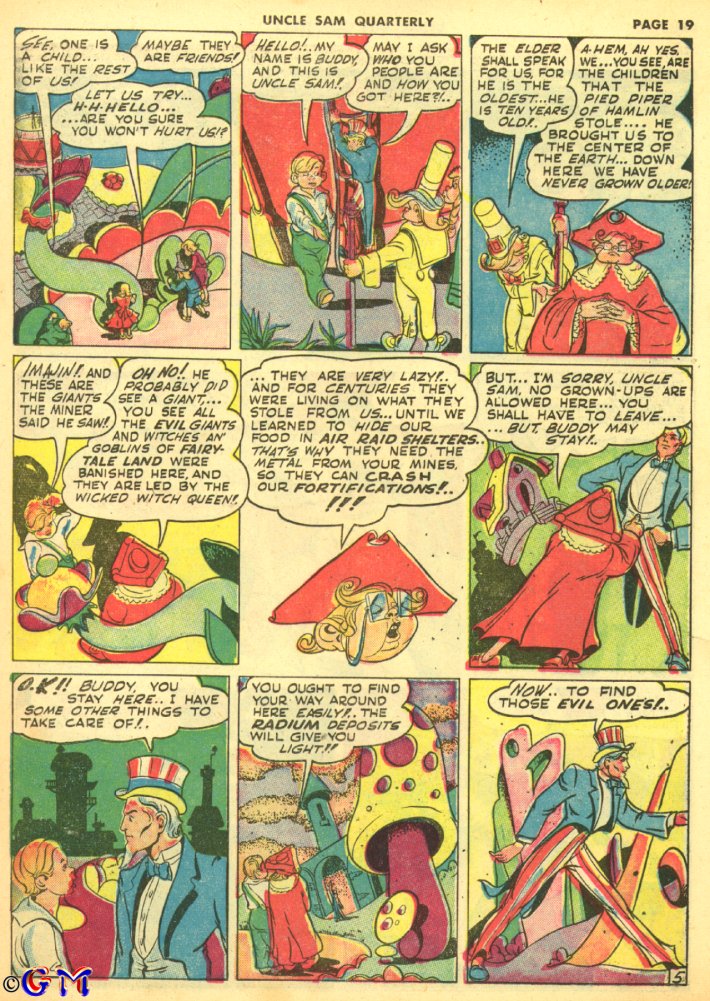
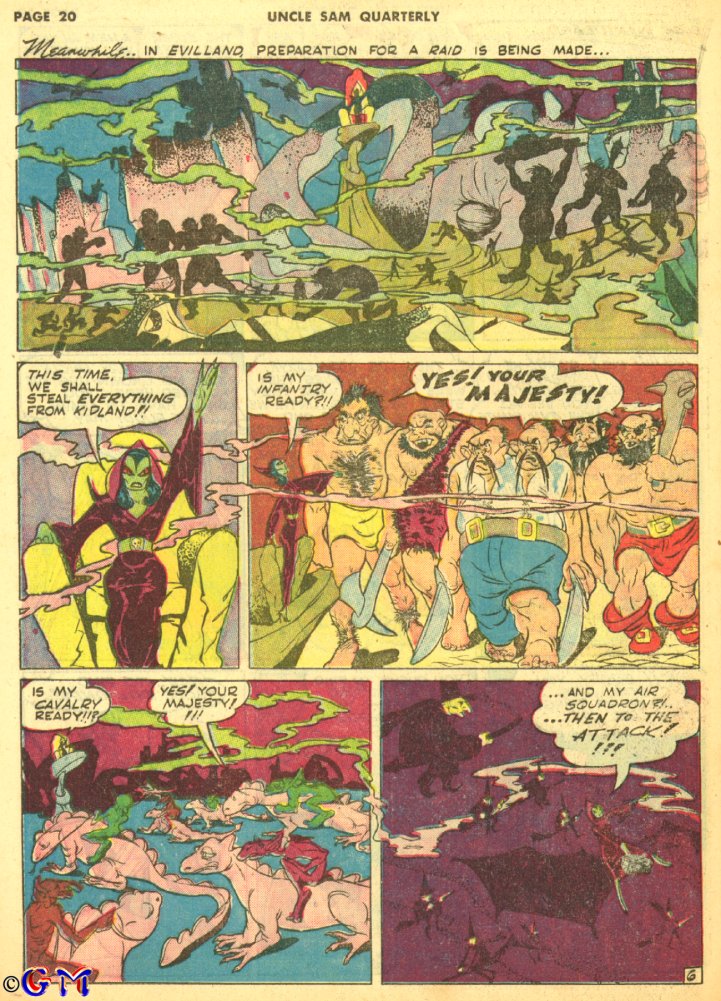
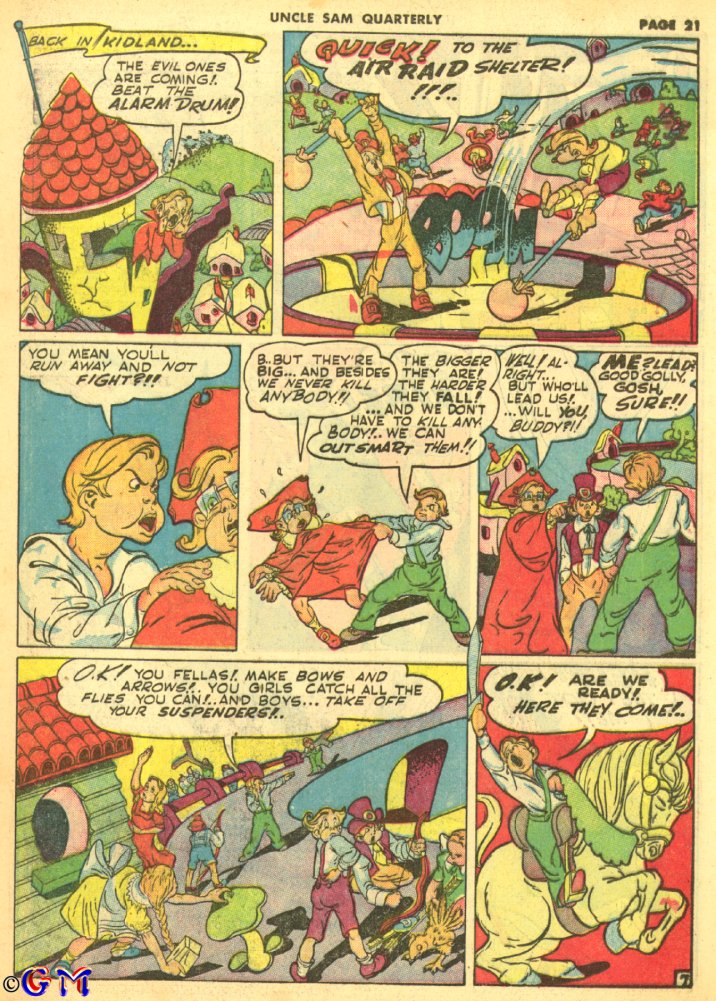
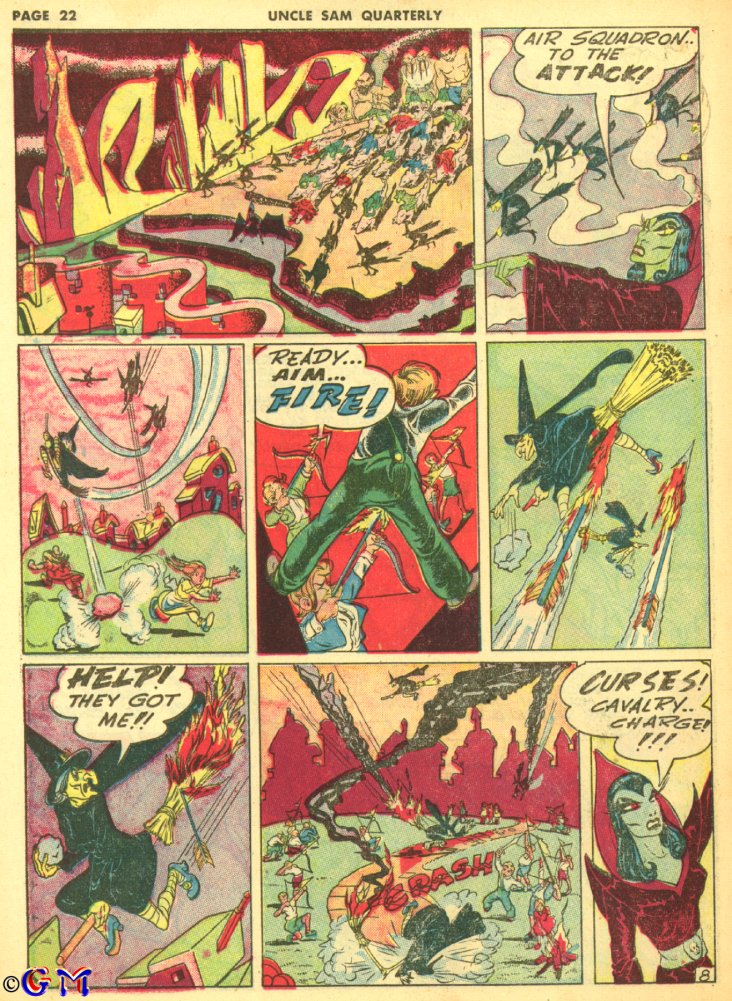
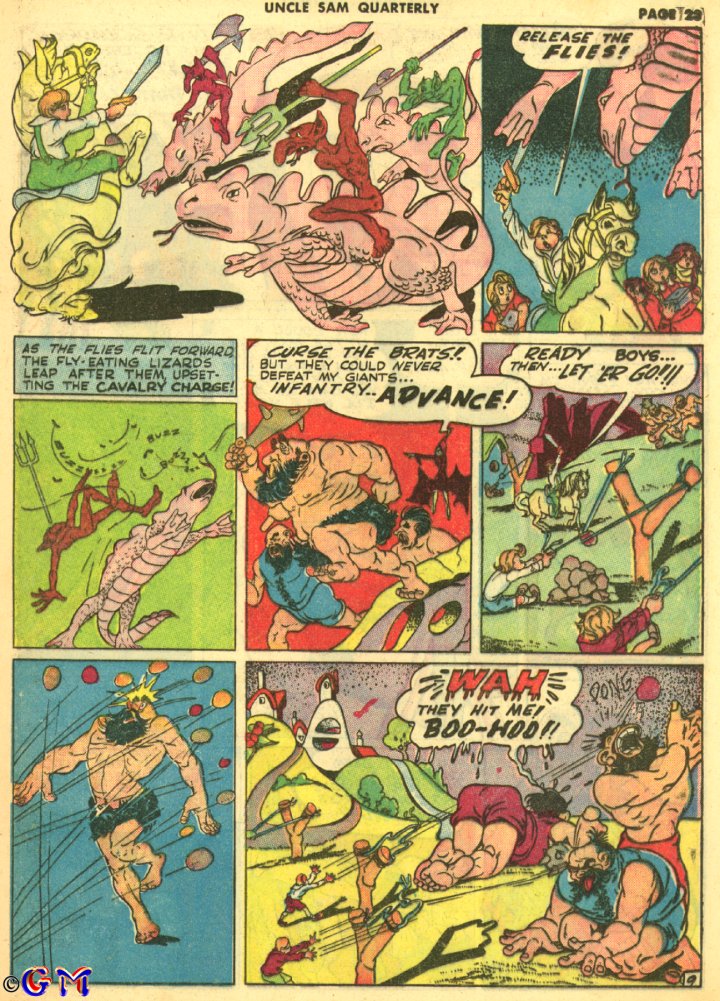
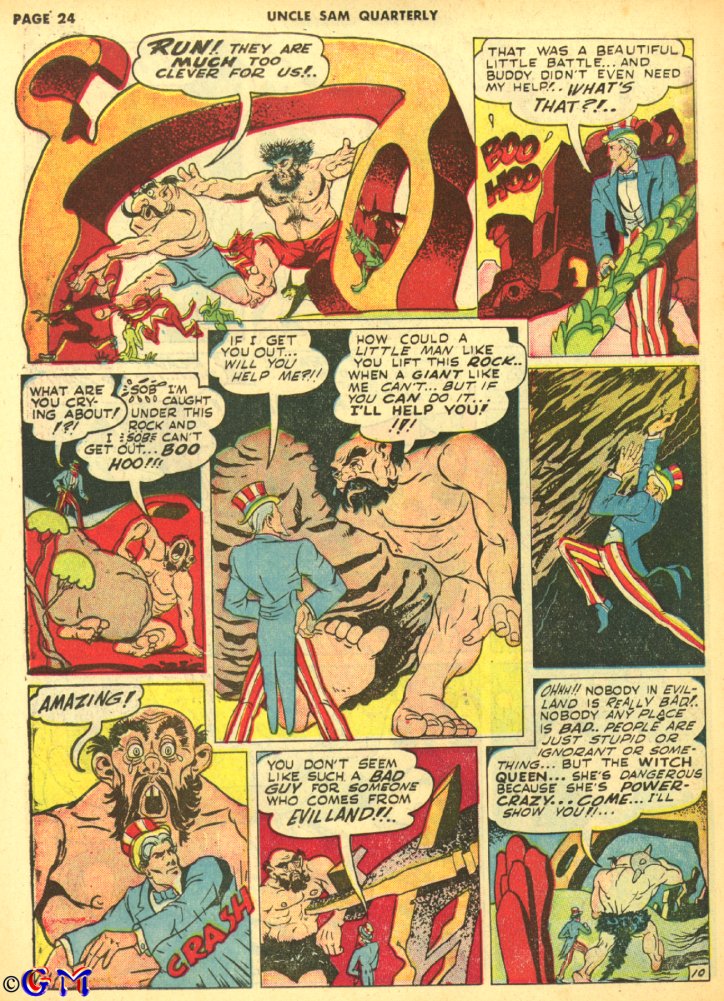
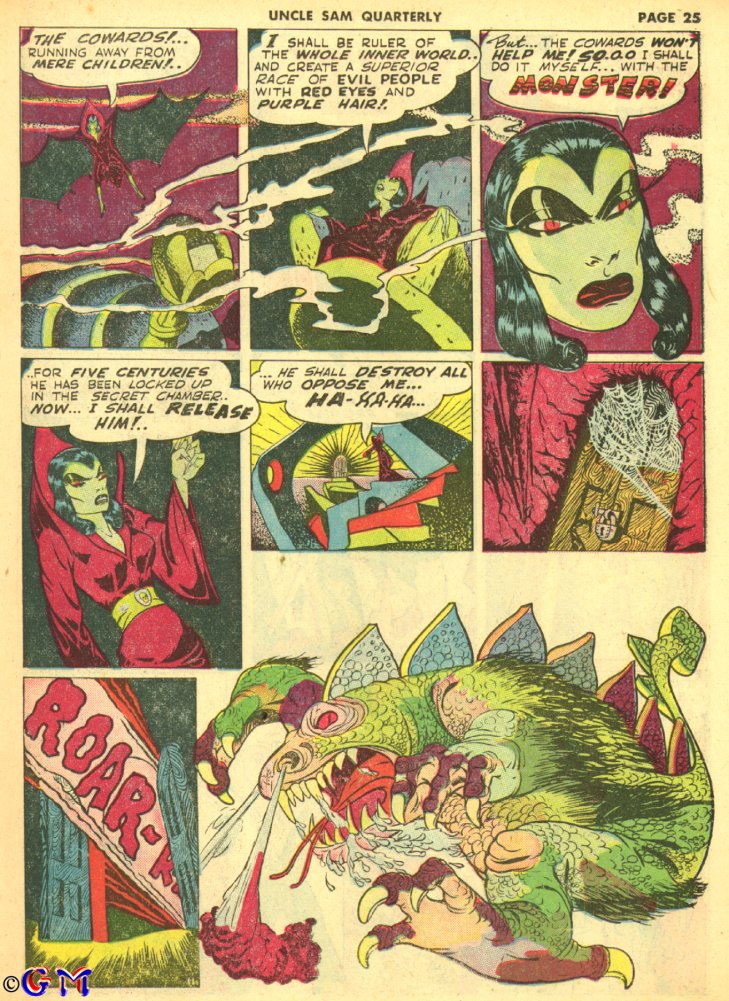
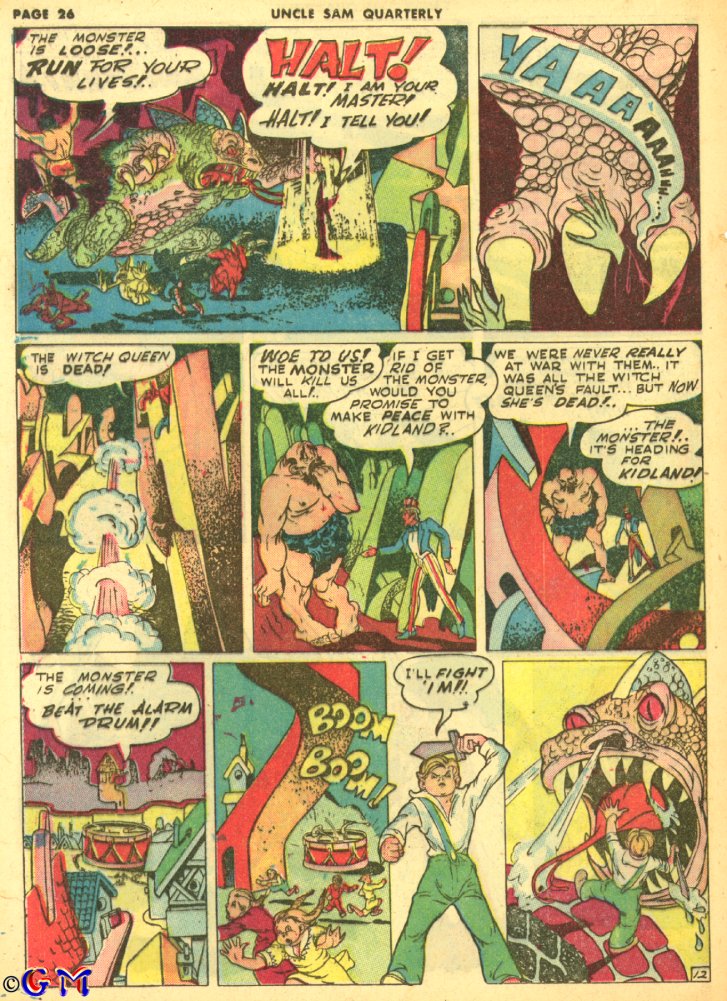
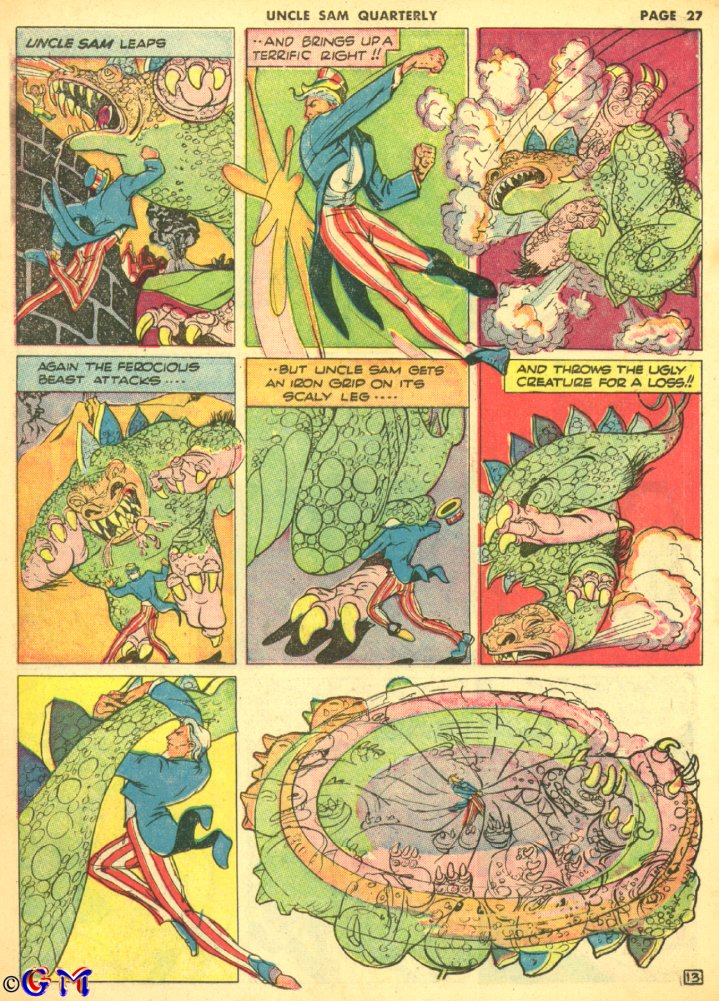
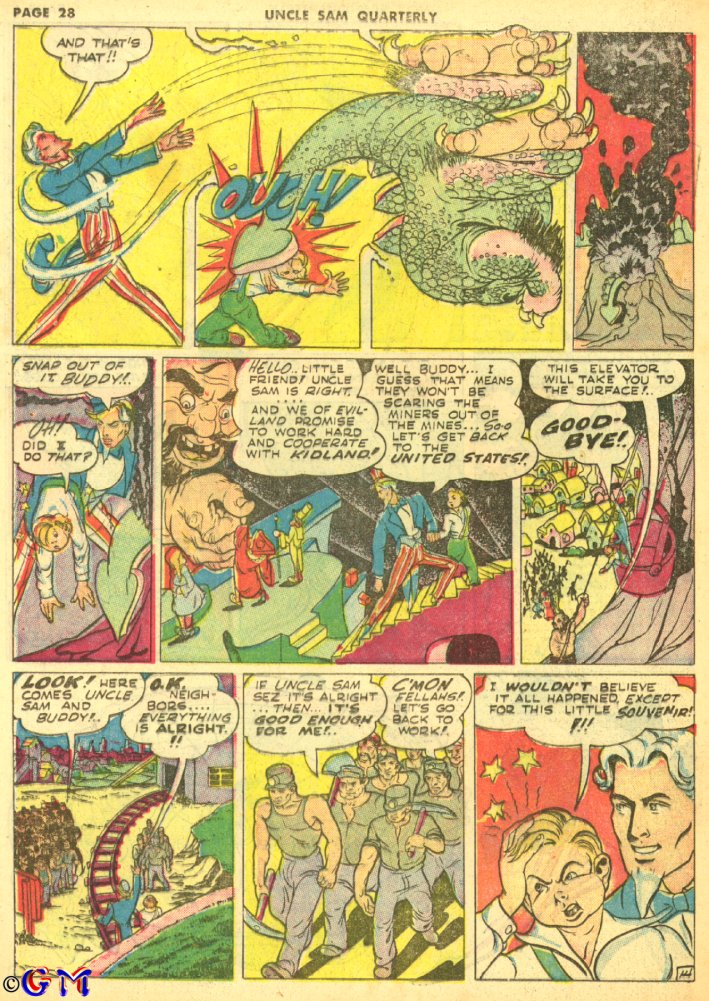
Then there’s ”War In Kid-Land” drawn by Mad’s Dave Berg (and possibly, according to the Grant Comic Book Database, written by Will Eisner) which is one of Sam’s more most fantastic adventures. Miners are abandoning their mines because of giant sightings (!) and seeing as how the mines were an essential defense industry FDR himself sends for Uncle Sam. While investigating Sam and Buddy find themselves in an underground civilization created by the immortal children the Pied Piper of Hamlin took to the center of the earth (which is, let’s face, an idea so good I’m aching to steal it). The kids are being terrorized by the evil giants and witches and goblins of Fairy Land and after our heroes give the giants a trashing we have this rather odd moment…
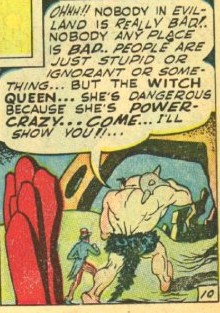
Which given their treatment of Germans and the Japanese is a pretty unusual sentiment to come across in a WWII era comic book.
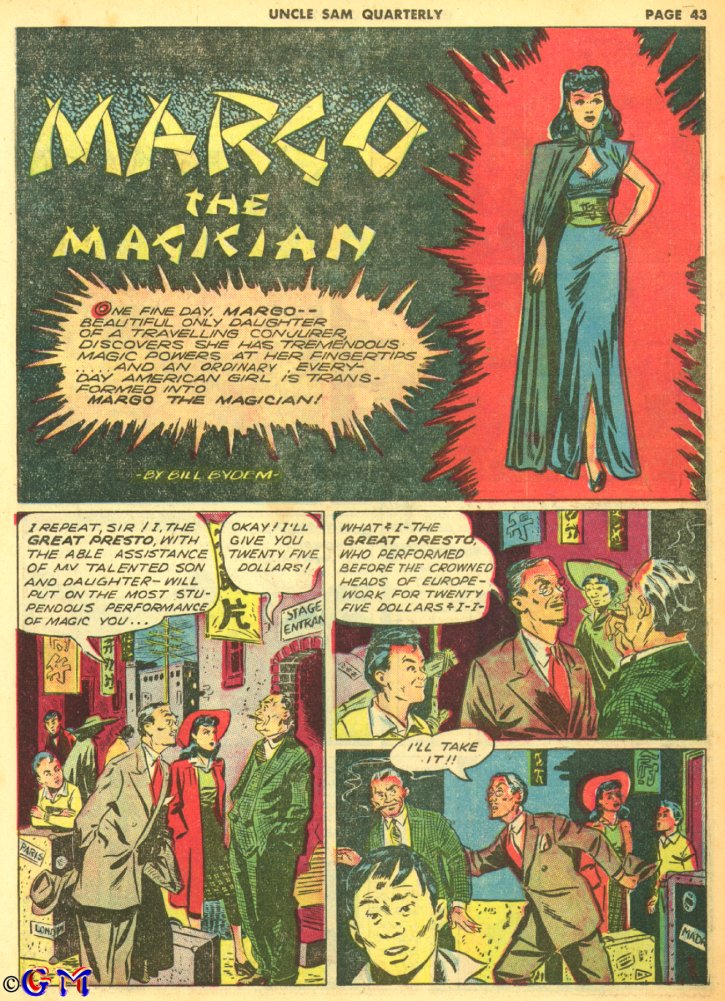
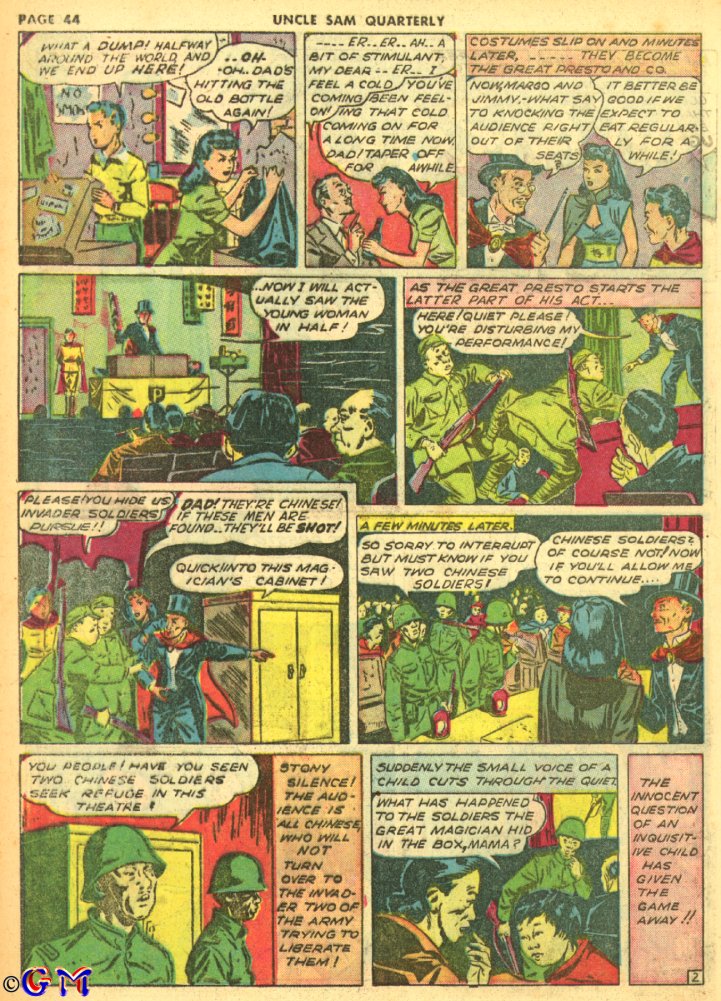
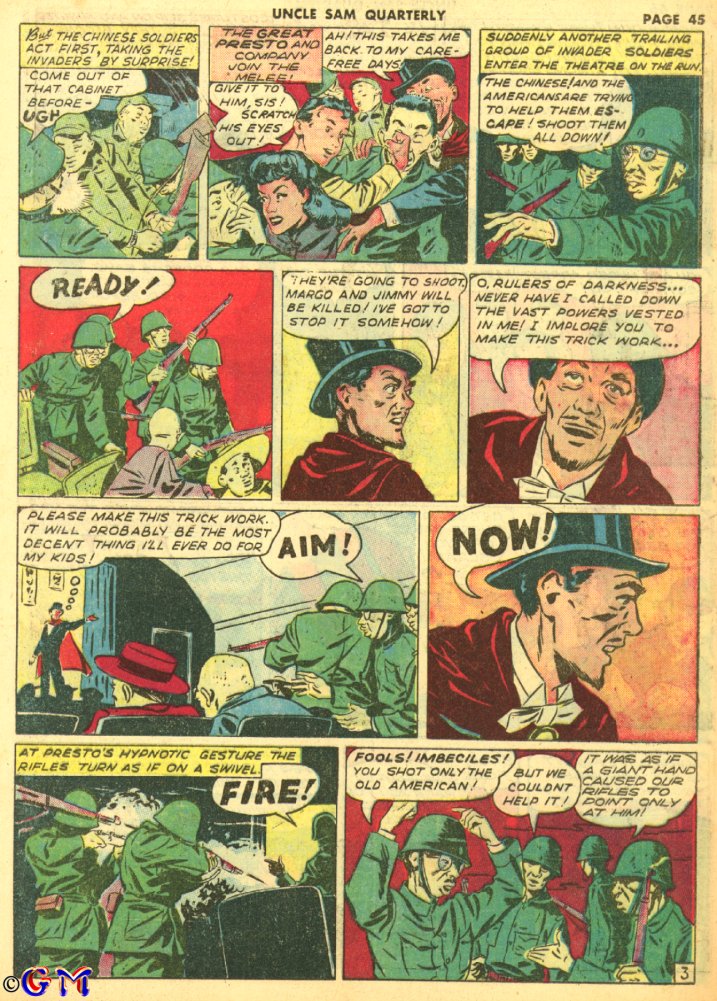
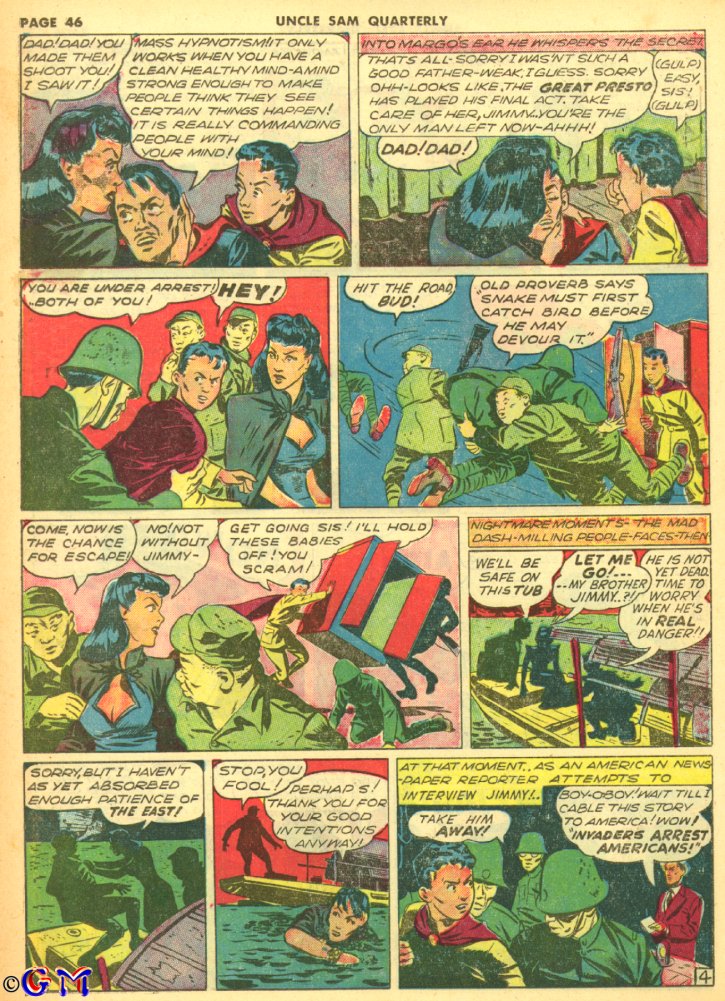
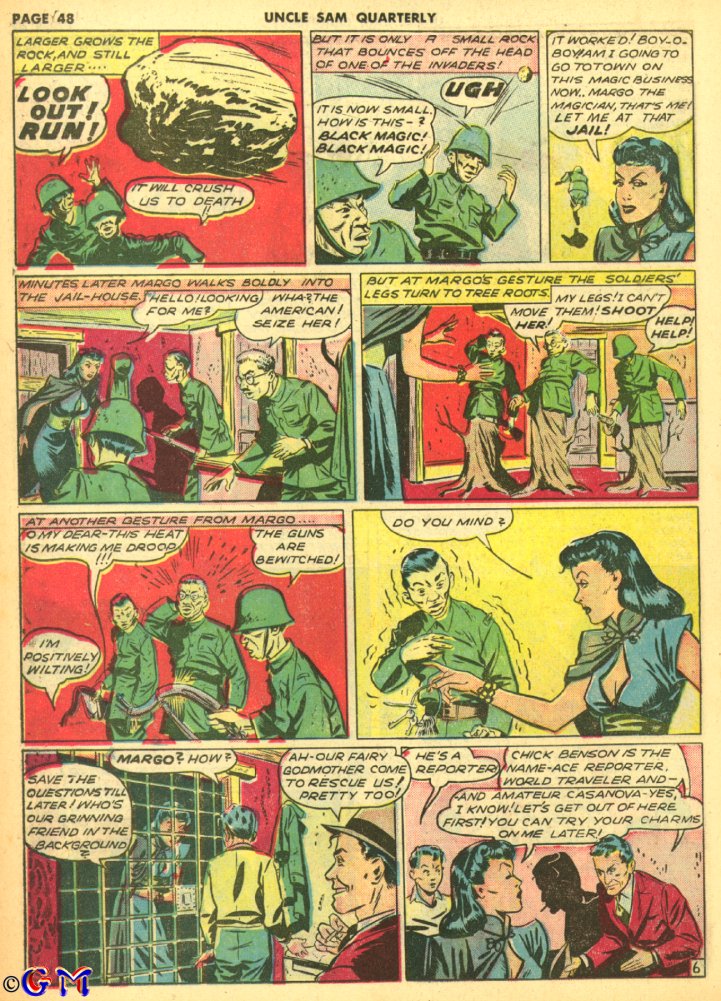
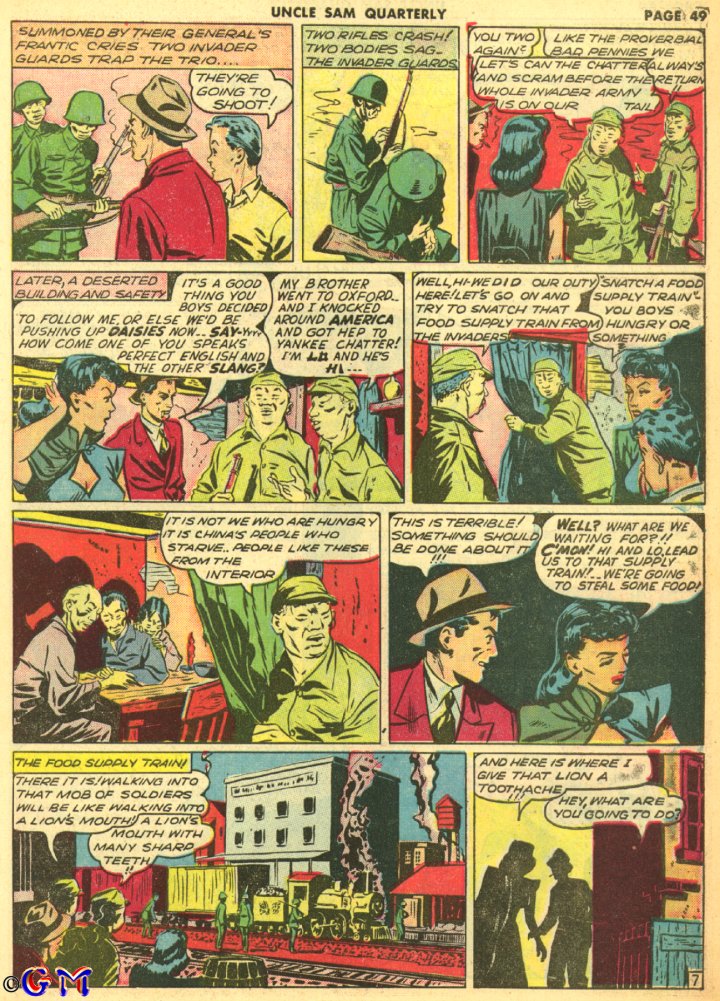
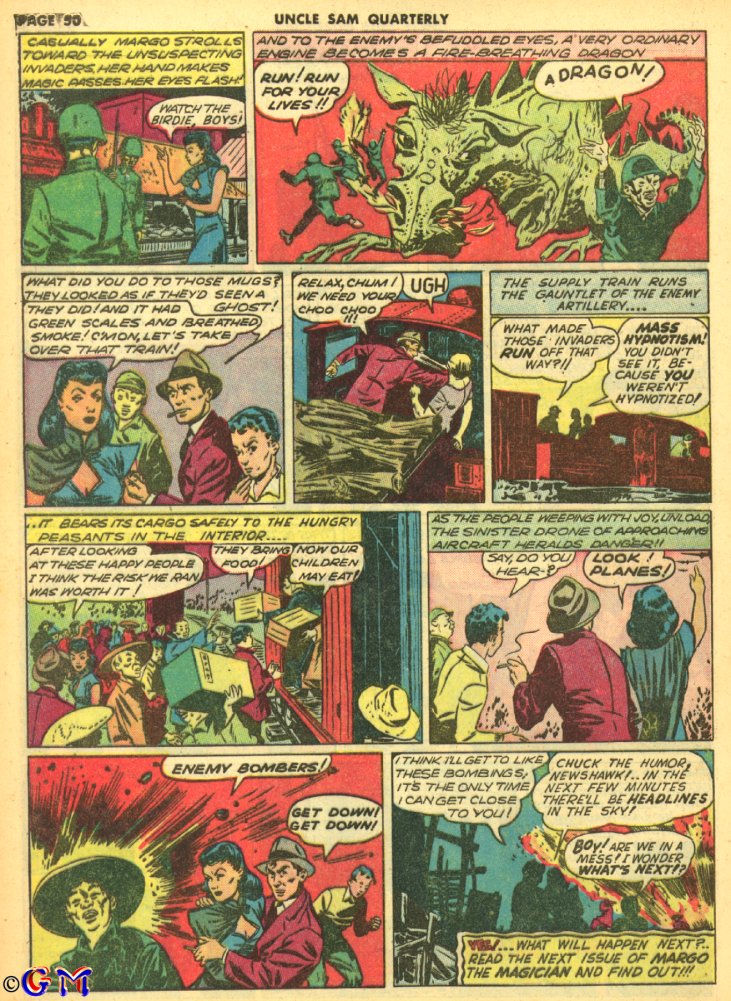
For no apparent reason even the comics that focused on the adventures of a single character also had back-up features; Uncle Sam Quarterly #2 had the first and only appearance of Margo the Magician. It’s a pretty interesting take on that Golden Age staple the Mandrake the Magician imitator; like Mandrake Margo’s power derive from hypnotism but she’s just figuring out how to use her powers, putting her at a distinct disadvantage as she struggles to survive in Japanese occupied China. It’s a handsome and stylish feature written and drawn by Bill Bydem which we know because he signed his work but sadly the artist is unknown to both me and the internet
— Steve Bennett




The 1st time I saw Mr.Fine’s work was in STERANKO’S HISTORY of COMICS Vol.II.Instantly fell in love with his work.Some of those Uncle Sam covers would have made great posters.