

Sacrilege!
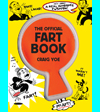
Bodacious Beth Davis in her column, The Library of Babble, on the Broken Frontier website recently reviewed the new Arf book. Here’s what Beth had to say…
What could be more sacrilegious than a marriage of Art and Comics? Art is a vision made real by the skill of the artist and exhibited in hallowed halls where hushed voices extol the singular genius of the creator. It springs from the deep and mysterious waters of the right brain. Comics, on the other hand, are the pedestrian scribblings of art school dropouts, who lack the discipline and creative vision to…. Hold on, there, Pilgrim! The marriage may be unholy, but its character — Modern Arf — is divine.
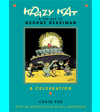
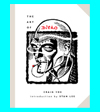
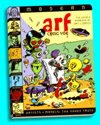
Volume 2 of Craig Yoe’s celebration of Modern Arf, Arf Museum, was published recently to rave reviews. The first volume, Modern Arf, is a dazzling anthology of rare comics and cartoons, many of them spoofing the relationship between artists and models, and many more lampooning modern art with friendly, yet wicked humor. Tucked in between are surprising treasures of comics history, including a feature on the origins of Alfred E. Newman, the “What, Me Worry?” kid, and a feature called “Cartoonists Go to Hell!” showcasing some of the gems of Jimmy Hatlo’s Inferno.
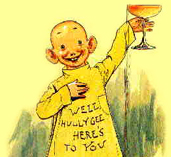
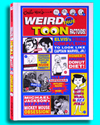
Arf Museum is impossibly more dazzling, filled with cartoons spoofing visits to the art gallery or museum, and finding the hilarity of modern art in its arty environs. Tucked into the riotous fun is a set of previously unpublished paintings of The Yellow Kid by R. F. Outcault, and part 2 of “Cartoonists Go to Hell!” showcasing some of the gems from the pen of Art Young. And just as if Yoe wanted to top his achievements in Modern Arf, Arf Museum is loaded with the added attractions of tattoos, Rube Goldberg, and sexy women enjoying the attentions of their gorilla boyfriends.
I haven’t even mentioned many of the other treats included in the two volumes, like rare comics from Jack Kirby and Stan Lee, cartoons by Hugh Hefner and Salvador DalÃ, and original art from the likes of Patrick McDonnell and Dean Yeagle. In each volume, Yoe leaves his quadruple role of collector, historian, editor, and designer, to draw original cartoons of his own. In Arf Museum, Yoe’s original art is curated by Arf sub-editor Bill Blackbeard. These anthologies are a comics-lover’s dream come true, like bumping into Santa at the hearth and finding out that the whole bag of toys is meant for you.
Modern Arf and Arf Museum are more than a combined 240+ pages of original art and rare finds, printed on high quality oversized stock in gorgeous full color and black and white. They are an incisive record of comics culture, a culture which in part developed in dialogue with modern art, and which stands in contrast to modern art’s earnest and often troubled struggle with the uncertainties of the modern world. Arf culture refuses to suffer. Arf practitioners refuse to get sucked into the troubles of modern times, because frankly, they can’t seem to take anything seriously. The practitioners of Arf are subversive, radical, even marginal, because they won’t even take themselves seriously. They are the best possible illustration of that old adage that sacred cows make the best hamburgers.
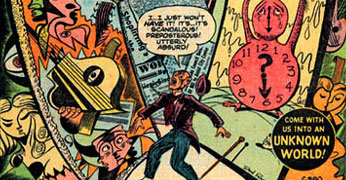
Arf Museum reprints the pages of a story from a 1950s comic book edited by Stan Lee called, “Modern Art.” It tells the tale of “an old geezer” who loves the 19th century. One day he visits the municipal art museum, and strolls the galleries appreciating the representational landscape art of Turner, Constable, Gainsborough, all “as perfect as photographs.” And then, to his horror, he finds modern art hanging in the museum! “Vulgar!” he cries. “It’s…it’s impossible!” “Ugh!” he yells. “Sacrilegious!” He screams at the museum curator, “You’re mad! A painting should be real! It should look like something actual!”
This is a common attack on modern art, which is not representational. Many of the art movements of the first half of the 20th century displayed a sincere earnestness to struggle with the new uncertainties established through Einstein’s relativity and Freud’s psychology, along with the devastation of two world wars and the resulting increase in the acceleration of technological change. Cubism, a favorite target of modern “Arfists”, was an innovation inspired by geometry, an impulse to explore the relationship between the human and the machine, and a need to struggle against the transitory. With great intellectual seriousness, the Cubists, Dadaists, and Surrealists set about revolutionizing the techniques and aims of painting with the purpose of shocking us into new ways of seeing. Modern art was concerned with portraying the difficulty of the human condition, the disruption that human beings were feeling, their struggles in incorporating uncertainty and rapid change.
The reaction was intense and sometimes violent. The cover of Lee’s comic book spoofs it, proclaiming, “Sometimes ‘Modern Art’ can be too modern!!!” While proponents and opponents of modern art battled over artistic standards of form and value, modern “Arfists” observed and cracked jokes. Everyone was the beneficiary of their wit: the artists, the confused public, the conservatives, and even themselves. In a 1932 cartoon by Paul Webb, two well-dressed women stand in a museum in front of a painting by Picasso. One says to the other, “Someone should give Picasso a good kick in the pants, Ella.” Otto Soglow’s Little King leaves the Royal Modern Art Exhibit to take in a sideshow starring Yipsel the Tattooed Man. In a 1939 installment of Gasoline Alley, Walt has a phantasmagoric dream after a visit to a gallery displaying modern art. Russell Patterson’s 1933 museum patron gets a black eye from the subject of a Fauvist painting, a gorgeous nude who resents his ogling.
Arfists and their creations are lustful, graceful, voluptuous, and funny. The Yellow Kid, Alfred E. Neuman, and a host of others cruise undisturbed through a disturbing world, their equanimity unruffled. These first two volumes in Craig Yoe’s series on Modern Arf depict the emergence of the comic artist as the court jester of the modern world. Artists with a keen eye, a deft hand and an impish madness skewered the pretensions of the age and…Hold on, there, Pilgrim!

— C. Yoe (in the funny papers)