Get these books by
Craig Yoe: |
|
|
|
|
|
|
|
|
|
|
|
|
|
|
|
|
|
|
|
|
|
|
|
|
|
|
|
|
|
|
|
|
|
|
|
|
|
|
|
|
|
|
|
|
|
|
|
|
|
|
|
|
|
|
|
|
|
|
Get these books by
Craig Yoe: |
|
|
|
|
|
|
|
|
|
|
|
|
|
|
|
|
|
|
|
|
|
|
|
|
|
|
|
|
|
|
|
|
|
|
|
|
|
|
|
|
|
|
|
|
|
|
|
|
|
|
|
|
|
|
|
|
|
|
|
Archive for April, 2011
Wednesday, April 13, 2026
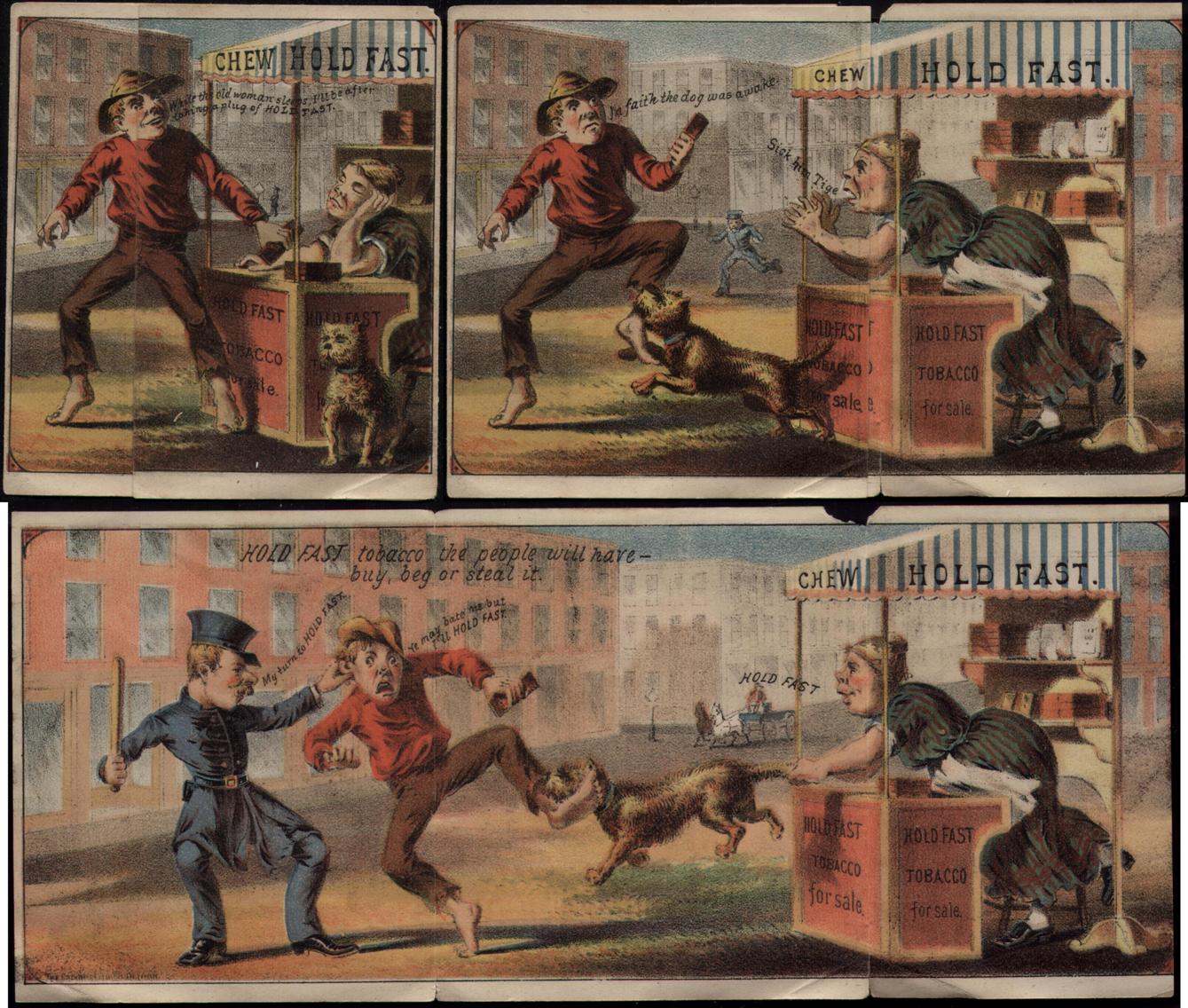
Resuming our series on Pre-YK “Talking” Comic Strips (sequential cartoons wherein the story is conveyed via pictures combined with in-panel dialogue, published prior to the supposed “invention” of same format in the October 25th, 1896 episode of The Yellow Kid), we return with some more examples found amongst Victorian Age cartoon advertising strips.
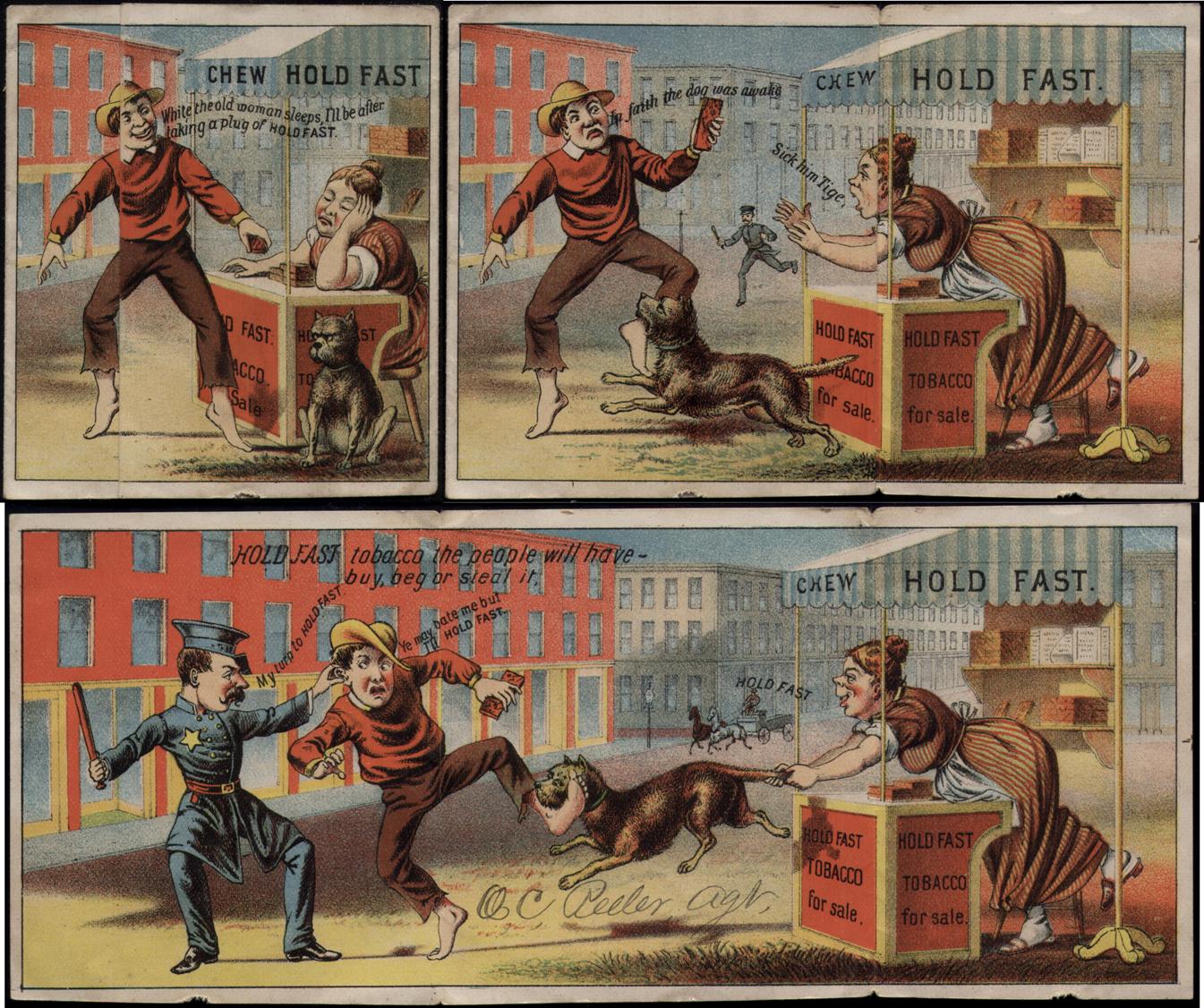
Above, the original version of a circa 1870s fold-out trade card, for Hold Fast Chewing Tobacco. Each panel is revealed as the card is unfolded. This particular give-away comic advertisement, was apparently so popular, that it continued being reprinted, and eventually (circa 1880s) had its art redrawn for the below version, which takes advantage of finer color printing techniques, whose cleaner art renders the in-panel dialogue easier to read. This card was highly popular, and long-circulated in the New York City area. (Note the name of the dog — “Tige” — is the same name R.F. Outcault would later give to Buster Brown‘s dog. Coincidence? Or, had Outcault seen these prior to his supposed 1896 “invention” of sequential in-panel dialogue in Yellow Kid? Further note: Outcault himself never claimed to have invented the format — rather, American comic strip historians made the claim years afterward, as part of their premise that the comic strip was invented in the United States.)
Click on the above & below pictures, to see larger, readable versions.
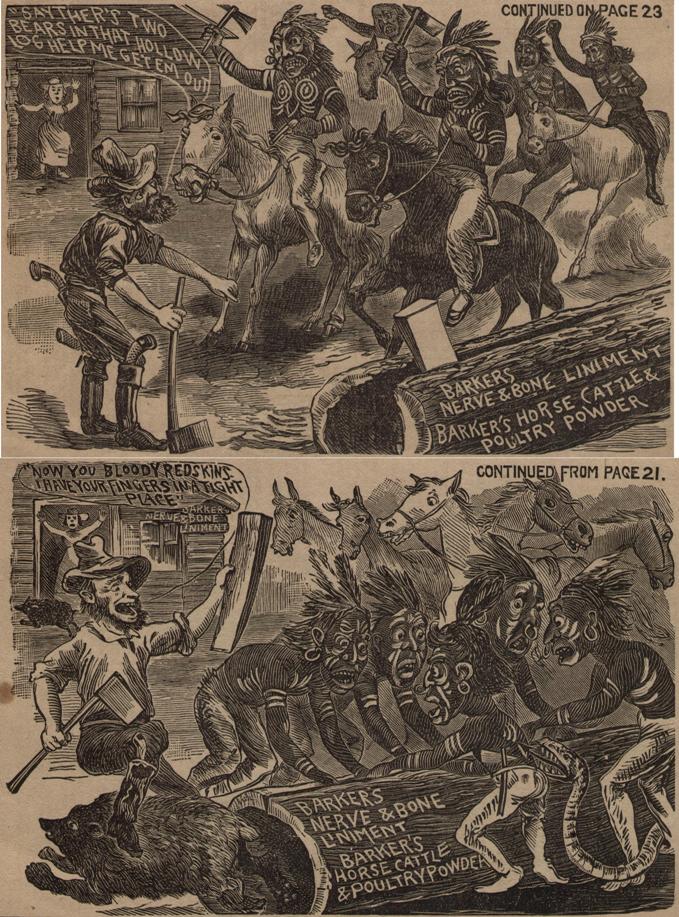
In the next two examples, nineteenth-century American (& European) advertising reflected the attitudes reflected the general racist attitudes of their societies. Below, by artist R.A. Williams, comes a two-panel strip found in the 1892 Barker’s Illustrated Almanac.
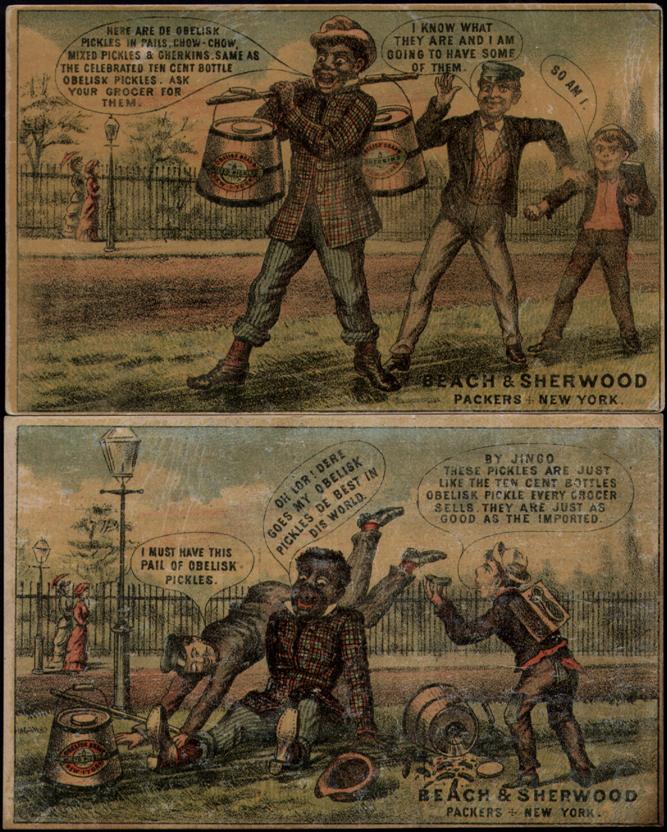
In our second unfortunately racist example, we have another circa 1870s-1880s two-panel comic strip ad, this time for Obelisk Pickles.
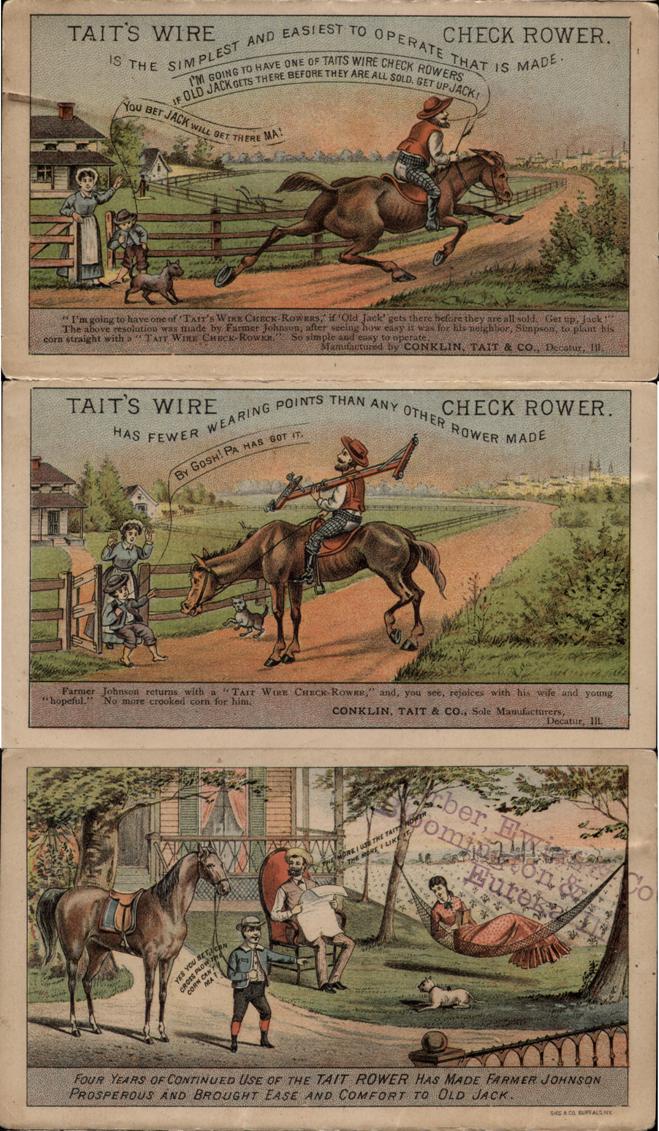
Finally (for today), we have a three-panel strip found in as part of an 1885 advertising pamphlet for Taits Wire Check Rower.
Doug Wheeler
PreYKStrips BlackHistory AdvertisingStrips NativeAmericanHistory

— Doug
Posted at 01:04 PM
Posted in General | permalink | No Comments »
Tuesday, April 12, 2026

Never pick a fight with Popeye. You heard it here first!

Click the link to listen.

Never Pick a Fight With Popeye

— DJ David B.
Posted at 10:04 PM
Posted in Comics-Tunes | permalink | 2 Comments »
Tuesday, April 12, 2026

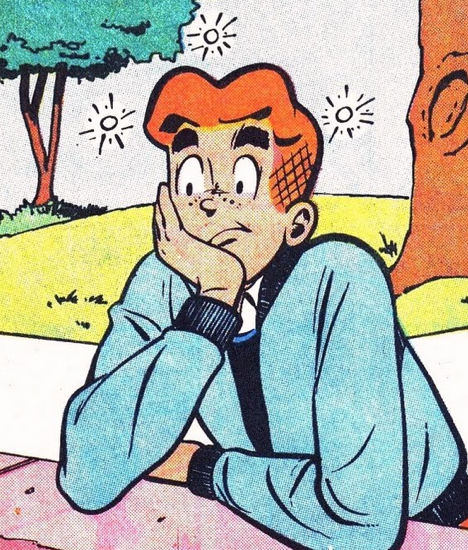
Here’s the first review of the new Yoe Books title ARCHIE-A CELEBRATION OF THE AMERICAN TEENAGER, which debuted at this past weekend’s MoCCA Festival and is scheduled to be released this month!
http://geekgirlonthestreet.com/2011/04/11/archiebibleidwmocca/
Here’s an analysis of a Frank Doyle/Harry Lucey Archie story from Archie super-fan Jaime Weinman at his blog Something Old, Nothing New.
http://zvbxrpl.blogspot.com/2011/02/mulling-over-change.html
Here’s a whole site devoted to Bob Bolling and his cult-favorite Little Archie!
http://theprideofwalvisbay.blogspot.com/
Whilst ordering your copy of our brand new Archie history elsewhere on this page, you might consider also ordering Craig’s upcoming Archie’s Madhouse collection which includes gems like this!
http://wallywoodart.blogspot.com/2010/01/madhouse-wood.html

— booksteve
Posted at 06:04 AM
Posted in General | permalink | No Comments »
Monday, April 11, 2026
 Image via Wikipedia
I’ve gone on (and on) about my love for British comics and while I’ll happily admit I’m not an expert on the subject I do know what I like. After reading several hundred of them (which is of course just a drop in the bucket considering that thousands upon thousands were published) I’ve developed some personal preferences when it comes to publishers, titles, characters, genres and artists. As it is in America in Britain there were two major publishers of comics, Fleetway and DC Thomson. I can’t tell if British kids had publisher brand loyalty or had endless debates amongst themselves as to which was better. But if I had been a British schoolboy in 60′s England (something I’ve thought about entirely too much) I wouldn’t have spent my pocket money on the output of DC Thomson.
I’m more than willing to admit my preferences are based on prejudices; I like humor comics but in my heart of hearts first and foremost I’ve always been a superhero/science fiction/action/adventure kind of guy. And while Fleetway published their share of humor titles their adventure weeklies (Buster, Valiant, Eagle, Lion, etc.) featured some of the most memorable characters in British comics history. Just off the top of my head there’s The Steel Claw, The Spider, Robot Archie, the Phantom Viking, Mytek the Mighty, Kelly’s Eye, The Leopard From Lime St., Dan Dare. etc.
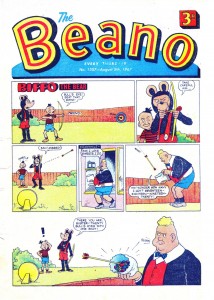
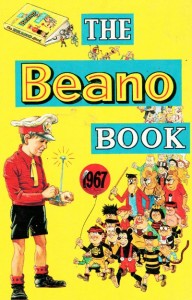
And though DC Thompson published adventure weeklies as well they’re undoubtedly best known for a pair of long-running humor weeklies, The Beano and The Dandy. The Beano frequently cover featured Biffo the Bear (who to me looks like the Bizarro World version of Mickey Mouse)…
…but its undisputed star was Dennis the Menace the misadventures of an exceedingly bad schoolboy and his dog (though to me it looks like the world’s ugliest sheep) Gnasher. To avoid confusion with Hank Ketcham’s comic strip of the same name outside the UK it’s often retitled Dennis & Gnasher (as is their animated series which is currently running on the kid’s cable channel The Hub).
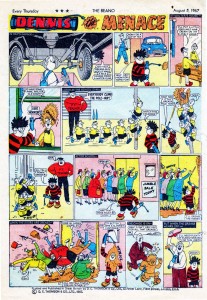
British boys weeklies tended to be real anthologies; the adventure ones usually had at least a couple of one or two page comedy features and the humor ones tended to have at least one adventure story in them. And The Beano had it’s share of adventure stories, like General Jumbo (see the cover below), a twelve year old boy who had a miniature, but very real, fleet of remote control planes and tanks (I know I often overuse the term “wish fulfillment” but, wow, what kid wouldn’t absolutely love that concept?).
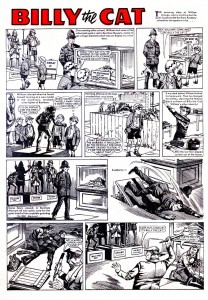
Billy the Cat, an ordinary schoolboy who had a secret life as a superhero…
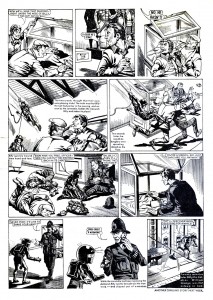
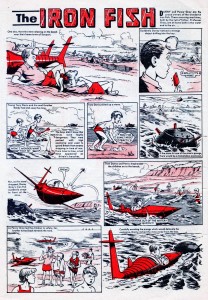
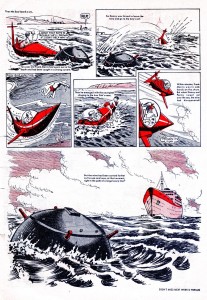
…and The Iron Fish about a boy and his super sub.
The Dandy‘s most popular characters included Korky the Cat…
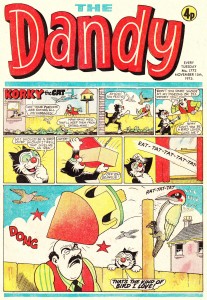
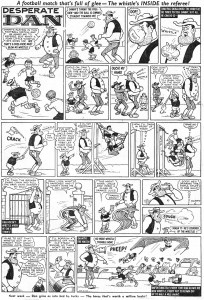
…and the good natured, super strong cowboy Desperate Dan. But, for me anyway, more interesting by far was…
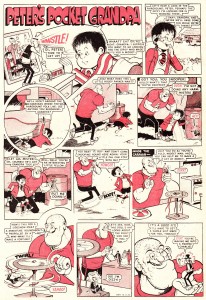
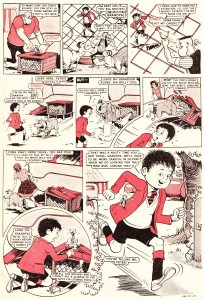
…Peter’s Pocket Grandpa which is, well, just a really, really disturbing concept if you think about it for more than five seconds.
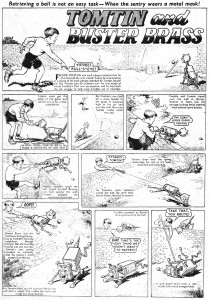
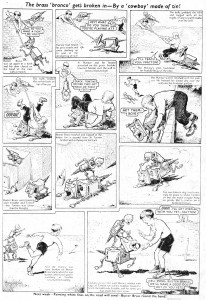
Yet another example of British boys comics obsession with robots is Tomtin and Buster Brass, about a boy’s robot cat and his endless battles with the neighbor’s robot dog.
And you’d probably be surprised by the sheer number of goofy space aliens who visited Earth and immediately went to 60′s Britain for the express purpose of paling around with schoolboys and inadvertently creating merry mix-ups for them. Case in point, Jack Silver.
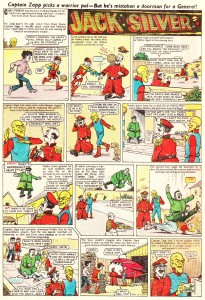
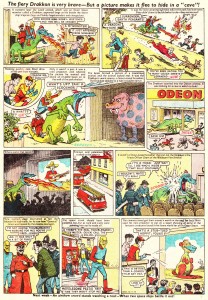
DC Thomson’s weeklies seemed to be intended for a slightly younger audience than Fleetway’s, their artwork tended to be a lot simpler (Fleetway often hired foreign artists; there was none of that at DC Thomson) and Fleetway usually had more imaginative material. While DC Thomson had their share of fantastic characters in general they tended to be more old fashioned and, well, British, which I know is hardly a defect for British comics. The DC Thomson adventure titles tended to look like what you’d expect a British boys weekly comic to be like (that is, if you ever gave it any thought at all); wall to wall plucky schoolboys, heroic WWII soldiers and people playing proper football.
I’ll present some examples of this in Part Two (yes, another two-parter on an extremely obscure topic; I’m on a roll), but in the meantime I’d like to present some of the more ‘fantastic’ characters from a DC Thomson title called Sparky. It was published weekly by DC Thomson from January 1965 to 1977 before merging with The Topper. In it’s early days Sparky‘s mascot character was, well, Sparky, the kind of comedy black ‘native’ stereotype that at this time (note the date; this issue was published in 1965; racial sensitive did not come to the U.K. in any significant way until the mid-70′s) Robert Crumb was lampooning with his character Angelfood McQueen.
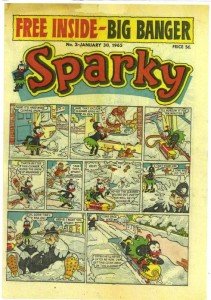
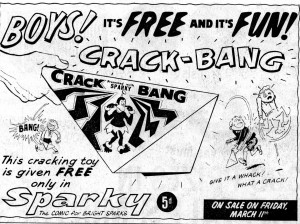
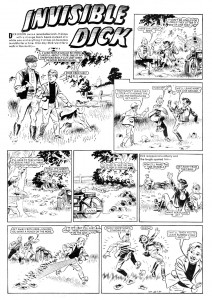
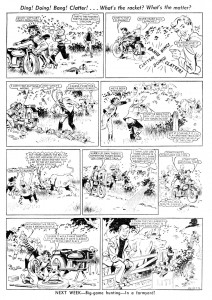
First up, Invisible Dick, the story of a boy who had a magic torch (flashlight) which shone black light and made things invisible. It’s also just a fun name to say; try it. Inviiiiiiiiiiiiiiiiiiisible Dick!
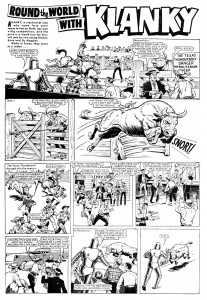
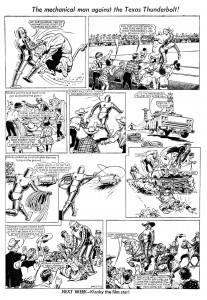
Klanky, an alien robot who is befriended on earth by Ernie and Sue Huggins. If you ever wondered what a alien robot would do at a rodeo, here you go.
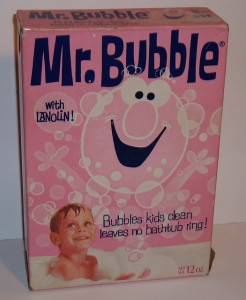
And finally one of the strangest things I’ve ever seen in a British comic (so far), Mr. Bubbles, a ‘bubble imp’ living in a plastic bottle similar to washing-up liquid; if you squeezed his bottle he would grant three you wishes.
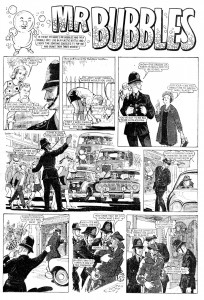
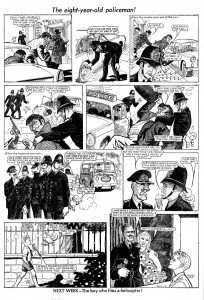
One can assume that this product was not available in the UK at this time.
— Steve Bennett
Posted at 10:04 AM
Posted in General | permalink | No Comments »
Monday, April 11, 2026
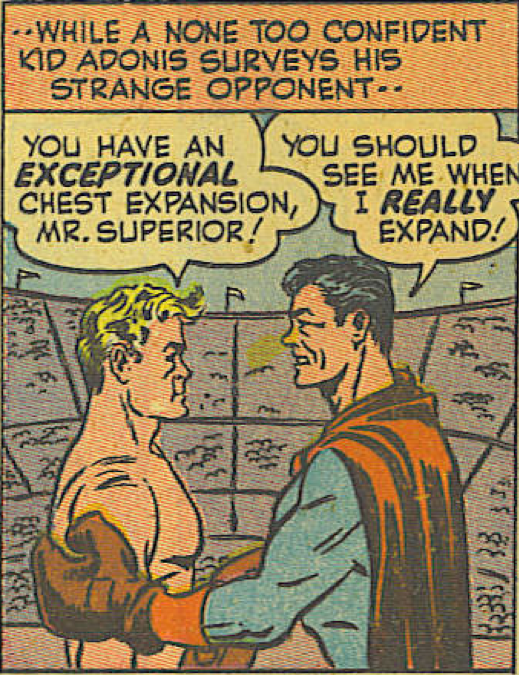
Here we have a fun 1948 parody that is essentially boxer Joe Palooka going up against Superman, interpreted here by the great Joe Simon and, according to GCD, Jack Kirby…although I don’t really see it.
http://fourcolorshadows.blogspot.com/2011/04/kid-adonis-simon-kirby-1948.html
Artist Nick Cardy is responsible for some of the best comic book covers of all time and a number of them were for DC’s Teen Titans in the late sixties and early seventies. Here’s a bunch!
http://diversionsofthegroovykind.blogspot.com/2011/04/grooviest-covers-of-all-time-nick-cardy.html
Here’s Harvey Kurtzman’s absolutely hilarious pre-Mad Pot-Shot Pete, seen here in original art along with sone other early Kurtzman gems.
http://blacknwhiteandredallover.blogspot.com/2011/04/post-39-harvey-kurtzmans-pot-shot-pete.html
Finally today, back to 1948 for a beautifully drawn jungle tale from longtime Flash Gordon artist Dan Barry, originally printed in a Buster Brown Shoes giveaway comic book.
http://comicbookcatacombs.blogspot.com/2011/04/gunga-in-tiger-buster-brown-shoe-co1948.html
— booksteve
Posted at 06:04 AM
Posted in General | permalink | No Comments »
Wednesday, April 6, 2026
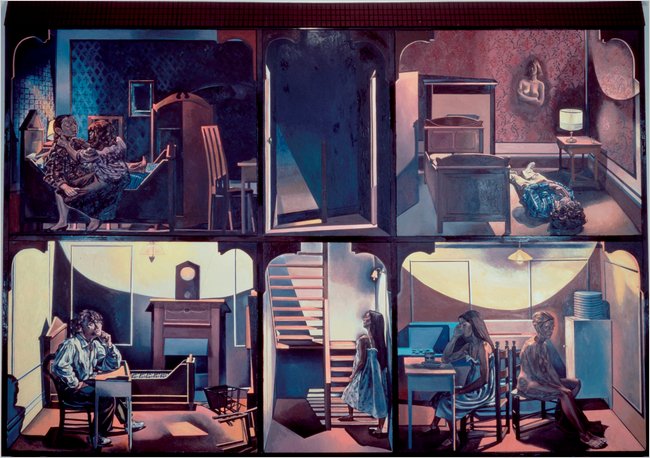

Late last week, Terry Keegan, informed me of the death of a mutual friend, Gabriel Laderman. In the midst of my moving, I was not paying attention to many news sources, and so had missed the announcements in numerous quarters. Gabriel Laderman (seen left), born December 26, 1929, was a painter and art critic of note. At top is a photo of one of his works — “The House of Death and Life”, painted 1984-85. Gabriel briefly maintained his own art criticism/commentary blog, Gabriel Laderman on Art (click on its title to go there). In 2008-2009, a travelling retrospective of twenty-five of his paintings made between 1963 and 1990 — Gabriel Laderman: Unconventional Realist — toured several university campuses.
Gabriel was in poor health when I first met him, fifteen years ago. He long struggled with leukemia, succumbing finally to heart failure on March 10th, 2011, at the age of 81. His passing and influence in the fine art world was noted by numerous publications, including The New Republic, and the New York Times.
While these articles naturally concentrate on Laderman’s artistic endeavors, he and I crossed paths in a less documented area of Gabriel’s interests — early 19th century American comic illustrations. Gabriel was both a devoted long-time collector and sometimes dealer, of mainly pre-Civil War American humorous illustrations. At the point when he and I met, I was a couple years into my pursuit of nineteenth century sequential comic books and cartoons, in all the media I could find them (obsessed with uncovering all I could, after having been told my entire life via comic publications such as Overstreet, CBG, and various comic strip history books, that with rare exceptions, virtually nothing of interest of a sequential nature existed prior to Richard Felton Outcault’s mid-to-late 1890′s The Yellow Kid ). To my couple years of blindly digging to discover what was out there, Gabriel Laderman had been collecting such material for decades. When I enquired into the nature of some of the books he had for sale, and detailed to him what I was seeking, Gabriel became excited to meet another person with an appreciation similar to his, as he had long felt like a loner in his obsession.
Laderman was somewhat amused at my concentration on books telling sequential cartoon narratives as being early comic books — Gabriel saw no difference between single panel illustrations and sequential narratives. (The general antiquarian book community, having bought into the “no comic books or strips existed before Yellow Kid” notion, regarded and classified such items as merely children’s picture books). Gabriel attempted to sway my interest to include single panel illustrations, particularly those of his favorite early American comic artist, David Claypoole Johnston, and comic illustrated almanacs. In some cases, such as the latter two, he succeeded. We corresponded periodically these past fifteen years, with Gabriel sharing some of his knowledge, while also sometimes withholding that knowledge (because, as he frankly stated, I had a knack for finding books that Gabriel himself was after, and so while a friend and ally in uncovering the history of comic illustration, I was also competition for acquiring books.) He was at times impressed by how I went about dating items (finding references to historical events/persons, to narrow the date, in addition to drawing style, fashions shown, range of existence of the publisher), and at times frustrated with my ignorance (he was peeved for years, at my having bought for a bargain an early rare comic illustration by an important comic artist, without my realizing either its importance or who the artist was — I simply liked it.) My correspondences with Gabriel, and his pushing me towards certain items and artists (such as Johnston), was an influence upon me when I was the primary creator of the first Victorian Age Comics section within the Overstreet Comic Book Price Guide (I authored the article, and provided eighty to ninety percent of the data and photos for the comics listed that first year, from my own collection — a fact Overstreet attempted to erase last year, by expunging my name from the list of the section’s creators, in favor of only those currently involved.) Having influenced the direction of my knowledge in creating the Victorian Age Comics section, Gabriel thereby influenced that first section itself (plus, directly contributed information to the section, in later years). The purpose of this article, is to make certain that Gabriel Laderman’s contribution to the field of comics history, is not overlooked amongst the (justifiable) dominance of coverage devoted to his paintings and art world commentary.
The New Republic article by Jed Perl, mentions Gabriel’s obsessive collecting of antiquarian books, nineteenth-century comic illustrations, and his interest in the works of D.C. Johnston, pointing out that Gabriel drew inspiration from Johnston in some of his own paintings. The influence of David Claypoole Johnston, and other pre-Civil War comic art, upon Gabriel Laderman, is obvious to see in a comparison of Johnston’s works with Laderman’s paintings (in addition to Gabriel’s paintings at the top and bottom of this article, you can see more of Gabriel Laderman’s works by click on the hyper-links found in this articles first two paragraphs).
Immediately below, is one of numerous political Before/After cards by David Claypoole Johnston (you pull/push the tab at the card’s bottom, to change the expression and text). This card depicts the loser of the 1856 Presidential Election, John C. Fremont. Beneath that, a page of cartoons cut out of the first 1828 collection of D.C. Johnston’s Scraps, ironically pasted back onto a scrapbook page by a nineteenth-century person unknown.
Click on the pictures below, to see larger versions.

Beneath, more examples of Gabriel Laderman’s passion for nineteenth-century comic art — comic almanacs. From left-to-right, the covers of Turner’s 1839 Comick Almanack, the Boston Comic Almanack for 1840, and, the 1846 edition of Elton’s Comic All-My-Nack. Beneath that, an example from the interior of the 1846 Elton’s. Influence can be seen here, too, in the style of Laderman’s own figures.
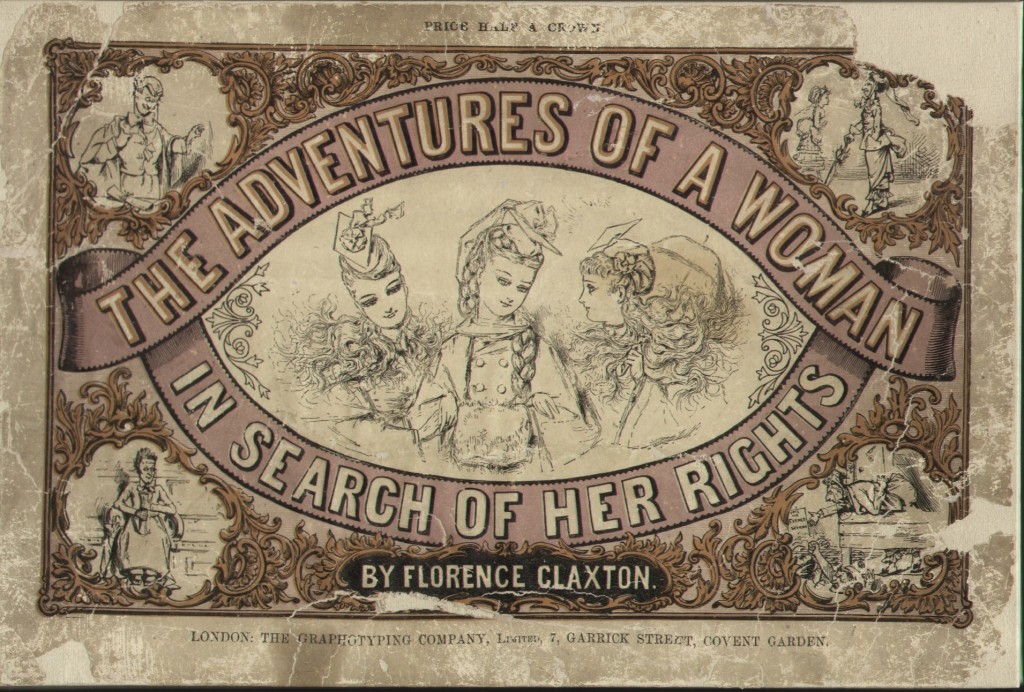
After the first Victorian Age section in Overstreet, co-author Robert Beerbohm (who has updated/modified the article & section every year since) visited Gabriel’s New York City apartment, to catalog sequential comic items Laderman owned, not yet listed in the Overstreet. (Robert got through a mere fraction of Gabriel’s vast collection). Beneath, amongst the items he found, was the early 1870′s comic book, The Adventures of a Woman in Search of Her Rights, by Florence Claxton.
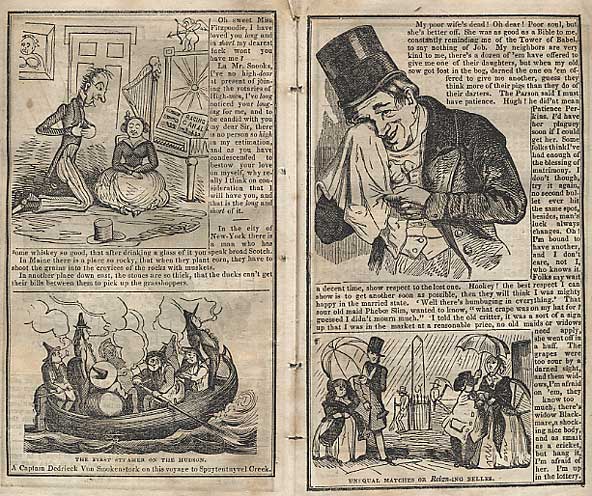
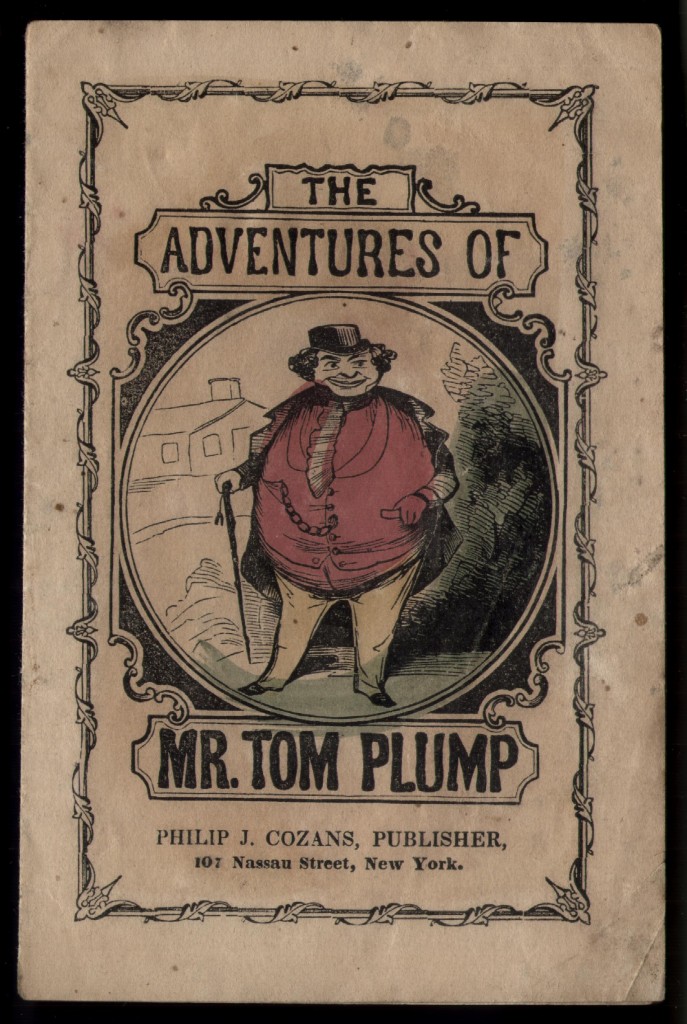
A few examples of Gabriel Laderman’s could occasionally be stubborn/argumentative. (Given comments in the other articles on Laderman, I don’t believe I am revealing anything unexpected; I tell this, affectionately.) For years, he refused to believe, or even acknowledge the possibility, that there could have been a hand-colored cover of the early 1850′s Gold Rush-themed comic book, The Adventures of Tom Plump (color cover, plus one of the interior pages, shown immediately below).
Below that, left, Illustrated Flying Sheets number 32, from published by Stroefer & Kirchner in the 1870′s (Gabriel long insisted they were from the 1850′s, even though Stroefer & Kirchner were not yet publishing then, and, that they reprinted German sheets, which were themselves post-1850′s). And right, the cover of an 1849 American copy of George Cruikshank‘s The Tooth-Ache (for years, Gabriel had a copy posted for sale, that he had dated as being from 1831, despite the fact that Cruikshank didn’t draw it until 1849; I repeatedly pointed this out to him, but he refused to believe that his copy wasn’t from 1831, and would never change the date he was advertising. I simply gave up after awhile; it wasn’t worth arguing over).
 |
 |
 |
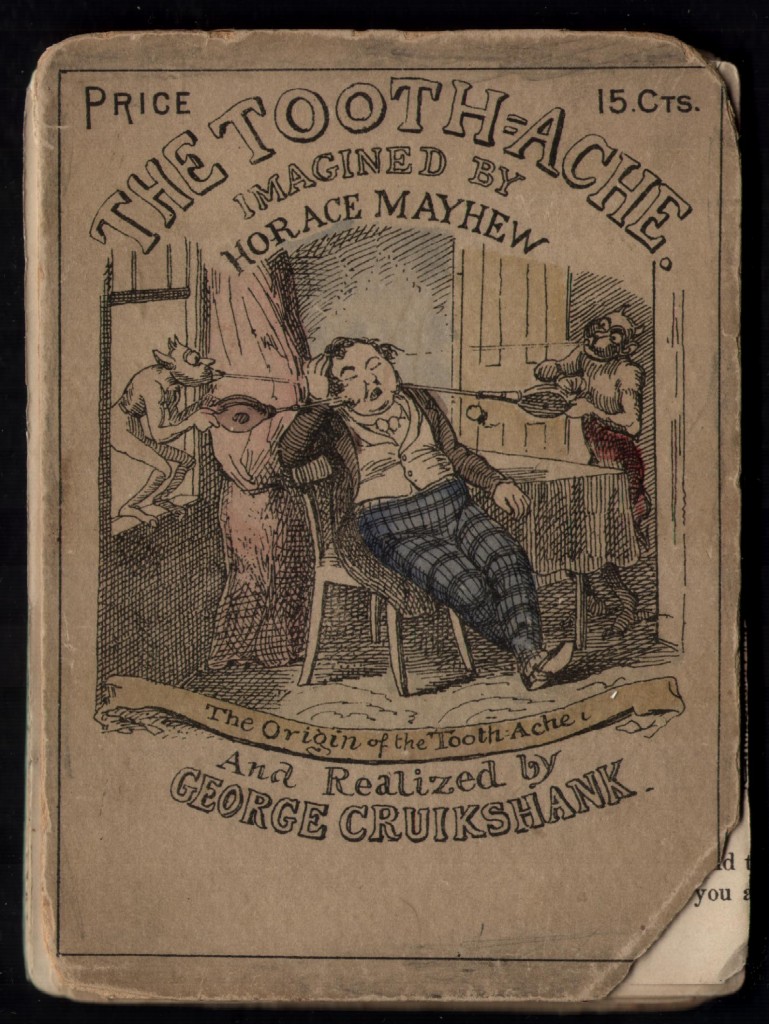 |
Perhaps I would’ve gained more information out of Gabriel, if not for my finding at a bargain price, a copy of the 1873 William H. Bell comic book, Quiddities of an Alaskan Trip, mere days after Laderman told me of the book’s existence. (Or perhaps, I just should have kept my mouth shut about it.) From that point forward, Gabriel was always somewhat cagy on the information he parsed out — and, he would always point to this specific example, as to why he didn’t dare be entirely forthcoming.


Another early sequential comic book Gabriel Laderman revealed to me — and in this case, sold me his spare copy — was the 1849-published Journey to the Gold Diggins by Jeremiah Saddlebags (in truth, by brothers J.A. & D.F. Read). The cover plus interior pages 7 through 9 are shown below. The influence of early comic illustration on Laderman, can again be detected, in the figures above (in Quiddities) and below (Saddlebags).


Yet another highly rare comic book in Gabriel Laderman’s collection (and one which I’ve never seen a copy of — the cover photo below comes from an advertisement for it, found on the back of another book), is the 1850′s Sad Tale of the Courtship of Chevalier Slyfox-Wikof. This is but one example, of the vast knowledge of early comic history that Gabriel Laderman knew of and possessed.
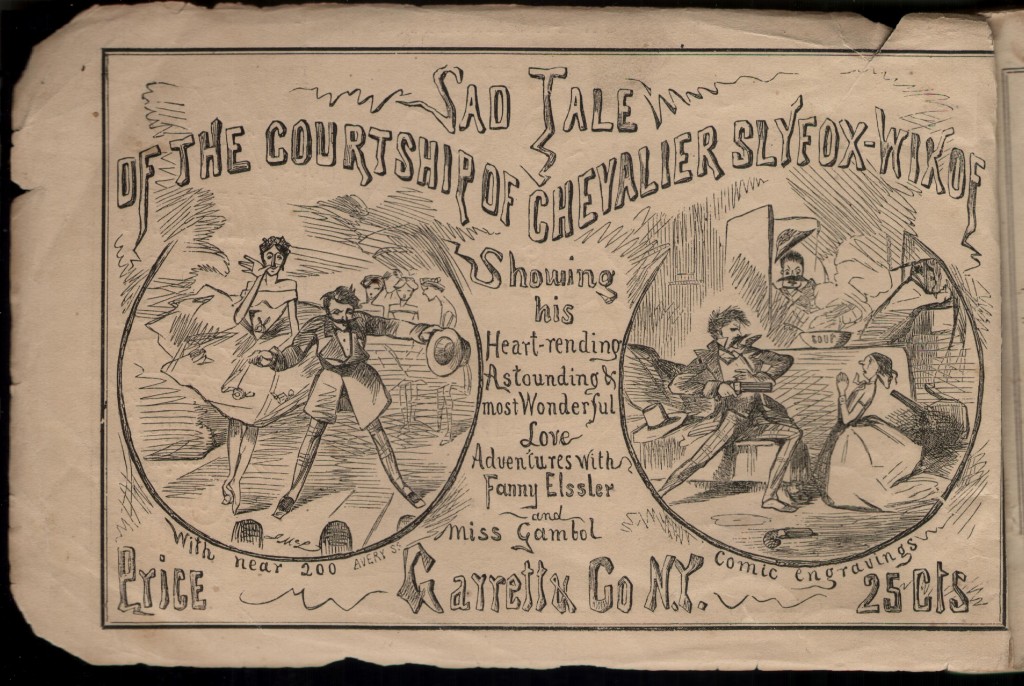
Finally, to close out this remembrance, below is a series of Gabriel Laderman’s paintings — “Murder and its Consequences”, finished in 1984.

Doug Wheeler
— Doug
Posted at 02:04 PM
Posted in Classic Cartoonists, General | permalink | No Comments »
Wednesday, April 6, 2026
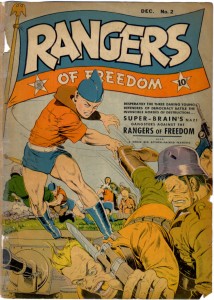
In Part One I mentioned how publishers in the Golden Age, Fiction House in particular, made sure that a character in one of their anthology comics shared a name with the title of the comic (i.e. Fight Comics had Captain Fight, Rangers Comics had Rangers of Freedom). One I should have also mentioned that Wing Comics had Captain Wings (see below).
The exception to this rule; Jumbo Comics. Jumbo Comics did not have a Captain Jumbo but, damn it, don’t you think they should have?
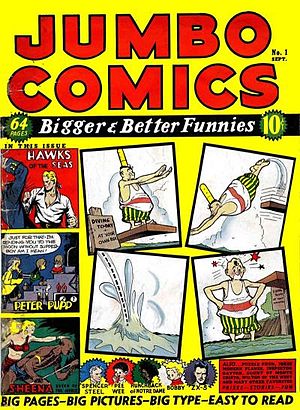 Image via Wikipedia
Which brings us back to Biff, Tex and Percy, the Rangers of Freedom…
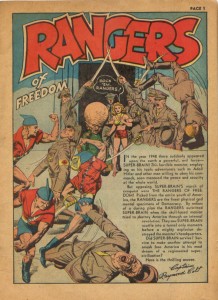
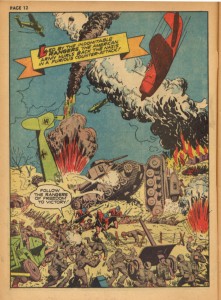
There’s a lot to take in on in very strange splash page that incorporates a big block of typewritten text for no discernible reason, but this is the detail you should be focusing on…

While the previous Rangers of Freedom story gave every indication that it took place in the present of 1941 before America’s entry into WWII, in this one for no reason the clock has been reset seven years into the future. One where Pearl Harbor never happened and America managed to stay out of the war in Europe, that is, until Super-Brain gives Hitler his marching orders.
Please to note; between issues Super-Brain’s super brain has gone down several hat sizes. Note the size of his dome in Rangers of Freedom #2…
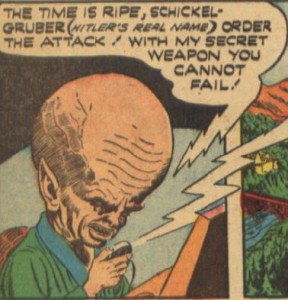
…and compare it to a panel from Rangers of Freedom #1 where he’s become a veritable dead ringer for MTV’s The Head (which was, for those of you who don’t remember the 90′s, was MTV’s desperate, lackluster attempt to duplicate the success of The Maxx).
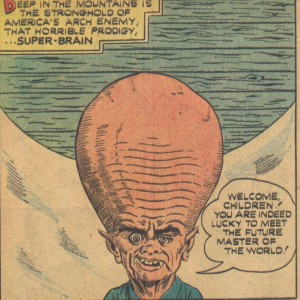
And now, back to the story:
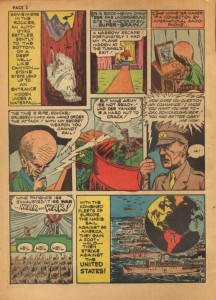
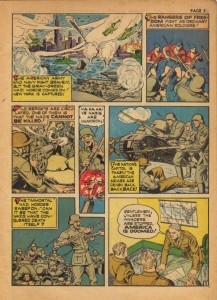
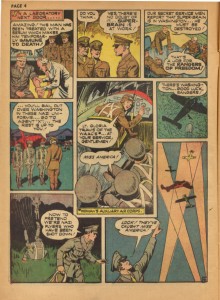
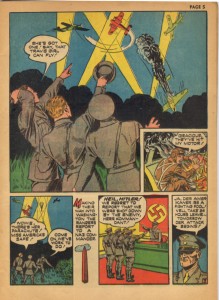
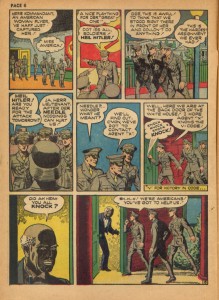
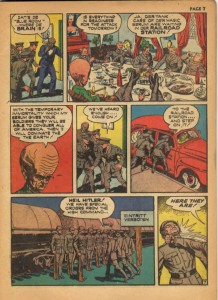
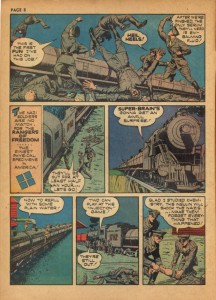
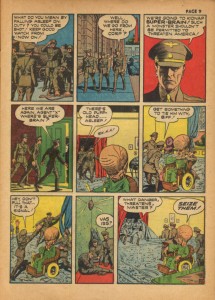
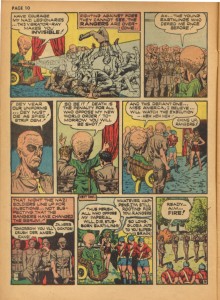
In the Rangers first adventure Super-Brain was referred to as a ‘prodigy’ and I freaking ran with it, theorizing he was a troubled teen who hatred of the world steam from his lack of a social life. But either writer ‘Captain Raymond Colt’ didn’t know what ‘prodigy’ actually meant or he changed his mind because in this issue Super-Brain refers to people as earthlings. Not once…
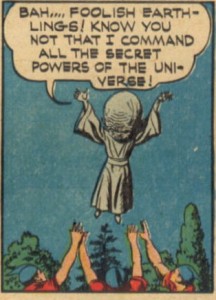
…but twice. Last time I wrote about how frequently not only was there “an undercurrent of sexual menace” towards women in Golden Age comic books there were overcurrents. Maybe you thought I was just trying to be clever but in a scene predating Revenge of the Jedi by several decades in this panel sweet, pure Miss America has been forced to dress like a futuristic disco hooker and is being led about on a golden chain by a hideous, lusting creature. That, my friends, is what I call an overcurrent.
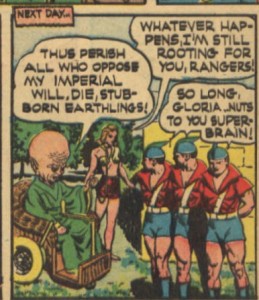
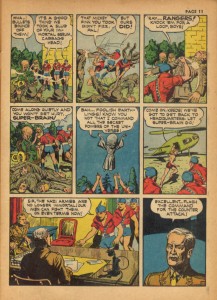
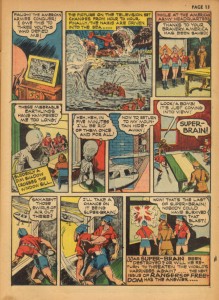
Sadly Rangers of Freedom #3, the issue where Miss America Gloria Travers gets her own Rangers of Freedom costume (sadly a female version of the boys outfit and not the gold halter and hot pants number) and officially becomes Ranger Girl remains unavailable…
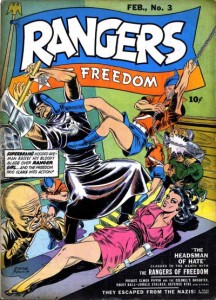
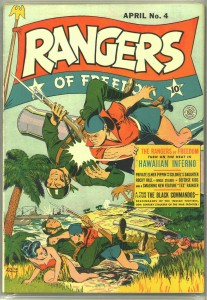
…but #4 is. Apparently that whole “1948″ thing was some kind of misprint because this Rangers story takes place in a present after America’s entry into the war. It’s a pretty prosaic little adventure where their enemy is the fiendish Japanese as much as it is Super-Brain and is completely lacking the apocalyptic elements of previous stories. And here Super-Brain’s head has been reduced to nearly normal proportions
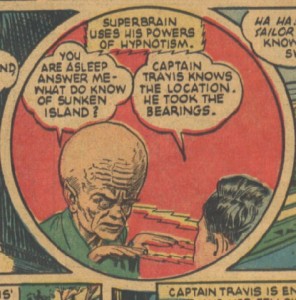
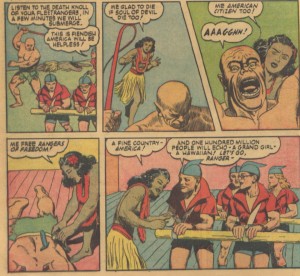
Though the story does have one fantastic element; a submersible island being used by the Japanese as a base who have naturally enslaved native Hawaiians to serve as a work force. Bringing us to this memorable masochism tinged whipping scene where the gang is rescued by an unnamed half naked (save for some strategically placed strands of flowers) native girl. She’s a bit of a mystery as she’s drawn with standard ‘white’ features but is colored in that particular shade of gray that current DC Comics usually reserve for Middle Easteners and those for Middle Eastern descent. And though her traditional dress signals her belief in the traditional Hawaiian way of life she seems perfectly onboard about the whole annexation of Hawaii (“Me American Citizen too!”, “A fine country — America!”).
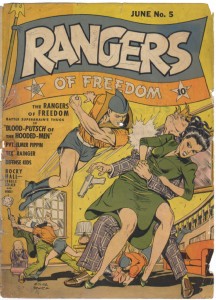
This proved to be the last appearance of the Rangers of Freedom because, although they made the cover to Rangers #5…
…inside we are greeted with an entirely different group of Rangers, U.S. Rangers led by a Captain Morgan.
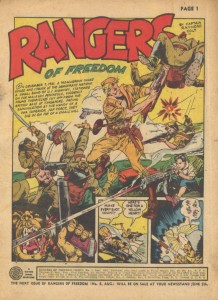 ‘ ‘
In the middle of Captain Morgan’s story we cut away briefly to Biff, Tex and Percy, dressed in regular army uniforms and on a plane, on their way to join Morgan’s unit. They say goodbye to Ranger Girl who has decided to become a Red Cross nurse, parachute into where Morgan is stationed…and are never seen again. Captain Morgan’s team was known as the Rangers of Freedom until Ranger Comics #7 after which they were known as U.S. Rangers.
Supposition; with America’s entry into the War the idea of these fantasy characters using the name “Rangers”, fighting fantasy laced battles was just not what the audience wanted to see. Which is kind of a shame because even when the Rangers of Freedom weren’t exactly good they were very, very weird. And sometimes that’s even better than being good.
— Steve Bennett
Posted at 08:04 AM
Posted in General | permalink | No Comments »
Wednesday, April 6, 2026
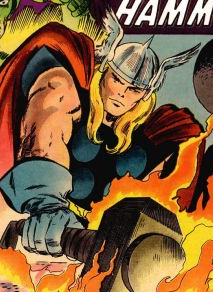
Just in time for the upcoming Thor movie, let’s revisit some classic Jack Kirby, etc. Thor (and Journey Into Mystery) covers in the latest By The Tens over at Random Acts of Geekery.
http://waffyjon.blogspot.com/2011/04/by-10s-journey-into-mysterythe-mighty.html
Writer David Anthony Kraft gave me a hundred dollars once so I hesitate to criticize his work but what makes this link interesting is the odd art combination of Paul Kirchner and Rudy Nebres!
http://diversionsofthegroovykind.blogspot.com/2011/04/black-and-white-wednesday-destiny.html
Here’s a nice little review of the late fifties million dollar debut of the original Bat-Woman in Detective Comics, topped by that great Sheldon Moldoff cover.
http://ibelieveinbatmite.blogspot.com/2011/04/batwoman.html
Finally today, here’s a look at a delightful early Silver Age team up between future book-mates, Atom and Hawkman, written by Gardner Fox with art by Kane and Anderson.
http://sacomics.blogspot.com/2011/04/atom-7.html
— booksteve
Posted at 06:04 AM
Posted in General | permalink | 1 Comment »
Tuesday, April 5, 2026
Just listen to what D. J. David B. (that’s me!) has for you this week. Your head will explode and your brains will fall out! It sounds like Popeye, yet he’s singing the Warner Bros. theme song. What in the world?
This isn’t some digital-age mastermix mash-up. This is a gen-you-ine vintage record from way back when. Hold on to your spinach and click the link below.
Billy Costello - The Merry Go Round Broke Down
— DJ David B.
Posted at 06:04 AM
Posted in Comics-Tunes | permalink | No Comments »
Monday, April 4, 2026
As previously noted (see COMIC BOOK COMPULSIVE — Super-American) if I absolutely had to name my least favorite Golden Age comic book publisher it would probably have to be Fiction House. You can’t argue with their success, based on a formula (that focused on two-fisted adventurers in stories with plenty of action and beautifully drawn weapons and women) clearly skewed towards an audience of older kids and G.I.’s who had become comic readers while in the service. But they just weren’t for me -and I’ll happily admit a lot of that had to due with the fact they lacked superheroes.
Not that the publisher didn’t dabble in them during their early days, as with Super-American here…
Though there were a couple of others, like Fight Comics briefly had a fairly lame (not only did he he belong to the bare-legged battalion of masked vigilantes his alter ego was a gym teacher) superhero named Captain Fight (before getting replaced by an unrelated standard soldier type, also named Captain Fight who’s strip lasted a lot longer).
I was intrigued by all of these guys after reading about them in Don Thompson’s All In Color For A Dime and decades later I was finally able able to track down the comics they appeared in. But sadly that wasn’t the case for a strip called Rangers of Freedom who appeared in early issues of Rangers of Freedom. It’s a title usually referred to as just Ranger Comics but if you look it up at the indispensable Grand Comic Database you’ll find it under Rangers of Freedom. Clearly for branding purposes it always seems to have made sense to publishers to have their anthology comics feature a strip that shared a name with the comic.
It was about a very strange federally sanctioned costumed kid gang composed of All-American teens named Biff, Tex and Percy. As the Rangers of Freedom they battled the villainous Super-Brain who was engaged in the kind of apocalyptic domestic terror campaign against America usually reserved for the villains in The Spider or Operator 5 pulps.
No doubt a big part of their appeal to me was the fact that not only did they wear costumes and fight an actual super-villain (back in the days when kids apparently felt they had gotten their monies worth if a masked mystery man engaged in a couple of pages of Greco-Roman wrestling with gangsters named like Butch or Rico), it was a reoccurring super-villain (back in the days when even marginally interesting opponents were routinely knocked off after a single appearance).
But, sadly, those issues of Rangers remained unavailable to me…until now. Usually when you’ve waited an interminable amount of time for something it invariably disappoints, but, happily, that’s not the case here. So from Rangers #1, written by someone supposedly named Captain Raymond Colt and drawn by Joe Doolin, I present the first appearance of Rangers of Freedom:
There are so many interesting little details to this story and while I usually try to avoid talking smack about Golden Age comics I believe a few of them are deserving of some DVD type commentary. Like…
…the boys are chosen by the government on the basis of winning some kind of nearly naked male teen contest (officially they’re been determined to be “Best Specimens of American Youth”) where the prizes are handed out by Miss America.
Besides looking good in swimsuits they were chosen because young people can apparently resist the mind powers of Super-Brain. They’re given “impenetrable uniforms” (I have questions but I’ll take the comic at its word, it’s just, if they were handing out impenetrable uniforms I’d prefer mine to have a little more material). Plus, dudes, seriously, what’s deal with their skullcaps? They look like they’re designed to pick up satellite radio.
Here’s our first look at Super-Brain who is, whoa, Basil Wolverton ugly. But he’s referred to as a ‘prodigy’ so he’s, what, a kid? If he’s supposed to be the same age of the boys that means, what, his attack on our democracy is due to his inability to get a date to the prom? I kind of hope so.
Part of the Super-Brain’s plan is to empty the nations lunatic asylums (back in those glorious days when we had lunatic asylum’s and they were universally full of kill crazy fiends) to raise an army. Fair enough when you’re using your mind powers to control them, but clearly this guy has got his heart set on a middle-management position in the new administration.
And there was frequently an undercurrent (and even an overcurrent) of sexual menace in Golden Age comics, so it’s kind of commendable that Super-Brain wants to wait until marriage to have sex with Miss America. Oh yeah, he’s definitely a teenager who just wants the prettiest girl in school to notice him.
And that’s it…for part one. That’s right, there’s a part two and I’m not going to wait until next Monday. Check back here tomorrow.
— Steve Bennett
Posted at 12:04 PM
Posted in General | permalink | No Comments »
|
SUBSCRIBE

A-List: The I.T.C.H. Blog Contributors
BLOGS
COMIC NEWS
MY FAVORITE SOURCES FOR COOL BOOKS
THE PUBLISHER OF YOE BOOKS
THE PUBLISHERS OF OTHER BOOKS BY CRAIG YOE
CATEGORIES
ARCHIVES
META
Every Wednesday is
WACKY WONDER WOMAN WEDNESDAY
archive
DOLL MAN WEIRDNESS
archive
|