







COMIC BOOK COMPULSIVE — Mandrake the Magician
As established in previous columns I love Golden Age comic books, but I also love old comic strips and happily for me a great deal of Golden Age comics contained reprints of old comic strips. While we’re currently living in the Golden Age of comic strip reprints there is still plenty of material which deserves to be collected. And until it is Golden Age comic books are a handy way to read the strips that publishers haven’t gotten around to yet. Like Moon Mullins, Mickey Finn, Joe Palooka…and Mandrake the Magician.
I love Mandrake. I know most comic fans swear by Lee Falk’s other major creation The Phantom and I understand why; The Phantom was your proto-masked mystery man and his strip contains all of the inherent elements of the genre that make guys like me go all squishy inside. He’s got an elaborate back story, a secret headquarters, props, weapons, pets, in short, stuff. But me I’m a contrarian son of a bitch; fandom can’t heap enough praise on Carl Barks Donald Duck, I love Floyd Gottfredson’s Mickey Mouse. Everyone else deep dish digs The Phantom, I loves me Mandrake something fierce.
I’m also an over particular son of a bitch; the Mandrake I love is the one from the 1930′s and 40′s, drawn by Phil Davis in his signature clean, sharp, art deco style. His adventures varied, from continuities that dealt with more or less conventional crime fighting to those were he went to lost lands or other worlds. OK, sure, even by the rather generous standards of the times (back when nobody expected a hero to have ‘emotional arcs’) Mandrake wasn’t much of a character. Actually, when he wasn’t being a jerk using his hypnotic powers to make (sometimes innocent) people think they were losing their minds just for fun he could be cool to the point of being languid. But I suppose the fact that he wasn’t your standard two-fisted adventurer was as big a part of his appeal as his powers or the fact he was dressed for the opera twenty-four/seven.
Of course Mandrake fans do have to deal with the strips’s stereotypical depiction of Lothar, his servant. On the one hand he was an African prince and the strongest man in the world, given by his authors the license to beat the living hell out of white guys. Which must have been secretly satisfying to the strip’s black readers; given the fact that a black man wasn’t supposed to even touch a white one at this time I’m really surprised more wasn’t made of this.
But on the other hand he was also depicted as being fairly child-like mentally, afraid of ghosts and and having a strange speech pattern. It definitely wasn’t the traditional ‘Negro’ patois given to comedy servants or the pidgin English spoken by African natives in the movies. The closest thing I can compare it to is how Bizarro Superman spoke in DC comics (i.e. instead of ‘I’ Lothar regularly referred to himself as ‘me’).
Davis drew the strip until his death in 1964 but even before his passing the strip had begun to address the one thing Mandrake the Magician lacked; stuff. After decades of not having a base of operations and being a free agent Mandrake settled down on his estate Xanadu and began working for the police. At first he was answerable to “The Chief” (who had a proper name but as far as I can tell it was rarely used) and his “Silly Stuff Department” which investigated supposedly impossible crimes.
Eventually Mandrake also began working for the head of an international organization called Inter-Intel also called (imaginatively enough) “The Chief”, this one supposedly a cigar smoking robot. In reality the real head of Inter-Intel was Hojo, who by day played the role of Mandrake’s rotund Chinese personal chief at Xanadu. Well, Hojo really was Chinese and a fat guy, and a chief for that matter, but it was never fully explained (to my satisfaction anyway) what the need for this kind of elaborate subterfuge was.
I couldn’t swear to it in a court of law but I think it’s a pretty safe bet that both these developments probably had more than a little to do with the success of both the Batman TV show and the James Bond movies. That theory was confirmed when I finally came across online the story from 1965 that introduced both Inter-Intel and Xanadu, “The Return of Cobra”.
Not that this version of the strip was all bad; when Mandrake wasn’t fighting conventional criminals there was still some pretty fantastic storylines. Like those involving Magnon, a godlike alien who in spite of being the emperor of a million planets invariably needed the help of a hypnotists. And after being a man of mystery for most of his career we finally discovered his origins, learned that he had family and picked up a regular opponent, The Cobra (who naturally turned out to be his brother).
And there was a definite upside; in 1965 Fred Fredericks took over the art which is when Lothar started being depicted and treated as an equal human being and Mandrake’s assistant/friend. Another important development from “The Return of Cobra”, in the second week Lothar’s signature fez vanished and was never seen again.
Which of course didn’t answer the question of what an African prince was doing wearing a fez in the first place when it wasn’t traditionally worn in Africa. But then, when it comes to that, why the hell did an African prince have a German name?
And although Mandrake and his great love Princess Narda didn’t actually marry until 1997 they (together with Lothar and his girlfriend Karma, an African princess/model) lived in Xanadu in what I always assumed had to have been spectacular sin. At least it always seemed that way to me. They definitely went unchaperoned (other than Hojo) and their adventures always seemed to begin and end in their swimsuits indolently lounging poolside.
Which I suppose was perfectly innocent and everything but it sure seemed salacious to my fevered adolescent mind…
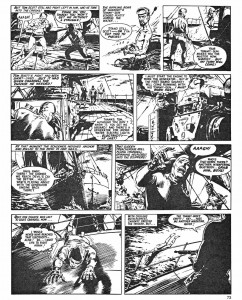
A couple of panels from the story I’ve posted this week are particularly noteworthy. The ones above contains one of my favorite tropes from old movies and comics, the “if you don’t pay your debt I’m going to have the sheriff throw you in jail!”. Modern audiences probably at least know this hoary plot device from the yearly showings of the 1954 movie White Christmas.
I know that the law varies from State to State and, especially in the past, it wasn’t always fairly implemented (to say the least), but I was unaware that America ever had debtor prisons. Plus, wouldn’t the Sheriff tell the complainant “this is a matter for a civil court and none of my business”?
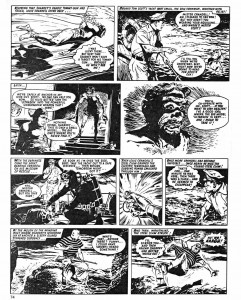
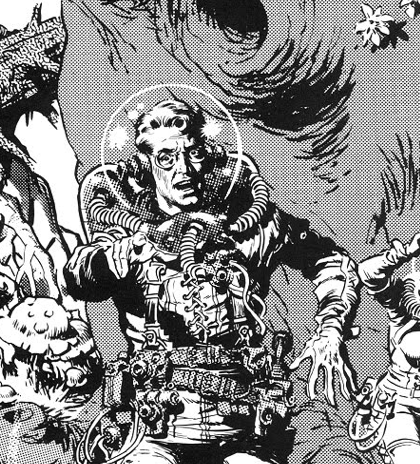
And naturally the story has to have (in the words of the movie Sullivan’s Travels) “a little sex”, so the professor has a beautiful daughter who not only stows away (I couldn’t tell you the last time somebody used this trope in all seriousness) but has helpfully come equipped with her very own “space costume”.
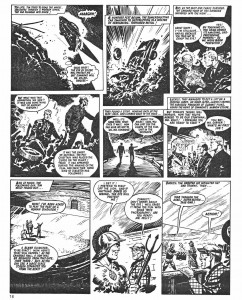
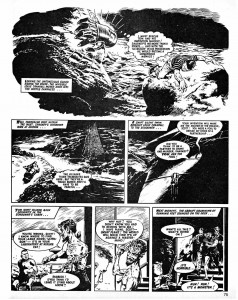
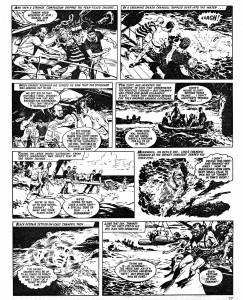
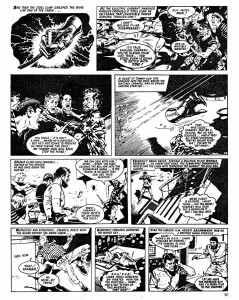
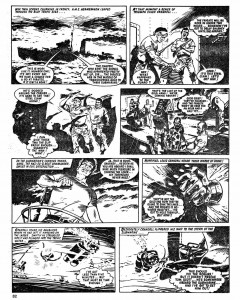
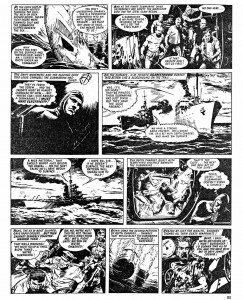
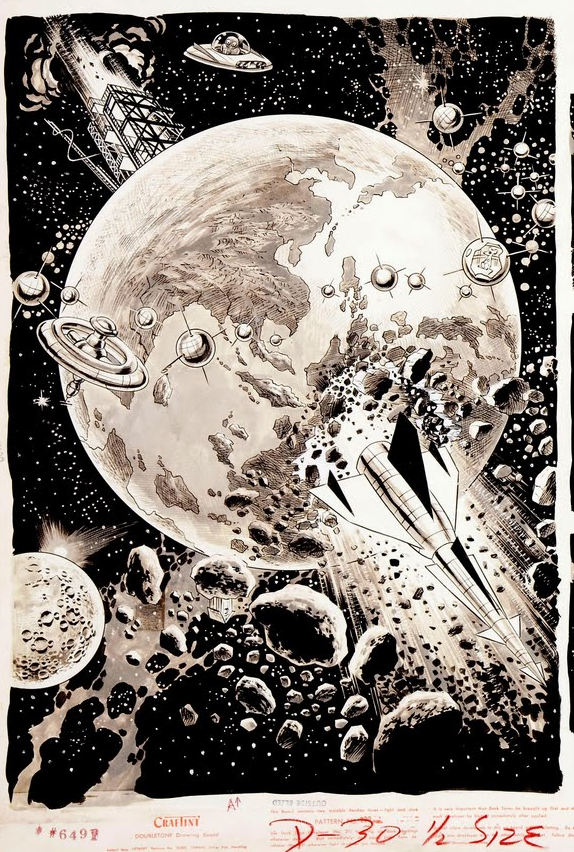
Feature Book #46 published by David McKay in 1946 reprints the “Fire World” Sunday sequence, which is one of Mandrake’s wilder adventures from the 40′s. Of course I feel compelled to point out it doesn’t have much of a plot. Oh, every once in a while Falk tries to dredge up some contrivance to create a little drama but it’s mostly just a travelogue of a fantastic world. Not that there’s anything wrong with that.
Oh, for the record several of the pages are in black and white because they weren’t included in this comic book and some helpful person put back scans of the missing pages in the version I downloaded. I’d give this person the credit they’re due…if I had any idea who they were.
— Steve Bennett